|
One of the hardest questions in an intimate relationship is: “Is this about me, or is this about you?”
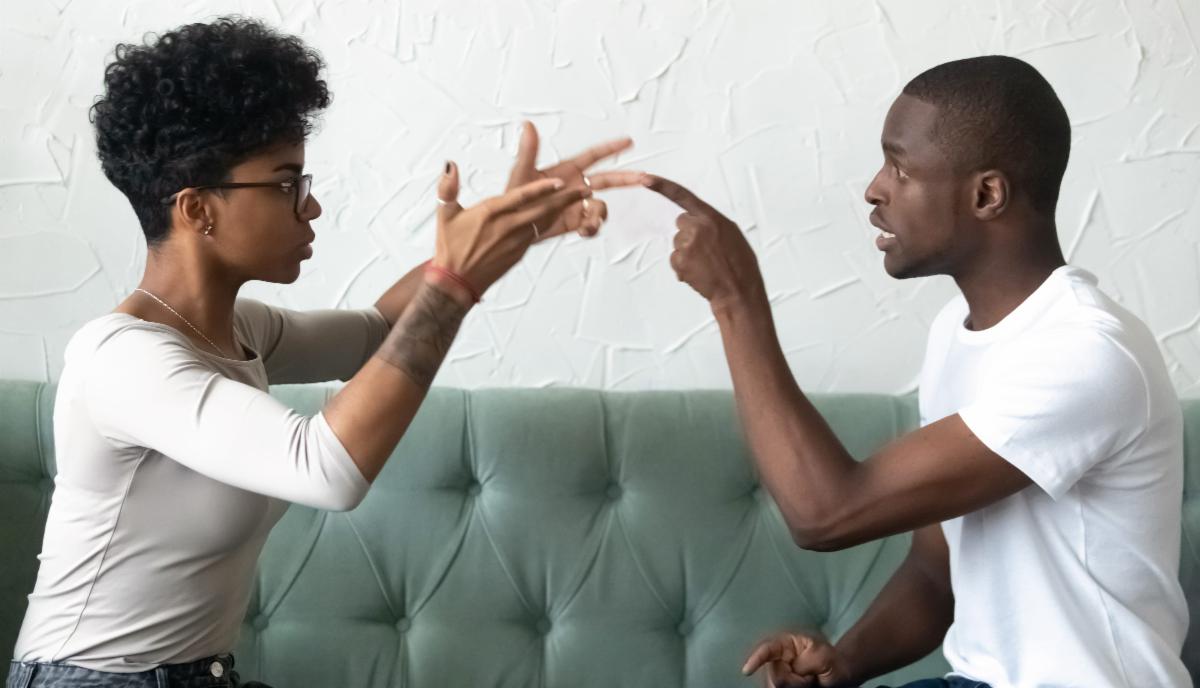
You say something ordinary, and your partner reacts as if you have committed a crime. Or your partner forgets something, and suddenly you feel ten years old, alone, unimportant, and furious. Or you find yourself having the same fight again and again, with different words but the same emotional ending.
At some point, most couples ask some version of the question: “Is this my trauma, your behavior, or our pattern?”
The honest answer is often: yes.
It may be your history. It may be your partner’s behavior. It may be the pattern between you. If you want your relationship to grow and become a safe haven for both of you, all three levels matter.
We do not come into love as blank slates. We bring our family histories, our nervous systems, our disappointments, our longings, our protective habits, and our unfinished developmental work. We carry in the (often unconscious) roles we learned early: the responsible one, the invisible one, the rescuer, the critic, the one who needs nothing, the one who feels everything, the one who keeps the peace, the one who explodes so someone will finally listen.
Then we have an accident - we fall in love!
At first, those old roles may not look like a problem. In fact, our previous history may shape our attraction to this mysterious other person. We "recognize" something. Perhaps we feel a certain chemistry; there is something comforting and familiar, or a feeling of “this person knows me” or “this person completes me.” We may feel in their presence in a way that we want to feel. We may also, quietly and unconsciously, sense that this person gives us another chance to solve an old problem.
This "strange attraction" is not necessarily a mistake. It is part of the curious genius of intimate relationships. Love often brings us close to the exact material we need to work with in the form of a challenging partner.
The problem begins when we confuse recognition with resolution.
Your partner may feel familiar because they activate an old template. They may remind you of someone who ignored you, controlled you, needed you too much, left you alone, criticized you, or made you feel responsible for their emotional state. Or you may, without realizing it, cast your partner in an old role and then respond to them as if they are that person.
Arnold Mindell, the founder of Process Work, wrote about the way our dreams, body experiences, and relationship issues can all express deeper unfinished processes. Borrowing loosely from his language, we might say that we sometimes “dream up” our partner as someone from our earlier life. We do not do this on purpose. We do it because the psyche is trying to bring forward something unresolved.
In the best case, this gives us a chance to see an old pattern clearly and grow beyond it. In the worst case, we stop seeing our partner accurately.
Terry Real uses the phrase “core negative image” to describe the distorted picture we hold of our partner at their worst. In those moments, your partner is no longer a whole person. They become “the selfish one,” “the cold one,” “the irresponsible one,” “the controlling one,” “the weak one,” “the one who never cares,” or “the one who always takes over.”
That image may contain a piece of truth. Most painful relationship patterns begin with some real behavior. But the core negative image also includes your projection, memories, fears, even old injuries. It is not just what your partner did today; it is what their behavior means through the lens of your history.
This is why couples can become so convinced that they are responding to reality while the other person feels completely misrepresented.
You may be responding to something real. You may also be responding to an old template that has been activated by something real. Both can be true.
This is where the question “Is it me or you?” becomes too small.
A better question is: “What belongs to me, what belongs to you, and what belongs to the pattern between us?”
Your trauma belongs first to you. That may sound blunt, but it is actually respectful. Your history is not your fault, but it is part of your life’s work. A partner can love you, care about your tender places, and learn to be gentle with your vulnerabilities. But your partner cannot become the parent who failed you, the protector you needed, the witness you never had, or the repair person for every wound you carry. When we ask a partner to heal our childhood for us, we place them in an impossible role. Then, when they inevitably fail, we may feel betrayed all over again. Worse yet, our partner may be doing the same thing to us! Then we enter a losing battle of blame and recrimination.
At the same time, this does not mean your partner gets to behave carelessly and then say, “That is just your trauma.” That is another distortion. If your partner knows something is tender for you, and repeatedly handles it harshly, dismissively, or irresponsibly, that is not care. Repeated callous handling of another's vulnerabilities inevitably becomes a relationship problem. Love asks us to care about each other’s vulnerabilities.
A mature relationship requires both truths.
- My history is mine to work with.
- Your impact on me matters.
- Our pattern belongs to both of us.
This is where Ellyn Bader’s developmental model of couples is so useful. In the early stage of a relationship, couples often bond through closeness, similarity, intensity, and a sense of “we.” This can be beautiful. Over time, however, it can also be a kind of enmeshment. The harder developmental task comes later when what once felt like understanding feels like a prison of entangled, repeating patterns. At that point, each partner will need to turn to their own development, to become more honest first with themselves, and then with their partner.
This stage is often where trauma patterns surface. One of you wants more closeness and experiences distance as abandonment. The other wants more space and experiences closeness as pressure. One of you wants to talk now. The other needs time to regulate and think before they can speak. One of you sees anger as danger. The other sees silence as danger. One of you feels controlled. The other feels unsupported.
At that point, couples often start blaming each other for the pain caused by these patterns of disconnection. This is, however, the signal that each partner is trapped in old expectations and beliefs, and it is time to do individual work, to differentiate. This can be a painful moment in a relationship, yet differentiation is not the end of love. It is the beginning of a more mature love.
Differentiation means I can be me while you are you. I can care about your experience without disappearing into it or demanding you fold into mine. I can tell you the truth without attacking you. I can hear your pain without making it all about me. I can take responsibility for my history without using that history as a weapon or a shield. This is the movement from childhood roles into adult partnership.
In adult partnership, we do not ask, “Whose fault is this?” as the only question. We ask, “What are we each expecting, protecting, or doing that is maintaining this painful pattern?”
If I know I become reactive when I feel ignored, my work is to learn what happens inside me when I feel ignored. I may need to notice the old story: “I do not matter.” I may need to regulate my body before I speak. I may need to make a clear request instead of attacking. I may need to grieve the old wound somewhere other than in the middle of a fight with my partner.
If you know you shut down when you feel criticized, your work is to learn what happens inside you when you hear disappointment. You may need to notice the old story: “I am failing, and I will be shamed.” You may need to stay present for one more sentence. You may need to say, “I want to hear you, and I need a moment to settle.” You may need to return to the conversation instead of disappearing.
The pattern changes when both people take their part seriously. I've learned from working with couples for nearly thirty years, that the pendulum often swings between individual development and couple's interactions if a couple is to develop truly robust and healthy partnership.
That said, some relationships do include real harm, coercion, betrayal, intimidation, contempt, or chronic irresponsibility. In those cases, the work is not to split responsibility down the middle. Safety, accountability, and repair always have to come first and a third party in the form of a skilled therapist is often needed.
In many couples, however, the repeated suffering comes from two protective systems colliding. One person’s protection triggers the other person’s defenses and protection. The more one pursues, the more the other withdraws. The more one criticizes, the more the other defends. The more one shuts down, the more the other escalates. Each person says, “I am only doing this because you do that.” And the pattern wins!
The way out begins when at least one person can say, “This is what happens in me. This is what I do next. This is what I want to do instead.”
Research on perceived partner responsiveness supports what many of us already know from lived experience: we feel safer and closer when our partner seems to understand us, validate what matters to us , and cares about our well-being. That does not mean our partner agrees with everything we say. It means they are willing to let our inner world matter.
That is a powerful sentence in any relationship: “Your inner world matters to me.” I put it this way to the couples I work with: If it matters to you, it matters to me. You may be enamored of horseback riding and I of computer coding. This doesn't mean we share equal enthusiasm for these activities, it means I am interested in you and your experiences and I want you to thrive in your world.
At the same time, healing patterns from childhood is my work, not my partners. Your partner can support your healing. They can learn your triggers. They can speak more gently. They can repair when they miss you. They can stop doing behaviors that repeatedly wound the relationship. They can become more responsive, more accountable, more emotionally skillful. You and your partner each take responsibility for attending to your own nervous system, your own story, your projections, your younger parts, your habits of blame, pursuit, withdrawal, compliance, criticism, or despair (whatever your favorite coping mechanism was as a child).
This is how a couple becomes an adult partner team without falling into parent and child roles with one another. Your partner cannot rescue you from your past, nor can you save them from theirs. That already happened. A partner is someone with whom we practice becoming more fully adult, more able to love honestly, and response-able for what we are making together.
So when the old question comes up — “Is it me or you?” — try making it bigger.
Questions to ask yourself instead:
“What old memories are being activated in me?”
“What are you (or me) actually doing in the present?”
“What pattern are we creating together? Is this a familiar pattern?”
“What is mine to work on?”
“What is yours to repair?”
“What do we need to do differently to create a healthier connection?”
The goal is not to have a relationship with no triggers. (That relationship probably does not exist.) The goal is to have a relationship where triggers become information instead of instructions based in past scripts. The challenging behaviors in ourselves or our partners simply tell us where care is needed, where boundaries are needed, where grief is unfinished, where responsibility has been avoided, and there is a new pattern is ready to be learned. When we can do that, trauma no longer gets to run the relationship from behind the curtain. It becomes part of the story we are learning to tell the truth about.
And when two people are willing to tell the truth, take responsibility, and care about each other’s tender places, our relationship becomes a place where we stop repeating the past and begin creating a better future.
Communication patterns, often learned in childhood, are a common cause of stuckness is relationships. Our Couples Communication course package can help you address those sticky spots with useful tools that will help you move to a better relationship. See our special, limited-time offer below.
|