Wisconsin Coastal Resilience Newsletter | | |
Greetings from the Wisconsin Coastal Resilience Team!
This month's newsletter contains:
Member-to-Member Updates:
- Paper Published on Coastal Hazards Communities of Practice
- 2025 UW-Madison Geospatial Summit with Keynote Speaker Dr. David Hart, WI Sea Grant
Lake Michigan Water Level Update
Resource Highlights:
-
CRC Coastal Hazards Overlay District Guide
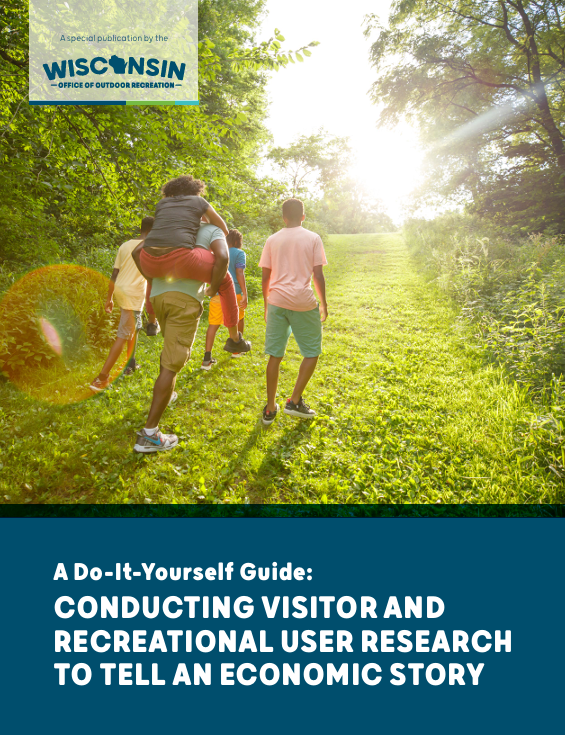
- Do-It-Yourself Guide: Conducting Visitor and Recreational User Research to Tell an Economic Impact Story
- Updated ASFPM Great Lakes Coastal Resilience Planning Guide
Around the Great Lakes:
- USACE Great Lakes Coastal Resiliency Study
-
RISC Publishes Report on Resilient Stormwater Management in the Great Lakes Region
Funding Opportunities:
- Daybreak Fund 2025 Request For Proposals
- NOAA Transformational Habitat Restoration and Coastal Resilience Grants
- NOAA Coastal Habitat Restoration and Resilience Grants for Tribes and Underserved Communities
- Great Lakes Environmental Justice Thriving Communities Grants
Trainings:
-
NOAA Facilitation Basics for Coastal Managers
Conferences:
-
Wisconsin AWRA 2025 Annual Meeting & Conference
- Peter Annin: Community Conversation on Nurturing Northeast Wisconsin's Freshwater Economy
- Green Bay Conservation Partners Spring Roundtable
- Great Lakes and St. Lawrence Cities Initiative Annual Conference
- IAGLR's 68th Annual Conference on Great Lakes Research
| | Paper Published on Coastal Hazards Communities of Practice | | |
Last year, CALM members Lydia Salus and Adam Bechle, along with Sarah Brown, published “Addressing Great Lakes Coastal Hazards Through Regional Communities of Practice” in the Journal of Great Lakes Research. The paper examines four regional communities of practice (CoPs), including CALM and the East River Collaborative. Among the paper’s findings, members reported that their participation in the CoPs resulted in outcomes that reduce coastal hazard risk and facilitate work across boundaries to navigate complex coastal hazard issues.
| | |
2025 UW-Madison Geospatial Summit
with Keynote Speaker Dr. David Hart, WI Sea Grant
| |
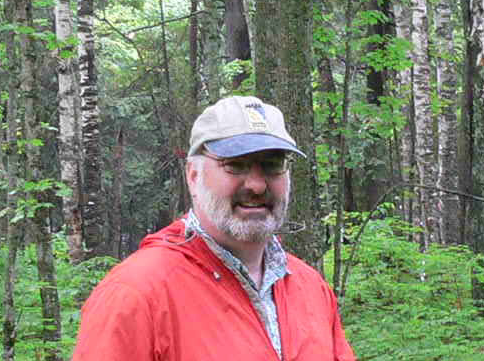
UW-Madison is hosting its 2025 Geospatial Summit Wednesday, April 16th at 10am at the Gordon Dining and Event Center in Madison. This year, the Summit will include speakers in the morning—CALM member Dr. David Hart from Wisconsin Sea Grant, Janet Silbernagel of Silvernail Geodesign, and Christian Andresen from the UW–Madison Geography Department—sharing how they incorporate geospatial data, tools, and technologies into their work. In the afternoon, the Summit will conclude with a career panel and career fair featuring representatives from local GIS companies and agencies. The event is free, open to all, and will livestreamed for those who can't make it in-person.
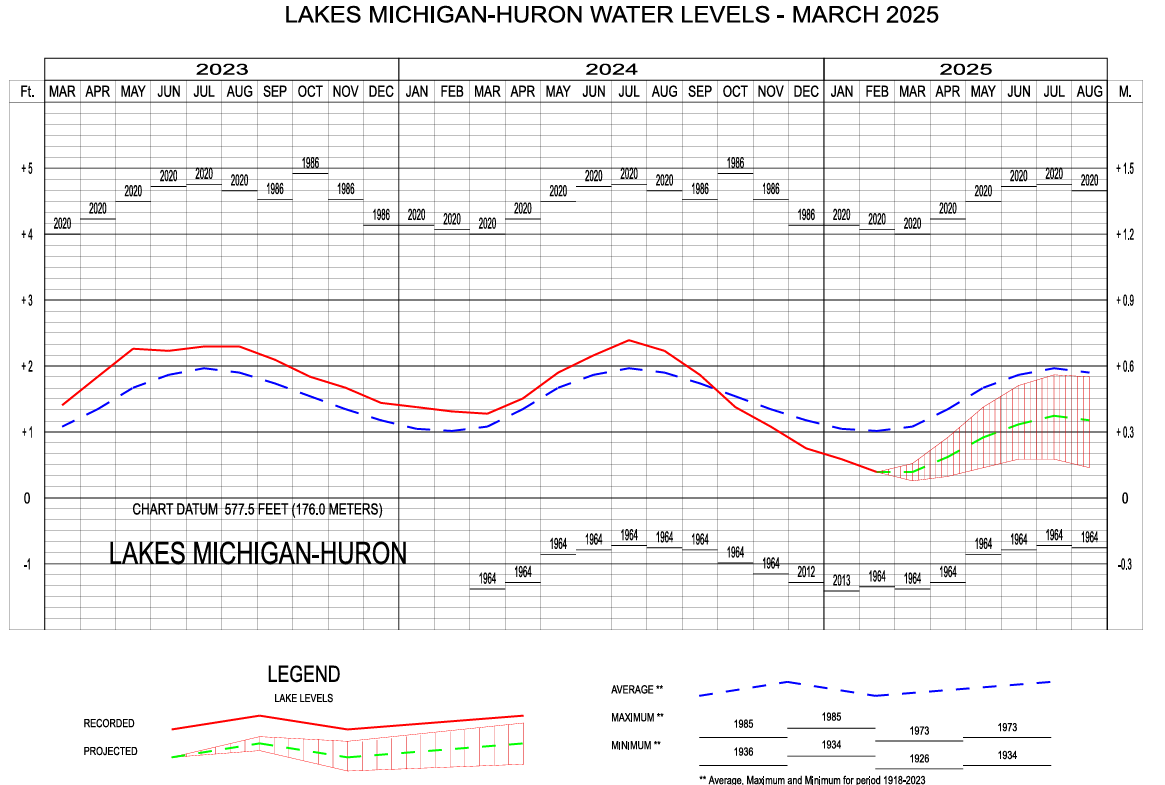
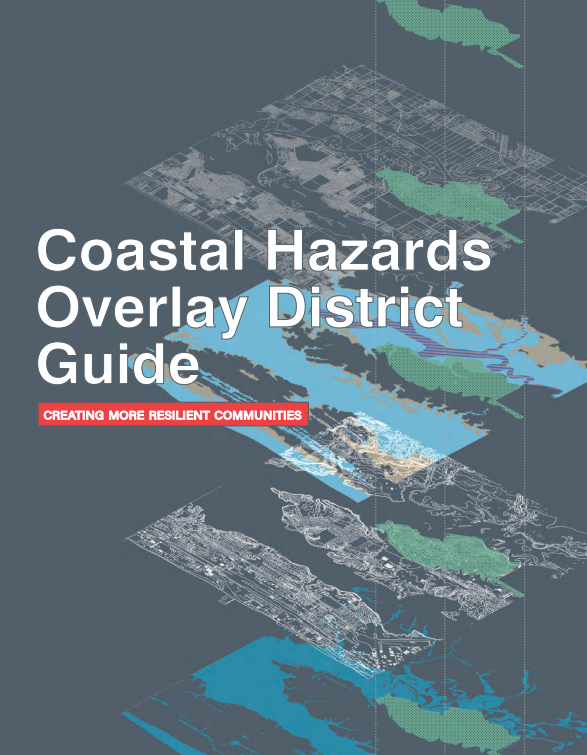
| | March 2025 Water Level Update | | Lake Michigan water levels were steady month over month, neither increasing nor decreasing from February to March. Lake Michigan is now about 8 inches below the long-term average water level for the month. Water levels are expected to begin their seasonal rise over the next month. | | CRC Coastal Hazards Overlay District Guide | | | | The Coastal Resilience Center of Excellence (CRC) has published a Coastal Hazards Overlay District Guide. An overlay district is a land use planning tool used to apply additional design standards and planning techniques within a geographically defined area. The purpose of the guide is to provide coastal communities of varied capacities and differing types of development patterns with a tool to mitigate the negative effects of natural hazards. | | Do-It-Yourself Guide: Conducting Visitor and Recreational User Research to Tell an Economic Impact Story | | The Wisconsin Office of Outdoor Recreation and the Harbinger Consultancy developed this Do-It-Yourself Guide to educate, support and encourage data collection by communities, organizations and constituents. This type of information can be used to catalyze public support and funding for projects or report on previous investments. This guide may also be useful for demonstrating the value of public access and resilience projects. | | | Updated ASFPM Great Lakes Coastal Resilience Planning Guide | | This guide was originally developed by the Digital Coast partnership in 2014 to show how coastal communities are using science-based information to address coastal hazards such as flooding, shore erosion, and lake-level fluctuations. This 2025 update features a fresh new look and updated content to reflect new science and understandings of the Great Lakes over the past decade. Updates include a new resilience planning section, in-depth community stories, and refreshed resources. | | USACE Great Lakes Coastal Resiliency Study | |
The Great Lakes Coastal Resiliency Study (GLCRS) is an estimated 6 year and $14.4 million cost-shared study by the U.S. Army Corps of Engineers with the Great Lakes States. The GLCRS is a comprehensive watershed assessment of the Great Lakes coastal areas and identifies coastal areas that could be vulnerable to future storms, flooding, extreme low or high water levels, erosion, and accretion; the identification of a range of actions to improve coastal resiliency; and the development of a collaborative-risk informed-decision framework to support the identification and prioritization of coastal investments by federal, state, and local governments, Tribal Nations, and nongovernmental organizations. To stay up to date on project updates, join the GLCRS mailing list.
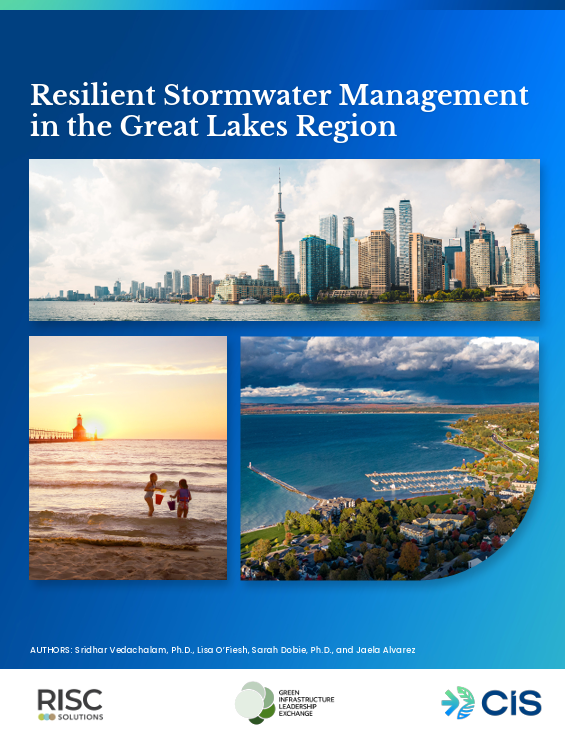
| | RISC Publishes Report on Resilient Stormwater Management in the Great Lakes Region | | | | This report, developed as part of the Resilient Infrastructure Sustainable Communities (RISC) project funded by the Great Lakes Protection Fund, examines the current state of green stormwater infrastructure (GSI) in the Great Lakes Region. It emphasizes the potential of GSI to address these challenges by reducing runoff, improving water quality, and mitigating urban heat islands, while also enhancing biodiversity and public spaces. | | Daybreak Fund 2025 Request for Proposals | | |
The Daybreak Fund is soliciting proposals for nature-based projects in the Western Lake Michigan Basin at the intersection of climate change and water quality. The Fund will award at least $1.5 million in grants in 2025 to support initiatives with multiple benefits to water quality, carbon storage, biodiversity, and people and communities throughout the basin.
Eligible Applicants: 501(c)3 non-profit organizations, municipalities and local government agencies, tribes, and educational institutions are eligible for funding. Collaborations are strongly encouraged, and projects that include sub-grants to partners are eligible.
Pre-application Deadline: April 11, 2025
Full Application Deadline: June 16, 2025
| | NOAA Transformational Habitat Restoration and Coastal Resilience Grants | | |
$100 million in funding is available for transformational habitat restoration and coastal resilience projects under the Bipartisan Infrastructure Law. Projects will support efforts such as reconnecting rivers to their historic floodplains, outplanting corals to rebuild reefs, building living shorelines that protect coasts from erosion and sea level rise, and more.
Eligible Applicants: Institutions of higher education, non-profits, commercial (for profit) organizations, U.S. territories, and state, local, and tribal governments.
Application Deadline: April 16, 2025
| |
NOAA Coastal Habitat Restoration and Resilience Grants for Tribes and Underserved Communities | | |
$20 million in funding is available for projects that will advance the coastal habitat restoration and climate resilience priorities of tribes and underserved communities under the Bipartisan Infrastructure Law. Through this funding, NOAA will help support community-driven habitat restoration and build the capacity of tribes and underserved communities to more fully participate in restoration activities.
Eligible Applicants: Tribes, tribal entities, underserved communities, or entities that partner with these groups such as institutions of higher education, non-profit organizations, commercial (for profit) organizations, U.S. territories, and state, local, and tribal governments.
Application Deadline: May 12, 2025
| | Great Lakes Environmental Justice Thriving Communities Grants | | |
$40 million is available to organizations working in and for underserved communities throughout the Great Lakes region. The program’s goal is to lift up community-led innovation and strengthen community-based groups by breaking down barriers to federal funding. All grants will be given to environmental and public health efforts in underserved communities as defined by the EPA (includes Indigenous groups, communities with recent disaster declarations, and communities under 10,000 people).
Eligible Applicants: Tribal governments and organizations, local governments, non-profit organizations, and institutes of higher education.
Application Deadline: Grant applications will be accepted from December 5, 2024 until November 2026. Grant announcements will be made several times a year until the end of 2026.
| | NOAA Facilitation Basics for Coastal Managers | | |
Virtual
Date: Wednesday, May 14 & Thursday, May 15
Time: 12p-3p CT
Productive meetings are essential to effectively plan for and manage the diverse interests and needs in our coastal communities. In this course, participants will learn basic facilitation skills, tools to engage participants, and techniques for dealing with disruptive behaviors. Class time is provided to practice using tools and skills to plan and facilitate meetings that accomplish objectives while minimizing conflict. Participants at every level are welcome, since these new skills will be useful even when attending, but not running, a meeting.
For additional information or to register, e-mail Jan.Kucklick@noaa.gov. For additional NOAA coastal management trainings, visit the Digital Coast Academy webpage.
| | Wisconsin AWRA 2025 Annual Meeting & Conference | | |
April 10-11
Wisconsin Dells, WI
The Wisconsin Section of the American Water Resources Association (AWRA) is holding its annual meeting. The meeting will include plenary, oral and poster sessions, plus lightning talks, addressing both surface water and groundwater issues in Wisconsin.
| | Peter Annin: Community Conversation on Nurturing Northeast Wisconsin's Freshwater Economy | | |
April 17
Green Bay, WI
Join keynote speaker Peter Annin, Director of the Mary Griggs Burke Center for Freshwater Innovation on the campus of Northland College and author of The Great Lakes Water Wars, as he discusses the Green Bay region and Wisconsin's position on the Great Lakes with access to abundant freshwater in a time of global water scarcity. For those who can't attend in person, the event will be livestreamed.
| | Green Bay Conservation Partners Spring Roundtable | | |
April 29
Green Bay, WI
The Green Bay Conservation Partners Spring Roundtable is an event to share information and foster collaboration among conservation practitioners, researchers and stakeholders working in the bay of Green Bay, Lower Fox River watershed, Green Bay’s west shore and Door Peninsula. The morning includes an opportunity for networking, regional and legislative updates, lightning talks, and student posters. Don’t miss this great opportunity to hear from partners involved in exciting restoration, monitoring, and other conservation projects around the region.
| | Great Lakes St. Lawrence Cities Initiative’s 2025 Annual Conference | | |
May 14-16
Milwaukee, WI
Hosted by the Great Lakes and St. Lawrence Cities Initiative, this conference will shine a spotlight on the vital role that local governments, industries, and innovators in the Great Lakes and St. Lawrence River Region play in tackling both regional and global water issues.
| | IAGLR's 68th Annual Conference on Great Lakes Research | |
June 2-6
Milwaukee, WI
Virtual
The International Association for Great Lakes Research (IAGLR) is having its 68th Annual Conference on Great Lakes Research. It will feature four days of inspiring science centered around the theme Creating Great Lakes Resilience. For those who cannot make it to Milwaukee, there will be a virtual option available. View additional information on conference programming and register below.
| | |
For questions about the CALM Network, or to submit something to the newsletter, contact:
Jake Kolanowski
jacob.kolanowski1@wisconsin.gov
608-261-9197
| | |
For questions about Lake Michigan coastal hazards or how to address them, contact:
Adam Bechle
bechle@aqua.wisc.edu
608-263-5133
| | University of Wisconsin Sea Grant Institute | (608) 262-0905 | 1975 Willow Drive, 2nd Floor, Madison, WI 53706 | | | | |