Bold Action Needed to Close Pennsylvania’s Funding Gaps | |
|
“Fill it in 4!” is the message from Education Law Center and our allies as state officials gear up to negotiate a 2025-26 state budget.
We have long advocated for Pennsylvania to address the constitutional deficiencies in how it funds our public schools. Last July, the General Assembly acknowledged a $4.5 billion adequacy gap and allocated $500 million to the 348 districts identified as underfunded. Now Pennsylvania must close that remaining $4 billion adequacy gap expeditiously to ensure all of our students have access to quality public education. Hence, we have advocated for the state to allocate $1 billion dollars each year for the next four years to close the adequacy gap.
So we will be closely watching Gov. Shapiro’s annual budget address on Tuesday, Feb. 4, and legislators’ responses.
This key point that we made in our funding lawsuit in Commonwealth Court still holds true: Pennsylvania’s underfunded school districts serve the students who have been most deprived of educational opportunity, but these students still get the least in terms of staffing, resources, and educational opportunities.
New funding has been having a positive impact in districts around the state; these funds are now being used to extend kindergarten to full days, expand afterschool tutoring, reopen school libraries, reduce class size in early grades, and more. These are programs and services taken for granted in adequately funded schools. Districts have also used their new funds to stave off cuts and maintain valuable programs initially supported with federal COVID relief funds that recently expired.
What’s needed now is another round of bold action toward closing funding gaps — and a long-term plan for fully funding our schools, as called for in Commonwealth Court’s ruling from February 2023. Please join us in this critical advocacy throughout the winter and spring. Plan to attend the PA Schools Work advocacy day in Harrisburg on May 13. And join a webinar on Feb. 13 if you want to learn more about school funding in Pennsylvania.
| |
|
Join Together in
Support of Immigrants
| |
|
None of us should remain silent in the face of sweeping attacks on civil rights and attempts to roll back equity. Please join with us to support our immigrant neighbors and communities, who are a primary target.
A series of executive orders seeks to facilitate deportations. The U.S. government has rescinded its guidance that treated schools, churches, and hospitals as “sensitive locations.” These developments are having a damaging impact on immigrant schoolchildren. Many children now fear going to school. Threats of immigration enforcement in schools and deportations also disrupt learning for our whole school communities.
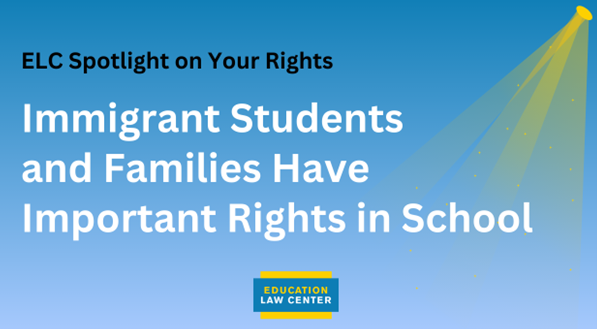
ELC is working with parents, immigration groups, school administrators, and teachers to be sure they understand schools’ legal requirements and families’ rights in this new environment. See our new flyer spotlighting immigrant students’ rights. And see this letter to school leaders that ELC issued today with our partners at the ACLU to outline students’ rights and schools’ obligations and to provide answers to common questions.
We are urging districts to adopt a Welcoming Schools board resolution or policy and clear protocol to address ICE enforcement.
The rights of immigrant students under federal and state law have not changed. For example:
- Undocumented immigrant students continue to have a constitutional right to be educated in our public schools regardless of their immigration status, and schools cannot inquire about a student’s status.
- ICE cannot enter non-public areas of schools without a valid judicial order signed by a judge or except in extremely rare emergency situations.
- Schools must ensure that immigrant students are free from discrimination, including bullying and harassment.
| |
Education Law Center will host a public webinar on Feb. 6 at 12 pm regarding ICE and Schools: Students’ Rights and Schools’ Legal Obligations, a presentation by Education Law Center-PA, ACLU-PA, and HIAS-PA. Advance registration is required here. Please join us to learn more. | | | |
Federal Actions on Title IX,
Gender Identity Don’t Change Schools’ Obligations to Students | |
|
Title IX injunctions and executive orders from the Trump Administration relating to gender identity have been in the news, but they do not require any change or action from Pennsylvania public schools.
The Title IX 2024 regulations were vacated for the whole country by a federal district judge on Jan. 9. The ruling effectively reinstates the prior 2020 regulations for all schools.
The 2020 regulations and Title IX case law still protect students from sex discrimination based on gender identity and sexual orientation. Pennsylvania schools are also still subject to the Pennsylvania Human Relations Act, which includes protections for LGBTQ students. Read more in our updated fact sheet on Title IX.
Multiple executive orders have been issued, trying to limit the rights of transgender and nonbinary students, spreading misinformation about our public schools and purporting to limit the curricula schools can teach. But executive orders cannot erase Pennsylvania law or Title IX cases that protect transgender students rights, nor does the federal government have legal authority to direct K-12 curricula.
| |
Plaintiffs Settle Claims
Against Glen Mills;
New Complaint System Launched | |
|
Pursuant to individual confidential settlement agreements, all claims filed by three named plaintiffs against Glen Mills Schools have been voluntarily dismissed in our lawsuit filed in 2019 on behalf of former students at the now-closed Glen Mills Schools in Delaware County.
Claims against the Pennsylvania Department of Education and Pennsylvania Department of Human Services were dismissed in August based on a settlement agreement. We previously entered into a settlement agreement with Chester County Intermediate Unit that provided relief to approximately 500 former students at Glen Mills.
Our case was originally filed as a class action lawsuit with our co-counsel Juvenile Law Center and Dechert LLP, challenging the actions of state and local officials and Glen Mills and its leadership in response to conditions of abuse and deprivation of education for youth placed there by courts. Glen Mills closed in 2019 based on findings of pervasive abuse and a reported culture of violence that disproportionately harmed Black and Brown young people who were court-ordered to Glen Mills as a result of systemic racial discrimination in our juvenile justice system.
Last week, in accordance with our settlement agreement with the commonwealth, PDE launched a new complaint system, which can be used by anyone to file education-related complaints concerning “publicly placed” students — defined as school-aged students placed in any residential facility, detention center, or state correctional facility by a court or child welfare agency.
We urge youth, parents, advocates, and organizations to use this new complaint system, through which complaints can be investigated by PDE’s newly created Office of Program Monitoring and Accountability. The new landing page also includes links to filing complaints regarding educator misconduct, curriculum deficiencies, and special education issues.
| |
Celebrate With Us September 25, 2025! | |
|
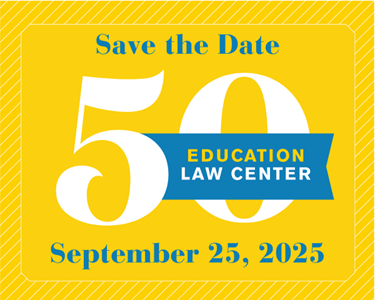
Mark your calendars today! We invite you to join us on Sept. 25, 2025, for the Education Law Center’s 50th anniversary celebration at the Switch House in Philadelphia.
Sponsorships are available now! ELC’s premier fundraiser serves as a unique opportunity to connect with key stakeholders in education advocacy and reform. Please contact Ariella Gregson to learn more about partnership benefits.
We hope you will celebrate this special milestone with us!
| |
Defending a Student’s Right
to an Independent Evaluation | |
|
The right to an independent educational evaluation (IEE) to determine eligibility for special education services is a critical protection. However, many students who are most marginalized by our education system —including children in foster care and multilingual learners — often face barriers to exercising this right.
Recently, ELC successfully challenged a school district’s denial of an IEE for “Ana,” a 16-year-old 11th grade multilingual learner in foster care. Ana had regularly attended high school, ready to learn, but the school did not provide the support she needed to develop foundational academic, communication, and social-emotional skills.
Despite documented concerns, the district found her ineligible for special education and denied a request from her education decision maker (EDM) for an independent evaluation. In ruling in favor of Ana’s EDM, the hearing officer held that the special education evaluation conducted by the district was not sufficiently comprehensive and rejected the school psychologist’s cursory conclusion that Ana could not be found eligible due to limited English proficiency and absence of adequate instruction.
Ana now has the right to an evaluation paid for by the district that will identify all of her needs and assist her education team to address them.
| |
New Translated Fact Sheets Available | |
ELC has updated translations of many of our rights-based fact sheets in multiple languages. A large number of ELC’s fact sheets are available in Spanish, and several fact sheets are also available in Chinese, Arabic, Nepali, and Portuguese. Most of these were updated in 2024.
Here is a complete list of our available translations, A comprehensive collection of ELC’s fact sheets is our annual Back to School Guide.
| |
Celebrate Black History Month! | |
|
In February, we at ELC — along with millions of educators, students, and families — observe and celebrate Black History Month! As we see fierce new attacks on initiatives to promote diversity, equity, and inclusion, including even the observation of this month, it is timely to remember why we observe and celebrate.
In 1926, the Black scholar Dr. Carter G. Woodson organized the first celebration of “Negro History Week” in February. Though it was timed around traditional celebrations of the birthdays of Abraham Lincoln and Frederick Douglass, Woodson aimed to elevate the wider stories of “countless Black men and women who had contributed to the advance of human civilization.” Fifty years later, the celebration was expanded to the month of February.
Woodson had two goals in mind, according to historian Lonnie Bunch: to use history to advance the cause of equality by demonstrating the important roles Black people played in creating the nation; and to counter a dominant culture that rarely “took notice of the Black community, except to dwell upon the negative.” Bunch writes persuasively on the continuing relevance of Black History Month, concluding “there is no more powerful force than a people steeped in their history.”
Bringing Black history into schools has required a decades-long struggle for inclusion. We applaud the educators who continue to do this work. We encourage readers to connect with efforts like the Teaching for Black Lives campaign and this week’s Black Lives Matter at School activities, as well as events and celebrations in your area.
| |
|
We want to highlight two more February events at which ELC attorneys are presenting that are free, open to the public, and may be of interest.
Senior attorney Kristina Moon is a panelist at an “Educational Equity Forum” on Feb.19 at 7 p.m., focused on “the rights and needs of public school kids, especially immigrant, LGBTQIA+ and Black and Brown Children.” This Philadelphia event is sponsored by the group Need in Deed and is being held at the First United Methodist Church of Germantown and is livestreamed. Register here.
Staff attorney Paige Joki will be speaking on a panel about “The Mechanisms and Harms of School Discipline: A Case Study of Pennsylvania” on Feb. 28 at 12:15 p.m.. The panel is one event in a conference on exclusionary school discipline sponsored by the UC Law SF Consortium on Law. To attend virtually, register here.
| |
|
1985: Class Action
Wins Improvements for
Asian Immigrant Students
| |
|
Each month in 2025, we are highlighting an ELC milestone or success as we mark our 50th anniversary. See our timeline of ELC milestones here.
In 1985, the Education Law Center brought a class action lawsuit, Y.S. v. School District of Philadelphia, with the aim of securing an adequate educational program for thousands of students who were immigrants from Asia.
Students who were just learning English were being placed in classes without the supports that they needed to participate and learn. Parents could not meaningfully participate in decisions about their children’s education because no one at the school spoke their language.
Our lawsuit resulted in a consent decree requiring the district to improve its academic program — for all multilingual learners, not only Asian students. The district expanded English for Speakers of Other Languages (ESOL) instruction; hired bilingual teachers, counselors, and paraprofessionals; and provided translation and interpretation services.
Under the “Y.S. Stipulation,” the district worked with ELC to monitor district progress annually over nearly three decades, and ELC pressed for continued improvements to ensure that all multilingual students and families had access to education.
Over time, the district opened the Office of Multilingual Curriculum and Programs as well as enrollment centers to assist families, Newcomer Learning Academies for high school students, and bilingual education programs in elementary grades.
Former ELC executive director Len Rieser, lead attorney in the lawsuit, said there’s more to be done “to build a truly adequate system for students and families whose native language isn’t English.” But he said the case increased the district’s capacity to provide meaningful instruction — “and did away with the idea that parents who speak other languages would have to fend for themselves.”
Learn more about the rights of multilingual students and families here.
Read more about the Y.S case.
| |
From Our Video Library:
Educating the Educators
| |
|
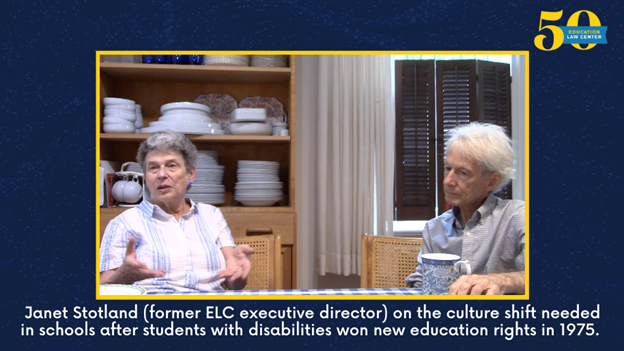
In this clip from our interview about ELC history with Janet Stotland and Len Rieser, former ELC co-directors, Janet speaks about ELC’s work after the passage of the law now known as the Individuals with Disabilities Education Act 1975. Educators had to be educated about the new legal environment and its implications.
Ensuring that districts are aware of and comply with federal and state law remains an important part of ELC’s work today.
| |
|
Welcome to our five spring semester interns:
- Courtney Todaro is a second-year student and Public Interest Scholar at Drexel University's Kline School of Law. Before law school, she worked in a Boston charter school through AmeriCorps. Courtney received her bachelor's in English from the University of Miami, where she minored in education.
-
Jeffrey Chmay is a third-year student at the Thomas R. Kline School of Law of Duquesne University and is editor-in-chief of the Duquesne Law Review. Prior to law school, Jeffrey was a band director at public schools in Colorado, Nevada, and Pennsylvania.
- Marilyn Torres is a second-year student at Drexel University’s Kline School of Law. She received her B.A. in criminology with minors in French and Spanish from Fairleigh Dickinson University, where she did an honors thesis on how structural disadvantages in early education leads to racial disparity in American prisons, which sparked her interest in education law.
- Oliver Robinson is a third-year student at Temple University Beasley School of Law. He received his bachelor's degree in sociology from Howard University. Prior to law school, he worked as an advocate for higher education access for low- and moderate-income families.
- Jackie Valadez is a second-year student at Temple University Beasley School of Law. Before law school, she worked for the Peace Corps and, as a volunteer, focused on increasing student engagement in the classroom. Jackie received her undergraduate degree from the University of Georgia.
| |
Check Out Our Job Postings! | |
50 YEARS: Rooted in Justice, Advancing Equity | |
Education Law Center | 215-238-6970 (Philadelphia) | 412-258-2120 (Pittsburgh)
| |
A copy of the official registration and financial information of the Education Law Center may be obtained from the Department of State by calling toll-free, within Pennsylvania, 1-880-732-0999. Registration does not imply endorsement. | | | | |