- Apartment rent growth continued to moderate in March, with rents across the Knoxville metro area increasing by just 1.3% from the previous year.
-
Home prices in the Knoxville metro area increased 11.7% from the previous year in the fourth quarter of 2023, which places the region at No. 8 in the U.S. for price growth, according to the FHFA House Price Index.
- A new analysis of Census data shows that rentals account for 15% of Knoxville's single-family housing stock, which is below the national average.
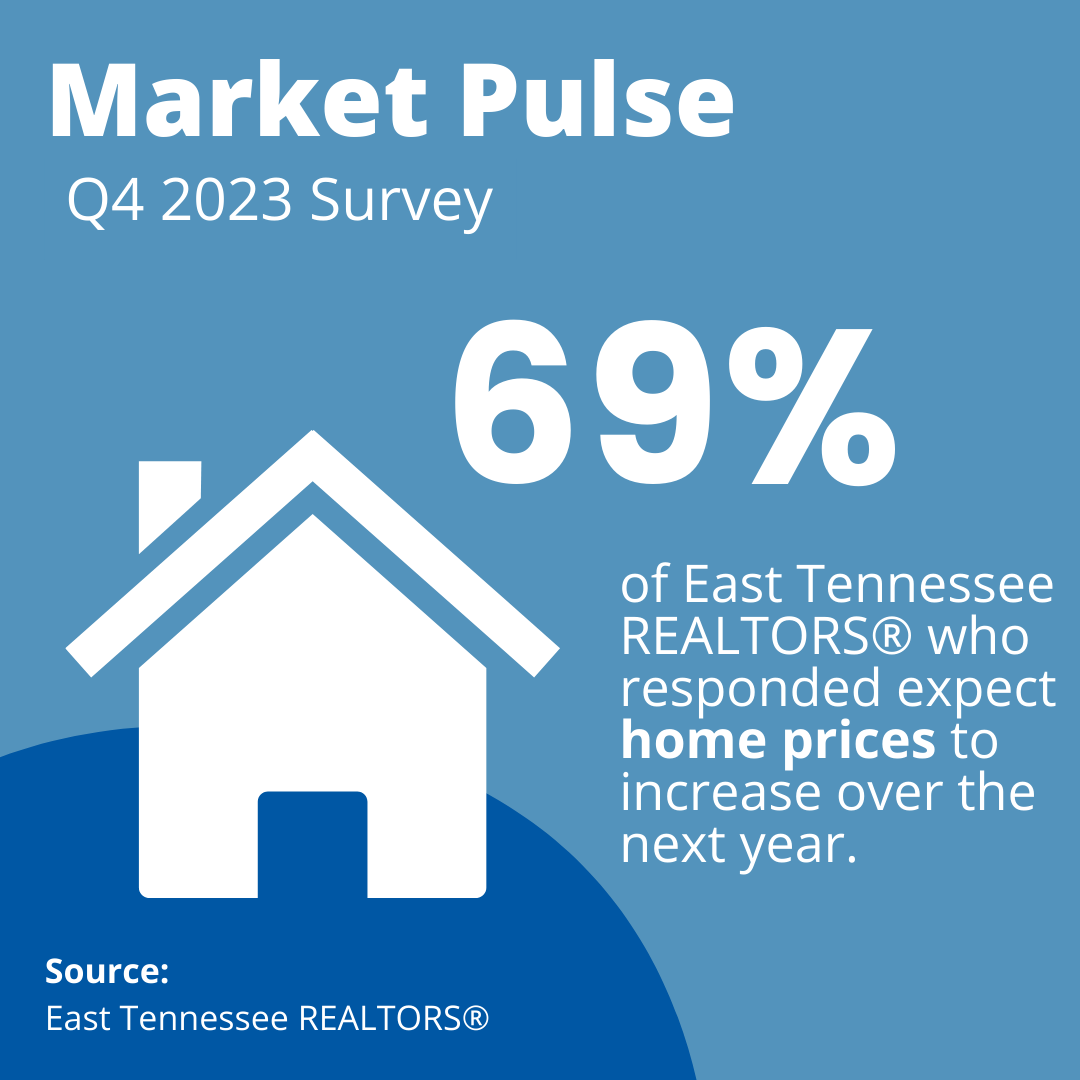
- According to the latest Market Pulse Survey, almost 7 in 10 of REALTORS® – 69%– expect home prices will increase over the next year, while 15% expect no change and 16% expect prices to decline over the next year.
| |
|
Editor's Note
Dear Readers,
Over three years ago, East Tennessee REALTORS® published the inaugural edition of Market Pulse (known as REALTOR® Pulse at the time), a monthly newsletter designed to leverage the MLS and provide data-driven insights about East Tennessee's housing market. Since then, Market Pulse has grown from just a handful of subscribers to a community of nearly 2,000 real estate professionals, government officials, community leaders, and others.
After more than 40 editions, my time as curator and editor of Market Pulse has come to an end with this month's newsletter. It has been my privilege to bring you the latest insights, analysis, and trends in the housing and economic landscape of East Tennessee over these past few years. While I may be stepping away, please know that Market Pulse is in capable hands and will continue to be your trusted resource for the latest housing news in East Tennessee.
Once again, thank you for reading... and Au revior!
With gratitude,
Hancen Sale
| |
|
Home Sales Report
March 2024
-
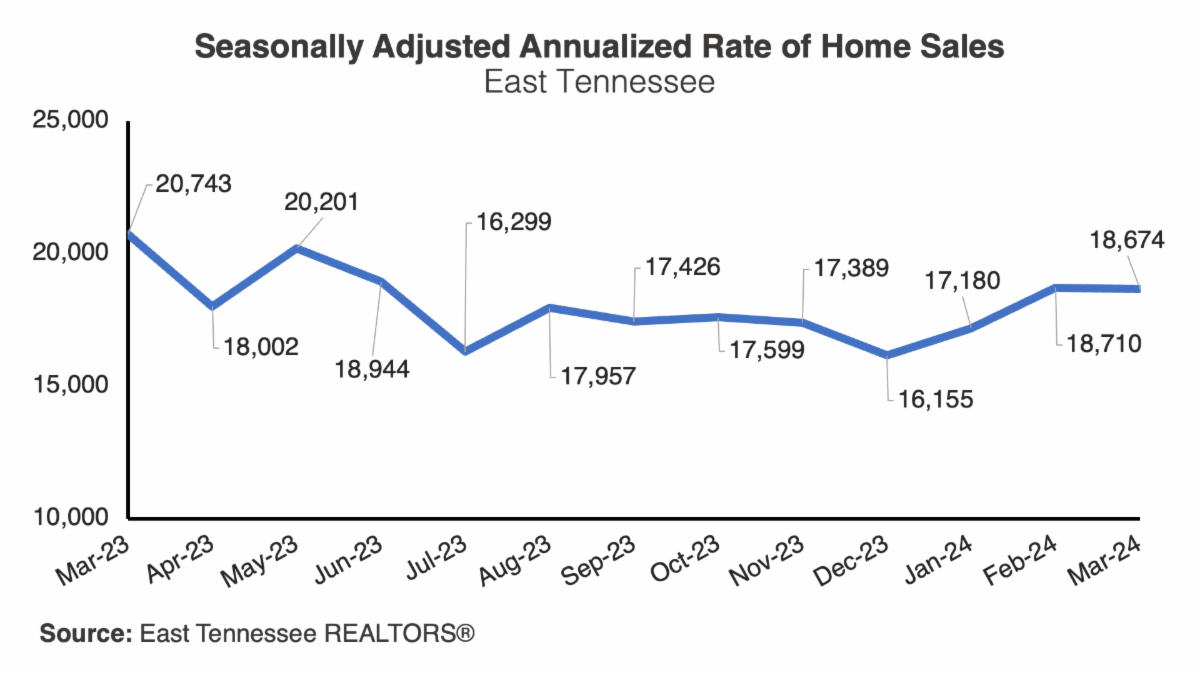
East Tennessee home sales declined 0.2% from the previous month and 5.6% from a year ago.
-
The median sale price was $350,497 — up 8.5% from the previous year.
-
Total housing inventory increased from the previous year – up 32.7% from a year ago.
-
Half of the homes sold were under contract in 19 days or less, up from 16 days a year ago.
-
45% of homes sold for the asking price or above, with 22% selling for more than the asking price. 9% sold for at least $10,000 over asking and 2.7% sold for at least $25,000 over asking.
-
The sale-to-list price ratio increased to 97.9% – down from 98.8% a year ago.
-
New construction represented 14.7% of total home sales.
East Tennessee REALTORS® reports home sales data using a seasonally adjusted annualized rate (SAAR), a statistical measure of home sales that takes into account typical seasonal fluctuations in the real estate market, such as increased home sales during the spring and summer months, by adjusting the data to provide an annualized rate. This rate represents the projected number of homes that would be sold over a year if the current sales pace were to continue.
| |
|
What's the Outlook? After a strong showing in February, home sales slowed in March as strong economic and job growth figures pushed up mortgage rates, which weighed on buyer demand. Despite higher mortgage rates and the slowdown in home sales, pending listings are up 5.5% from the previous year across the region. Although still low by historical standards, inventory levels are appreciably higher than a year ago.
Unlike the broader East Tennessee region, Knox County saw home sales increase 4.5% from the previous year – the second consecutive month of annual gains.
| |
National Association of REALTORS® Reaches Agreement to Resolve Nationwide Claims Brought by Home Sellers | |
|
The National Association of REALTORS® announced a proposed agreement that would end litigation of claims brought on behalf of home sellers related to broker commissions.
In our commitment to maintaining the transparency and trust that you've come to expect from East Tennessee REALTORS®, we have launched a new landing page: etnrealtors.com/settlement. This centralized hub is dedicated to keeping REALTORS®, industry stakeholders, and the public informed with the latest and most significant developments regarding the proposed settlement.
| |
Commentary: Will the NAR settlement lower home prices? | |
|
Hancen Sale
Government Affairs and Policy Director
| |  |
|
Some analysts have claimed the proposed settlement and resulting rule changes will lower housing costs, but we are unlikely to experience a broad decline in home prices for myriad reasons.
As noted in a recent report by the Urban Institute, "home prices and rents are primarily determined by the supply and demand for housing units and by changes to that supply and demand," which is a simple yet important point. These changes are driven by macro-level factors such as interest rates, migration trends, and household formation. By comparison, commission rates have little, if any, direct effect on housing supply and demand.
Even if the terms of the NAR settlement ultimately bid down commission rates – which isn't a forgone conclusion given commissions are already negotiable – it is still unclear whether it would be buyers or sellers who stand to benefit. In theory, the seller could share a portion of their savings with the buyer (e.g., by reducing their asking price to account for the lower commission fees). But this is an unlikely scenario in practice, especially in a seller's market. Instead, most of the benefit of lower commission rates would likely be realized by sellers in the form of higher profit margins. After all, this is a class action lawsuit on behalf of home sellers.
Nevertheless, it is important to place the blame for high home prices where it belongs. Real estate agent commissions have little, if anything, to do with the current housing affordability woes. It is the massive supply shortage that's driving up the cost of housing.
| |
Built-for-Rent Construction Continues Booming | |
Single-family homes comprise the vast majority of the nation's housing stock, and the majority are occupied by families who own them. However, the strong financial performance has made single-family rental properties a more attractive investment in recent years for big and small investors alike. | |
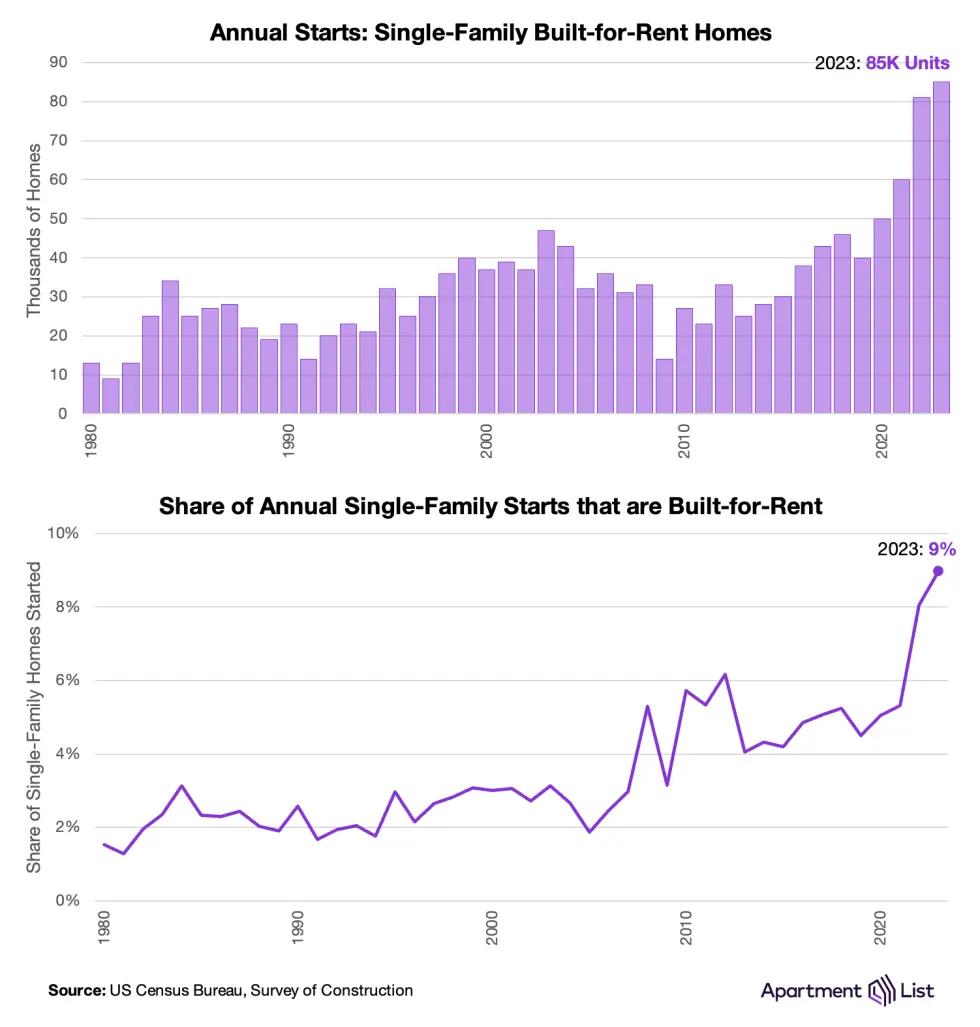
A new report by Apartment List suggests there has been a surge in "built-to-rent" (BFR) communities: a large-scale development of single-family homes that are designed for renter occupancy from the start. Despite this growth, the build-to-rent model is still a fairly small portion of the broader single family rental market. According to Census data, rentals comprise approximately 15% of the Knoxville Metro Area's single-family housing stock – which is below the national average (16.6%). | |
|
Why a Housing Shortage Exists Despite More Houses Per Person
Excerpt from the Marginal Revolution:
| |
|
When I post about the skyrocketing price of housing and the need to build, commentators (include some of the most astute commentators on MR), will sometimes object by pointing to the increasing and historically high number of houses per capita. They question how this aligns with rising prices and wave vaguely towards factors like monopoly pricing, hedge funds, Airbnb, vacancies and so forth, implying that more construction isn’t the solution. The real explanation for rising prices amid greater homes per capita is actually quite simple, fewer kids. Kevin Erdmann has an excellent post on this going through the numbers in detail. I will illustrate with a stylized example.
Suppose we have 100 homes and 100 families, each with 2 parents and 2 kids. Thus, there are 100 homes, 400 people and 0.25 homes per capita. Now the kids grow up, get married, and want homes of their own but they have fewer kids of their own, none for simplicity. Imagine that supply increases substantially, say to 150 homes. The number of homes per capita goes up to 150/400 (.375), an all time high! Supply-side skeptics are right about the numbers, wrong about the meaning. The reality is that the demand for homes has increased to 200 but supply has increased to just 150 leading to soaring prices.
Now what do we do about this? One response is to blame people’s choices–immigrants are buying all the houses, hedge funds are buying all the houses, tourists are renting all the houses, everyone should want less and conserve more! Going down this path will tear the country apart. The other response is the American way, in the words of Bryan Caplan’s excellent new book, build, baby, build!
| |
Using Data to Tell the Housing Story | |
|
Market Pulse Survey:
Q1 2024 Results
Results from the latest iteration of East Tennessee REALTORS® Market Pulse Survey indicate buyer and seller traffic across East Tennessee improved in the first quarter of 2024, and a growing share of REALTORS® expect both home prices and home sales will increase over the next year.
| |
- Buyer traffic increased nominally in the first quarter of 2024. Over 1 in 5 respondents (21%) reported seeing more buyer traffic than this time last year, compared to 10% last quarter. Similarly, seller traffic improved with 20% of respondents reporting more seller traffic than this time last year, compared to just 14% last quarter.
- REALTORS® expectations about buyer and seller traffic over the next three months stalled in the first quarter of 2024 after multiple quarters of improving expectations. 32% of respondents expect more buyer traffic than this time last year, compared to 37% last quarter. Expectations about future seller traffic, however, improved slightly with 34% of respondents expecting seller traffic to increase compared to this last time last year.
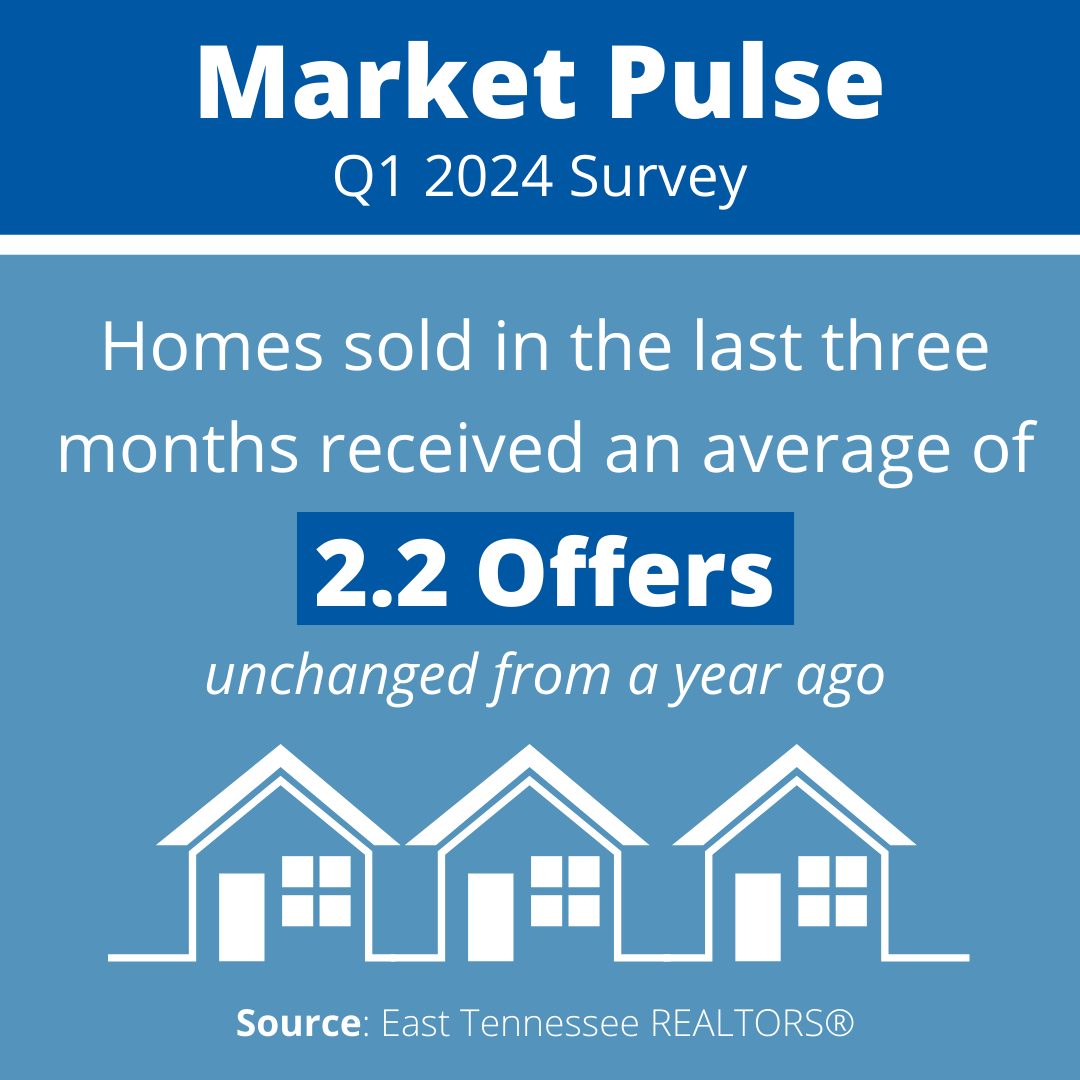
- The typical home sold in Q1 2024 received an average of 2.2 offers, unchanged from a year ago but down from 2.4 offers in Q4 2023.
- A majority of REALTORS® – 51% – expect home sales will increase over the next year, up from 50% the previous quarter and 28% a year ago.
- Almost 7 in 10 REALTORS® – 69%– expect home prices will increase over the next year, while 15% expect no change and 16% expect prices to decline over the next year.
- All-cash sales represented 29% of all home sales in Q1 2024, down from 31% the previous quarter and 37% a year ago.
- 60% of buyers in the past three months waived at least one contingency in their purchase contract, up from 43% a year ago.
- Among homes that went under contract in Q1 2024, 10% had an appraised value that was less than the contract price.
| |
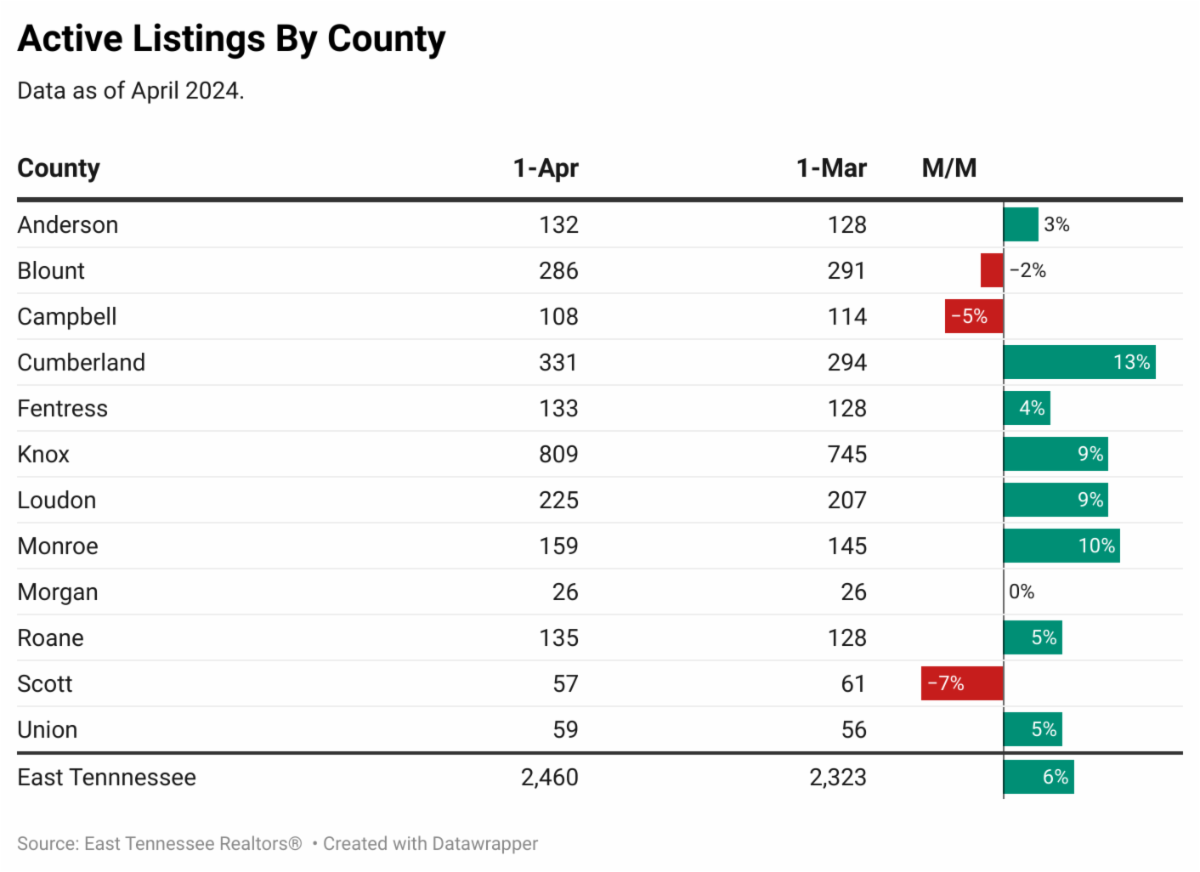
The spring selling season is in full swing with housing inventory increasing by 6% from March to April across the entire East Tennessee REALTORS® footprint. Cumberland, Monroe, Loudon, and Knox counties experienced the largest monthly increase in inventory, while Scott, Campbell, and Blount experienced monthly declines. | | |
|
|
"Though rebounding from cyclical lows, home sales are stuck because interest rates have not made any major moves. There are nearly six million more jobs now compared to pre-COVID highs, which suggests more aspiring home buyers exist in the market."
– Lawrence Yun, Chief Economist at NAR
| |
|
What Makes the U.S. Mortgage Market Different
In the wake of the pandemic-induced housing market frenzy, changing economic conditions and higher mortgage rates have led some prognosticators to raise concerns about the potential for a housing market crash. Despite these concerns, several factors – such as higher lending standards and a lack of housing supply – make such a scenario unlikely.
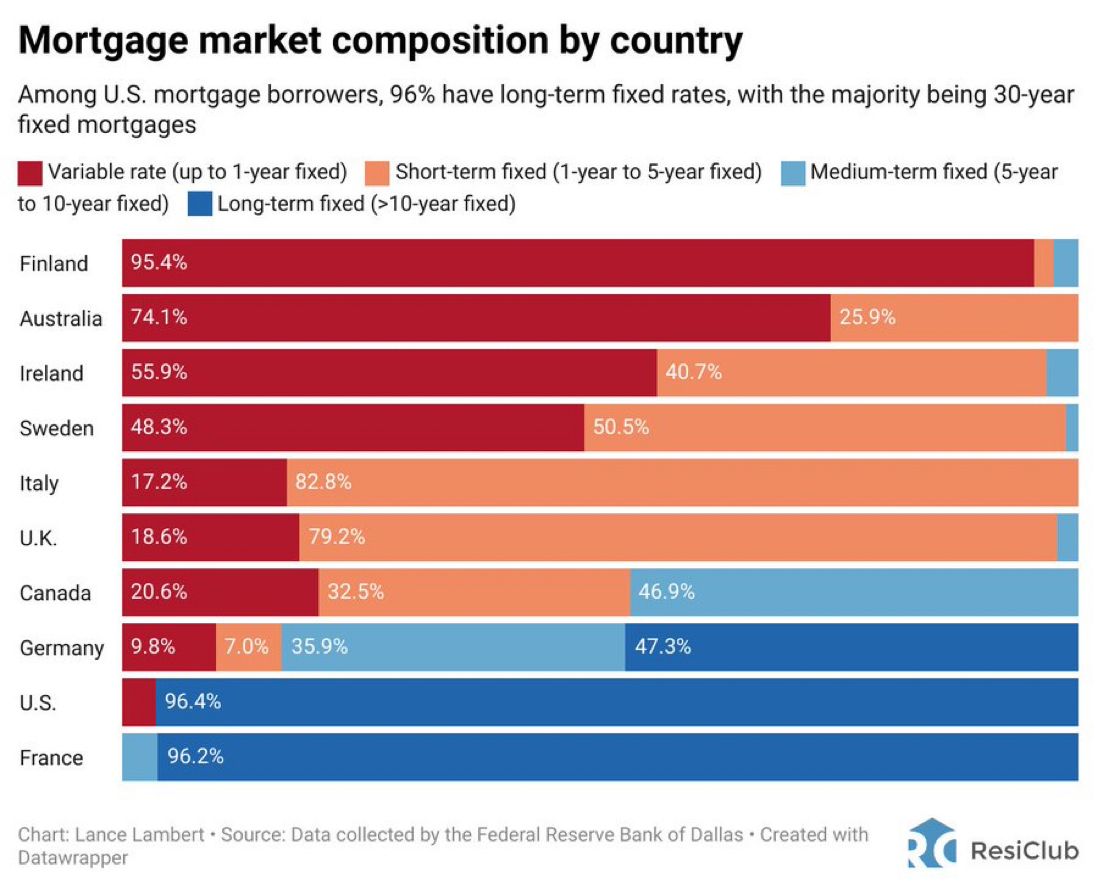
Another factor protecting against a widespread drop in home prices is the structure of the U.S. mortgage market. Unlike most other major developed economies around the world, roughly 96% of outstanding mortgage debt in the U.S is in the form of long-term fixed rate mortgages as opposed to variable rate debt.
| |
The prominence of fixed-rate mortgages in the U.S. means very few homeowners have seen their monthly mortgage payments rise in the higher interest rate environment promulgated by central bank efforts to slow inflation. As a result, the U.S. housing market has fared much better than many of its international counterparts, with very few homeowners being priced out of their home in real-time. | |
Stay up-to-date with the most recent information about East Tennessee's housing market. Here's the latest from local media: | |
|
Mortgage Rates Surpass Seven Percent
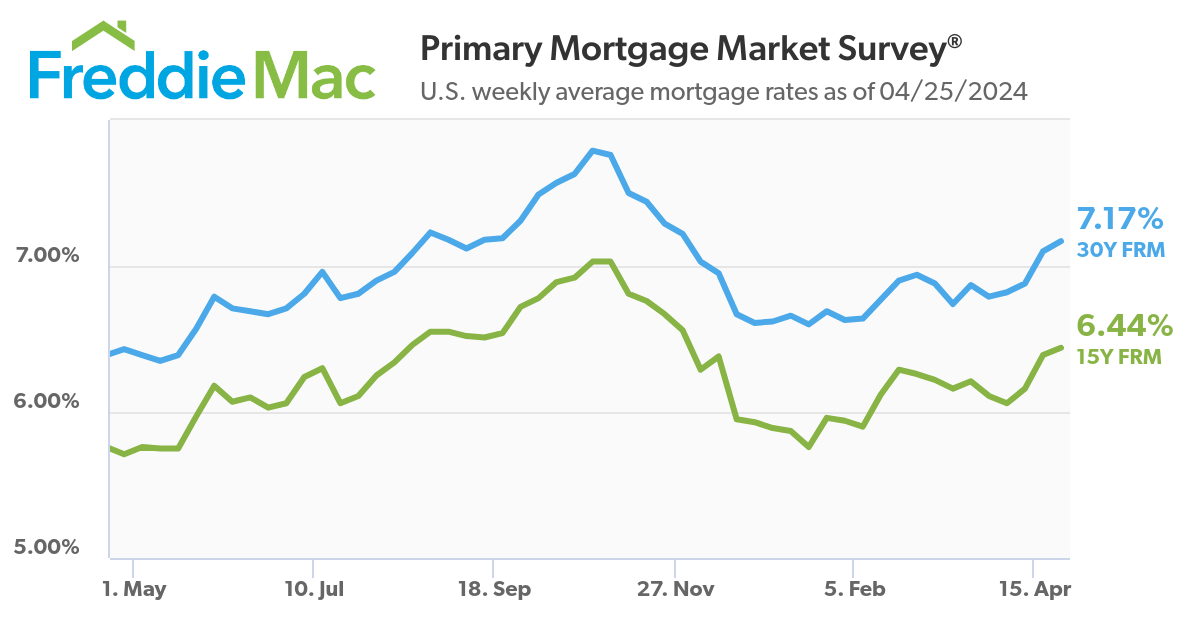
Mortgage rates surpassed 7% in April as strong economic and inflation data decreased the likelihood of interest rate cuts in the short-term. According to Freddie Mac's Primary Mortgage Market Survey, the 30-year fixed mortgage rate (30Y FRM) averaged 7.17% for the week ending April 25, 2024, compared to an average of 6.4% this time last year.
| |
What's the Outlook? Newly released data from the Commerce Department indicated slowing economic growth but higher-than-expected inflation, further complicating the outlook mortgage rates. While slowing growth would typically encourage the Fed to lower interest rates, inflation has largely moved sideways in recent months – suggesting mortgage rates will remain elevated through the early summer months. | |
|
Market Pulse is a monthly research newsletter providing a rundown of the latest housing
and economic research and analysis across East Tennessee.
| |
Was this email forwarded to you? Subscribe here. | | | | |