Learn21's Weekly EdTech Update

September 3, 2026

The Deadline Moved. The Work Shouldn’t.
By Stacy Hawthorne, Ed.D.

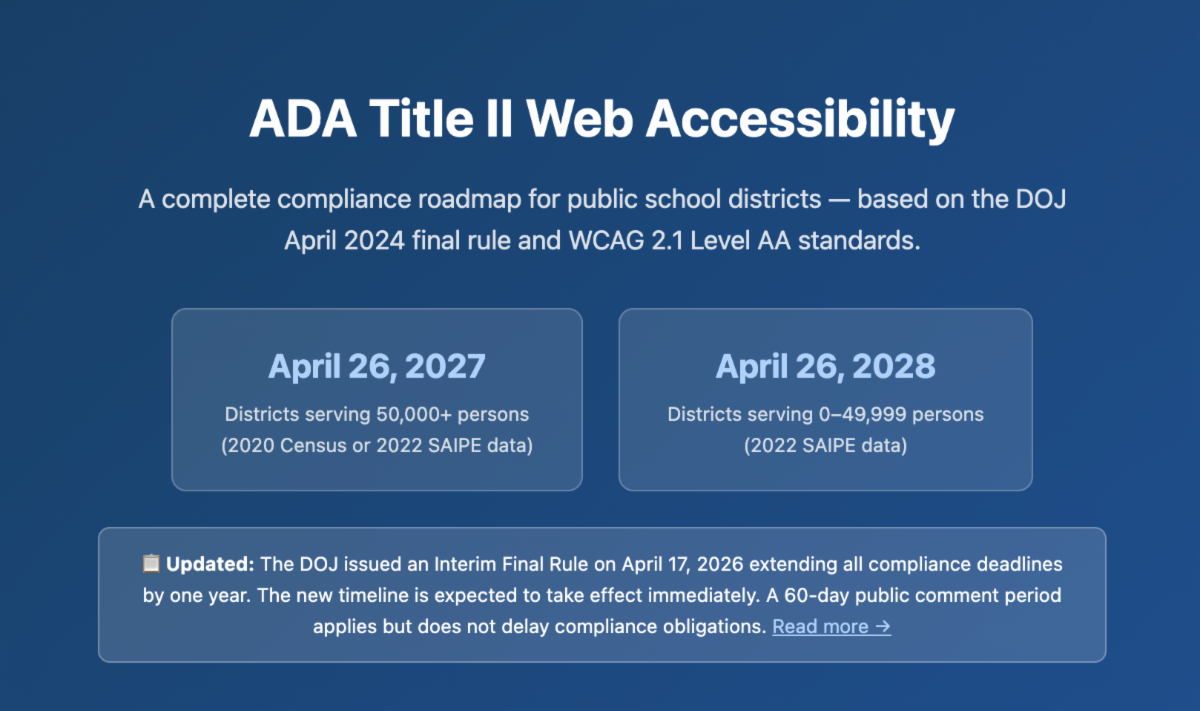
The U.S. Department of Justice has extended the compliance dates for its Title II web and mobile application accessibility rule by one year. Public entities serving populations of 50,000 or more now have until April 26, 2027, while those serving fewer than 50,000 have until April 26, 2028.


For school districts, that sounds like good news. But it would be a mistake to translate “one more year” into “we can deal with this next year.”


This Is Bigger Than the District Website

The rule establishes WCAG 2.1 Level AA as the technical accessibility standard for web content and mobile applications provided by state and local governments, including public schools.


“Web content” means much more than the homepage someone redesigned three years ago. Think about the digital ecosystem families, students and staff encounter every day: webpages, online forms, documents, PDFs, videos, images, mobile apps and other digital content used to access district programs and services.


Now think about how many people create that content. The communications office posts a PDF. Human resources uploads a job description. A principal sends out a digital newsletter. A department publishes a form. Someone posts a flyer as an image. A teacher adds material to a district-supported platform.


Accessibility cannot live solely with the technology department because digital content doesn't live there either. That is why this additional year matters.


Use the Year to Build a System

The goal should not be to spend March 2027 frantically fixing thousands of files. The goal should be to create an organization that produces accessible content as part of its normal work. 


The Department of Justice itself recommends beginning well before the compliance date and points public entities toward several practical steps: establishing accessibility policies, determining who is responsible for the work, regularly testing content, creating processes for accessibility requests and training employees.


District leaders also do not have to start from a blank page. The EdTech Leaders Alliance has created an ADA Title II Web Accessibility resource specifically for public school districts that turns the federal requirements into a practical roadmap. The tool walks districts through 11 action steps, from determining the correct compliance deadline and building a cross-functional team to inventorying digital content, prioritizing remediation and reviewing vendor contracts. It also includes guidance on the rule’s exceptions, sample accessibility language, procurement considerations and a 30-item teacher accessibility checklist for everyday content creation. For districts wondering where to begin, it offers a useful way to turn a very large compliance challenge into manageable work that can start now.


For school leaders, that means starting now. Inventory the digital places where your district provides information and services. Identify your highest-use and highest-impact content. Determine who owns accessibility across departments. Build accessibility expectations into content creation and staff training. Make accessible documents, captions, alternative text and good digital design ordinary practice rather than remediation projects.


And take a serious look at procurement. One of the most important details in the rule is that using a vendor does not transfer the district's responsibility. If a district uses a contractor, licensed platform or other third party to provide web content or mobile applications on its behalf, those services may still need to meet the accessibility requirements.


That should change some conversations with vendors. “Is your product accessible?” is a start. “What accessibility standard do you meet? How do you test it? How do you address known issues? What documentation can you provide us?” is much better. Accessibility belongs in procurement before the contract is signed, not in a support ticket after a student or parent discovers a barrier.


Compliance Is the Floor

There is another reason not to treat April 2027 or April 2028 as the starting point. Students, employees, parents and community members with disabilities need access today.


The DOJ makes clear that the ADA's broader requirements for effective communication, reasonable modifications and equal opportunity continue to apply before these new compliance dates arrive.


The deadline moved. The responsibility to serve people did not. Districts have been given something extraordinarily valuable: time to do this thoughtfully instead of reactively. We can use it to chase inaccessible PDFs one at a time, or we can use it to build better habits, better procurement practices and better systems.


By the time the new deadline arrives, accessibility should not feel like one more compliance initiative. It should simply be how we do digital.

Media Literacy Minute

Common Sense Media Completes K-12 AI Literacy Curriculum

New research finds 70% of U.S. teens now use AI for schoolwork, but only about a quarter say a teacher has ever discussed how AI works or how to judge whether AI-generated information is trustworthy. This EdTech Innovation Hub report covers Common Sense Media’s newly completed free K-12 curriculum, which now spans AI literacy, media literacy, and digital well-being lessons for every grade.


Google AI Search Poses “Unacceptable Risk” to Youth Media Literacy

A new Common Sense Media study found that Google’s AI Overview and AI Mode often treat unverified social media posts with the same authority as medical institutions and peer-reviewed research, leaving young users to sort fact from “confident fabrications” largely on their own. This Davis Vanguard investigation breaks down the findings and what they could mean for classroom AI guidelines.


Media Literacy as a Survival Skill: Lessons from the West Bank

A University of Rhode Island program trained Palestinian educators to teach students to spot deepfakes, manipulated images, and propaganda, with participants describing media literacy less as an academic subject than as a tool for safety and civic resilience. This Rhody Today report found that engagement rose most with hands-on, real-world examples, a lesson educators anywhere can apply.

What a VPAT Proves, and What It Doesn't

By Kevin Ghantous

I recently worked through completing VPATs for our own products at Learn21, and the process taught me something uncomfortable: how easy it would be to produce one that looks complete and says almost nothing. The vendor fills it out. The vendor decides the scope. The vendor writes the remarks, or doesn't. And the longer I sat with that, the more I wondered how many of these documents districts are collecting without reading.


Somewhere in your procurement files sits a stack of them. A vendor filled one out, someone checked the box, and the file closed. It feels like due diligence, so it is worth being clear about what the document actually tells you.


A completed VPAT (Voluntary Product Accessibility Template), formally an Accessibility Conformance Report (ACR), is a set of claims a vendor makes about its own product. No independent body reviews it. No one certifies it. It proves the vendor knows the standard exists and was willing to put something in writing on a specific date about a specific version. Everything past that lives in the details, and the details are where better questions start.


Start with scope. Some reports cover the full platform. Others cover the marketing website, the admin console, or a single module. If the report describes the vendor's portal and your students spend their day in the assessment engine, you may be holding a document about software nobody in your building touches.


Check the date and version. An ACR filed in 2022 against version 4.2 says very little about the version shipping this fall. Accessibility regresses. A redesigned navigation bar can break keyboard focus across an entire product, and nothing in your file will reflect it.


Ask how the evaluation was performed. Automated scanning catches only a portion of WCAG issues - color contrast and missing alt text, mostly. Screen reader navigation, focus management, and error handling require a human using assistive technology. Vendors who tested with real users are usually glad to say so.


Then read the remarks column, the most useful part of the document and the most frequently empty. A row marked "Partially Supports" with no explanation tells you almost nothing. Vendors who have done the work write detailed remarks, because they know exactly where their gaps are.


"Do you have a VPAT?" is a start. "Which version does it cover? How was it tested? What do the Partially Supports rows mean for our students?" is much better. And a ten-minute check beats all of it: have someone walk one real student workflow, login to submission, using only a keyboard.


With Title II deadlines approaching, districts will be collecting more of these documents than ever, and ETLA's ADA Title II Web Accessibility resource includes procurement guidance and vendor questions to help put them to work. The paperwork is not the product. Read it before you file it.

Big Ideas

Three food stories that prove there's more chemistry in your kitchen than you think.


Scientists Turned Plastic Bottles Into Vanilla Cookies

Researchers at Southern Illinois University Carbondale engineered yeast and microbes to break down PET plastic — the stuff in soda bottles — and crop waste, converting them into proteins, vitamins, and flavor molecules. The result, dubbed "µBites," is a 3D-printed, vanilla-flavored cookie dough that started as a NASA Deep Space Food Challenge entry and could eventually feed astronauts or disaster-relief zones. The cookies are safe to eat but still awaiting institutional approval for human taste tests, and at $60 per kilogram to produce, there's a long way to go before they hit grocery shelves.


Turns Out Animals Have Been Eating "Bioplastic" for Millions of Years

Before humans invented biodegradable plastic, bacteria beat us to it. Many microbes store carbon and energy as natural bioplastics called PHAs. Scientists studying a bizarre gutless marine worm discovered it can digest these microbial bioplastics directly, and when they went looking, they found the same enzyme superpower in over 66 animal species across nine phyla, from starfish to earthworms. The find rewrites a basic assumption in biology, that only microorganisms could break down PHAs, and opens new questions about how much microbial carbon quietly flows into the wider food web.


The Exact Temperature That Keeps Mangoes Fresh Weeks Longer

Mangoes are usually shipped at 79–86°F, which speeds up ripening and spoilage. Researchers at Hainan University found that storing them at a specific 54°F sweet spot dramatically slows ripening, preserves firmness, and activates the fruit's own internal antioxidant defenses, all without triggering the "chilling injury" that makes tropical fruit turn mushy and gray when it gets too cold. It's a simple fix with a real supply-chain payoff: better cold-chain transport could mean less waste and fresher fruit traveling farther.

X Share on X
LinkedIn Share on LinkedIn

www.learn21.org

LinkedIn        X        YouTube        Instagram