|
Product Stewardship Updates
March 6, 2025
| |
DON'T MISS EARLY-BIRD PRICING FOR THE U.S. PRODUCT STEWARDSHIP FORUM — ENDS MARCH 31ST | |
|
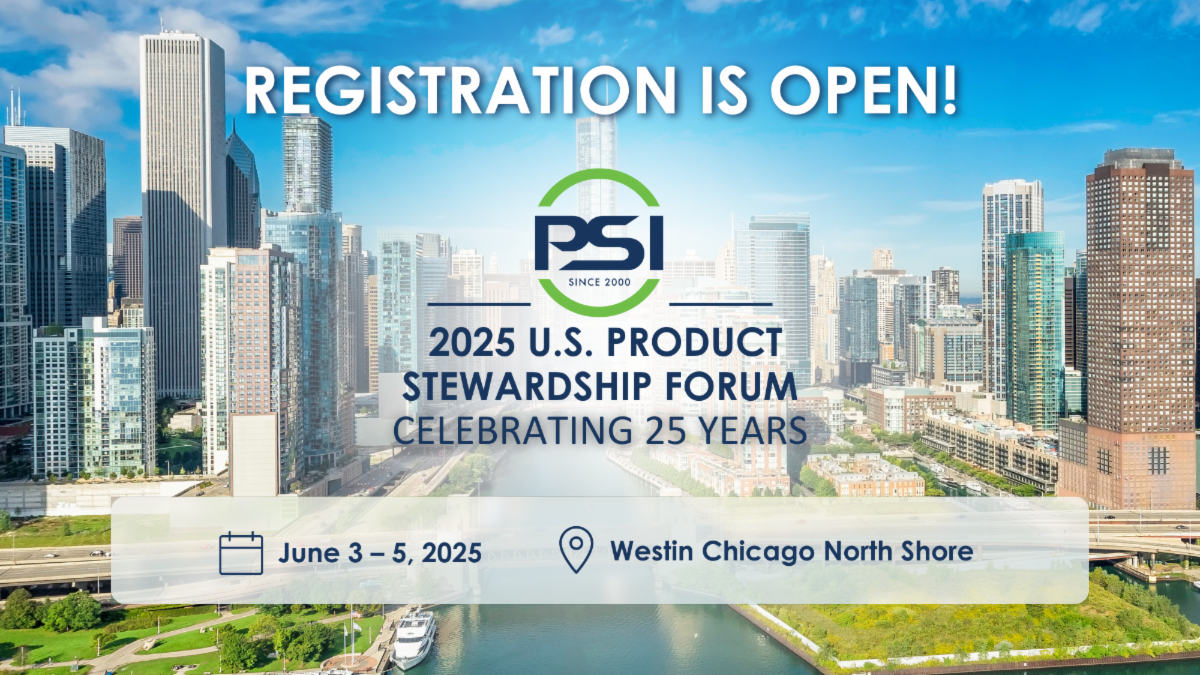
Join 300 EPR leaders from around the world June 3-5, 2025, at the Westin Chicago North Shore for three days of cutting-edge EPR solutions, collaborative problem-solving, and high-impact networking. Register now to lock in early-bird pricing before it ends on March 31!
The 2025 U.S. Product Stewardship Forum is where EPR takes center stage—bringing together industry leaders, policymakers, and innovators to tackle challenges, share solutions, and define the next phase of producer responsibility. Attendees will leave with clear, actionable steps to drive meaningful change and shape the future of EPR.
For more than two decades, PSI’s U.S. Product Stewardship Forum has been the premier conference for EPR, consistently ranked as the most valuable event in the field for its caliber of speakers and breadth of stakeholder perspectives. Private industry (producers, PROs, waste management), U.S. governments at all levels, environmental organizations, academics, and international experts all come together to advance innovative, impactful ideas.
| | Don’t wait—early-bird pricing ends March 31! Secure your spot today and be part of the conversations shaping the future of EPR. | |
PSI WELCOMES NEW TEAM MEMBERS: DARLA ARIANS AND KRISTINA BENOIST | |
|
PSI is excited to welcome Darla Arians as Policy & Program Director and Kristina Benoist as Communications & Marketing Manager!
Darla brings deep experience in EPR program implementation and policy development, having served as Colorado’s EPR Lead, where she oversaw the state’s packaging EPR program. She co-founded the Colorado Product Stewardship Council and helped lead the passage of Colorado’s first EPR law for paint. With over 20 years in waste management, she has played a pivotal role in shaping and improving producer responsibility programs at both the local and state levels.
Kristina brings a strong background in nonprofit communications and marketing, specializing in digital strategy, stakeholder engagement, and advocacy. She holds a bachelor’s degree in Environmental Studies and a master’s in Environmental Education. At PSI, she is leading communications, branding, and event marketing, including promotion of the U.S. Product Stewardship Forum and key EPR initiatives.
Their expertise will help advance PSI’s leadership in EPR policy, program development, and stakeholder engagement. We are thrilled to have Darla and Kristina on board!
| |
PACKAGING EPR ADVANCES AS OREGON, MINNESOTA, AND COLORADO TAKE KEY STEPS | |
|
Momentum for packaging EPR continues to grow as Oregon, Minnesota, and Colorado take major strides toward implementation.
Oregon’s Plastic Pollution and Recycling Modernization Act reached a milestone with DEQ’s approval of Circular Action Alliance’s (CAA) program plan, setting the stage for the July 1, 2025 launch. As the first state to finalize a full PRO program plan for packaging EPR, Oregon is leading efforts to modernize recycling by funding and implementing system upgrades, establishing new collection sites for hard-to-recycle materials, and enhancing education initiatives. To support producers through this transition, PSI partnered with DEQ to host a webinar on material-specific exemptions, helping businesses understand compliance requirements.
Meanwhile, Minnesota has officially named CAA as its PRO, marking a key step in the rollout of its packaging EPR program. Producers of covered materials must register with CAA by July 1, 2025. PSI worked alongside Hennepin, Ramsey, and Washington counties and other stakeholders to develop a program with support from a broad range of stakeholders that will effectively expand recycling access and fund infrastructure investments.
Colorado is also making progress; CAA submitted its program plan outlining how producers will fund, manage, and improve statewide recycling systems. This marks a major step toward implementing Colorado’s producer-funded recycling framework, which aims to enhance collection, increase efficiency, and ensure equitable access to recycling services across the state. PSI continues to support the Producer Responsibility for Statewide Recycling Advisory Board as facilitator. The Advisory Board recently completed its review of the stewardship plan submitted by the Lubricant Packaging Management Association (LPMA) and is now reviewing CAA’s plan. Read more.
With California and Maine also implementing packaging EPR laws, these latest developments reinforce the shift toward producer-funded waste management solutions. If you missed PSI and OR DEQ’s webinar on material-specific exemptions or want to explore more about Oregon’s Packaging EPR implementation, recordings from the full series are available here. For more details, visit Oregon DEQ, Circular Action Alliance, and Colorado EPR Plan.
| |
REUSE GAINS MOMENTUM IN EPR: LESSONS FROM FRANCE AND THE U.S. | |
Iulia Cozlenco / Canva Teams | |
|
As reuse and refill strategies gain traction in EPR, both policy-driven initiatives and on-the-ground programs are demonstrating how circular systems can replace single-use packaging.
Citeo, the PRO in France, launched its ReUse pilot across four regions, bringing reusable packaging to 16 million consumers. This large-scale initiative—the first step toward a national reuse model—aims to transform packaging, distribution, and consumption.
At the same time, reuse is becoming a key component of U.S. state packaging EPR laws.
- California prioritizes reusable and refillable packaging through eco-modulated fees to incentivize producers.
- Colorado is assessing reuse infrastructure to lay the groundwork for future expansion.
- Maine and Minnesota also include reuse in their EPR frameworks, signaling to industry a shift in expectations for packaging sustainability.
- Oregon’s Recycling Modernization Act is funding waste reduction and reuse programs to support long-term change.
At the institutional level, College of the Atlantic (COA) has eliminated all to-go plastics from its dining operations, replacing them with a reusable container system. The initiative—developed by Linnea Goh ’25 in partnership with Post-Landfill Action Network (PLAN)—was supported by funding from the Marine Debris Foundation (MDF), where PSI CEO and Founder Scott Cassel serves as a board member.
With reuse gaining traction across policy and practice, PSI will continue to track developments, engage stakeholders, and support the expansion of reuse within EPR.
Read more about Citeo’s ReUse pilot and COA’s initiative.
| |
FEDERAL CHALLENGES CREATE UNCERTAINTY FOR RECYCLING AND EPR PROGRESS | |
|
A federal funding freeze is putting billions in nonprofit grants on hold, raising concerns about delays to recycling infrastructure projects and producer responsibility programs. The pause in federal funding could severely impact nonprofits working on environmental initiatives, including waste and recycling efforts. Waste Dive reported that confusion around halted funding is creating uncertainty for state agencies and environmental organizations, many of which rely on federal support for recycling infrastructure and hazardous waste programs.
At the same time, proposed tariffs on recycled packaging materials from Canada and Mexico are driving up costs for producers and recyclers, adding financial pressure to an industry already navigating new EPR laws. Waste Dive reported that tariffs on paper, plastic, and packaging materials could increase production expenses, disrupt domestic recycling markets, and make it more difficult for states to meet EPR-mandated recycling targets. Industry leaders are warning these tariffs could discourage investment in recycling infrastructure, push producers toward virgin materials, and ultimately hinder EPR implementation efforts.
While these federal challenges create uncertainty, state-led producer responsibility programs continue to move forward, reinforcing the need for stable, producer-funded waste solutions. PSI will continue tracking these developments and working with stakeholders to ensure EPR remains a driving force in sustainable materials management.
| |
A MUST-READ FOR ALL EPR PROFESSIONALS! | |
|
PERSPECTIVES ON PRODUCT STEWARDSHIP:
Navigating an extended producer
responsibility path to a circular economy
by Scott Cassel, CEO and Founder of PSI
| |
Learn about the emergence of the EPR movement in the U.S., Canada, and Europe; the basic elements and best practices reflected in all effective EPR bills; how to build consensus with other stakeholders; and key definitions, terminology, and issues. Includes in-depth case studies on how EPR bills were developed and laws implemented regarding packaging, paint, and batteries. | |
- The federal funding freeze puts billions in nonprofit grants on hold, disrupting waste and recycling initiatives and triggering legal pushback. Read more.
- State agencies and environmental groups face uncertainty as halted federal grants threaten projects focused on recycling infrastructure and producer responsibility programs. Read more.
- Tariffs on recycled packaging materials from Canada and Mexico may increase costs for producers and challenge compliance with packaging EPR laws. Read more.
- Recycling industry leaders warn that tariffs on key materials could destabilize domestic markets, making it harder to meet EPR-mandated recycling targets. Read more.
- New Jersey is moving forward with packaging EPR as a state Senate panel advances legislation to reduce packaging waste and establish a producer responsibility framework. Read more.
- The global waste trade remains largely unregulated, allowing plastic, e-waste, and hazardous materials to be shipped from wealthier nations to developing countries under the guise of "recycling.” Read more.
|
|
The Product Stewardship Institute is a policy expert and consulting nonprofit that pioneered product stewardship in the United States. Since 2000, PSI has helped enact 141 extended producer responsibility (EPR) laws across 20 product categories in 33 states — the bedrock on which the circular economy is built. We work with businesses, nonprofits, academia, and governments to ensure that products are responsibly managed from design to end of life. Join us at www.productstewardship.us. | |
|
The Product Stewardship Institute, Inc. is an equal opportunity employer and provider. Persons with disabilities who require alternatively formatted materials to ensure effective communication should contact Amanda Nicholson at info@productstewardship.us or 617.236.4855.
| | | | |