September 30, 2020
Top stories
What does it take to turn your memories into a memoir? When is the right time to write a memoir about your life? How do you report on your own experiences and fact-check them? How do you determine what you don’t know and decide what to leave out? And when, and how, do you tell the people closest to you about their role in the narrative? 

These issues will be discussed in a 45-minute program with memoirists Mindy Greiling, author of “Fix What You Can: Schizophrenia and a Lawmaker’s Fight for her Son”; Abby Maslin, author of “Love You Hard: A Memoir of Marriage, Brain Injury, and Reinventing Love”; journalist Angela Greiling Keane, managing editor, states and Canada at POLITICO, whose family played a role in both memoirs; with moderator Aly Colón, Knight Professor of Media Ethics at Washington & Lee University. 

Registration is open for the program, which will be held on Oct. 2, from 11:30 a.m.-12:15 p.m. 
If you’re not sure whether you have introverts on your team, ask people what they need from you. Don’t assume you know who is an introvert and who is an extrovert. Assumptions — and silence — can lead to misunderstandings.

Check in individually with the introverts on your team. They’ll likely share more one-on-one than in a group setting. And since they may do their best work in writing, and lean more heavily on email or Slack, it may take a little prompting to talk face-to-face (even virtually). After a long day of Zooming, introverts will prefer quiet time to a Happy Hour, so give everyone permission to recharge however works best for them and make it safe to skip those extra social plans that may otherwise feel like one-too-many obligations.

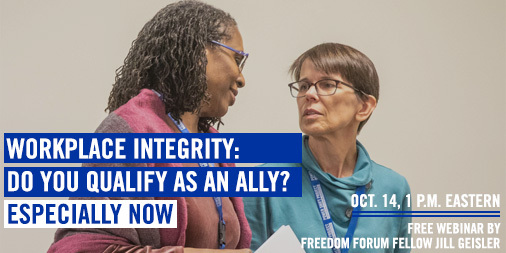
Advice from Jill Geisler, Bill Plante Chair in Leadership & Media Integrity, Loyola University Chicago, Freedom Forum Fellow in Women’s Leadership

Click here to read Jill’s previous posts.
Disappointment is so, well, demanding. 

Whether it’s feeling let down in a one-time situation or by the ongoing reality of, say, not knowing when you’ll return to the newsroom as you knew it, the emotional roller-coaster of disappointment takes its toll on a person’s mental and physical health.  

Disappointment occurs when thoughts and expectations don’t align with reality. Here’s what experts recommend when coping with disappointing circumstances:

  • Allot a specific amount of time to feel disappointed, angry or sad. Naming the feelings, which may come in waves, will help you honor your emotions.
  • Avoid all-or-nothing thinking by reframing situations as objectively as you can.
  • Ask yourself whether the situation is one in which you can — or should — change your expectations.
  • Practice acceptance of situations completely out of your control.
  • Trust your ability to take action, even in small ways, and exert control. Redirecting your energy to actionable efforts can provide a sense of working toward an outcome more aligned with your expectations.

Read on for more self-care tips, or share how you are taking care of yourself right now.
This newsletter is written & edited by the National Press Club Journalism Institute staff: Beth Francesco, Holly Butcher Grant, and Julie Moos. Send us your questions and suggestions for topics to cover.

Get this from a friend? Subscribe, and view the archives.