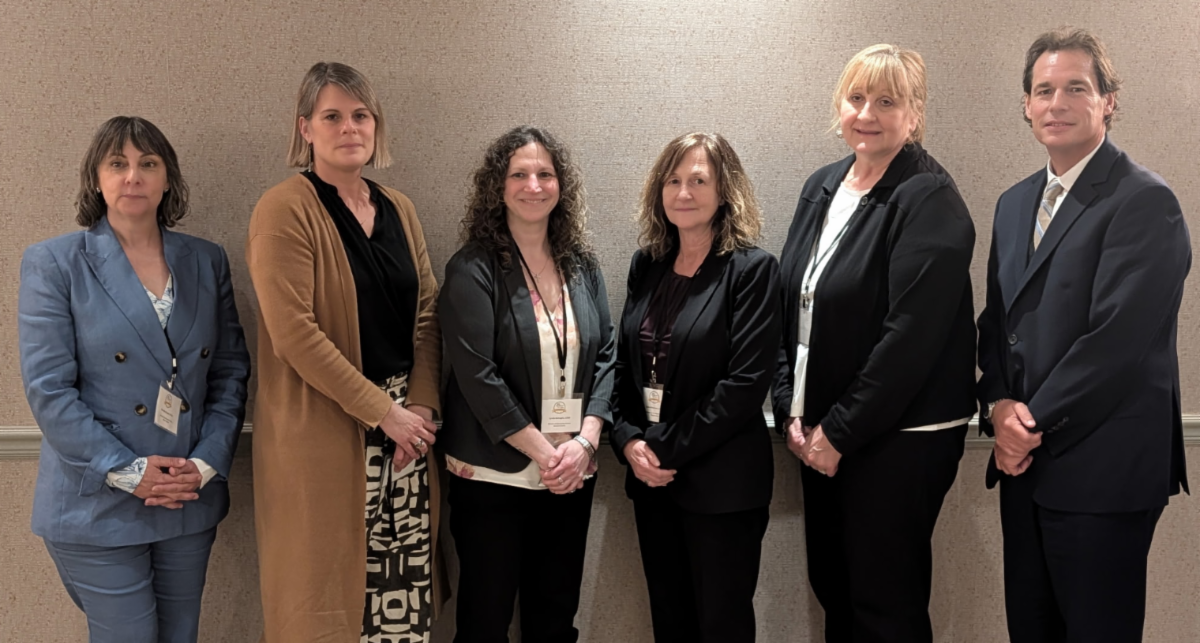
From L-R: Richelle Gregory, M.Ed.; Jean-Marie Niebuhr, LCSW-R; Lynda Battaglia, LCSW; Laura Kelemen, LCSW-R; Suzanne Lavigne, MHA, CASAC-M; Michael Orth, MSW | |
CLMHD Elects New Slate of Officers for the 2026–2028 Term
At the Spring Full Membership Meeting on May 12, members voted in a new slate of Officers for the 2026–2028 term. The newly elected Officers will begin their term on June 11th. This leadership reflects deep experience and continued commitment our members, the Directors of Community Services (DCSs), bring to leading local behavioral health systems across New York State.
Michael Orth, MSW, will serve as Chair. Michael has dedicated more than 37 years to public service in the human services sector, joining the Westchester County Department of Community Mental Health in 1993 and serving as Commissioner/DCS since 2018. He has served on the CLMHD Executive Board as both 2nd Vice-Chair and 1st Vice-Chair and has been appointed to several state-level bodies, including the NYS Behavioral Health Services Advisory Council, the Daniels Law Task Force, the Behavioral Health Crisis Technical Assistance Center Advisory Council, the NYS Opioid Settlement Board, and the NYS Behavioral Health Integration Planning Council. He steps into the Chair role as outgoing Chair Laura Kelemen, LCSW-R, DCS for Niagara County, concludes her term. Laura's leadership over the past four years has been invaluable, and we are deeply grateful for her service.
Suzanne Lavigne, MHA, CASAC-M, DCS for Franklin County, will serve as First Vice-Chair, and Lynda Battaglia, LCSW, DCS for Genesee County, will serve as Second Vice-Chair. Richelle Gregory, M.Ed., DCS for Clinton County, continues in her role as Treasurer. Joining the officer team as Secretary is Jean-Marie Niebuhr, LCSW-R, Commissioner/DCS for the Dutchess County Department of Mental Health.
We congratulate all of our incoming Officers and look forward to the work ahead.
| |
Trivia Nights, Valentine’s Cards: Overlooked Social Connections Can Prevent Suicide
Nearly every Tuesday for a decade, Steve Siple attended a bar trivia night with friends in Birmingham, Alabama. After moving to North Carolina, he developed a new ritual — joining other Charlotte locals on Saturdays to pick up trash along the city’s light rail. These are more than fun outings to Siple. They help keep him alive. Siple has battled suicidal thoughts in the past. He lost his father to suicide, and one of his sons has struggled with thoughts of hurting himself. That’s made Siple vigilant about protecting himself and his family. In addition to seeing a counselor regularly and speaking openly about mental health, he prioritizes social connection. “Loneliness was, over my lifetime, one of the greatest risk factors” for suicide, said Siple, a former board chair for the American Foundation for Suicide Prevention. To some, this concept may seem obvious. Yet in the overall approach to suicide prevention, it’s often overlooked. Treatment of a serious mental illness that can lead to suicide, such as major depressive disorder, often centers on medication and talk therapy with little or no consideration of factors such as social isolation or financial duress. Now, there’s a growing movement to address loneliness not just through personal choices but also through public policy. Read more here.
| |
Associations Between Maternal Opioid Use Disorder Treatment and Pregnancy Outcomes
Opioid use disorder (OUD) during pregnancy can pose serious risks for both mother and child. This study of Medicaid records from 29,193 women found that pregnant women who received OUD treatment, including medication, talk-based therapies, or both, had significantly better pregnancy outcomes than those who received no treatment. This study underscores that receiving treatment for OUD is significantly associated with better pregnancy outcomes. Read more here.
| |
What to Know About Recent Federal Actions Involving State Medicaid Program Integrity
The Trump Administration continues its focus on rooting out fraud, waste, and abuse in federal programs, including Medicaid. In March 2026, President Trump issued an Executive Order establishing the Task Force to Eliminate Fraud, chaired by Vice President J.D. Vance. In May 2026, the Centers for Medicare and Medicaid Services (CMS) announced a six-month nationwide moratoria (or pause) on the enrollment of new Medicare hospice and home health agency providers. The Department of Health and Human Services (HHS) has also taken nationwide and state-specific action in the Medicaid program, including:
CMS state-specific financial action and inquiries:
- In early 2026, CMS used multiple procedures simultaneously to address potential fraud in Minnesota, including deferring (or pausing) $350 million in federal Medicaid funding for past expenditures.
- In May 2026, CMS issued what it reports is the largest deferral in its history, deferring $1.3 billion in federal Medicaid funding for past expenditures in California.
- CMS has also sent letters seeking information about Medicaid program integrity, provider oversight, and fraud prevention to California, Florida, Maine, and New York. Read more here.
Related: Navigating Medicaid Suspension For Incarcerated Adults
| |
DEA Finalizes OUD Treatment Rule: What It Means for Behavioral Healthcare
The Drug Enforcement Administration issued a final rule that codifies sweeping changes to how practitioners can prescribe and administer medication-assisted treatment for opioid use disorder, effective July 9. Here are seven things to know:
- The DEA formally removed the DATA-waiver program from its regulations. As a result, any practitioner with a standard DEA registration and Schedule III authority may now prescribe buprenorphine for OUD — no separate waiver required.
- Under the old framework, DATA-waived practitioners faced limits on how many OUD patients they could treat. With those limits now, eliminated, there is no federal cap on patient volume.
- Any practitioner seeking a new or renewed DEA registration to dispense Schedule II–V controlled substances must meet one of the several conditions. Read more here.
| |
Hoarding Disorder Is More Common Than You Think. Here’s How to Help
In 2024, shortly before her father died, Madison Lovelle entered his home for the first time in 17 years. They’d shared a loving, supportive relationship for the entirety of her 40 years, but like many children of hoarders, myself included, she preferred to spend time with him elsewhere. The mountain of things inside his home just made it too unsafe, unsanitary and uncomfortable for a visit. Now, though, her dad was ill: Following a stroke, she was there to take care of him. His hoarding disorder made care difficult. “He was upstairs, and he could not get downstairs,” she told USA Today, but had begged her not to call EMS because he didn’t want strangers in his home. “And honestly, I don’t know that they would have been able to get through there,” she said. “You can’t make sense out of it, but there was this connection to the stuff,” Lovelle said. “He genuinely was worried about that stuff going in the trash. And it really did cause him a lot of anxiety.” Hoarding disorder is more common than most people realize, and is estimated to affect between 2% and 6% of the population according to the International OCD Foundation. Stigma keeps many families silent and struggling alone. Read more here.
| |
Study: Access to Health Care for Rural Residents with Disabilities Severely Lacking in All Researched Areas
While accessing health care is hard for rural residents, it’s even harder if they have disabilities, new research finds. According to a study by the University of Minnesota Rural Health Research Center, individuals in rural counties have less access to primary care providers, dental care providers, and mental health care providers than either other rural residents or urban residents. “As disability prevalence in a (rural) county goes up, so does the likelihood of the county being in a healthcare workforce shortage area,” Carrie Henning-Smith, lead researcher on the study and co-director of the Rural Health Research Center, said. That adds another harder twist to healthcare in rural areas, she said, because rural residents are already more likely to have a disability than their urban counterparts. According to the U.S. Census Bureau, in 2021, a little more than one in seven rural residents (14.7%) reported having a disability, while just 12.6% of urban residents did. Read more here.
Related: Impact and Opportunities for CCBHCs in Rural Communities
| |
Addiction Stigma in America: How Public Knowledge Shapes Attitudes Toward Recovery
The Addiction Policy Forum and Gallup released Addiction Stigma in America: How Public Knowledge Shapes Attitudes Toward Recovery, featuring findings from a nationally representative study examining Americans’ addiction literacy and how it influences stigma, attitudes toward individuals in recovery, and support for public health policies. The study included a nationally representative sample of 5,097 U.S. adults surveyed through Gallup’s probability-based panel between May 9 and 15, 2025. The web-based survey measured:
- Addiction Knowledge: Beliefs about addiction as a health condition, risk factors, and effective treatment approaches.
- Self-Efficacy: Confidence in recognizing signs and symptoms of addiction, helping someone struggling with addiction, and locating accurate information and resources.
- Stigma Across Three Domains:
- Stereotypes: Inaccurate beliefs about people in recovery.
- Prejudice: Negative emotional reactions or attitudes toward people in recovery.
- Discrimination Intent: Unfair or unjust treatment toward people in recovery.
Overall, the findings demonstrate that higher addiction knowledge is strongly associated with lower levels of stigma and greater support for evidence-based public health policies. Read more here.
| | |
UPCOMING EVENTS & TRAININGS
Addressing Cannabis Use Disorder in Primary Care Settings—A Lifespan Approach Advisory: Dissemination Webinar
June 11, 1:30 - 2:30 pm, SAMHSA
Balancing Public Meeting and Records Transparency Amid Rising Threats and Public Pressure
June 11, 2 - 3 pm, NACo
Weathering Uncertainty: Climate Change, Chronic Stress, and Mental Health
June 11, 3 - 4 pm, MindSite News
Mandated Reporting for First Responders & Law Enforcement
June 12, 10 - 11 am, NYS Justice Center
High-Impact Court Decisions for High-Risk Youth
June 15, 12:30 - 1:45 pm, CSG Justice Center
Essential Clinical and Peer Supervision Practices in Substance Use Disorder Services
June 17, 12 - 1:30 pm, NAADAC
Community Connect Webinar
June 17, 1 - 2 pm, USDA
The Critical Window: A New Behavioral Health Framework to Address Needs After Jail Booking
June 17, 2 - 3 pm, CSG Justice Center
H.R.1 Webinar series: SNAP benefits and H.R.1 changes
June 17, 4 - 5 pm, CSH
Reframing Opioid Use Disorder and Co-Occurring & Co-Morbid Disorders Through a Systems Lens
June 23, 1 - 2 pm, National Council for Mental Wellbeing
Identifying Service Members, Veterans and Their Families
June 24, 12 - 1:30 pm, Suicide Prevention Coalition Academy
Treating Internet Addiction: AI, Pornography, Social Media, Online Gambling, & Gaming
June 24, 12 - 1:30 pm, NAADAC
Leveraging Homeless Courts and Care Courts to Support Individuals’ Homelessness, Mental Illness, and Substance Use Disorders Needs
June 24, 3:30 - 5 pm, SAMHSA's GAINS Center
Workforce Strategies for Tobacco Treatment: The Role of Community Health Workers and Peer Support Specialists
June 25, 12 - 1 pm, National Council for Mental Wellbeing
From Curious to Capable: AI's Impact on Organizational Culture and Practice in Behavioral Health
June 30, 1 - 2 pm, National Council for Mental Wellbeing
Evaluations that Matter: Turning Program Evaluation Findings into Insight and Action
June 30, 1 - 2 pm, SAMHSA
Integrating Medications for Alcohol Use Disorder Into the Certified Community Behavioral Health Clinic Model: Lessons Learned
June 30, 1 - 2 pm, PCCS
New Community Engagement Requirements Rule: What You Need to Know
July 1, 1 - 2 pm, National Council for Mental Wellbeing
Provider Investigation Basics - 3-Day Virtual Training
July 7, 9, 9:30 am - 12:30 pm, NYS Justice Center
Change Management Is a Leadership Skill: Are You Pushing Staff Through Change or Pulling Them?
July 9, 1 - 2 pm, National Council for Mental Wellbeing
Driving Impact Through Data: Key Performance Metrics in CoCM
July 15, 1 - 2 pm, CoE-IHS
Leveraging Program Outcomes to Drive Policy Change
July 15, 1 - 2 pm, Social Current
Operationalizing Interdisciplinary Practice to Treat Opioid and Stimulant Use Disorder In Behavioral Health & Primary Care
July 16, 1 - 2 pm, National Council for Mental Wellbeing
Understanding the Importance of Care Coordination for Individuals with Serious Emotional Disturbance or Serious Mental Illness who are Homeless
July 22, 2:30 - 3:30 pm, NASMHPD
Malicious False Reporting (New training!)
July 23, 11 am - 12 pm, NYS Justice Center
Building a Healthy Workplace Culture: Psychological Safety, Accountability, and Support
July 23, 1 - 1:45 pm, Social Current
5th Annual School Mental Health Summer Academy
August 11 - 12, 9 am - 12:30 pm, SMHRTC
Anticipating Policy Change
August 13, 1 - 2 pm, Social Current
SAVE THE DATE - The 2026 New York State Suicide Prevention Conference
September 29 - 30, Ithaca, NY
| |
CLMHD CALENDAR
June
Mental Health Committee Meeting
June 11: 3 - 4 pm
Children & Families Committee Meeting
June 16: 12 - 1:30 pm
Membership Call
June 17: 9 - 10:30 am
Developmental Disabilities Committee Meeting
June 18: 1 - 2 pm
CLMHD Offices Closed - Juneteenth
June 19
JULY
Executive Committee Meeting
July 1: 8 - 9 am
CLMHD Office Closed - Independence Day
July 4
Addiction Services & Recovery Committee Meeting
July 9: 11 am - 12 pm
Mental Health Committee Meeting
July 9: 3 - 4 pm
LGU Clinic Operators Call
July 14: 10 - 11 am
Membership Call
July 15: 9 - 10:30 am
Children & Families Committee Meeting
July 21: 12 - 1:30 pm
| |