Quick, Timely Reads
On the Waterfront
|
|
Crooning:
Music We Were Supposed to Like
|
|
Dr. David Frew, a prolific writer, author, and speaker grew up on Erie's lower west side as a proud "Bay Rat," joining neighborhood kids playing and marauding along the west bayfront. He has written for years about his beloved Presque Isle and his adventures on the Great Lakes. In this series, the JES Scholar-in-Residence takes note of life in and around the water.
|
|
‘Catch a falling star and put it in your pocket,
Never let it fade away
Catch a falling star and put it in your pocket,
Save it for a rainy day
For love may come and tap you on the shoulder,
Some rainy day,
And just in case you really wanna’ hold her,
You’ll have a pocket full of star-lite.’
–– Popularized by Perry Como, 1958
|
|
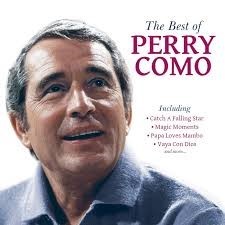
The 1950s “seemed” like simpler times. And discounting the Joseph McCarthy anti-communist Senate hearings, the cold war, and constant threats of nuclear disaster, they may have been – or at least it appeared so in the popular media. But there was an impending revolution. Elvis Presley, the Beatles, and folk music were just beginning to emerge; hiding in the wings and about to explode onto the cultural scene. For our parents, catchy ditties like Perry Como’s “Catch a Falling Star” were the best of American music. The relaxed, easy crooner on television, Perry Como, was speaking to a bygone era. He was a popular star who stood in front of a traditional “big band” and in pre-war Tommy Dorsey, Benny Goodman, and Guy Lombardo style, he sang Americana in a soft style that had been dubbed “crooning.” |
|
The lyrics were nonsense, but they rhymed. Put a star in your pocket? Como didn’t swivel his hips, feature a lead electric guitar, wear his hair in a “crazy” way or use lyrics that spoke of protest. He was non-threatening. Popular music of the time was accelerated by a Saturday night television show called “Your Hit Parade.” Each week the hit parade singers, sponsored by Lucky Strike, “covered” the most popular sons of the previous week. The hit parade singers consisted of a regular cast of two men and two women, one of whom, Julius La Rosa, used a crooning style. The show counted down to the No. 1 song of the previous week, and often featured guest stars who sang their popular own tunes: Doris Day, Frank Sinatra, Patti Page, and more.
“Your Hit Parade” had moved from radio to television in 1950 and lasted for an amazing nine years before it was eventually done in by the evils of rock n’ roll. In the show’s subsequent obituary, it was noted that audience reactions to Snooky Lanson, one of the regular singers who had attempted to sing a rendition of the week’s No. 1 song, “You Ain’t Nothin’ but a Hound Dog,” by Elvis Presley was the final blow. Snooky’s attempt was trashed by the audience as well as critics. The growing popularity of rock n’ roll, as well as folk music had destroyed the show and its ratings.
|
|
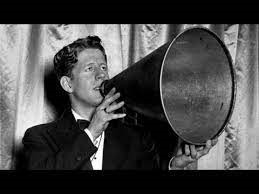
Rudy Vallee singing through his megaphone |
|
Perry Como was one of the last of a long succession of crooners, which probably began with Rudy Vallee. Valle’s career began in the 1920s in New England after he enrolled at Yale and formed a musical group to help pay his tuition. The group was popular throughout the Boston to New York area and played at live venues during the early 1920s while he was going to college. Originally, Vallee’s group, called the Connecticut Yankees, was an instrumental band with Vallee playing saxophone and his bandmates playing piano and violins. Eventually, the band was pressured to add a vocalist and Vallee, himself, took on the singing duties. Vallee’s voice was characterized as a “weak and stringy tenor,” so to add enough volume to reach the back of the room in pre-microphone days, he began using the kind of megaphones that cheerleaders had employed at Yale. He experimented with various sizes and shapes, eventually settling on the ones that gave him the best tones. Vallee’s soft but charismatic singing caught on, especially with young women and he quickly became a heartthrob.
Vallee’s touring fame soon led to a recording contract and, by the late 1920s, he had a radio program as well as a series of bestselling records. His reputation as a heartthrob led to enormous sales and, by 1930, he was the most successful recording artist in the United States. The crooning style that he became famous for evolved from his unique use of recording microphones (new at the time). He turned them to a very high volume and sang right into them in much the same way that he had used the megaphone. He was using the microphone to take the best advantage of his weak tenor voice. The vocal weakness that had made him reluctant to sing turned into a style that young women swooned over decades before female audiences were to go absolutely crazy over modern artists like Elvis Presley and the Beatles. Rudy Vallee was “knocking them dead” both with his records as well as his immensely popular radio program. And then, quite suddenly, the Great Depression ended it all. Record sales came to a halt, radio advertisers disappeared and the once-prosperous Rudy Vallee and his record company, RCA Victor, were left without revenue.
Depression era circumstance led to an interesting Erie story. In an attempt to salvage some of the revenue that had been lost to the economy, RCA Victor decided to send Rudy Vallee and his band out on tour. Of all their artists, Vallee was the best at live performances, and record company executives decided to risk their investment on the hope that audiences, especially young girls, would find a way to afford a reasonably priced concert ticket, even if they were not buying records. And they were right. Wherever Rudy Vallee performed, it was to a packed house. The Depression tour was mostly in the Eastern United States, where the bulk of the record market had been, but eventually he and his band played at Waldameer’s Rainbow Gardens. He was booked there on a Friday evening and scheduled to play in Buffalo the following week.
|
|
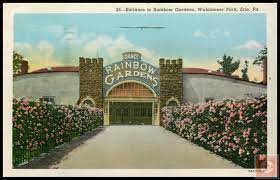
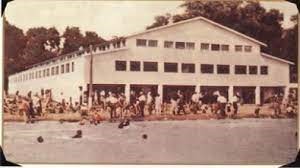
Waldameer’s Rainbow Gardens was a popular local music venue starting in the 1920s and 1930s. |
|
In Port Dover, just across the lake from Erie, Ben Ivey, who owned the Summer Garden, learned about Vallee’s Erie booking and contacted the tour manager to ask if he would be interested in playing there after the Erie gig. Vallee’s manager was reluctant to add the additional date, even though he was interested in the additional revenue. The hesitation involved concerns over how to transport Vallee and his band from Erie to Port Dover and then to Buffalo. Vallee always traveled by train so that he could bring his white Steinway, baby grand piano with him and there were no reliable passenger railroad connections between Erie and Port Dover. |
|
Waldameer’s Rainbow Gardens was a popular local music venue starting in the 1920s and 1930s. |
|
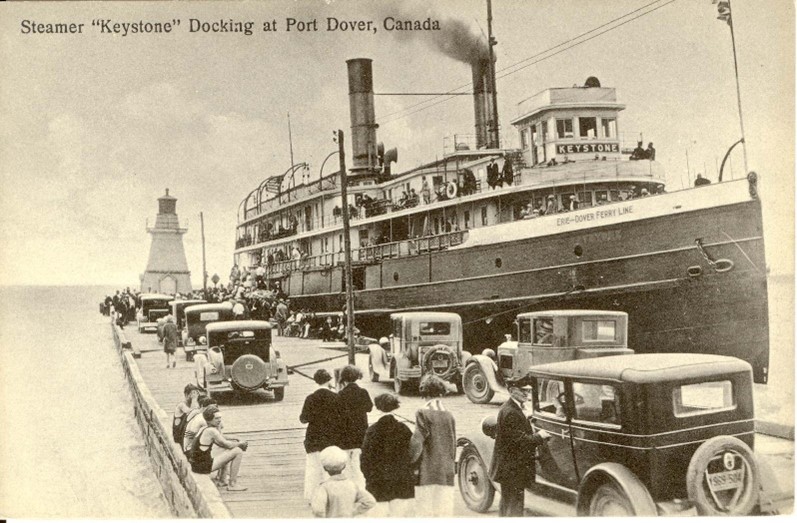
Ben Ivey solved that problem by booking passage for Vallee on the Nicholson Ferry that ran daily from Erie’s Public Dock (Dobbins Landing) and arranging to have the piano moved from Rainbow Gardens to the Public Dock. After the concert at the Summer Garden, Vallee and his piano were loaded aboard another ferry that regularly ran from Port Dover to Buffalo. |
|
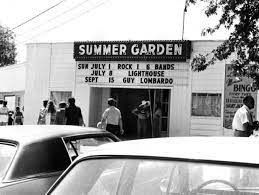
Port Dover’s Summer Garden featured an astonishing array of famous musical acts, including Louie Armstrong, Count Basie, and Guy Lombardo. |
|
The Summer Garden was on the beach at Port Dover. |
|
Eventually the rock n’ roll disease that brought down one of America’s most popular television shows (Your Hit Parade) and began to rot the minds of Bay Rats effectively destroyed Port Dover’s famous Summer Garden, as well. When the 1950s blended into the 1960s, regular acts at the Summer Garden shifted from big bands and other famous North American musicians to rock n’ roll bands. Sadly, these bands did not attract the kind of Ontario audiences that had traveled great distances and were willing to pay premium ticket prices. Instead, the Summer Garden began featuring relatively unknown rock groups. It was the beginning of the end for the iconic music hall, which went out of business in 1988.
One of these local groups, which eventually became known as “The Band,” began playing at the Summer Garden as a backup group for Ronnie Hawkins and eventually found itself doing gigs in Toronto. After learning their craft at the Summer Garden as a backup group, The Band struck out on its own and eventually attracted the attention of Bob Dylan (Dylan’s manager was from Toronto). When Dylan took The Band touring and began to shift from traditional and pure-acoustic folk to an electric sound, his folkie fans declared that rock n’ roll had finally gone too far!
|
|
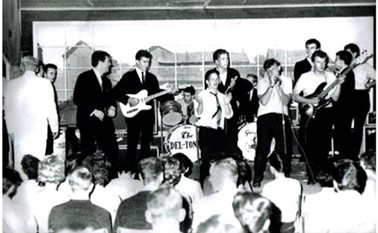
The stage at the Summer Garden in about 1966 includes Ben Ivey (back turned and wearing his signature white suit), Ronnie Hawkins and Robbie Robertson (center left), and Levon Helm (partially obscured and playing the drums on the right). Rick Danko is on bass in the front row. |
|
Somehow, crooning ultimately survived rock n’ roll. Frank Sinatra carried on, specializing in live Los Vegas shows, and Bing Crosby, earlier the king of the crooners, made a comeback. Tony Bennett continued to tour, delighting mature audiences at about the same time that younger people were filling rock concerts. Dean Martin and Eddie Fisher made continuous appearances and a new artist, Andy Williams, emerged to carry mellow singing traditions into modern television, through the end of the 1960s and into the 1970s. Moon River. |
|
Accidental Paradise Available at TRECF!
Accidental Paradise
by Dr. David Frew and Jerry Skrypzak
|
|
The beautiful book on Presque Isle published by authors David Frew and Jerry Skrypzak – “Accidental Paradise: 13,000-Year History of Presque Isle” – is on sale at the Tom Ridge Environmental Center’s gift shop and through a special website, AccidentalParadise.com.
The book, priced at $35 plus tax and shipping, can be ordered now through the website sponsored by the TREC Foundation, AccidentalParadise.com.
Presque Isle Gallery and Gifts on the main floor of TREC, located at 301 Peninsula Drive, Suite #2, Erie, PA 16505 will also handle sales daily from 10 a.m. to 4 p.m.
For more information, send an email to aperino@TRECF.org.
To watch "Accidental Paradise: Stories Behind The Stories" click here.
|
|
ABOUT THE AUTHOR
Historian and author David Frew, Ph.D., is a Scholar-in-Residence at the JES. An emeritus professor at Gannon University, he held a variety of administrative positions during a 33-year career. He is also emeritus director of the Erie County Historical Society/Hagen History Center and is president of his own management consulting business. Frew has written or co-written 35 books and more than 100 articles, cases, and papers.
|
|
|
|
|
|
|