Newburyport’s maritime trades formed much of the fabric of the community from the late 1700s for about a century.
The active waterfront was dotted with shipyards and wharves to receive goods from abroad. Hundreds of vessels were launched, sending local men (and some women) to the far flung shores of Asia, Europe and the West Indies.
Marine societies were being formed along the northeast seaboard. Boston was the first, founded in 1742, followed by the Salem Marine Society in 1766, and the Newburyport Marine Society in 1772. The East India Marine Society, also in Salem, followed the others in 1799. Each was created for ship masters to promote knowledge of navigation and professionalize their trade as well as to provide support for widows and children of deceased captains.
The Newburyport Marine Society had rooms on State Street where they held their meetings and created a cabinet of curiosities to display objects acquired from the "four quarters of the globe, and products of the seven seas" according to the Newburyport Daily News.
During its heyday the Society had over 200 members. In 1906 Captain William H. Bayley wrote a comprehensive history of this remarkable organization including tales of the high seas and cameo biographies of many of its members.
In 1919, Captain Bayley died leaving four members of the Society, only two of whom still lived in Newburyport. The collections, amassed by so many ship masters, were presented to the Historical Society of Old Newbury.
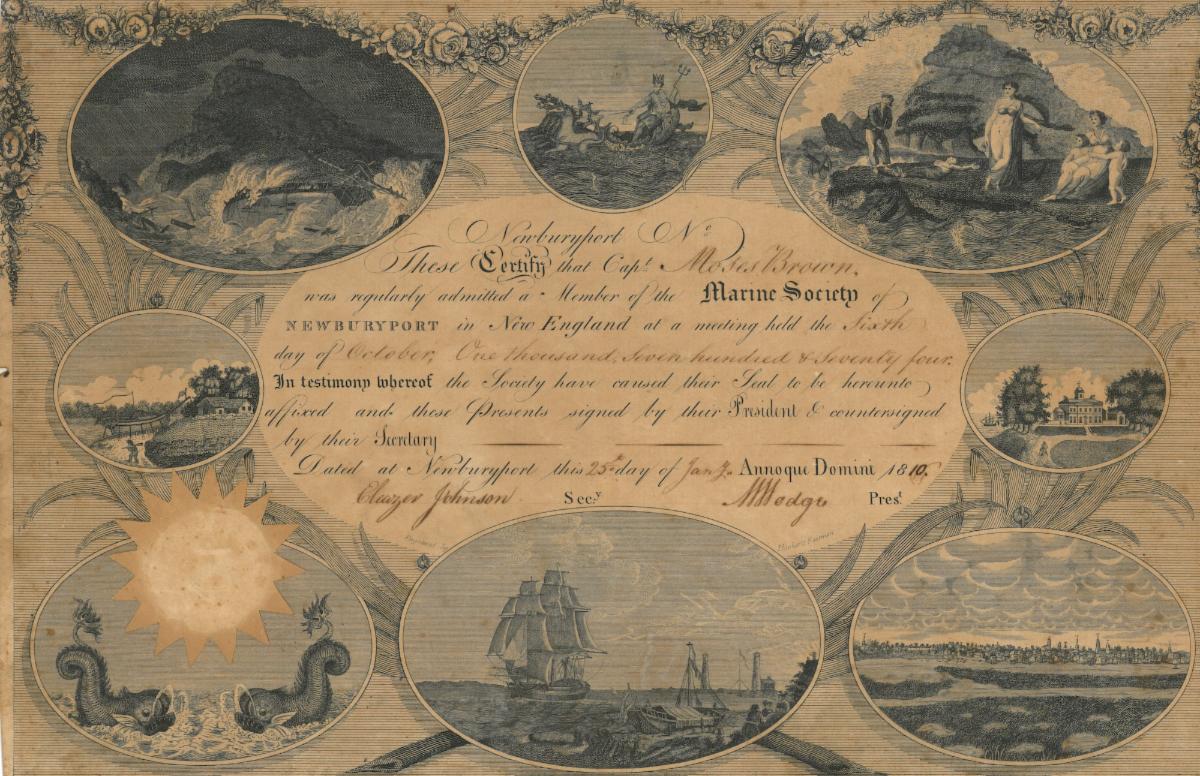
The Marine Society began negotiations with engraver David Fairman and printer William Hooker of Hooker & Fairman in January 1808 to procure a plate emblematical of the society. The delivery of the plate and 100 prints for a cost of about $150 did not occur until 1810.
Although members were enrolled from the time of its establishment, the Marine Society did not issue official certificates to its members until that time. A small number of these certificates exist either in museums or are held by descendants of the ship masters' families. The museum is fortunate to have several in its collections.
The central text is surrounded by eight vignettes including from top left, a shipwreck; Neptune in a shell drawn by two seahorses; figures shipwrecked on a rocky Greek island; a view of a stately building; the town of Newburyport seen from the water; a ship in the harbor including the twin lighthouses, signal tower and keeper's house on Plum Island; two stylized spouting whales; and a small ship docked near a cottage.
The certificate illustrated here was presented posthumously to the family of Captain Moses Brown.
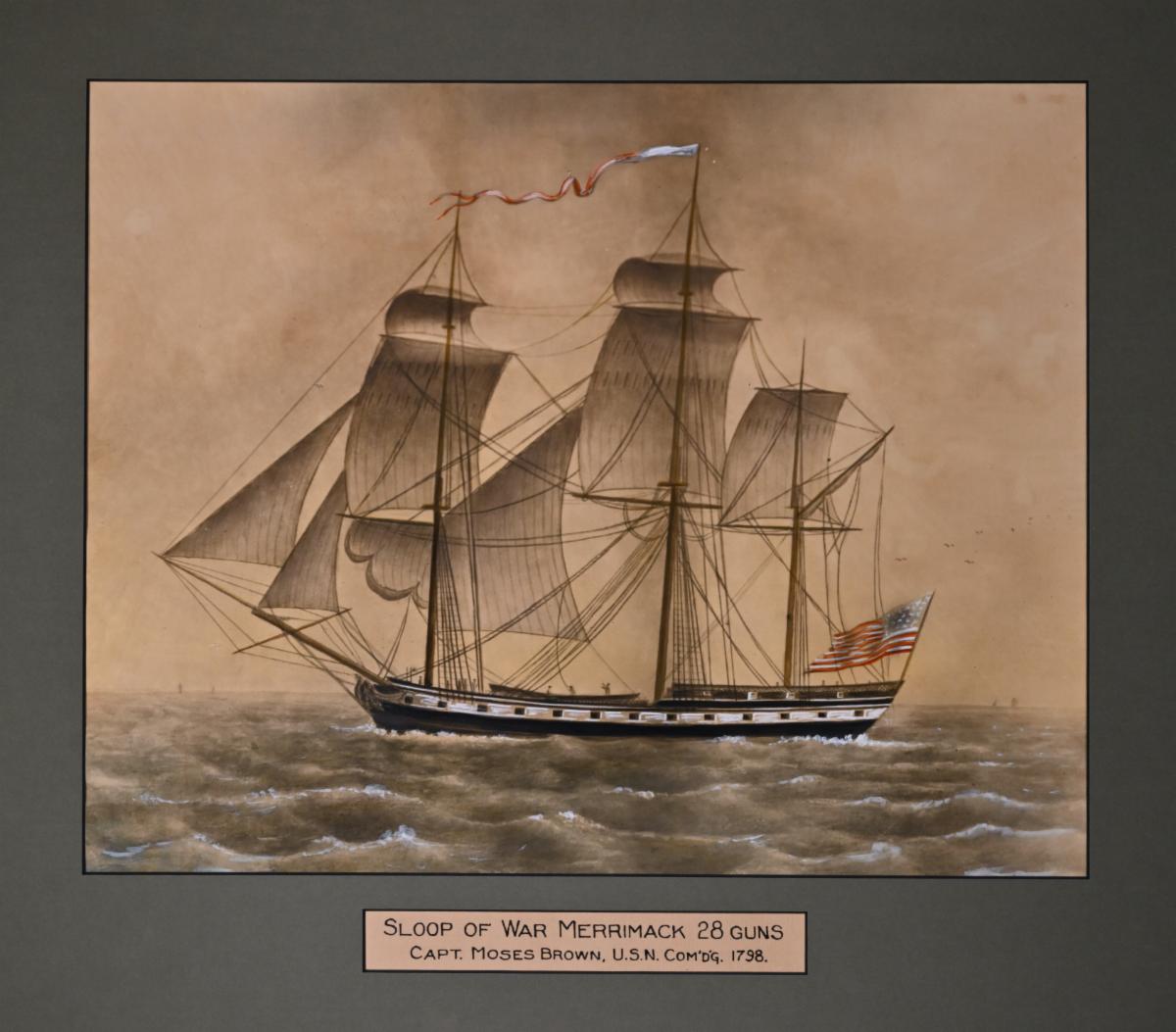
The captain was born on Ring's Island in January 1742. At the age of 15, he was apprenticed to Captain William Coffin and served under him until 1763, thus beginning a distinguished career. Brown traveled to Nova Scotia, England and the West Indies commanding several ships and was held as a prisoner of war more than once. He was master of the Diligent, the Intrepid, and the Merrimack. Brown married Sarah Coffin in 1764.
Homebound from Guadeloupe in January 1804, Brown was seized with apoplexy and died within sight of Rhode Island. He was buried at sea, days short of his sixty-second birthday.