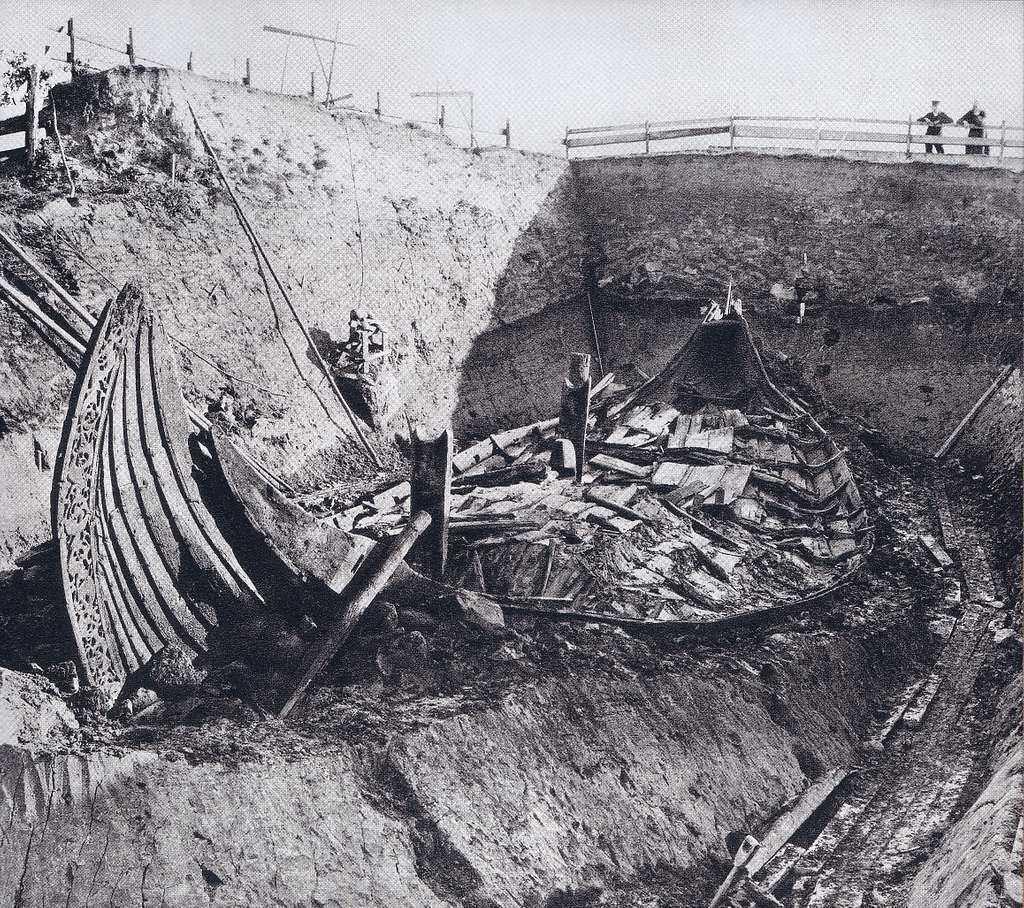
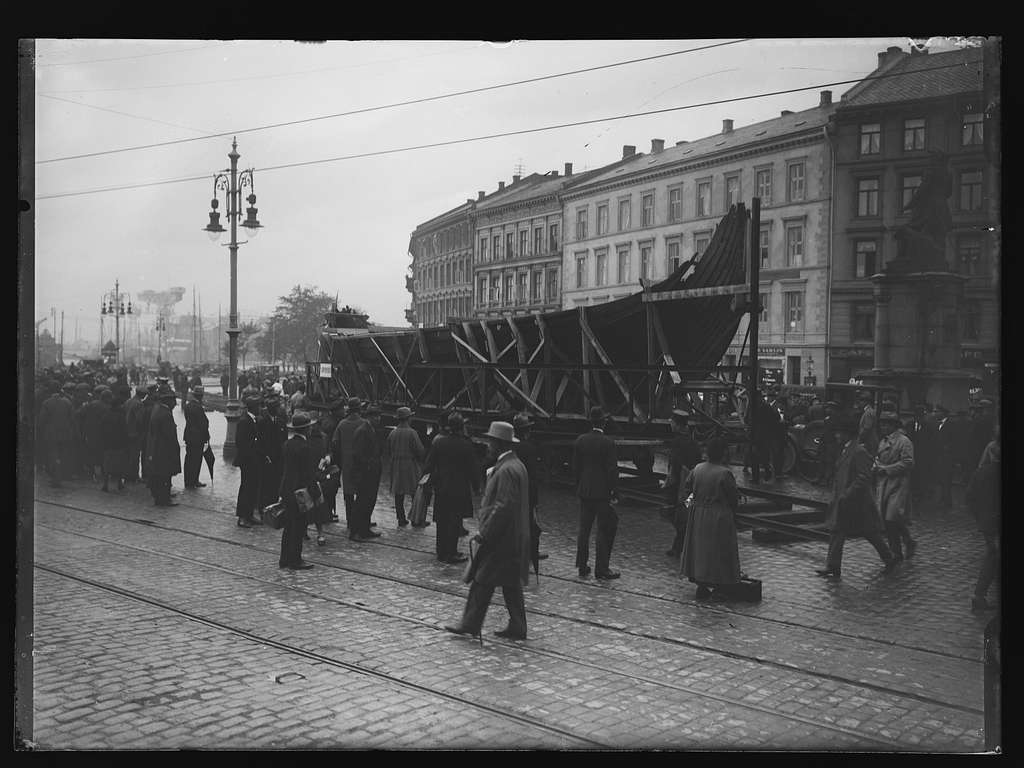
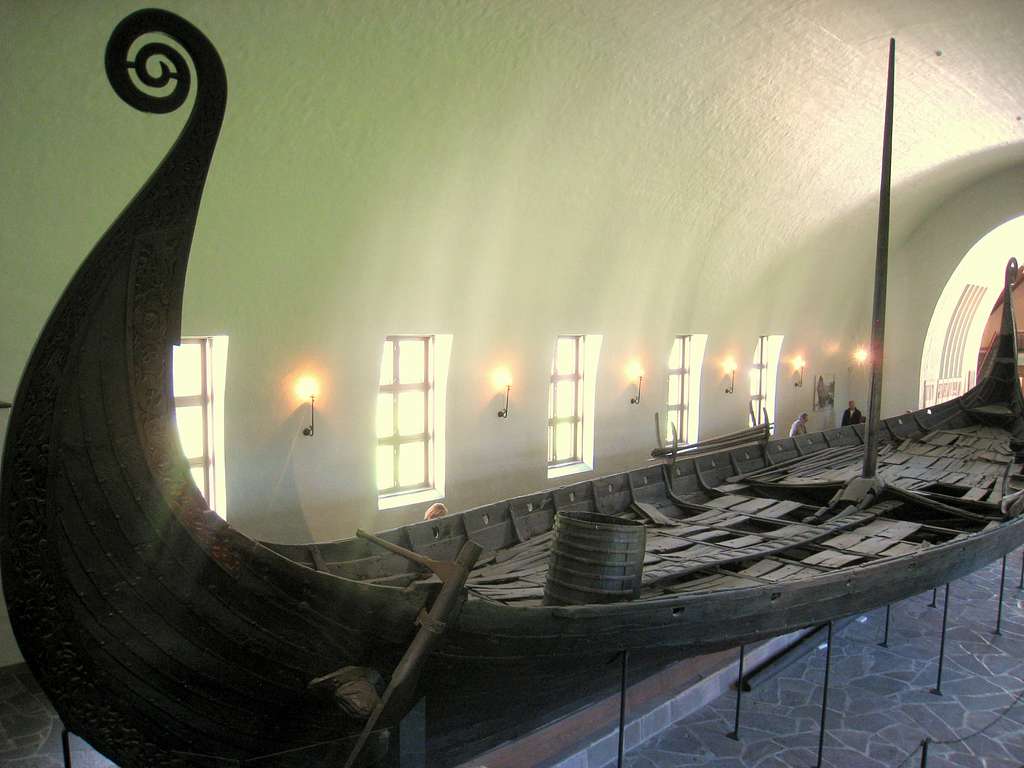
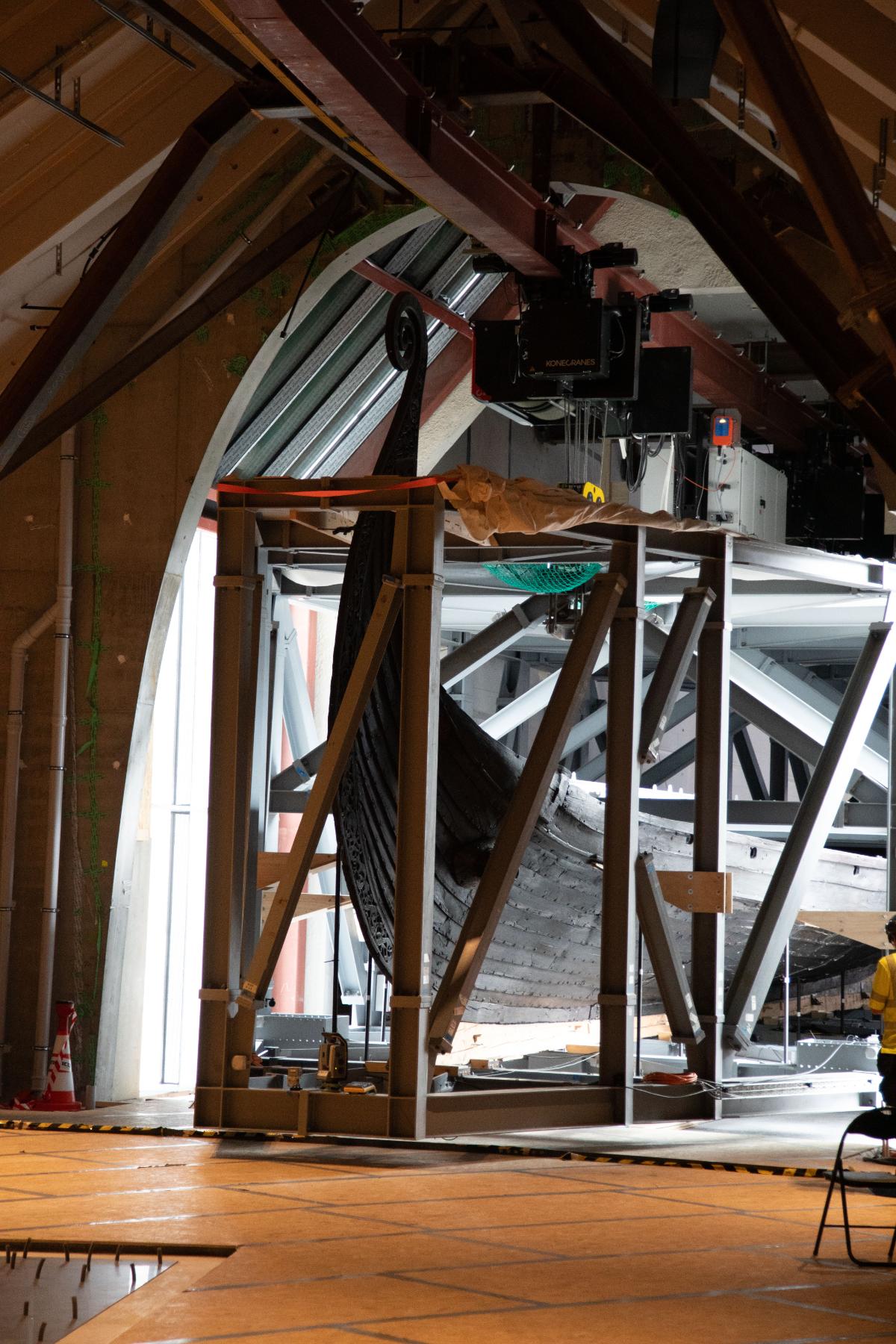
| The ten-hour journey is captured here in a time-lapse video. | The craft in question was the Oseberg ship, a Viking longship built around the year 820. This priceless example of Viking shipbuilding tradition had been on display in the Viking Ship Museum in Oslo, Norway, along with two other vessels. The facility had been shuttered in 2021 because the humidity, dust, and vibrations generated by half a million visitors annually was threatening the ships’ fragile timbers; the journey on 10 September was to relocate it to its new permanent home in a wing of the museum engineered to better protect them. The other two ships will be moved into the wing over the course of the next few months, after the relocation coordination team has had the chance to take a deep breath, relax, and possibly enjoy a few days free from the anxiety of handling an 1,100-year-old fragile artifact. | The pressure of layers of turf and rocks surrounding the burial mound had broken the ship into about 2,000 fragments. The discovery of a buried Viking ship attracted to much local attention that a fence had to be erected to help keep curious bystanders at a distance. Photo: PD | The ship was discovered in 1903 on the Oseberg farm in Tønsberg, Norway. Alerted to the discovery of a wooden artifact on the property, the University of Oslo’s Professor Gabiel Gustafson determined that the site was the remains of a Viking burial mound. Gustafson’s excavation of the site began the following summer and the project lasted well into the fall of 1904. The grave mound, 44 meters (144 feet) in diameter, had been six meters (20 feet) high when constructed, but it had settled to a height of about two and a half meters (8 feet) high at the time of the excavation. The contents of the mound were fairly well protected by the surrounding clay soil and tightly-packed layers of turf on top, but soil subsidence and the layer of stones piled around the ship had broken it into thousands of fragments over time. Additionally, grave robbers had broken into the mound, possibly during the Middle Ages, causing further damage to the site as well as the relocation of some of the contents from where they had been buried originally. In addition to the ship and burial chamber, the team recovered the skeletons of two women, the skeletons of at least ten horses, a cart, three sleighs, a sled, three beds, and two tents, as well as ship tools, like a gangway and oars, and textiles and personal belongings. | 1926: The Oseberg ship, assembled at the University of Oslo, was carefully guided over the streets powered by the King's Guard and then floated over to its new home in the Viking Ship Museum on Bygdøy. Photo: PD | Material from the site was transported to Oslo, where Gustafson and fellow archaeologists preserved each piece using substances such as alum salts and linseed oil. Many of the ship fragments, flattened over the centuries, were steam-treated to reshape them in order to reassemble the ship. Remarkably, about 90% of the re-created vessel is composed of these original fragments. A museum was constructed in Bygdøy, a peninsula that would become part of Oslo in 1948; the Oseberg ship was installed in the Viking Ship Museum in 1926, and was later joined by two more ships, identified by the locations of their discovery as the Gokstad ship and the Tune ship. The museum was designed to accommodate about 40,000 visitors per year, but interest in the vessels and the accompanying objects from the burial mounds far exceeded expectations. It also became clear that the artifacts needed more protection from moisture and vibration, so a new wing of the museum was built to house them. The Gokstad and Tune vessels and other material from the mound will follow, and the museum is expected to open to the public in 2027 under a new name, the Museum of the Viking Age. | | Until just a few weeks ago, the Oseberg ship had been displayed in the Viking Ship Museum as seen here, although the space has been closed to the public since autumn 2021 to protect the artifacts. Photo: PD | In order to examine the seaworthiness of the ship, a replica was built in the 1980s; she sank almost immediately on her 1987 maiden voyage. Ragnar Thorseth, who was aboard the replica, referred to both as Oseberg and as Dronningen, told an interviewer: “Oh my gosh. You wouldn't believe it. There she was full sail, full crew—we had a film crew from the BBC on board. What an introduction to Viking ships. She sailed right down to the bottom in 120 feet of water.” Ship reconstructors went back to reexamine the original ship, and concluded that mistakes had been made in shaping the fragments and piecing together the ship—perhaps erroneous assumptions, perhaps forcing pieces to fit together in a way that they hadn’t fit together originally—and faithfully reproducing the structure now in the museum might not have reflected precisely the hull shape of the vessel in 820. Ballasting and the amount of sail were also considered as factors. A scale model of the ship was tank-tested to determine how to improve its seaworthiness. The replica was raised and modified; her sides were made higher by two strakes, and she was fitted with a smaller sail for stability. Oseberg/Dronningen was then sailed successfully until she was lost in a squall in 1992. | | Navigating the ship through the passage to its new home was a painstaking process with no room for errors. When power tools were used, workers used vibration sensors and halted work when vibrations reached levels that might damage the artifacts. Photos courtesy Museum of the Viking Age, University of Oslo. | | |
A new replica was begun in 2010 and launched in June of 2012, with Norway’s King Harald and Queen Sonja in attendance, as well as 20,000 well-wishers. This new vessel, Saga Oseberg, continues to sail today as an ambassador of the Viking ship tradition, taking on guest crew for one-hour sails. Both this active replica, and the original, pieced back together from 2,000 fragments, connect us to the maritime tradition that, in so many ways, was not that different 1,200 years ago from our maritime experience today. We salute the years of planning and the painstaking precision that the Viking Ship Museum’s team and partners have been putting into preserving these treasures for us and for generations to come.
Extra Credit
Every Genius Detail That Made Viking Longships Remarkable
The replica ship Saga Oseberg website
Sea History Today is written by Shelley Reid, NMHS senior staff writer. Past issues can be read online by clicking here.
| | | | |