|
President's Message
The Conclusion of Joshua’s Ministry (Joshua 22–24)
"Israel served the Lord throughout the lifetime of Joshua and of the elders who survived him and who had experienced everything the Lord had done for Israel."
(Joshua 24:31)
By burying Joseph’s bones in the Promised Land, a significant chapter in Israel’s history reaches its intended goal. This act marks the fulfillment of God’s promise to give the land to the ancestors of Israel, signaling the completion of the Exodus.
Joshua began his life as “Moses’ servant” and now enters the ranks of Israel’s leaders as “God’s servant.” Unlike Moses, Joshua is buried in the Promised Land, a testament to the fulfillment of God’s promises. Verse 31 hints that after Joshua and the surviving elders who witnessed God’s great deeds pass away, Israel may face vulnerable times.
Conflict for Unity (Chapter 22)
With the conquest of Canaan complete, Joshua summons the tribes of Reuben, Gad, and the half-tribe of Manasseh to commend their faithfulness in keeping their promise. As these tribes prepare to return to their lands east of the Jordan, Joshua emphasizes the importance of upholding Israel’s core commandments.
A conflict arises when these eastern tribes build an altar at Gilgalot, located between the territories of Judah and Benjamin, instead of at the officially designated site of Shiloh. Israel was meant to have only one central altar, and building it elsewhere was perceived as a threat to the unity of the nation. Throughout Israel’s history, God consistently works to bind the tribes together, ensuring that His chosen people remain a unified community despite potential divisions.
Final Exhortation (Chapter 23)
Now advanced in age, Joshua gathers the leaders of Israel to deliver his farewell address, which takes the form of a final testament. Although addressed to all of Israel, it is primarily the leaders who listen. Joshua firmly reminds them that God’s law must remain the ultimate standard for the life of the people.
He warns against serving foreign gods, reinforcing that Israel must resist the temptations posed by unconquered nations. Joshua also emphasizes the importance of avoiding intermarriage with surrounding peoples, particularly the Canaanites. Israel’s destiny depends entirely on its exclusive covenant relationship with God.
The Shechem Assembly (Joshua 24)
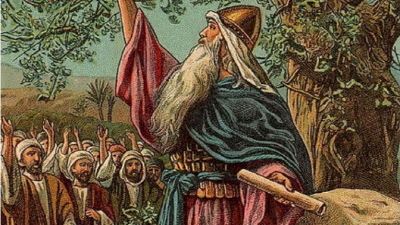
Joshua once again gathers representatives of the twelve tribes. Unlike his farewell address in chapter 23, chapter 24 depicts a dialogue between Joshua and the people. Rather than simply a farewell ceremony, this chapter gives the impression of finalizing the distribution of the land. Because this covenant ceremony serves as the conclusion of the Book of Joshua, it appears at the very end.
Joshua makes it clear how dangerous it is to serve God insincerely. The people understand what he is addressing. Even if they later turn away from God, resulting in God’s withdrawal from them, they cannot blame God; they must acknowledge their own wrongdoing as witnesses. Joshua also keeps in mind that the Israelites have, up to this point, carried images or amulets of foreign gods. Through this solemn ceremony, Israel is called to abandon these idols and symbols.
Reflection
As representatives of the people, Joshua makes a covenant with God and sets up a large stone as its sign. This stone will serve to remind future generations of the obligations they have inherited. The ceremony presumes that the people will regularly gather at this site, likely for covenant renewal. The Book of the Law not only records statutes and ordinances but also details the process of covenant-making. It emphasizes that this assembly takes place at the sanctuary in Shechem.
Ultimately, the conquest narratives in Joshua underscore that Israel is called to become God’s people, living in the Promised Land while serving only the one true God. Today, we too are called to honor the intentions and legacy of our spiritual predecessors through faithful practice. In reality, people often forget even the requests or last wills of their parents. Bearing this in mind, it is truly beautiful to study Scripture carefully and put into practice the noble intentions of our ancestors.
|