|
USCC Diversity, Equity, Inclusion
and Access (DEIA) Survey
Please Participate!
|
|
|
During March 2024, the US Composting Council (USCC) published its first Diversity, Equity, Inclusion, and Access (DEIA) survey to gain a greater understanding of how the compost industry can determine and address the access gap in the composting industry. This survey is set to run until April 15th, 2024.
This study aims to collect demographic data which will provide insight into how USCC can foster growth in diversity, equity, inclusion and access within the compost industry. This data will also be measured in comparison to aggregate data for all study participants. At the end of the study, each participant will get a unique report which will only be accessible to them that will provide useful data for their organization to increase access opportunities.
Please consider taking the survey and learning more about its benefits to the industry today.
|
|
|
Legislative Update
Washington: HB 2301, Food Waste and Composting
|
|
|
A second Organics Management bill, HB 2301, has passed in the Washington 2024 legislative session. WORC actively supported passage of this bill to recover more organic waste, prevent food waste, and support compost markets. It was signed by the Governor on March 28.
House Bill 2301 will:
-
Provide funding via grants for various organics programs, including food waste prevention, and the implementation of HB 1799 (2022 Organics Management Law) and requirements laid forth in this bill.
-
Require food and yard waste diversion and collection for organics management processing from single-family in urbanized areas and commercial customers by April 2030. Service must be offered by April 2027.
-
Study compostable produce stickers. Ecology must study the status of compostable produce stickers and provide a report to the legislature by September 2025.
-
Adjust compostable products labeling standards. The bill added a few laboratory-based certifications to what is currently accepted, and it allows for the use of small amounts of green and brown to be used on non-compostable plastic if it is part of a logo or less than 0.25” wide.
-
Expand the compost purchase subsidy. This WSDA reimbursement program established in the 2022 Organics Management Law (HB 1799) for farms purchasing compost, now includes reimbursement for compost from small, solid waste permit-exempt facilities (but prioritizes those processing food waste), allows WSDA to allocate different dollar amounts to farms depending on acreage, and increases the maximum subsidy value from $10K to $20K per farm per year.
-
Adjust compost procurement reporting for jurisdictions. The first reporting date is pushed back from December 31, 2024, to March 31, 2025 (to report on 2024 data). Procurement reporting will be required each March 31 thereafter.
-
Create a food donation workgroup. Ecology must convene a workgroup of stakeholders to study food donation from businesses and provide a report to the legislature by September 2025.
|
|
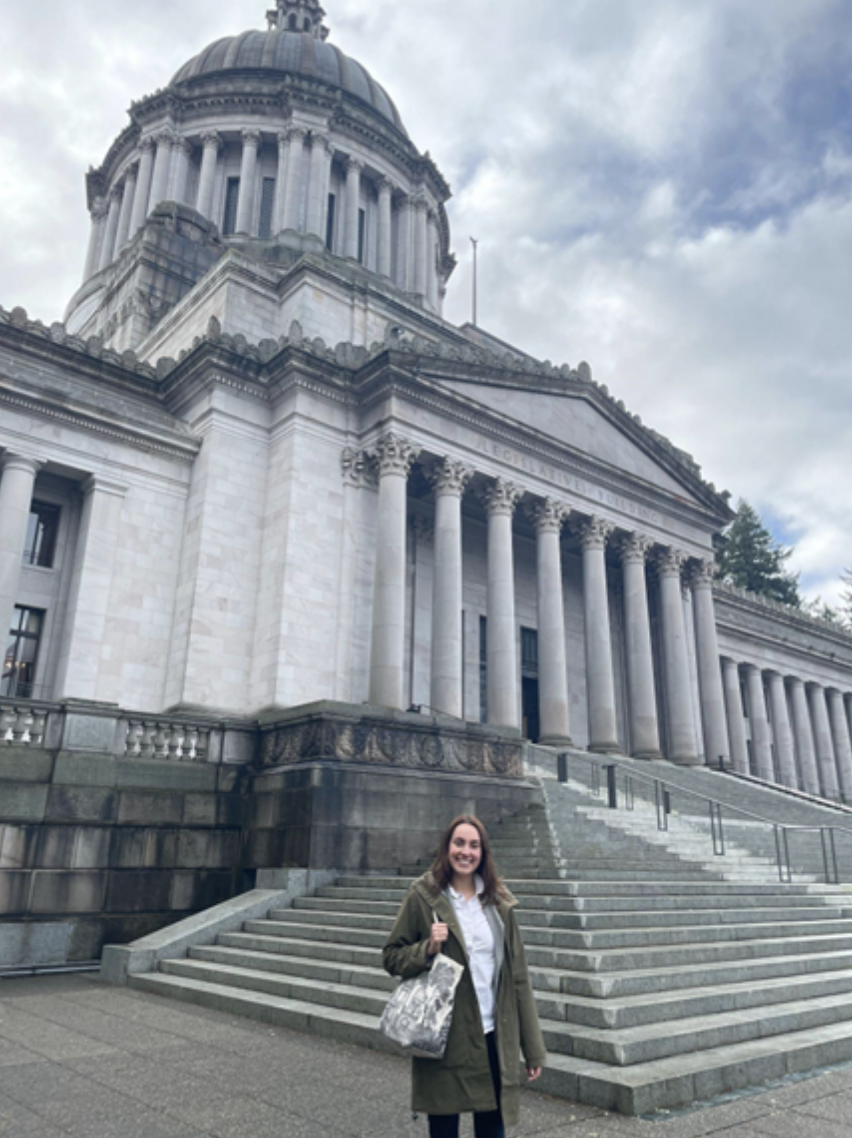
WORC Board Treasurer, Liv Johansson, provided testimony on behalf of WORC in support of HB 2301 in Olympia this year. |
|
|
On March 12, 2024, the US Senate passed the Recycling and Compost Accountability Act (S.1194).
This bill establishes data collection and reporting requirements concerning composting and recycling programs. It directs the Environmental Protection Agency (EPA) to collect data and study various aspects of recycling, composting and contamination. One report must specifically address the capability of the United States to implement a national composting strategy to reduce contamination rates.
The EPA must inventory residential recycling facilities, evaluate curbside and drop-off recycling and composting programs, develop best practices for government and Indian tribes which may be used to enhance recycling and composting.
The Government Accountability Office must report on the recycling practices of federal agencies.
|
|
|
Food Waste Prevention Week:
April 1st - 7th
|
|
|
April 1st through 7th is Food Waste Prevention Week! Organizations from all over the US are presenting in-person and virtual events to share food waste prevention information, strategies, and support. There will be social media events, art contests, story time, and a range of other educational and fun experiences.
It is estimated that approximately 31% - 133 billion pounds -- of the food produced in the US is wasted, a cost of about $161.6 billion in 2014. That is about 1,249 calories per day per capita. In the shadow of this massive waste, food insecurity remains problematic. People in the US are going hungry. There are a multitude of strategies to reduce waste at every level of production, sale, and use. Food Waste Prevention Week helps all players connect and share resources and ideas to address this problem.
Wasted food has impacts beyond the evaluated cost. The cost to produce food includes potential land depletion, heavy equipment emissions, potential fertilizer contaminants, methane emissions in landfills, water for processing, etc. The impacts are far reaching.
Washington’s Center for Sustainable Food Management has excellent resources for residents and food donation organizations. Washington can proudly claim that our state has the most registered partners on FoodWastePreventionWeek.com than any other state.
|
|
|
EPA Offers Support and Funding for Environmental Justice |
|
|
The Environmental Protection Agency and its partners are offering technical assistance and grants for communities with environmental justice concerns. Funding and support will focus on environmental projects in local communities and tribal nations.
To provide technical assistance, the EPA and other federal departments functioning under the Thriving Communities Network, will provide 16 Thriving Communities Technical Assistance Centers across the US. In the northwest, both Northwest Environmental Justice Center and the University of Washington Center for Environmental Health Equity serve all of EPA Region 10 (Alaska, Idaho, Oregon, and Washington). The centers will be in place for at least five years to support community and tribal goals through finding grants, giving advice, planning, documentation, feasibility and other services. The assistance may be a one-time brief consultation or up to 160 hours of technical assistance.
Additionally, the EPA will provide Community Change Grants and Technical Assistance for the application. Grants funding is open to partnerships between two community-based non-profit organizations (COBs), a COB and a Federally Recognized Tribe, a COB and a local government, or a COB and an institute of higher education. The project should reduce pollution, increase community climate resilience, and build community capacity to address environmental and climate justice challenges. Grants will provide $1 million to $20 million for a total of $2 billion under the Inflation Reduction Act.
|
|
|
Member Spotlight: Olympic Organics |
|
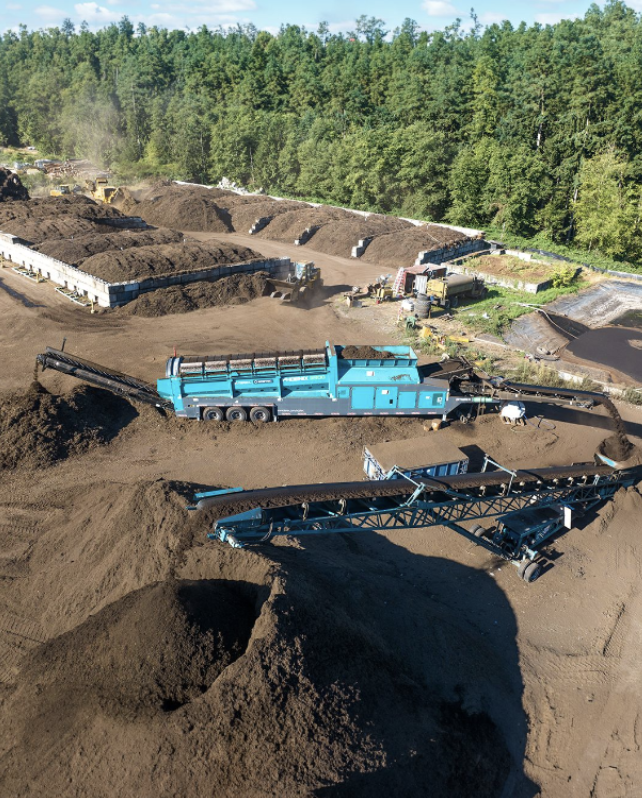
Since September 2022, Olympic Organics, operated by DTG, has been a cornerstone of sustainable agriculture and community enrichment in Kitsap County. With deep roots in the region, Olympic Organics has been serving the local community for years, operating from its two strategic locations in Kingston and Bremerton, WA.
At the heart of Olympic Organics' mission is a commitment to providing high-quality organic materials and soil back to the community. Annually processing between 30 to 40 thousand tons of material, the company employs a meticulous 4-stage composting process with a pre-sort system to provide clean feedstock inputs, 12 ASP bunker bays, ensuring optimal conditions and temperatures are maintained throughout. Using a 33-foot trommel screen equipped with a ½ inch screen, Olympic Organics uses air handlers to separate light contaminates from tailings and finished product with precision, delivering clean and nutrient-rich compost.
Community engagement is a fundamental pillar of Olympic Organics' mission. Actively involved in local initiatives, the company donates soil to food bank gardens, supports local farmers with compost supplies, and collaborates with organizations like the Master Gardener Foundation of Kitsap County. All compost produced meets the rigorous specifications set by the Washington State Department of Transportation (WSDOT) for fine and medium compost.
Olympic Organics offers a range of services tailored to meet the diverse needs of its customers. From material pick-up at their facilities to home deliveries and blower truck services, the company ensures convenient access to its premium organic products. Moreover, residents can contribute to the sustainable cycle by dropping off materials such as yard waste, mixed soil, and sod at both the Bremerton and Kingston locations, furthering Olympic Organics' commitment to environmental stewardship and community collaboration.
|
|
|
Washington Organic Recycling Council
5727 Baker Way NW, Suite #200 | Gig Harbor, WA 98332
1-877-460-5880
|
|
|
|
|
|
|
|