March 10, 2025

Amundi Letter


We have received multiple inquiries from clients receiving a letter from Amundi.


This is a legit letter from Amundi. The Pioneer bond fund (you own) through Schwab is being acquired by Victory. The fund does not change, and the same managers are staying in their role. Since you are an owner of the fund they need enough shareholders to approve the transaction. We use this fund (Pioneer Bond) as a portion of the conservative part of your portfolio.


You may have received an email or a previous shareholder material for a voting proxy. This is their way of trying to contact the shareholders to have them vote. If they do not get enough shareholders to approve, then they must incur an additional mailing.


You are not required to vote but if you have time you may want to contact them. The board is encouraging shareholders to approve the recommendation.


Please let us know if you have any questions.

The Markets

What do weather and investing have in common?  


From 1991 to 2020, the average temperature of the United States was 54.7° Fahrenheit. Of course, that doesn’t mean the temperature in every state on every day was 54.7°F. The weather varied dramatically from place to place and month to month.


The same is true of investment averages. At the end of February, the average annual total return* for the Standard & Poor’s (S&P) 500 Index over the past 10 years was 12.98 percent. That doesn’t mean the S&P 500 returned 12.98 percent every year – it didn’t. The index’s total return varied dramatically from year to year. 

The stock market doesn’t provide level returns. In some years returns are positive, and in other years returns are negative. After two years, of stellar returns from U.S. stocks, the market has been experiencing a pull back.


Last week, U.S. financial markets were volatile. “A roller-coaster week for markets ended on that same note, with stocks whipsawing as traders tried to make sense of a myriad of headlines around the economy, tariffs and geopolitical developments. Just minutes after a slide that drove the S&P 500 down over 1 [percent], the gauge staged an ‘oversold bounce’ as Federal Reserve Chair Jerome Powell said the economy is fine. The Nasdaq 100 briefly breached the threshold of a correction. Bonds fell,” reported Rita Nazareth of Bloomberg.


In contrast, some European stock markets moved higher last week. “President Donald Trump’s drive to shake up the world order is creating some surprising winners. As the U.S. stock market reels from tariff fears, German stocks are surging because the government has committed to almost $1 trillion in new spending on infrastructure and defense…The sea change in policy is creating a giddy optimism in German markets not seen in decades,” reported Brian Swint of Barron’s.


The divergence in performance brings home the value of a diversified portfolio.


When markets are volatile, remain confident and resist the impulse to react to short-term performance. The assets in your portfolio were carefully chosen to help you reach your financial goals. Unless your goals and risk tolerance have changed, your asset allocation shouldn’t. The weight of evidence accumulated over previous decades supports the idea that staying the course – holding a well-allocated and diversified portfolio and rebalancing periodically – is a sound way to pursue long-term financial goals.


Last week, major U.S. stock indices finished the week lower despite a rebound on Friday. U.S. Treasury yields were mixed last week with yields for shorter maturities dropping while yields on longer maturities rose.


*Total return includes reinvested dividends.

american-flag-building.jpg

The Spotlight Was On The Real Federal Reserve Of Atlanta


You may have seen a headline or two about GDPNow last week. It’s the Atlanta Federal Reserve (Fed)’s unofficial economic growth forecasting model – and it’s been delivering twists and turns worthy of a reality TV show.


GDP, or gross domestic product, is the value of all goods and services produced in the United States. “The percentage that GDP grew (or shrank) from one period to another is an important way for Americans to gauge how their economy is doing. The United States' GDP is also watched around the world as an economic barometer,” reported the Bureau of Economic Analysis.


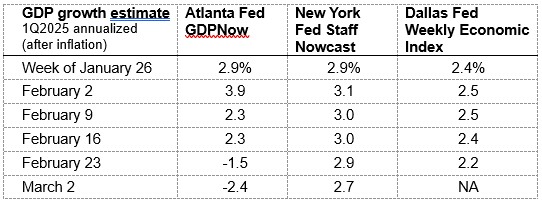
At the end of January, the Atlanta Fed’s GDPNow model estimated the United States economy would expand by 2.9 percent in the first quarter of 2025. Since then, the estimate has moved sharply lower. Last week, GDPNow projected the U.S. economy will shrink in the first quarter, contracting by 2.4 percent.


It’s a remarkable swing that captured a lot of media attention.


How should investors weight this bit of unofficial data? Probably not too heavily because GDPNow can be volatile. “These estimates are published regularly as new economic data is released…There were 11 [releases] in February alone. Friday's [February 28’s] shock reading of -1.5% was led by a record-high $153 billion trade deficit in January, most likely as firms front-loaded imports ahead of tariffs, and Monday's decline was driven by soft manufacturing activity. There's every chance -2.8% turns into a positive reading in a few weeks,” reported Jamie McGeever of Reuters.

Other Federal Reserve Banks also have economic growth forecasts. These models also have been moving lower, but they haven’t shot into negative territory like GDPNow. The New York Nowcast dropped from an estimated 2.94 to an estimated 2.67 percent for the first quarter, and the Dallas Fed’s Weekly Economic Index moved from 2.4 percent to 2.2 percent.


The average absolute error of final GDPNow forecasts is 0.77 percentage points. The final forecast is expected in April.

thinking_girl_idea.jpg

Weekly Focus - Think About It


“Courage is willingness to take the risk once you know the odds. Optimistic overconfidence means you are taking the risk because you don't know the odds. It's a big difference.”

– Daniel Kahneman, Nobel Prize-winning psychologist

Bruce Kuehl | 763.542.8884 | bruce.kuehl@avior.com

Investment management and financial planning services offered through Avior Wealth Management, LLC a registered investment advisor. Investments involve varying degrees of risk and there can be no assurance that the future performance of any investment or investment strategy will be profitable or equal past performance results. All investments subject to loss including the loss of principle. Nothing contained herein should be construed as tax advice. Specific, individual tax questions should be asked of your CPA or accountant.


Please remember to contact Avior, In writing, if there are any changes in your personal/financial situation or investment objectives for the purpose of reviewing/evaluating/revising our previous recommendations and/or services, or if you want to impose, add, or modify any reasonable restrictions to our investment advisory services. Unless, and until, you notify us, in writing, to the contrary, we shall continue to provide services as we do currently. Please advise us if you have not been receiving account statements (at least quarterly) from the account custodian. A copy of our current written disclosure Brochure and Form CRS (Customer Relationship Summary) discussing our advisory services and fees continues to remain available upon request or at www.aviorwealthmn.com.