Two of the biggest questions my clients ask:
What should I charge for my product/service?
and the follow up
Am I winning my fair share of the deals?
Without a doubt, these questions relate to one of the core problems companies are challenged with. If you price your product too high, you risk losing deals or driving your prospects away. If you price too low, you’re leaving money on the table. Where is the sweet spot and how can you make sure you’re winning your fair share of the deals? Read on…
|
|
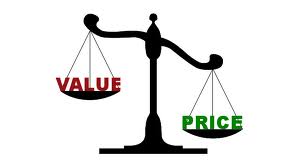
The heart of this problem is understanding the importance of Value relative to Price. If your prospective customer understands completely and agrees with the value your product brings, then price is no longer an issue. Conversely, if you have done a poor job explaining your value proposition then price becomes a big objection.
This diagram shows this ratio clearly. When the scale tips in favor of value, price is no longer a factor. When it tips the other way, price is paramount because value is lower.
Bottom line, if you want to get your price, you darn well better spend time proving to your customer the value of your product/service. The biggest reason salespeople fail is by not spending enough time listening to their customers and then rushing to the “close” when the customer is not convinced of the value.
|
|
Premature Pricing
The quickest way to lose a sale is to discuss price prematurely. It’s common that your prospect will be asked early in the sales process (maybe even in the first meeting) “By the way, what’s this going to cost me” or “Before we continue, I need some numbers to make sure it’s in the budget.” DO NOT EVER answer this question!! It is a trap, and a sure recipe for disaster, and shame on you if you step into it !
If it’s early in the sales process, you’re just getting to know each other. You’re just discovering their needs/wants, issues and problems. You probably haven’t yet determined if your product is a good match for their needs. You don’t even know if you can solve their problem, so any price you throw out will be WRONG and rejected immediately. Whether you tell them it costs a dollar or a million dollars, the answer will be wrong. They have no frame of reference, nothing to compare with, so at this point it’s just a wild guess and a waste of time.
The proper way to handle this request is to gently defer your answer until a more appropriate time. You can answer with something like this:
“We’ll be happy to discuss pricing options a little bit later, but first we need to find out more about your company and the issues you’re dealing with. By the way, given the sales organization we’ve been discussing, what do you think your top 3 challenges might be in the coming 2-3 years?”
|
Your initial discovery process should focus on finding out as much as possible about the company, the key individuals, and the critical problems or issues they are challenged with. The best way to do this is to use the following types of questions.
The 4 C's
Curious
-- Find out as much as possible about their business. Ask many open-ended questions and show you are interested.
Change
-- Find out what has changed in the past few months. Who transferred out, who got promoted, what are the new product lines. How has their business changed?
Concerns
-- What are the biggest issues they're dealing with? What are they worried about? What are they constantly having trouble with? What really needs to be fixed?
Consequences
-- What are the consequences if (Problem X) is not solved? What impact are they feeling from (Issue Y)? What happens if (Problem X) doesn't get solved? How have they tried to solve it in the past?
|
It’s important to spend time asking these questions and listening carefully to the answers. Of particular importance is category #4, consequences. When the customer really considers this question, they will begin to understand the IMPACT of the problem, and the pain it is causing them personally and to their company. As a result, they will tell you precisely and directly the VALUE they could achieve if the problem is solved, in their own terms. It’s important that you listen and prompt them until they articulate this value and also realize the consequences if they don’t take action to resolve it. |
|
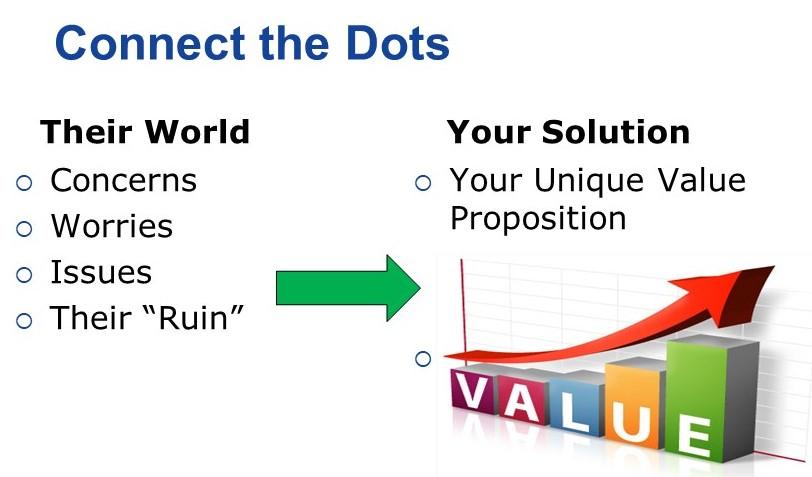
Match their Issues with your UVP
Now that the customer has discussed the impact of their problem (pain), and the consequences if they don’t handle it, you are ready to proceed. To do this, you will simply connect your Unique Value Proposition (UVP) with their problem, and it should be a good match.
|
Review what they’ve told you about their problem, and the impact that it’s having on their company. Then you can discuss in greater detail how your product/service is an ideal solution to their most urgent problem. Since your solution is truly “unique”, and it is a perfect match for their concerns, they should emphatically agree and in many cases will eagerly ask you to proceed.
Close the Deal
After the above steps have been taken, it’s now time to discuss price and complete the transaction. Your competitive research should have been completed, and you should know the price ranges in your industry for comparable products or services. Since your value is extremely high, and has been agreed upon by the customer, you will be able to price at the top of the market.
There are all sorts of sophisticated negotiating techniques that you could employ, but for this article let’s keep it simple. Take your top range price and then add an additional premium, which you will present as your total price. Usually, the customer (especially in the US) will simply agree to your quotation and proceed. If they don’t agree, you have built into your quotation some room to negotiate.
If any pricing objections occur, they can be surmounted by pointing out the value you deliver and confirming the size of their problem and the consequences of not handling it. As a useful analogy, consider the following: If someone is dying of thirst and you happen to have several bottles of water, do you think they would spend time negotiating the price of a bottle? Of course not!
Keep it simple and direct, and just close the deal.
Here’s to your success!
|
13 years ago, I researched and wrote about Selling Value in my first book, Precision Selling, Chapter 4 "Easy Sales." You can download it from Amazon Kindle by clicking HERE.
I’ve been speaking and training business executives on "How to Sell during these Challenging Times." To view a recent 20-minute Zoom presentation, available on my YouTube channel, click on this LINK.
|
Click on the video below to learn about the Connexia Group, and the value we deliver for our clients. |
Quick Links
My social media and video links are below. Please view, join, connect or follow where appropriate. Here's to your Success!
Maximum Sales Results
|
|
|
|
Connexia Group | (949) 858-0755 | www.ConnexiaGroup.com |
|
|
|
|
|
|