|
The objective
The days and weeks after a hospital stay can be a challenging time for patients. As a primary care-based, integrated health system, Kaiser Permanente Washington is well positioned to deliver evidence-based, post-discharge care to help reduce rehospitalization within 30 days of discharge. Kaiser Permanente Washington leaders partnered with the ACT Center to improve how patients are identified for post-discharge support, with the goal of reducing preventable rehospitalizations by helping care teams focus resources on members most likely to benefit from extra support.
The work
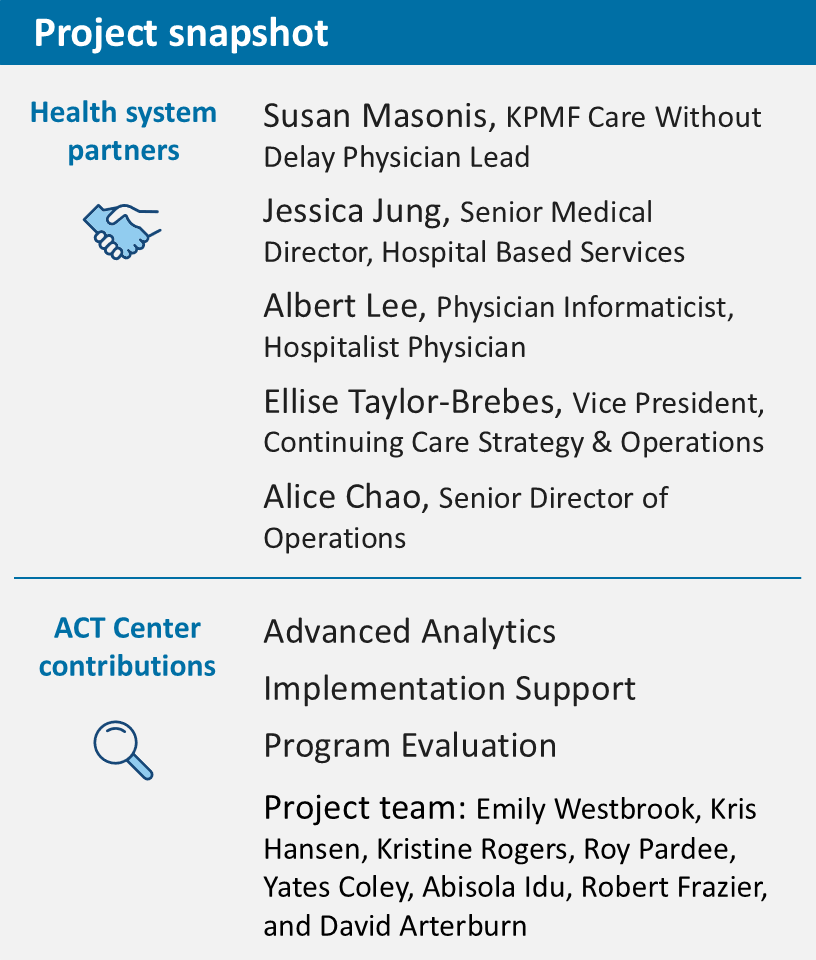
The ACT Center Advanced Analytics team is working closely with clinical and operational leaders at Kaiser Permanente Washington to develop and evaluate a new risk stratification model that identifies members at highest risk of rehospitalization. To customize risk stratification for the Kaiser Permanente Washington population, the new model leverages data from Virtual Hospital — a platform used in our rounded hospitals to collect real-time data on hospitalized members. Key milestones to date include building the risk model into the electronic medical record, developing a discharge registry that flags patients at high risk for rehospitalization, designing workflows to align the registry with “Care Without Delay Transitions Program” workflows, integrating risk information into care management processes, and developing tools to help care teams prioritize follow-up outreach and support after discharge.
What we’re learning
Early findings suggest the new approach more accurately identifies patients at higher risk for rehospitalization at Kaiser Permanente Washington — which allows care teams to focus their efforts on a smaller, more targeted group of patients who are most likely to benefit from extra support after a hospital stay. The project has reinforced the importance of combining analytics with close collaboration from care teams to support successful, sustainable implementation. This tailored approach to risk stratification is also informing work in other Kaiser Permanente regions that use contracted hospitals. Recently we were able to provide data on rehospitalization risk among patients discharged to home compared to patients who are discharged to facilities such as Skilled Nursing.
What we’re hoping to achieve
By providing care teams with more actionable information at discharge, the project aims to support smoother transitions from hospital to home, improve coordination of follow-up care, and help more patients recover successfully without needing to return to the hospital within 30 days. Ultimately, we hope the new risk model will contribute to improving key HEDIS measures and lowering costs related to hospitalizations.
|