|
Living Jesus:
Faith Over Frustration
by Fr. Michael S. Murray, OSFS
| |
During his three years of public ministry, Jesus changed countless lives for the better. As word of Jesus’ power spread throughout the region, greater numbers of people approached him seeking healing for themselves or others. The crowds continued to grow in size to the point where it was almost impossible for Jesus to have time for himself to rest and refit: he was pursued everywhere he went. Add to that the issues he often had with “the Twelve” and the increasing sniping he experienced at the hands of the religious leaders of the time, there can be no doubt that Jesus’ experience of being human brought with it its share of frustration, especially when — as occurred frequently enough during his ministry — people were demanding “signs” or proof of his identity and authority, which served as a trigger that set Jesus off.
As in the story recounted in John 4:43-54 relates:
“There was a royal official whose son was ill in Capernaum. When he heard that Jesus had arrived in Galilee from Judea, he went to him and asked him to come down and heal his son, who was near death. Jesus said to him, ‘Unless you people see signs and wonders, you will not believe.’ The royal official said to him, ‘Sir, come down before my child dies.’ Jesus said to him, ‘You may go; your son will live.’ The man believed what Jesus said to him and left.”
And despite his momentary frustration, Jesus didn’t take it out on the official and was true to his word.
| |  | |
It certainly sounds like Jesus was on his last nerve when yet another person approached him with a request for a healing. Despite Jesus’ initial reaction, the royal official was not going to take “no” for an answer. And to his credit, Jesus did not allow his frustration at the moment to result in withholding from the official the healing he so desperately sought for his son.
In other words, Jesus pushed through the experience of feeling frustrated and overwhelmed and remained true to his vocation: being a person for others, especially when taxing and exhausting to do so.
It’s safe to say that we can all relate to Jesus. We all have those moments in our lives when we feel spent, we’re on our last nerve, or we believe that we simply have nothing left to give to somebody else at a particular place and time. As we see in this example of Jesus’s own struggle to be faithful to who God wanted him to be, it’s precisely when we feel overwhelmed in the face of another’s need(s) that we are challenged to push through our frustration and find in our faith the stamina to be people for others.
Just like Jesus did.
| | |
May is for Mary
by Elizabeth Connell Wright
As winter releases its grip on nature and spring awakens creation to stretch for the sun, May has long been considered a time of renewal. Before Christ's birth, ancient civilizations celebrated the goddesses of spring and fertility in May, but for centuries now, the month of May has been dedicated to Mary. There are also two Marian feasts days this month: On May 13, we celebrate Our Lady of Fatima, commemorating the day of the first apparition of Mary at Fatima in 1917, and on May 31 we celebrate the Visitation.
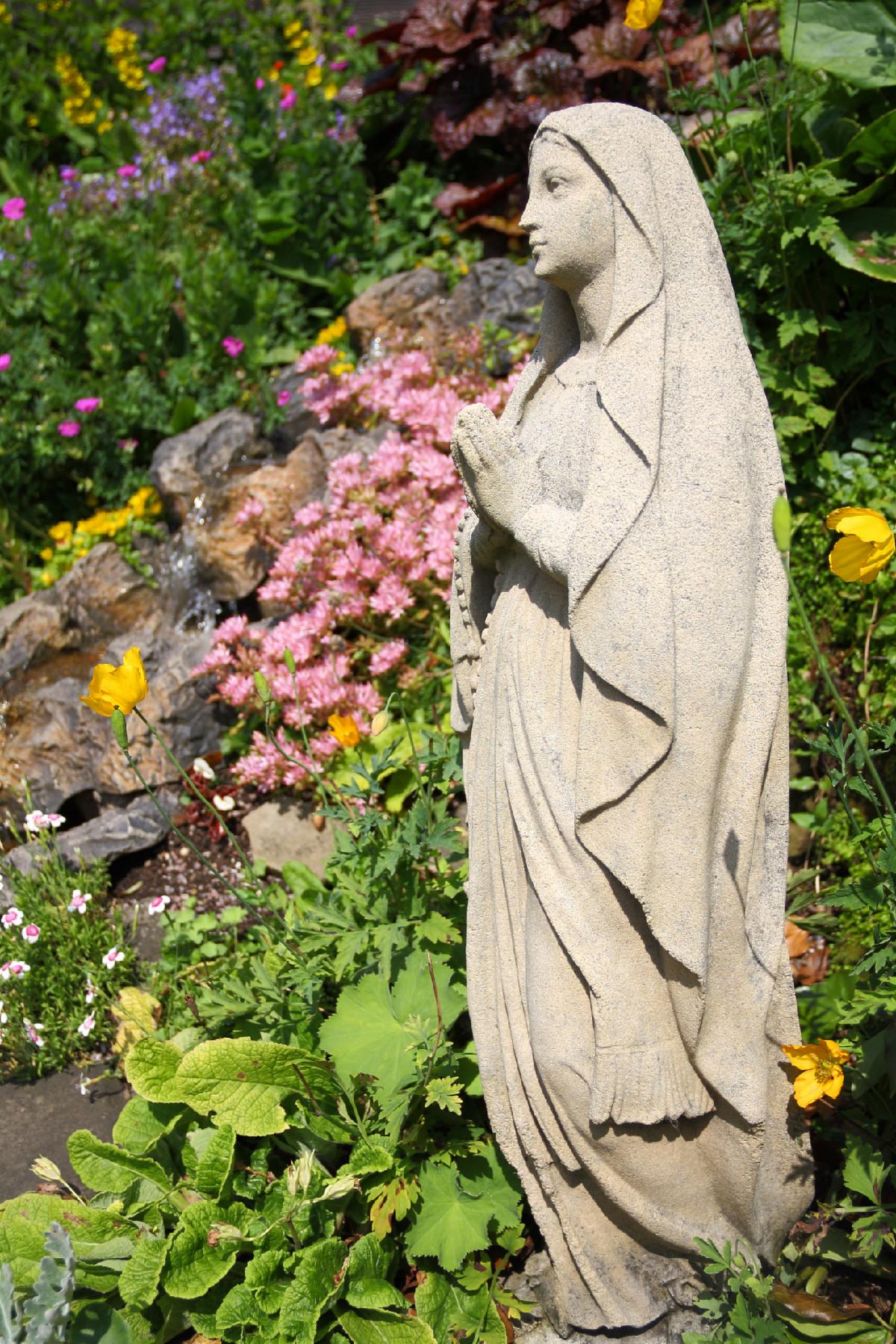
May is also celebrated with the crowning of Mary — often on the first of the month but can be anytime in May. Traditionally, children will place a crown of flowers on statutes of Mary as a symbol of their devotion to her. Not only do we honor Mary by presenting her with flowers, but through tradition we have come to understand Mary's virtues through flowers. “Mary is a garden of delights in which all kinds of flowers and spice plants remind us of the virtue,” said St. Jerome, and St. Francis de Sales referred to her as the “flower of our humanity.”
Following are just a few of the many flowers that bloom as symbols of Mary:
| |
The Rose: Considered a noble and beautiful flower, the rose has long been a prominent symbol of the Blessed Virgin Mary. The delicate beauty, in both color and scent, represents her grace, while the thorns embody her suffering and sorrow. Rosary comes from the Latin rosarium, which means “rose garden.” The 53 Hail Marys recited in the Rosary are like a spiritual bouquet honoring Mary.
The Lily: Born without sin, Mary was the pure vessel always intended to bring Christ into the world. Lilies embody her Immaculate Conception, and Mary is often pictured holding a lily. In churches, the Easter lily is used to signify the celebration of the Resurrection, and Mary’s role in the salvation story.
The Violet: Early each spring, delicate violets emerge from the ground announcing the awakening of creation. Like Mary, the violet is steadfast, even in harsh conditions. The bloom symbolizes the profound humility of the Blessed Mother. The heart-shaped leaves mirror her unwavering love and compassion, while the drooped flower embodies the sorrow of Mary.
| |
The Iris: Fleur-de-lis, the French symbol of the Holy Trinity, literally means “flower of the lily,” however, it is the iris (rather than the lily) that is commonly associated with the fleur-de-lis. Besides the Trinity, the three iris petals are also said to represent faith, hope, and charity. Accepting her role as Mother of Our Savior required God’s blessings of grace and obedience. The iris is a symbol of Mary’s devotion of fidelity and faithfulness in her “yes” to God.
The Carnation: Mary, Mother of Hope, blooms in the colorful carnation. Just as God so loved the world that he gave his only begotten son, Mary’s love for humanity prompted her to say “yes.” She accepted the role of motherhood, sacrificing so much to bring hope. Red is said to represent love of both Mary and Christ, especially sacrificial love. While pink represents life, humility, and maternal love.
The Columbine: Columba is Latin for dove. The petals have often been seen as five doves in a circle, symbolizing the Holy Spirit, who actively engaged God’s plan for Mary with the Immaculate Conception. Born without sin, she was worthy to be a vessel. The most common color is blue, which traditionally represents Mary — rooted in Exodus 24:10 when Moses met the God of Israel to establish the covenant, “and they beheld the God of Israel. Under his feet, there appeared to be sapphire tilework, clear as the sky itself.” Blue is also equated with fidelity, purity, and eternity. Legend said that white columbine emerged from the ground wherever Mary’s foot touched and for that reason, white columbine is commonly called “Our Lady's Slippers.”
The Morning Glory: One of the many titles of Mary is Morning Star, like the first star in the dawn sky, morning glories open their trumpet-shaped petals to proclaim a new day. This daily renewal is a symbol of Mary’s hope, the New Eve who ushered in the dawn of Salvation. Their fleeting blooms remind us that our time here is but a glance in the eternity we seek with the Lord.
| |
The Lily of the Valley: The Song of Solomon 2:1 says, “I am the rose of Sharon and the lily of the valleys.” Like this verse, lilies of the valley symbolize love, but their bent blooming heads also mirror loss. The graceful white blossoms are sometimes called “Our Lady’s Tears.” In life, love and tears are often partners — it is with the greatest of love that we feel the most significant loss, and this is certainly true for Mary of Sorrows. Another Marian legend says that lilies of the valley sprang from the tears that flowed from Mary at the Cross.
Baby’s Breath: The dainty bloom of baby’s breath is called “the veil of Mary” or the “breath of the Holy Spirit.” Commercially, this flower is often used as filler in arrangements, so we may overlook its individual splendor. The wispy blossoms have an ethereal presence representing the gentleness and simplicity of Mary. Baby’s breath also symbolizes a new beginning, and Mary, as the Ark of the Covenant, our New Eve, embodied all the hope of new life.
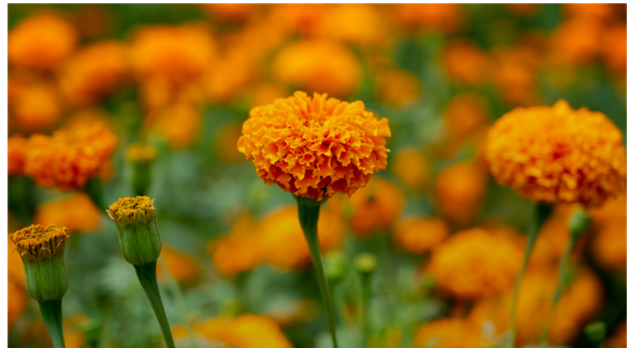
The Marigold: Showcasing bold hues of orange and gold, Mary’s gold symbolizes Mary as Queen of Heaven. Legend has it that early Christians placed marigolds in front of Marian statues as tokens of devotion instead of gold coins as a prayer offering. The marigold symbolizes majesty and the shining gold of the blooms throughout gardens is seen as her crown encircling us.
| |
This spring, many of us will be tending our own gardens. Gardens are places of peace, where one can witness the renewal of life and quietly connect with creation. When the flowers that symbolize Mary are planted together in an area consecrated (set aside) for her, it is called a Mary Garden. The focal point of a Mary Garden is a statue of her. Mary Gardens are a place to spend time with the Lord through his mother, while in the presence of creation, contemplating her virtues and offering up our own spiritual bouquets. As we honor Mary this month, May is the perfect month to start or refresh your Mary Garden.
| | |
Lord, have mercy.
Christ, have mercy.
Lord, have mercy on us.
Christ, hear us.
Christ, graciously hear us.
God the Father of heaven, have mercy on us.
God the Son, Redeemer of the world,
God the Holy Spirit,
Holy Trinity, one God,
Holy Mary, pray for us. (repeat after each line)
Holy Mother of God,
Holy Virgin of virgins,
Mother of Christ,
Mother of the Church,
Mother of mercy,
Mother of divine grace,
Mother of hope,
Mother most pure,
Mother most chaste,
Mother inviolate,
Mother undefiled,
Mother most amiable,
Mother most admirable,
Mother of good counsel,
Mother of our Creator,
Mother of our Savior,
Tower of David,
Tower of ivory,
House of gold,
Virgin most prudent,
Virgin most venerable,
| | | |
Virgin most renowned,
Virgin most powerful,
Virgin most merciful,
Virgin most faithful,
Mirror of justice,
Seat of wisdom,
Cause of our joy,
Spiritual vessel,
Vessel of honor,
Singular vessel of devotion,
Mystical rose,
Ark of the covenant,
Gate of heaven,
Morning star,
Health of the sick,
Refuge of sinners,
Comfort of Migrants,
Comforter of the afflicted,
Help of Christians,
Queen of Angels,
Queen of Patriarchs,
Queen of Prophets,
Queen of Apostles,
Queen of Martyrs,
Queen of Confessors,
Queen of Virgins,
Queen of all Saints,
Queen conceived without original sin,
Queen assumed into heaven,
Queen of the most holy Rosary,
Queen of Families,
Queen of Peace.
| | |
Lamb of God, who takes away the sins of the world, Spare us, O Lord.
Lamb of God, who takes away the sins of the world, Graciously hear us, O Lord.
Lamb of God, who takes away the sins of the world, Have mercy on us.
Pray for us, O holy Mother of God. That we may be made worthy of the promises of Christ. Let us pray.
Grant, we beseech thee, O Lord God, that we, your servants,
may enjoy perpetual health of mind and body;
and by the glorious intercession of the Blessed Mary, ever Virgin,
may be delivered from present sorrow,
and obtain eternal joy. Through Christ our Lord. Amen.
| Originally approved by Pope Sixtus V in 1587 | | |
Catholic Social Teaching
for Everyone
by Bob More & Chris Offen
Starting on May 13 and continuing for the next seven Wednesday evenings, St. John Neumann is presenting an exciting new adult faith formation program, Catholic Social Teaching for Everyone. We hope you’ll register for this free series (here). This article gives some background on why the parish is offering this program, why we’re calling it Catholic Social Teaching for Everyone, and what you can expect from the program.
First, as the U.S. Conference of Catholic Bishops wrote in “Sharing Catholic Social Teaching: Challenges and Directions,”
“Far too many Catholics are not familiar with the basic content of Catholic social teaching. More fundamentally, many Catholics do not adequately understand that the social teaching of the Church is an essential part of Catholic faith. This poses a serious challenge for all Catholics, since it weakens our capacity to be a Church that is true to the demands of the Gospel. We need to do more to share the social mission and message of our Church.” [Emphasis added.]
Many of us may have heard of one or more themes of Catholic Social Teaching, such as the life and dignity of the human person or the option for the poor and vulnerable. But few of us have had the opportunity to study the full scope of the Church’s social doctrine. That’s a shame because, as the Bishops note in the same document,
“The Church's social teaching is a rich treasure of wisdom about building a just society and living lives of holiness amidst the challenges of modern society. It offers moral principles and coherent values that are badly needed in our time. In this time of widespread violence and diminished respect for human life and dignity in our country and around the world, the Gospel of life and the biblical call to justice need to be proclaimed and shared with new clarity, urgency, and energy.” [Emphasis added.]
| |
Second, this program is called Catholic Social Teaching for Everyone because the Church’s teaching both enriches and challenges us all, irrespective of our political leanings. As Pope John Paul II said, the Church’s social doctrine “belongs to the field, not of ideology, but of theology and particularly of moral theology.” (Sollicitudo Rei Socialis, no. 41.)
The U.S. Bishops elaborate that the principles and themes of Catholic Social Teaching “provide a moral framework that does not easily fit ideologies of ‘right’ or ‘left,’ ‘liberal’ or ‘conservative,’ or the platform of any political party. They are not partisan or sectarian, but reflect fundamental ethical principles that are common to all people.” (Forming Consciences for Faithful Citizenship, no. 55.)
Indeed, although “destined primarily and specifically to the sons and daughters of the Church, her social doctrine. . . is a teaching explicitly addressed to all people of good will . . . .” (Compendium of the Social Doctrine of the Church, no. 84.)
Third, what you can expect from the program is an opportunity to learn about the “rich treasure of wisdom” that constitutes Catholic Social Teaching, explore some of the key tenets with others in small group discussion, and consider what response you may wish to make to what you’ve heard and discussed.
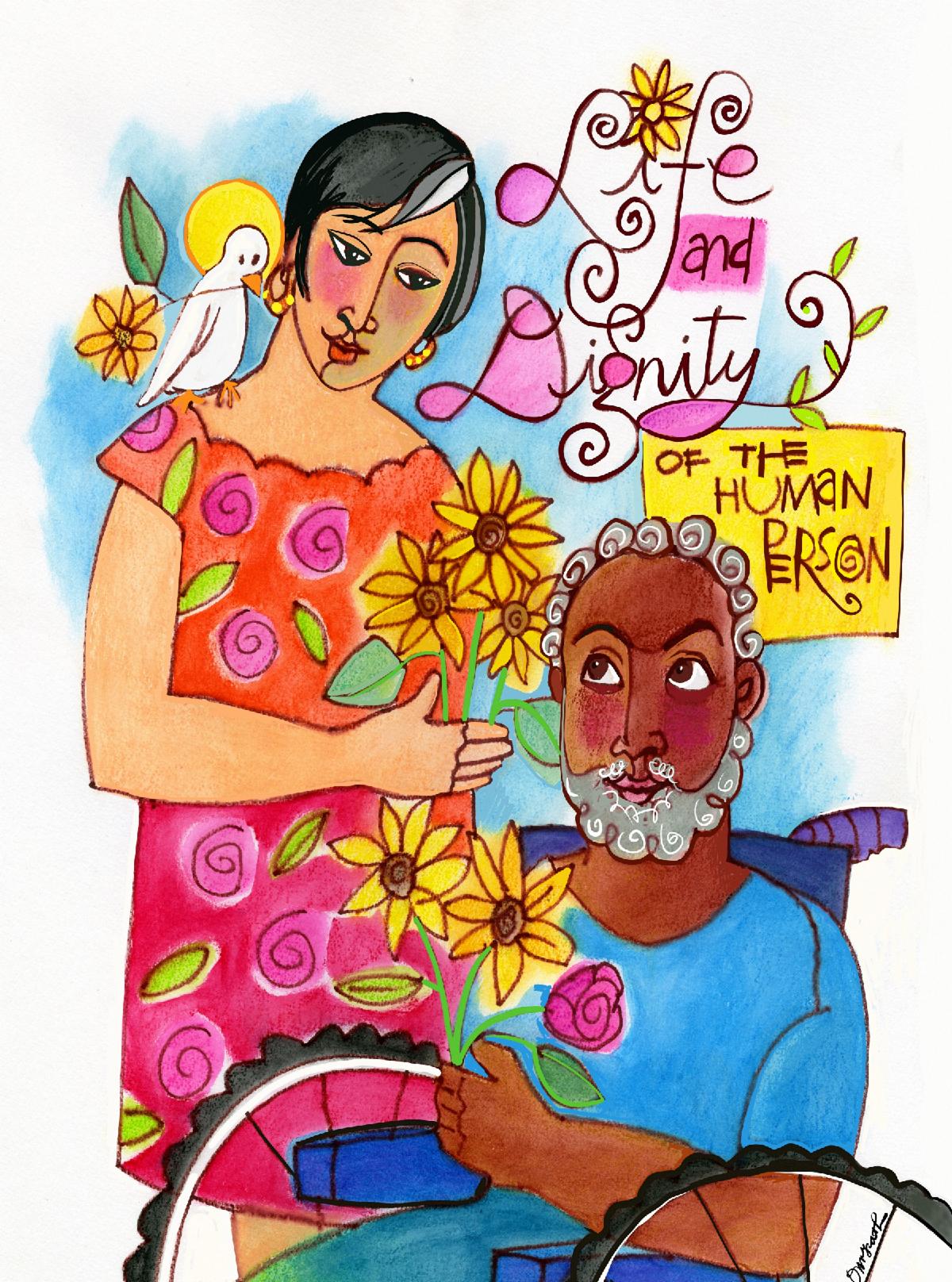
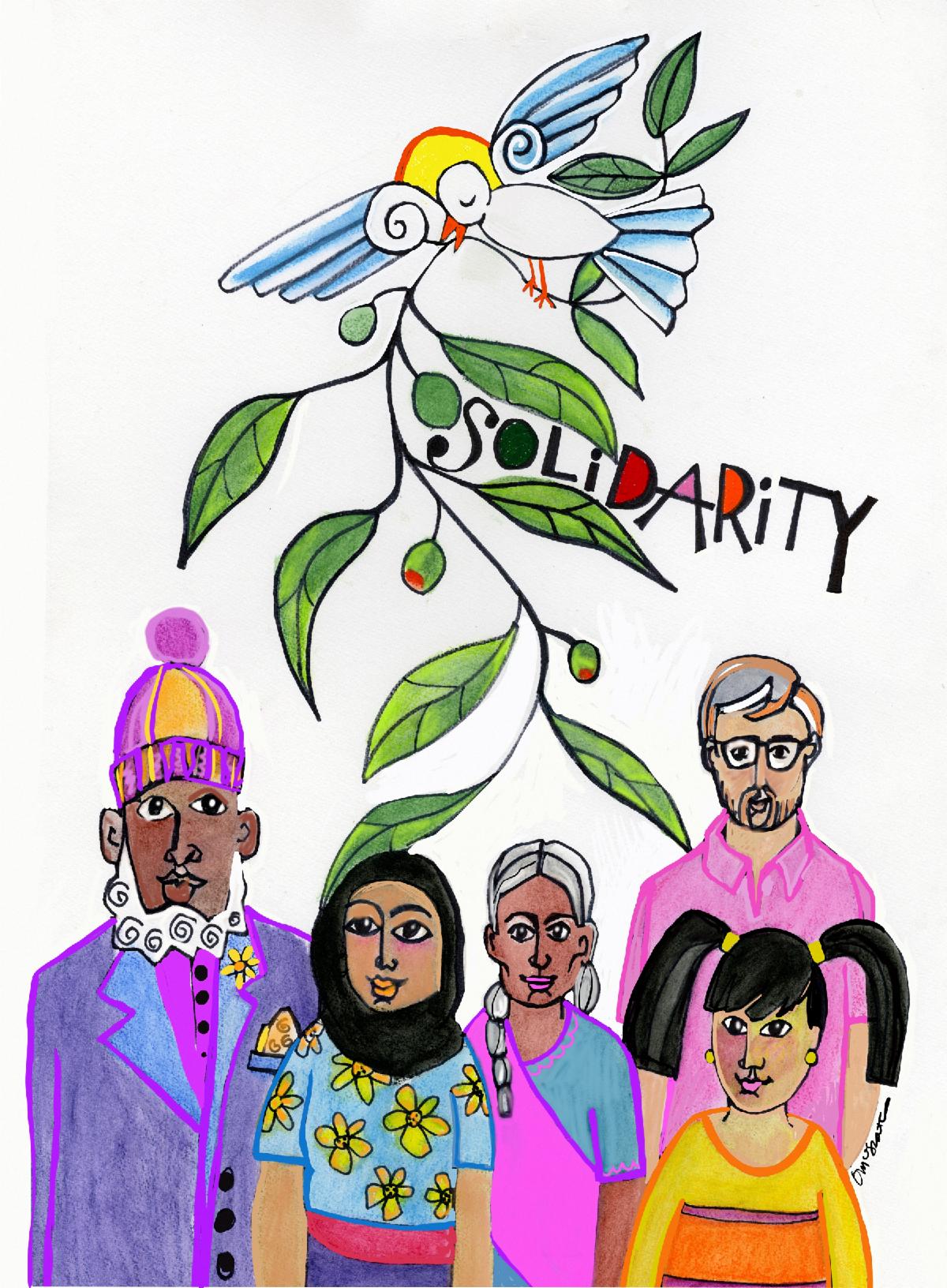
- The first session will be an introduction to the program and an overview of Catholic Social Teaching. Subsequent evenings will each focus on one of the seven themes of Catholic Social Teaching: human life and dignity; option for the poor and vulnerable; family, community, and participation; rights and responsibilities; dignity of work and rights of workers; solidarity; and care for God’s creation.
| | |
Each session will have three components of about 30 minutes each:
- Opening prayer and a presentation of Church teaching related to the nightly theme;
- Reflection and small group discussion of two quotations from Church documents related to the nightly theme; and
- An invitation to action using a USCCB examination of conscience relative to the nightly theme and learning about SJN ministries related to the theme.
As part of the third component for each session, representatives of a few SJN ministries will make brief remarks about how their ministry relates to the night’s theme. You will then have time to visit the ministries’ display tables to ask questions, pick up any handouts they may have, and sign up to get more involved if you wish.
Presenters for the eight weekly sessions are SJN Outreach, Faith Formation, and Communications staff and volunteers. Please join us — and invite your family members and friends!
CST theme pictures used with permission of Brother Mickey McGrath, OSFS.
| | |
May 8: One Year with Pope Leo
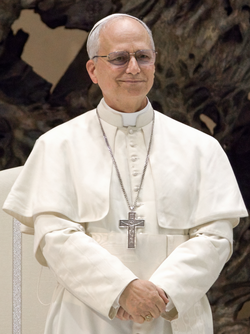
It is hard to believe that May 8 will mark a year since we gathered around televisions and devices anticipating white smoke. Our time spent watching the seagulls perched on the Sistine Chapel (quite oblivious to the excitement) was rewarded when Cardinal Robert Prevost, an American, was introduced as the new pope! In some ways it still seems hard to believe, especially for those of us who never believed there would be an American pope in our lifetime.
In this first year, Pope Leo has proved himself to be a pragmatic and faithful shepherd of our Church with a heart for peace and justice. Let us continue to pray for him as he leads the Church. May the Lord protect him and fill him with wisdom.
V. Let us pray for Leo XIV, our Pope.
R. May the Lord preserve him, and give him life, and make him blessed upon the
earth, and deliver him not up to the will of his enemies.
Our Father. Hail Mary.
O God, shepherd and ruler of all the faithful,
look favorably on your servant Leo XIV,
whom you have set at the head of your Church as her shepherd;
grant, we pray, that by word and example
he may be of service to those over whom he presides
so that, together with the flock entrusted to his care,
he may come to everlasting life.
Through our Lord Jesus Christ, your Son,
who lives and reigns with you in the unity of the Holy Spirit,
God, for ever and ever. Amen.
| | |
For God and Country
by Elizabeth Connell Wright
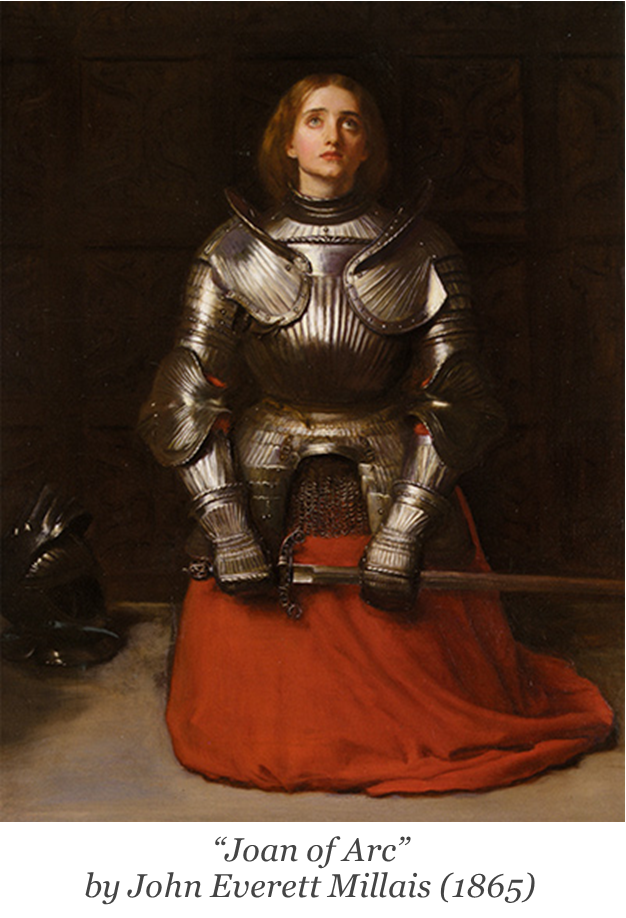
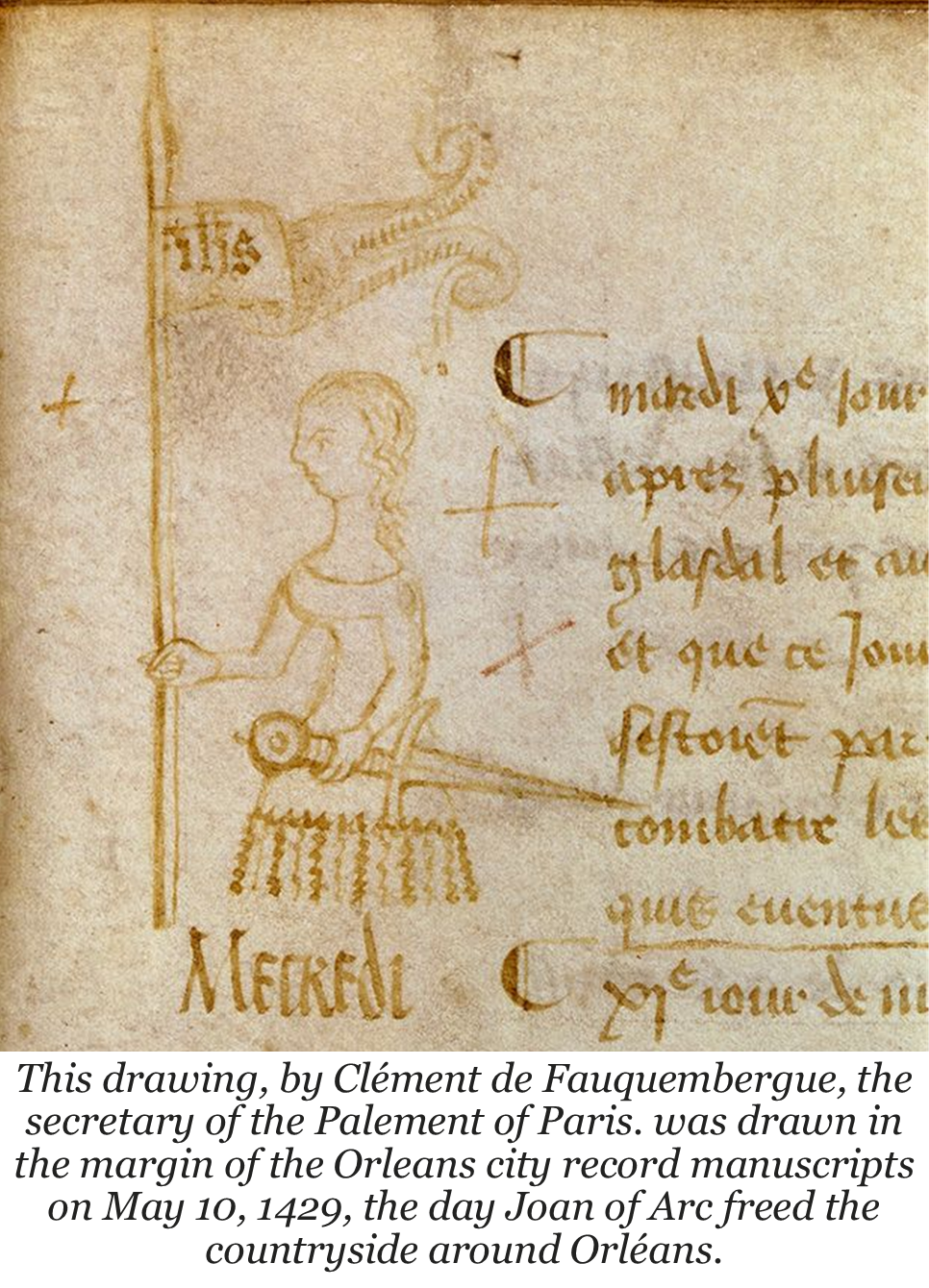
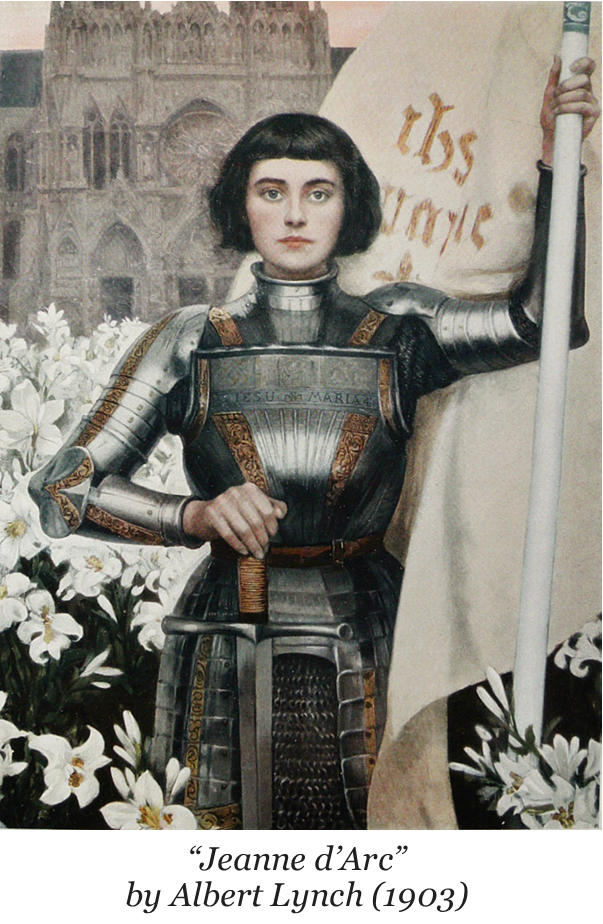
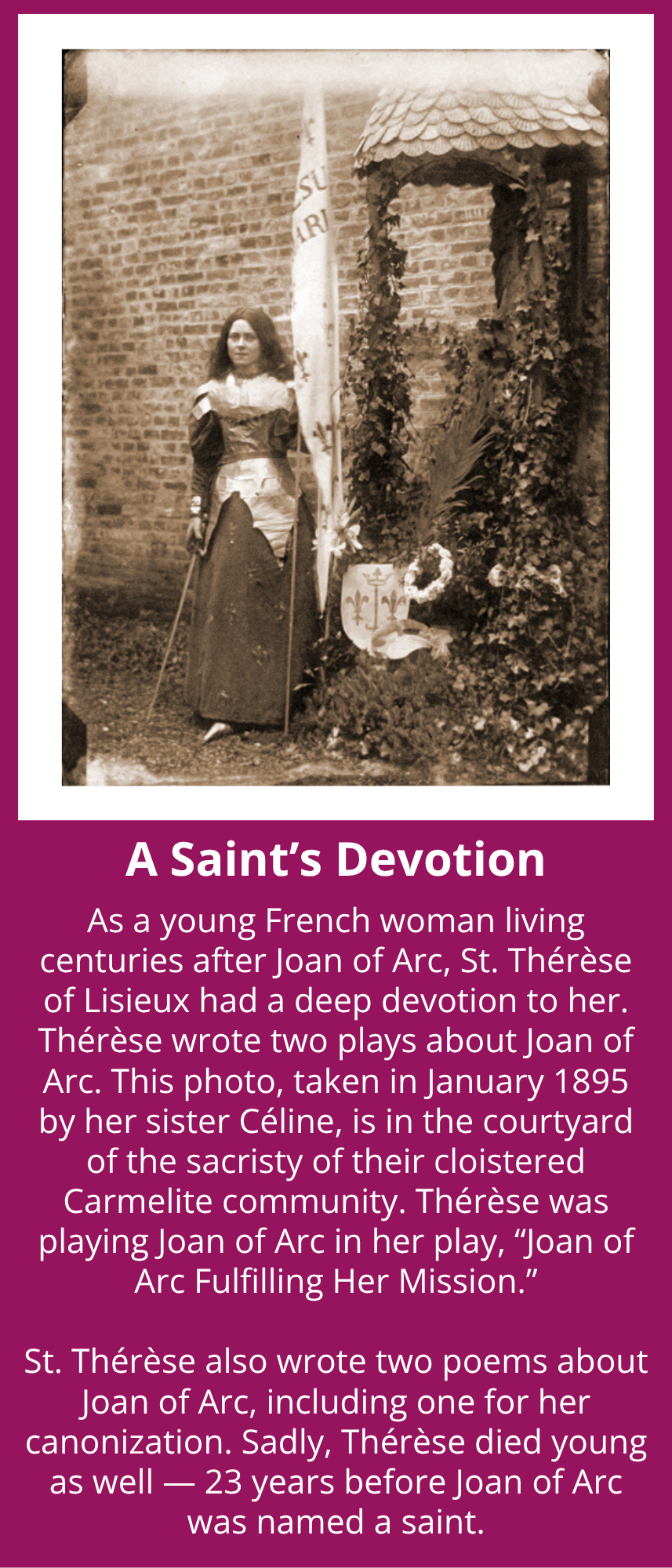
I often wonder what some famous historical figures would think about the way we portray them today. From slight exaggerations to outright manipulation, we tend to retell their stories in ways that may not entirely reflect reality. Joan of Arc's story is certainly no different. In her life and death, both Church and political figures exploited her for their own gains, and today, her story is often distorted for the sensationalism of secular media, music, and even fashion. From Mark Twain’s fascination with her (despite being anti-Catholic), which culminated with the publication of “Personal Recollections of Joan of Arc” in 1896 to Madonna’s 2015 ballad “Joan of Arc” to artist Chappal Roan’s portrayal of the saint at the 2024 MTV VMAs, where she performed in chainmail armor wielding a medieval sword in front of a castle set ablaze, it seems that her memory and her mission have been, at the very least, diluted. It is true — Joan of Arc is fascinating and admirable in her courage, but pop culture in the more modern era has twisted it to the point that I wonder, have we lost sight of the fact that her improbable story was divinely inspired — and wholly centered on her obedience to God.
| |
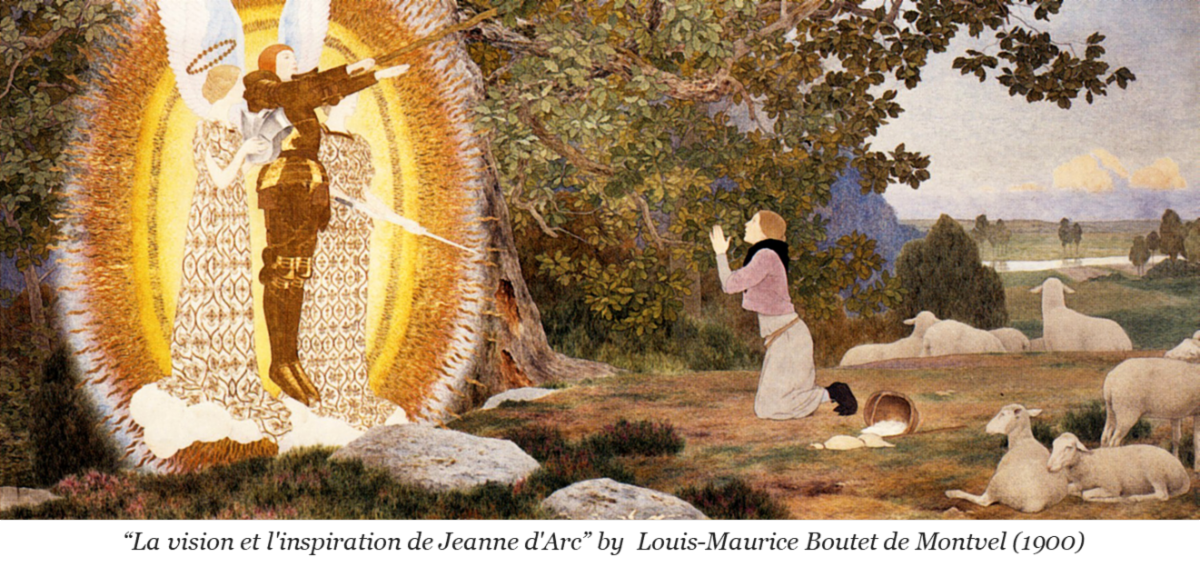
Joan was not from or “of” Arc — in fact, there isn’t such a place as Arc. She was born Jehanne d’Arc (or possible other Anglicizations of her father’s surname) to Jacques d’Arc and Isabelle Romée in Domrémy, France, on Epiphany, January 6, 1412. In documents from her trial, she refers to herself simply as “Jehanne la Pucelle,” translating to “Joan the Maid.” Her father was a peasant farmer, and she was most likely illiterate, living a simple life in a devout Catholic family when she began having mystical visions of St. Michael the Archangel, St. Catherine of Alexandria, and St. Margaret of Antioch around the age of 12.
In describing the significant historical details of her life, Pope Benedict XVI said in a January 2011 General Audience, “When Joan was born, in 1412, there was a Pope as well as two antipopes. In addition to this internal laceration in the Church, were the continuous fratricidal wars among the Christian peoples of Europe, the most dramatic of which was the protracted Hundred Years War between France and England.” The Hundred Years War had been ongoing since 1337 when King Edward III, King of England and son of Isabella of France, made a claim for the French throne. By 1428, the situation was quite dire as the English troops surrounded the city of Orléans, south of Paris. The House of Burgundy, traitors to their countrymen, had aligned with England and had already claimed Normandy and controlled Paris. The siege of Orléans had resulted in a food shortage that was slowly choking the city and extinguishing any hope of a French victory. It was then that the saints, or “voices” as Joan called them in the trial transcripts, directed her to save Orléans by helping Charles VII to be crowned King of France.
| When Joan was finally brought into the presence of the King at Chinon in March of 1429, he was concealed amongst over 300 courtiers, dressed as a commoner, yet Joan immediately identified him, later saying, “When I entered into the chamber of the King, I recognized him among the others on account of my Voices, which revealed him to me.” Imagine his surprise, when a young woman of just sixteen with no training on a horse, let alone battle, asked him to send her to reclaim France’s territory and see him crowned the rightful king. To prove the sincerity and reality of her divine mission, in private conversation she recited back to him the exact prayer he had spoken to God in a moment of solitude — he was convinced. | |
After Charles VII accepted her plea to lead an army at Orléans, Joan of Arc sent horsemen to Sainte Catherine de Fierbois, where the voices had told her a sword would be found — the sword of Charles Martel, grandfather of Charlemagne. As it had been revealed to her, the sword was found beneath the floor by the church altar. According to lore, the sword had five crosses on the blade, but it was never seen again after the siege of Paris, and she refused to divulge any information about the sword at her trial.
By late April 1429, she and her army entered Orléans with a banner that had been painted at Tours and blessed at the Church of Saint-Sauveur at Tours. The standard was carried into battle by Joan herself, who did not fight in battles or kill anyone. Instead, she elevated the banner high in battle as a reminder that they were sent by God. At her trial, when asked to describe the banner, she said, “I had a standard whose field was sown with lilies. There was a figure of Christ holding the world and on each side of Him was an angel. It was made of a white fabric called ‘boucassin’ (buckram). Written above: Jhesus Maria (Jesus and Mary), as it seems to me, and it was fringed in silk.” It is said that the remains of the banner were destroyed during the French Revolution.
| |
The French largely recognized Joan of Arc’s mission as divine. Joan’s complete trust in God, coupled with her pious nature was an inspiration to her army, emboldening the troops to continued success in subsequent battles. By July 1429, Joan of Arc and Charles VII enter Reims where the French king was anointed and coronated at the cathedral. In September, Joan pressed Charles to support a mission for the liberation of Paris, however, she was given an inadequate force, and they were forced to retreat after only a few days. Joan was wounded with an arrow to her thigh. Against her advice, King Charles agreed to a truce with the English, disbanded his army, and tried in vain to negotiate a deal with France's enemies.
In the spring of 1430, Joan led her small army to Melun, France, where they waited for reinforcements requested from Charles VII. By May, they marched to Compiègne, continuing to wait for necessary support that never materializes. On May 23, 1430, Joan of Arc is captured by forces from Burgundy, and essentially abandoned by the king and her army. She is held in the tower of Beaurevoir, still close to the siege of Compiègne. The voices of the saints continued to assure her that the French would be victorious there, and in November, that is exactly what happened.
Around this same time, Joan of Arc is sold to the English for 10,000 livres — an extraordinary sum said to be equivalent to about half a million dollars. Joan is then transported to Rouen, France, an English stronghold. On January 9, 1431, her trial by an ecclesiastical court, appointed by Pierre Cauchon, bishop of Beauvais, commenced with 70 charges including witchcraft, sorcery, heresy, theft of a horse, and dressing as a man. The bishop was aligned with the interests of the English and Burgundian party and sought to discredit King Charles VII through the trial of Joan of Arc; he hoped this would elevate him to archbishop. The trials continued and by April, twelve charges remained against Joan of Arc, centered mainly on her claims to have had contact with God and her persistence in dressing in men’s clothing. During her trial, she was repeatedly questioned about wearing men’s clothing and disregarding her female sex, an act that violated the laws of the Church. According to trial transcripts, she replied, “It is both more seemly and proper to dress like this when surrounded by men, than wearing a woman’s clothes.”
| In May, she agreed to wear women’s clothes and was given a sentence of life imprisonment, but after just a few days of wearing a dress in a prison, she returned to wearing men’s claiming the voices of the saints told her to do so for protection. Her relapse was considered heresy and within two days, on May 30, 1431, her head was shaved, she was tied atop wooden scaffolding in the Old Marketplace in Rouen, France, and she was burned at the stake. As flames consumed her, witnesses claimed that she continued to call on the name Jesus. She was just 19 years old. |
| |  | By 1452, both Charles VII, who owed his kingdom — now fully restore — to Joan, as well as Joan’s mother, Isabelle, and two of her brothers, Jéan and Pierre, had petitioned Pope Callixtus III to reexamine the trial. Finally, on November 7, 1455, a retrial began at Notre Dame Cathedral in Paris where Isabelle testified, “I had a daughter born in lawful wedlock, whom I had furnished worthily with the sacraments of baptism and confirmation and had reared in the fear of God and respect for the tradition of the Church ... yet although she never did think, conceive, or do anything whatever which set her out of the path of the faith ... certain enemies ... had her arraigned in religious trial ... in a trial perfidious, violent, iniquitous, and without shadow of right ... did they condemn her in a fashion damnable and criminal, and put her to death very cruelly by fire ... for the damnation of their souls and in notorious, infamous, and irreparable damage done to me, Isabelle, and mine.” On July 7, 1456, the retrial concluded declaring that Joan’s condemnation was based on “false articles of accusation.” The court ordered Bishop Cauchon’s sentence to be removed from the record of proceedings and those pages burned, clearing the name of Joan of Arc in the record.
Over four hundred years later, on May 16, 1920, the canonization of St. Joan of Arc was celebrated by Pope Benedict XV. She is the only person to have been declared both a heretic and a saint by the Catholic Church. In the end, the extensive investigation and interviewing of eyewitnesses for her retrial, laid the foundation for her cause for canonization. Upon her canonization, Pope Benedict XV said the life of Joan of Arc was “a proof of the existence of God.” He continued to state that, throughout history, all who tried to explain what she did without including God simply “got lost in a labyrinth of inextricable mazes.”
| It is true that people have always tried to point to something other than God to explain her unusual life. While she was living, those who opposed her didn’t necessarily deny a supernatural force in her life; it is that they believed it to be the devil, rather than divine intervention. Yet today, there are those who attempt to explain Joan of Arc’s mystical experiences as everything from madness to drinking unpasteurized milk. In response to the latter theory, historian Régine Pernoud wrote, “If drinking unpasteurized milk could produce such potential benefits for the nation, then the French government should stop mandating the pasteurization of milk.” | |
Regardless of skepticism, Joan of Arc is widely regarded as a hero, perhaps more so today than ever. She is one of a handful of saints whose story resonates far beyond the confines and devotions of the Church, transcending even to non-believers. Mark Twain said, “She is easily and by far the most extraordinary person the human race has ever produced.” Her bravery, independence, and strength are often admired, even idolized, but that isn’t really what made her special. She was an illiterate peasant girl who became the improbable savior of a nation — literally changing the course of history. Her accomplishments are far beyond mere courage. Joan possessed an unwavering trust in God. A faith so pure and simple in its childlike nature that we struggle to imagine it. What truly made St. Joan of Arc a hero was the incomprehensible depth of her faith and the persistent “yes” she said to God…even to her last breath.
| | |
The Pope's Intention for
Prayer and Action for May:
That everyone might have food.
Let us pray that everyone, from large producers to small consumers, be committed to avoid wasting food, and to ensure that everyone has access to quality food.
| | | |
Current Mass Times
Saturday: 5 p.m.
Sunday: 7:30 a.m., 9:30 a.m., 11:30 a.m., 2 p.m. (Spanish), 5 p.m.
Monday-Friday: 9 a.m.
Wednesday & Friday: 12:10 p.m.
(The12:10 p.m. Mass will begin summer break after Mass on May 22.
The Mass will resume on September 16).
Watch a livestreamed or recorded Mass
Confession
Saturday: 10 a.m.-10:30 a.m. (English)
Sunday: 3 p.m.- 4 p.m. (Spanish)
| | | Elizabeth Connell Wright, Communications Director, is the editor of SJN's monthly newsletter. If you are interested in submitting an article to the newsletter or have a topic that you would love to see an article written about, please emailt ewright@saintjn.org. Thank you for reading our monthly newsletter! | | | | |