Mayo Hayes O’Donnell’s article was published on March 27, 1950, in the Monterey Peninsula Herald. Her story provides a snapshot of early Castroville and its residents.
MAYO HAYES O’DONNELL
PENINSULA DIARY
Castroville’s History
Castroville, part of the El Rancho Bolsa Nueva y Moro Cojo, Spanish-Mexican grant of 40,000 acres, which included the present Fort Ord, granted to Simeon Castro and Maria Antonio Pico de Castro, was founded in 1863 by their children and heirs: Juan Bautista Castro, early Monterey County supervisor; General Manuel Castro, who in 1846 fought General John Fremont at El Gabilan or Fremont’s Peak; Maria Antonio Castro de Sanchez, wife of Rafael Sanchez y Galvan, a native of Cadiz, Spain, and one of the first attorneys in Monterey County; Juana Castro de Merritt, wife of Josiah Merritt, a native of New York state, first Monterey County superior court judge, and three younger brothers, Leandro, Jose Antonio and Jose Francisco Castro.
A site was immediately chosen for a Catholic church and rectory. They were built and the church named, La Iglesia de Nuestra Senora del Refugio, translated means “Church of Our Lady of Refuge,” The present pastor is Reverend J.G. Franco. During those early years, successful church bazaars, were held in the town hall. This two-story wooden building still stands on the main street. In later years an Episcopal Church was erected in the other end of town.
A unique and small Chinatown, one block in length, bordered the town on the east side.
A tract of land on the north end of Castroville was given for a cemetery.
The population consisted mostly of Irish and Portuguese with a smattering of Chinese, and was a thriving community before the founding of Salinas and Watsonville.
Castroville boasted one of the first hospitals in the county, built and operated by Dr. James George Martin. Dr. Martin’s wife was Guadalupe de Allen, heroine of Ann Fisher’s “Cathedral in the Sun,” and of George Allen, early Monterey settler. Mrs. Martin’s sweetness and gentleness of manner prompted her family and friends since early girlhood, to call her “La Senorita.” This endearing pet name remained with her throughout her life. The hospital was later destroyed by fire.
The Saint James Hotel, built and operated by the James Murphy family and a lovely small park stood near the Southern Pacific depot. The Southern Pacific Company built the roundhouse and operated it there for many years before moving it to Salinas.
One of the leading papers in California in the early was The Castroville Argus published by Juan Bautista Castro. Young and brilliant Joseph Merritt, eldest son of Judge Merritt, was the editor.
The old brick building, recently remodeled, standing on Merritt street, was built by Manual Merritt and Townsend Wood (father of Mrs. Charles Kiernan and Mrs. Ethel Little of Monterey) grain brokers and owners of a general merchandise store there.
Joan B.R. Cooper believing in the future of Castroville, built on the north end of Merritt street, his residence, an imposing two-story house. It was one of the handsomest and largest homes in the county. It stood in a center of a block, surrounded by a formal garden. Still showing traces of its former grandeur, it stands now as a rooming house.
Mr. Cooper was the son of Captain John Cooper, Monterey pioneer of 1823, half brother of Thomas Oliver Larkin, first and only American consul to Monterey: On the maternal side, he was the nephew of General Mariano Guadalupe Vallejo. His mother was Dona Encarnacion Vallejo Cooper.
Besides the above mentioned, there were many other homes and places of business in those early days.
Castroville is surrounded by rich, fertile land and in its heyday dairy farming, potato and grain raising were the chief industries. The potatoes and wheat were packed in 100-pound sacks and hauled in farm wagons drawn by six horses to Moss Landing and from there shipped by boat to all parts of California and eastern markets. Now it is lettuce, artichokes and beets and is known as “Artichoke Center of the World.”
To Mrs. Maria Antonia Bach Thompson, the granddaughter of Maria Antonia Castro de Sanchez, one of the founders of Castroville, and of Rafael Sanchez y Galvan, I am indebted for the information contained in this sketch of the early days of the neighboring community.
Juan B. Castro gave the right of way to the Southern Pacific railroad.
Other homes of note were the Juan M. Castro charming rambling white house, with a vine-covered porch surrounding the front and side, green shuttered and enclosed by a picket fence. The home stood on Merritt street. Another was the white-gabled Walsh residence, erected on one of the side streets, surrounded by a lovely old-fashioned garden and high-trimmed cypress hedge.
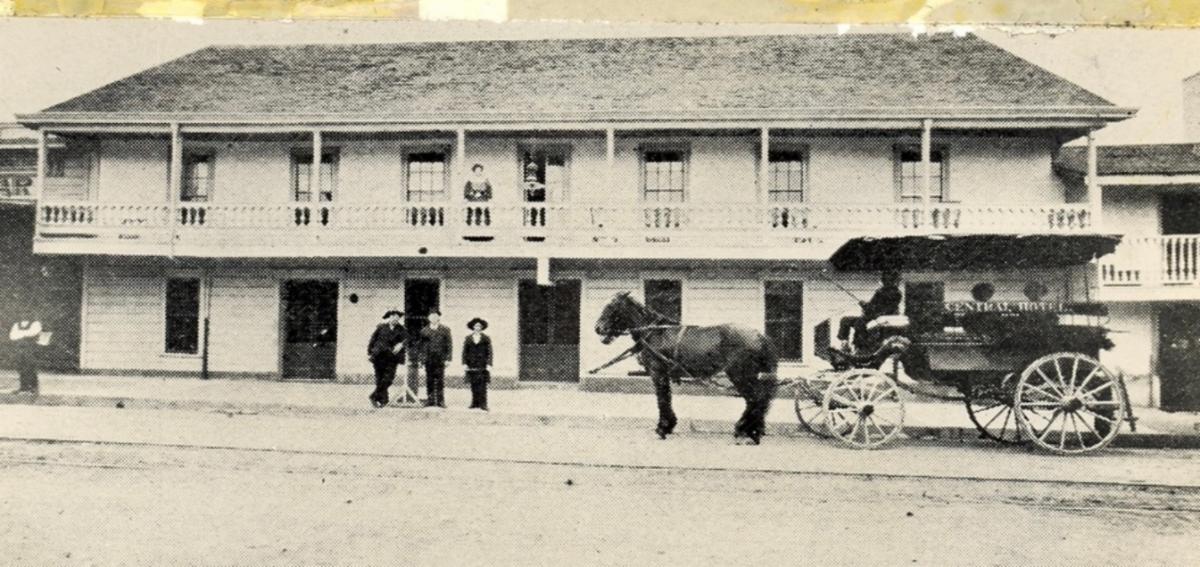
A carry-all drawn by two well-groomed horses met passengers at the depot.
During Castroville’s middle years of prosperity a well-stocked livery stable, with both horses and vehicles, catered to the wants of its gay blades.