Weekly Digest Number 18 - May 3rd, 2022 |
|
Welcome to the RWU Rail & Labor News! This news bulletin is produced and emailed out each Tuesday morning. We hope you find each week's news and information useful. If so, please share with co-workers, friends, and colleagues. If you like, you can sign them up to get all the news from RWU HERE. Or forward them the link. Note: If you read over this news bulletin each week, you will be sure to never miss the important news of what is going on in the railroad world from a worker's perspective!
|
|
(Editor's Note: Wringing their hands at the STB hearings, neither the CEOs, the shippers, nor the government officials could come up with a solution to the snarled state of the U.S. freight railroad network, despite the fact that there was general agreement that at its core, the problem was a shortage of train crews, the inability of the Class One's to retain and recruit employees. Given the problem, the solution is so obvious, and every railroad worker knows it. Treat the employees with dignity and respect, and compensate them adequately for their labor. Period. Specifically, the demand for single person train operations is a contradiction for an employer to expect people to hire into a job that this same employer hopes to abolish in the coming months. And the existing employees are leaving due to harsh attendance policies, a lack of a pay increase, attacks on the union contract, low morale, etc. SOLUTION: A - Remove the issue of single person crews from the bargaining table; B - Bargain attendance policies as requited by the Railway Labor Act; and C - Eliminate entry level rates and starvation wages for new hire trainmen. These three simple measures - all of which the carriers could easily agree to immediately - would solve the staffing crisis in short order. The Class One's are rife with cash. The costs would be minimal. The payoff for all of us - shippers, passengers , workers, and the rail industry - would be great.)
|
|
STB Seeks Ways to Quickly Ease Railroad Service Problems
Railroads say they’re working to address crew shortages, but shippers and rail labor blame Precision Scheduled Railroading for gutting rail capacity
|
|
WASHINGTON — There were more questions than answers on Tuesday as federal regulators sought ways to remedy railroad service problems that defy a quick fix because they are rooted in a shortage of train crews.
Shippers told the Surface Transportation Board that rail service has deteriorated, with delays mounting as transit times have in some cases doubled from normal levels. The slowdown in rail network velocity has forced shippers to curtail or suspend production due to late empty or loaded freight cars, and even prompted farmers to consider culling their herds and flocks for lack of feed.
Railroad performance metrics need to improve soon, STB Chairman Martin J. Oberman told the railroads. “The country is going to have a lot of trouble if 30 days and 60 days from now these numbers aren’t much different,” he says. “If we’re relying only on hiring, I don’t see you being able to get there in 30, or 60 or 90 days. We’re going to miss the planting season, we’ve got fuel problems. That’s what I’m concerned about.”
A range of shipper associations, joined by the U.S. Department of Agriculture, asked the STB to take several steps that they say will improve service and spotlight problems in the rail network.
The board should clarify railroads’ common carrier obligations, impose penalties for poor service and inefficient use of privately owned freight cars, and expand reciprocal switching. They also sought a simpler way to challenge rates, urged the board to require railroads to provide first- and last-mile service data, and said railroads should have to file annual service assurance plans. And they applauded the board’s proposal to adopt a new rule that would expand its emergency service powers.
Oberman, during the first day of a planned two-day hearing, asked shippers if there were any steps the board could take in the next 30 to 90 days that would improve service.
Shippers were at a loss as to what remedies the board could adopt immediately. “If we had a silver bullet we would have brought it to you,” says Chris Jahn, CEO of the American Chemistry Council, the trade group representing chemical manufacturers.
Transportation Secretary Pete Buttigieg acknowledged that there wasn’t much the board could do in the face of crew shortages. “These are complex issues,” he says. “There’s no single step available to deliver ideal freight rail service overnight.”
|
|
(Editor's Note: Labor's testimony at the hearings was at times lacking. A low point was when SMART-TD's President Jeremy Feguson felt obliged for some reason to commend CSX - not once but twice - for its "changing culture," whatever that means. But BMWED attorney Rich Edelman hammered home labor's essential points in a well prepared and thought out presentation and Q&A. Well worth watching.) |
|
Labor Attorney Rich Edelman Provides Scorching Testimony to the Surface Transportation Board |
|
On April 25th and 26th, members of the Surface Transportation Board heard scores of testimonies from unsatisfied shipping companies and exasperated labor representatives and employees concerning the troubled and mismanaged Class 1 freight railroads. It was a public shellacking of railroad management and one that was long due.
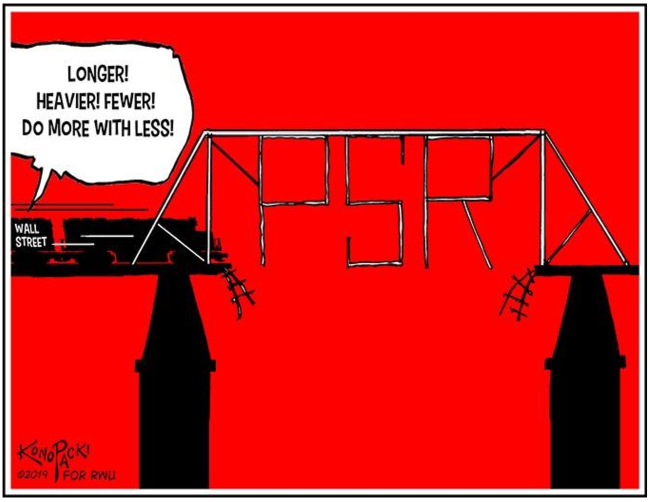
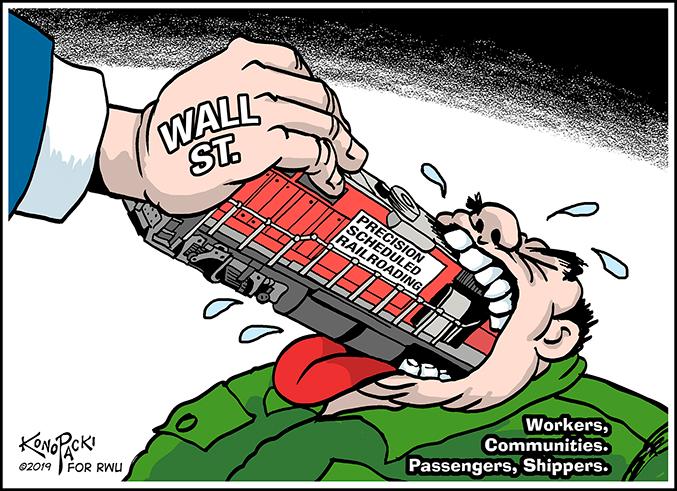
The indoctrination of “Precision Scheduled Railroading,” the brainchild of the late modern-day robber baron Hunter Harrison, and a never-ending desire to satiate Wall Street, has left the railroads with their pants down.
The testimony and subsequent Q&A (25:29) runs close to an hour long, but we encourage you to listen. Brother Rich could not have done a better job spelling out the mismanagement and greed of the freight carriers, and how their singular focus on shareholder’s limitless greed has resulted in a failure to meet the demands of their customers and left them without the manpower and expertise of skilled labor to pull them out of their self-inflicted jam.
|
|
Poor Rail Service Threatens U.S. Economy, Shippers Tell Federal Regulators |
|
WASHINGTON — Utilities are worried that the slowdown in coal deliveries could threaten U.S. electricity supply and destabilize the power grid.
Chemical producers say erratic rail service has forced them to curtail production of essentials like chlorine used to treat public drinking water systems and the plastics used in medical products.
And one of the nation’s largest retailers of diesel fuel, renewable diesel, ethanol, and diesel exhaust fluid says Union Pacific’s plan to cut its shipments by 50% will create fuel shortages, bring trucking to a halt, and raise prices at the pump.
Those were among the shipper concerns raised on Wednesday during a second day of hearings on railroad service problems that have been created by a shortage of train crews.
“The nation’s supply chains are in a dire situation today because of this. And it’s not getting better, it’s getting worse. And the longer it goes on, the worse it’s going to get,” Ross Corthell, chair of the National Industrial Transportation League’s rail committee, told the Surface Transportation Board.
He adds: “I don’t want to be doomsday, but it’s critical to our national security at some point in time. We have to be able to move commodities. And it’s becoming more and more challenging every day.”
Shippers complained about how lengthy delays, erratic service, and missed switches forced them to curtail or halt production or shift some shipments to more expensive trucks. Some products, such as chlorine and coal, have no alternative to rail. “We need to move coal and right now it’s just not happening,” says Katie Mills, a lawyer for the National Mining Association.
|
|
(Editor's Note: Yet another well written and heart-felt piece by a Class One rail worker. Brothers DeLay and Lindsey speak for all of us. Hopefully their words will inspire other fellow workers to action. NOTE: With more and more railroad voices speaking out, it becomes harder and harder for the rail carriers to thwart our speech and threaten us with discipline. All are welcome to join the chorus. They cannot fire us all!) |
|
‘It is Getting Worse. People are Leaving’ |
|
Dear Chairman Oberman and Board Members:
Greetings, I hope this finds you all well. A fellow engineer passed along information from another engineer, who I have never met, Mike, 17 years an engineer, like me, with a degree, like me (art, English), which has led to writing this body. The issues before you are customer service shortages and labor shortages. I will address one issue on the topic of service shortages: Precision Scheduled Railroad (PSR) monster trains.
The Surface Transportation Board already knows this; the FRA knows this, the shippers know this; the car owners/lessees know this, the executives know this; and certainly the front line knows all too well: It is impossible to get goods to market in a timely way, when the train has derailed. Monster trains keep derailing to the point where it seems, from almost all the above parties, this has become normalized and acceptable. What other conclusion can one come to: It keeps happening, on a routine basis.
Derailments of monster trains have become so frequent, that in my little section of the U.S. economy (although a major artery) it has become a blur. It is hard to keep them straight. By last summer, 2021, I thought CNN would just keep a helicopter out here, dedicated to the State of Iowa alone for aerials of the most recent spectacle. And just two weeks back, March 2022, one monster train, eastbound, derailed into a westbound train on adjacent track! Fate had it that both crews were ok. Yet: Is counting on miracles a valid operating model?
I
|
|
(Editor's Note: The rail carriers' lame attempt to appease the workforce has been rejected. To assist in retention and recruitment of employees, a more realistic proposal to the unions would be to drop the demand for single person crews, bargain over attendance issues, and eliminate entry level rates. See editor's note atop lead article.) |
|
NCCC Proposes ‘Advance Payments,’ Unions Say It’s Not Enough |
|
The National Carriers’ Conference Committee (NCCC) on April 22 proposed “to enter interim agreements with all rail labor organizations in national handling providing for advance payments of up to $600 per month, representing amounts that are expected to be due under future national collective bargaining agreements.” While most unions had declined as of April 25, NCCC said it would “hold open the proposal” for their further consideration.
|
|
(Editor's Note: As previously noted, this fight is one that has major implications for Amtrak going forward. The Class One's are drawing a line in the sand and attempting to thwart the ability of Amtrak to expand service. In fact, a carrier victory in this theatre could very well spell doom for any hope Amtrak may have for on-time performance on existing routes and schedules.) |
|
Amtrak Dumps its Nice Guy Persona in Fight for Gulf Coast Trains |
|
Amtrak, which typically speaks in a mild-mannered tone on social media, has reinvented itself as a flamethrower that’s launching snarky missives at the freight railroad companies that it says are blocking passenger train travel on the Gulf Coast.
Amtrak trains outside the Northeast corridor generally run on tracks owned by freight railroads, sharing the tracks on an agreed upon schedule, though unexpected delays occur when the freight railroads deviate from the schedule and run their own trains hours ahead or behind schedule.
(The freight railroads generally face no penalty for doing so, as the Justice Department has only once acted against a freight railroad for failing to give Amtrak the priority US law requires.)
The relationship between Amtrak and these partners has long been contentious, with Amtrak describing the railroads as the largest cause of delays for its passengers. It began releasing an annual report card in 2018 that graded the railroads. Most receive low marks. Now, in a dispute with freight train operating companies CSX and Norfolk Southern, Amtrak is going even farther to make a point.
|
|
(Editor's Note Whether you work in freight or passenger service, work in the rail industry or ride the train, we all need to support better passenger train service for all.) |
|
Tell Congress to Fund Better Trains in FY23 |
|
Congress is in the midst of determining funding levels for passenger rail for Fiscal Year 2023. Please contact your members of Congress and ask them to fully fund Amtrak and passenger rail in FY23 appropriations, and provide dedicated funding for high-speed rail.
The bipartisan Infrastructure Investment and Jobs Act (IIJA) authorized historic investments in America’s rail infrastructure, and provides an unprecedented opportunity to modernize our nation’s passenger rail network. However, authorization does not actually put the money to use—appropriation does. By providing the full appropriations for passenger rail and dedicated funding for high-speed rail, Congress can help the IIJA fulfill its promise.
Please make your voice heard by contacting your representatives right now. Tell them you support the maximum for Amtrak and passenger rail programs, and dedicated funding for high-speed rail.
We've provided a form letter but we strongly encourage you to write about why you want better trains and how they will improve your life. Please write this at the beginning of the email.
You can also have an impact by calling your representatives. Write down their numbers before submitting the email.
|
|
Signal Workers Walk Out at Toronto Union Station |
|
TORONTO — Signal and communications workers at Toronto Union Station have gone on strike, creating the possibility of service disruptions at the station which sees more then 300 trains daily.
The CBC reports 95 members of the International Brotherhood of Electrical Workers walked out at 12:01 a.m. today (Wednesday, April 20) after the union failed to reach agreement with Toronto Terminal Railway. The workers handle signal and communication maintenance and train control in the station’s rail corridor.
Provincial transit agency Metrolinx says it has a contingency plan in place to deal with the strike and hopes impact to GO Transit and Union Pearson Express service will be limited.
The workers have been without a contract since December 2019; a tentative agreement reached in September 2021 was not ratified by union members. The railroad says wages are the primary matter in dispute.
|
|
(Editor's Note: Once again, despite the the Class One's crying about all of the problems and issues they face - none of which according to them are their own fault - they rack up record breaking profits - on lower volumes of freight moved. These are no longer transportation companies but cash cows for Wall Street investors to milk dry.) |
|
CSX 1Q22 Earnings Soar on Lower Volume |
|
CSX’s first-quarter 2022 financials included whopping increases of 21% in net earnings and 26% in diluted earnings per share, despite a drop in volume.
CSX’s 1Q22 net earnings of $859 million, or $0.39 per share, compared to $706 million, or $0.31 per share, in the same period last year. Operating income was $1.28 billion compared to $1.10 billion in the prior-year period, a 16% increase. Revenue reached $3.41 billion for the quarter, increasing 21% year-over-year, as an overall revenue-per-unit increase of 24% more than offset a 2% decline in volume. First quarter operating income included $17 million of expense related to increases in environmental reserves and a $20 million gain from property sales recognized from the 2021 transaction with the Commonwealth of Virginia. (Download the Quarterly Financial Report below.)
|
|
STB Proposes Amendment to Emergency Service Rules |
|
The proposed rule would clarify that the STB may act on its own initiative to direct emergency rail service, and to establish an accelerated process for acute service emergencies.
Over the past year, the board has heard informally from a range of stakeholders about inconsistent and unreliable rail service. In recent weeks, rail service has become even more unreliable, with most stakeholder concerns focusing on crew shortages and inability to move trains, STB officials said in a press release.
Board members have also heard reports of challenges such as tight car supply and unfilled car orders, delays in transportation for carload and bulk traffic, increased origin dwell time for released unit trains, missed switches and ineffective customer assistance.
As a result of those issues, the board will hold a hearing tomorrow and Wednesday on current rail service problems affecting the network and recovery efforts involving several Class Is. STB staff have met informally with stakeholders who observed that the existing regulations governing expedited relief for service emergencies are inadequate and the process is too prolonged, resulting in the regulations being rarely used, board officials said.
|
|
(Editor's Note: Hard to fathom how a locomotive is only "in use" when its wheels are in motion. A locomotive in switching service may stop and start 100 times or more during a shift. And while sitting still, an engineer may may set and release the locomotive brakes, conduct air tests, advance the throttle to pump up air, turn up the heater, dim the headlight, etc. But all of these functions are not considered "in use." The highest court in this land has now corroborated that a locomotive is only "in use" when the wheels are rotating. Amazing abuse of the English language. George Orwell is turning in his grave.) |
|
Supreme Court Split Upholds Ruling on Union Pacific Injury Case |
|
WASHINGTON — The U.S. Supreme Court split 4-4 on a case involving an injury suffered by a Union Pacific employee in a decision announced Thursday, meaning a lower court ruling stands that absolves the railroad in the case.
The case involved UP engineer Bradley LeDure, who was injured when slipping on oil on the walkway of a locomotive stopped at a yard in Illinois. He argued that the railroad was liable under the Locomotive Inspection Act, which requires regular inspection of locomotives “in use.” The railroad argued that stationary locomotives are not in use [see “Supreme Court set to hear arguments …,” Trains News Wire, March 28, 2022]. The 7th U.S. Circuit Court of Appeals had found for Union Pacific, leading LeDure to appeal to the Supreme Court.
Reuters reports UP lawyer Scott Ballenger said in a statement, “We are very pleased that the Supreme Court left in place the Seventh Circuit’s sensible rule that preparing a locomotive for use is not the same as using it.” The Department of Justice had filed a brief in support of LeDure, while groups including the U.S. Chamber of Commerce filed briefs supporting the railroad
The Supreme Court’s single-sentence decision — “The judgment is affirmed by an equally divided court” — offers no details on how justices voted, other than noting that Justice Amy Coney Barrett did not take part. She was involved when the case was decided by the 7th Circuit.
|
|
‘Industries Dependent Upon the Railroads’ Service are Forsaken’ |
|
The March 24 letter has gotten support from various rail unions and other stakeholders in recent days. These stakeholders are also asking the STB to examine the causes behind the service delays.
Here’s a roundup of what’s been said recently:
Unions criticize headcount reductions, blame service issues on lack of adequate staffing
The rail unions cite precision scheduled railroading (PSR) as being the cause of many of the service issues occurring today, according to recent correspondence to STB.
In a Monday letter to the board, the Transportation Trades Department (TTD) of the AFL-CIO said it agreed with NGFA’s assessment of deteriorating service conditions on the Union Pacific (NYSE: UNP), BNSF (NYSE: BRK.B) and Norfolk Southern (NYSE: NSC). The union said PSR, an approach that seeks to streamline operations, “looms large in the disruptions [NGFA] members are currently facing.”
PSR encouraged the railroads to trim their workforce, including staffing for the market-sensitive train and engine crews, according to the TTD letter signed by its president, Greg Regan. But when demand bounced back, the railroads didn’t have enough workers to manage the demand, Regan said.
“NGFA cites that a lack of available crews has resulted in long delays. This should come as no surprise, as the carriers have spent the last several years slashing tens of thousands of jobs across every craft, without regard to the impact this would have on the provision, quality or frequency of service,” Regan said.
He said that to make up for the reduction in employee headcount, the absence policies adopted by some of the railroads became punitive.
“Rather than pursue real measures to return headcount to appropriate levels, the carriers have instead focused on extracting maximal hours from the existing workforce under the threat of discipline and termination,” Regan said.
|
|
(Editor's Note: As the STB hearings took place early last week (see above), the numbers were sure incriminating. Most of the Class Ones - except those that were involved in corporate merger shenanigans over KCS - showed record profits on lower volumes. The problem is right there out front and center for all to see. While the Class Ones might be enjoying the debacle, the rest of of are not happy at all.) |
|
Intermodal Slide Continued in Q1 |
|
Total intermodal volume in first-quarter 2022 fell 6.6% to 4,312,905 units compared with 4,616,262 units in first-quarter 2021, according to the Intermodal Association of North America's quarterly intermodal market report.
Domestic container shipments increased 5.2% to 2,046,210 units, but international container volume dropped 15.5% to 1,997,046 units and trailer counts fell 12.8% to 269,649.
The weak Q1 volume total — which was was the third-smallest quarterly volume in the past four years — came on the heels of a 9.8% decline in fourth-quarter 2021 and 2.9% dip in third-quarter 2021, IANA officials said in the report. The Omicron surge and was evident as January intermodal loadings declined 13.3%.
Loadings in the seven highest-density trade corridors — which collectively handled more than 60% of total volume — all declined in Q1.
"Supply-chain issues continued to impact volumes in the first quarter, especially on the international side," said IANA President and CEO Joni Casey in a press release. "On the other hand, domestic containers stood out for a respectable year-over-year gain. Higher levels of transloading are primarily responsible for this trend."
Total North American intermodal volume for all of 2022 is expected to increase 0.9%, with declines in the year's first half and gains in the second half, IANA officials project. International container volume is forecasted to decline 2.8% this year with a greater share of imports landing on the East and Gulf Coasts — where intermodal has a lower share — in addition to a larger number of transloads moving in domestic containers off the West Coast.
|
|
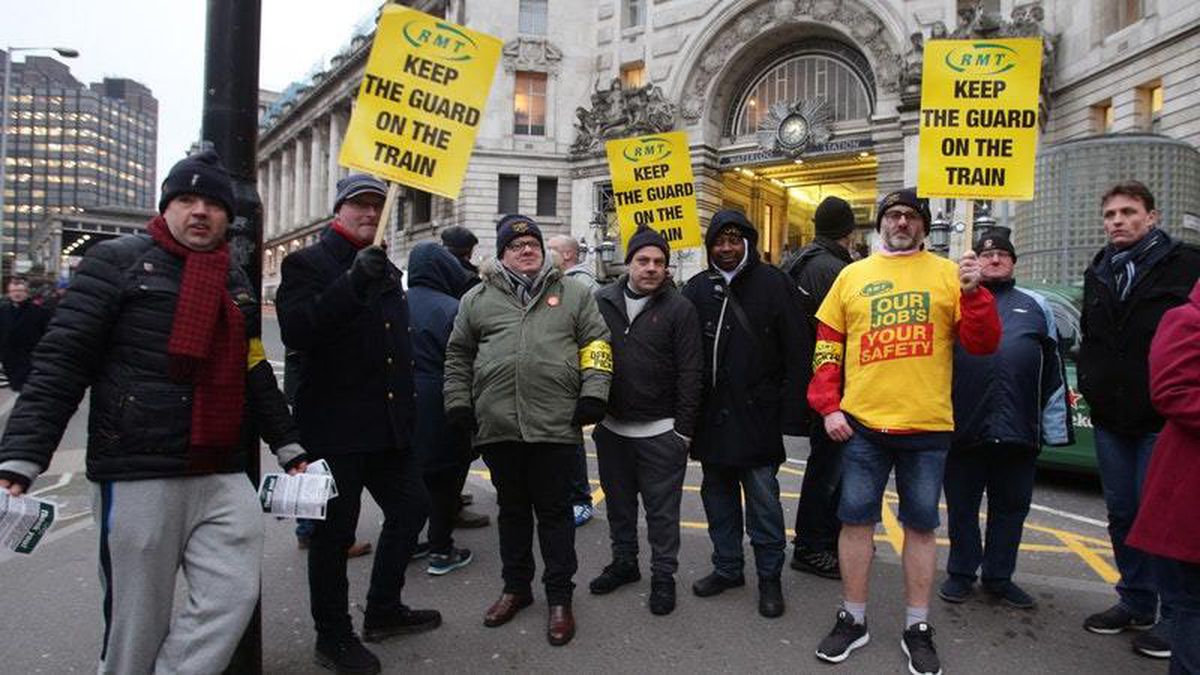
(Editor's Note: North American rail workers would be wise to keep an eye on the actions of their fellow workers and unions in the UK. The RMT union has long advocated and advanced a militant approach to the struggle. Perhaps we can learn something from them on this side of the Atlantic.) |
|
UK Union Warns for "Biggest Rail Strike in Modern History" |
|
The UK may be on the verge of what trade union RMT calls the biggest rail strike in modern British history. The union plans to ballot its members in the railway sector, asking to back strike action. The ballot, which opens on 26 April and runs until 24 May, could result in labour being withdrawn from fifteen passenger train operating companies in England and Wales, as well as over 40,000 railway workers from Network Rail, the national infrastructure agency.
The RMT union says Network Rail intends to cut at least 2,500 safety-critical maintenance jobs as part of a 2 billion GBP reduction in spending on the network. Meanwhile, staff of train operating companies have been subject to pay freezes, threats to jobs and attacks on their terms and conditions.
Removing safety critical jobs
Echoing the strikes of the 1970s, and even further back into the crippling strikes in the 1920s that culminated in the General Strike of 1926, union leaders have said that if members vote “yes” in the ballot, and breach the “anti-trade union” legal threshold for turnout, then a national railway strike could begin as early as June.
Fears of worsening industrial relations have been voiced already this year, with trades union sources making dire warning of a summer of discontent on the network. “Railway workers have had to contend with pay freezes, the prospect of losing their jobs and repeated attacks on their terms and conditions”, said RMT general secretary Mick Lynch. “Removing 2,500 safety critical jobs from Network Rail will spell disaster for the public, make accidents more likely and will increase the possibility of trains flying off the tracks. Train operating companies have praised our members for being key workers during the pandemic but have refused to keep staff pay in line with inflation and soaring living costs.”
|
|
(Editor's Note: As their forefathers did 80 years earlier when helping to repel the Nazis, Belarusian railway workers have become heroes, engaging in acts of sabotage to thwart the Russian war effort in Ukraine. French and other rail workers likewise have a heroic history of opposing tyranny and oppression.) |
|
The Belarusian Railway Workers Who Helped Thwart Russia’s Attack on Kyiv
A clandestine network of railway workers, hackers and dissident security forces wreaked havoc on supply lines
|
|
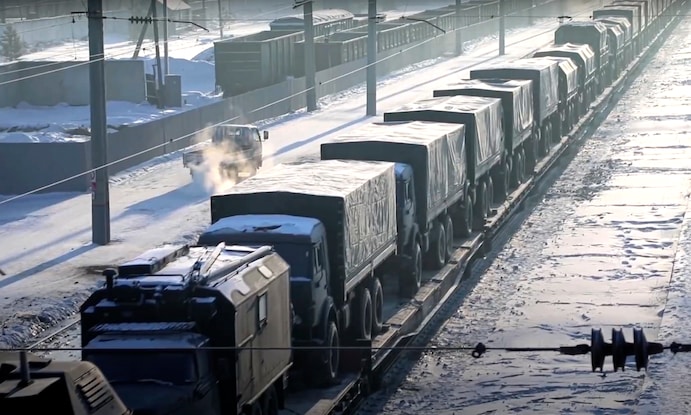
When Russian troops first streamed across the Belarusian border into Ukraine for what they had assumed would be a lightning assault on Kyiv, they were intending to rely on the region’s extensive rail network for supplies and reinforcements.
The Russians hadn’t taken into account the railway saboteurs of Belarus.
Starting in the earliest days of the invasion in February, a clandestine network of railway workers, hackers and dissident security forces went into action to disable or disrupt the railway links connecting Russia to Ukraine through Belarus, wreaking havoc on Russian supply lines.
The attacks have drawn little attention outside Belarus amid the drama of the Russian onslaught and the bloody aftermath of Russia’s humiliating retreat. Fierce Ukrainian resistance and tactical errors by an ill-prepared Russian force were likely enough to thwart Russia’s plans, analysts say.
But the Belarus railway saboteurs can at least claim a role in fueling the logistical chaos that quickly engulfed the Russians, leaving troops stranded on the front lines without food, fuel and ammunition within days of the invasion.
Alexander Kamyshin, head of Ukrainian railways, expressed Ukraine’s gratitude to the Belarusian saboteurs. “They are brave and honest people who have helped us,” he said.
The attacks were simple but effective, targeting the signal control cabinets essential to the functioning of the railways, members of the activist network said. For days on end, the movement of trains was paralyzed, forcing the Russians to attempt to resupply their troops by road and contributing to the snarl-up that stalled the infamous 40-mile military convoy north of Kyiv.
|
|
|
|
|
|
|