Rail Workers Weekly News Digest
Number 7 - February 18, 2020
|
|
Below is a series of articles compiled over the previous week.
They are of interest to railroad workers.
_____________________________________________
|
|
Article 1 -
CREW CONSIST NEWS
Federal judge orders rail union to negotiate on train crew size
(Editor's Note: The rail carriers first proposed the end of the two-person crew in 2004. Railroad workers have held them off for 15 years! And we intend to continue to beat back any attempt at single employee operations. All hands on deck!)
A federal judge has ruled that a rail labor union representing train conductors must start negotiating with the U.S. Class I railroads on the issue of train crew staffing. The parties began their
latest round of collective bargaining
on Nov. 1, 2019.
The
National Railway Labor Conference
(NRLC), a group representing the railroads, said Tuesday’s decision allows the rail industry to discuss train crew staffing and the deployment of train conductors in light of new safety and operational technologies.
“The court ruling allows for serious discussions over all aspects of crew staffing,” said Brendan Branon, chairman of the NRLC and the National Carriers’ Conference Committee, the bargaining representative for the major U.S. freight railroads. “The industry wants to work collaboratively with SMART-TD to shape a future, ground-based role of the conductor, and this ruling brings the parties to the bargaining table to begin those discussions now.”
The union argued during the suit that provisions in the existing labor agreements barred discussion of proposals to reduce train crew size, according to the ruling.
But Pittman ruled that the union was violating the RLA by refusing to bargain “in good faith.”
In his 22-page decision, he acknowledged broader concerns that a reduction in crew size might endanger a train carrying hazardous materials but said the lawsuit wasn’t the proper venue to analyze that.
|
|
Article 2 -
OIL TRAINS
Double Trouble in Saskatchewan
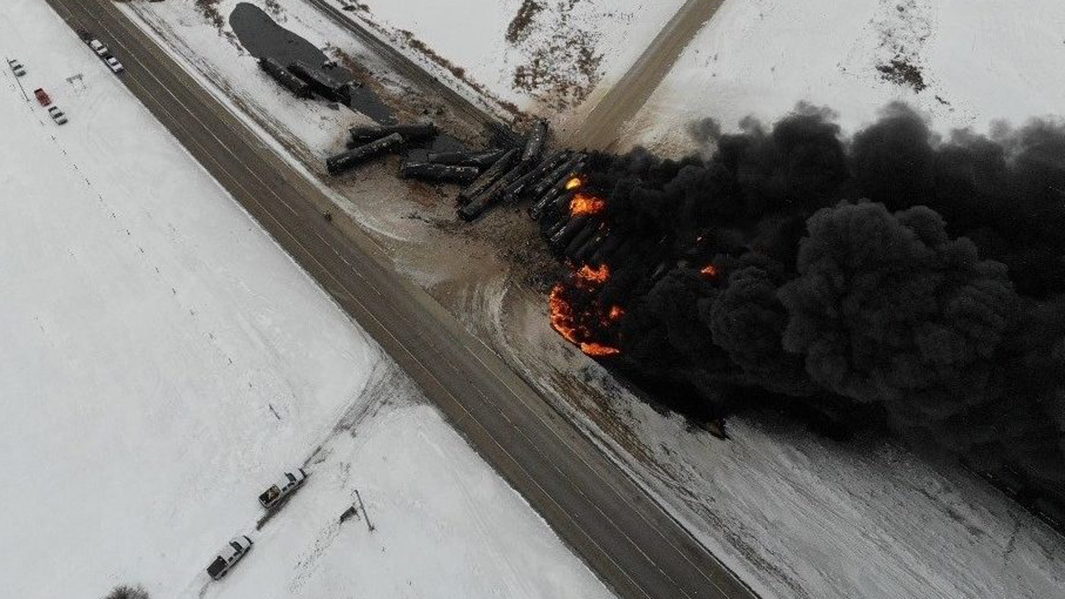
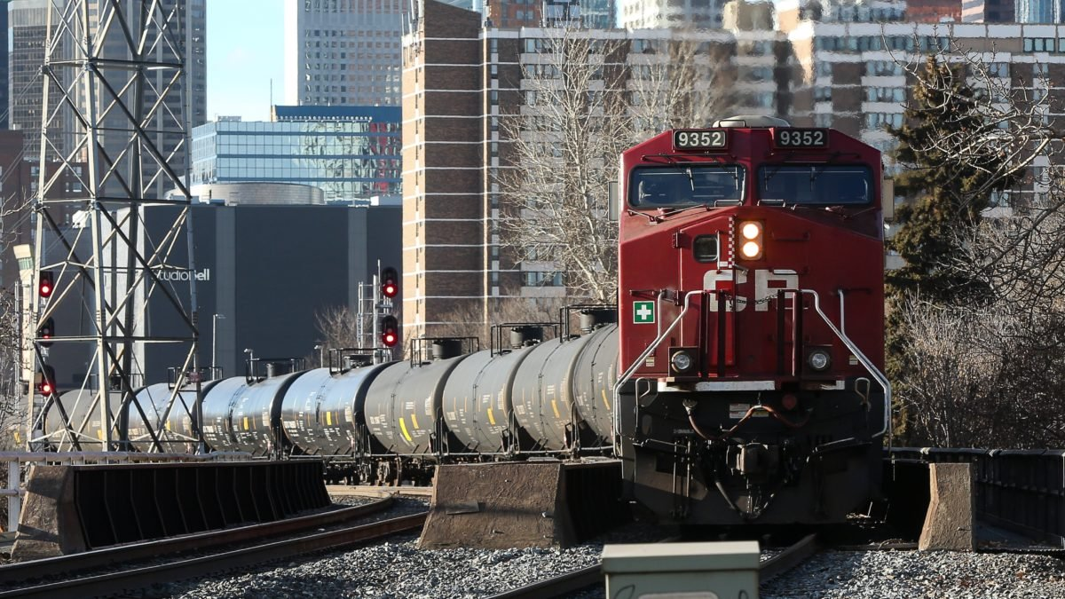
On Feb. 6—the second time in less than two months—a Canadian Pacific tank car train carrying Alberta bitumen diluted with highly volatile petroleum gases derailed near the tiny town of Guernsey, Sask. The derailment created an explosive fire and prompted the evacuation of more than 80 nearby residents.
The rapid-fire incidents echo a similar sequence in mid-winter 2015, when a pair of CN trains carrying Alberta bitumen derailed three weeks apart near the northern Ontario indigenous people’s community of Gogama, with similar explosive results.
By the grace of Great Manitou, nobody was killed or injured in any of the four accidents because they occurred outside of population centers—unlike the 2013 catastrophe that incinerated the downtown of the Quebec town of Lac-Mégantic, killing 47. No one was held criminally responsible for the deaths, after juries refused to convict the three employees of the defunct Montreal, Maine & Atlantic* selected as scapegoats by Canadian prosecutors.
Clearly, there is something amiss in the state of CBR in Canada. Aside from the actions of often-criticized Transport Canada and Transportation Safety Board, the country’s wicked northern winters are definitely a strong factor in these accidents.
|
|
Article 3 -
RAIL SAFETY
Disasters foretold: Boeing 737 Max 8 and Lac-Mégantic
There are some disturbing similarities between the Boeing Max 8 scandal and the July 2013
Lac-Mégantic rail disaster
. Both reveal a predictable pattern.
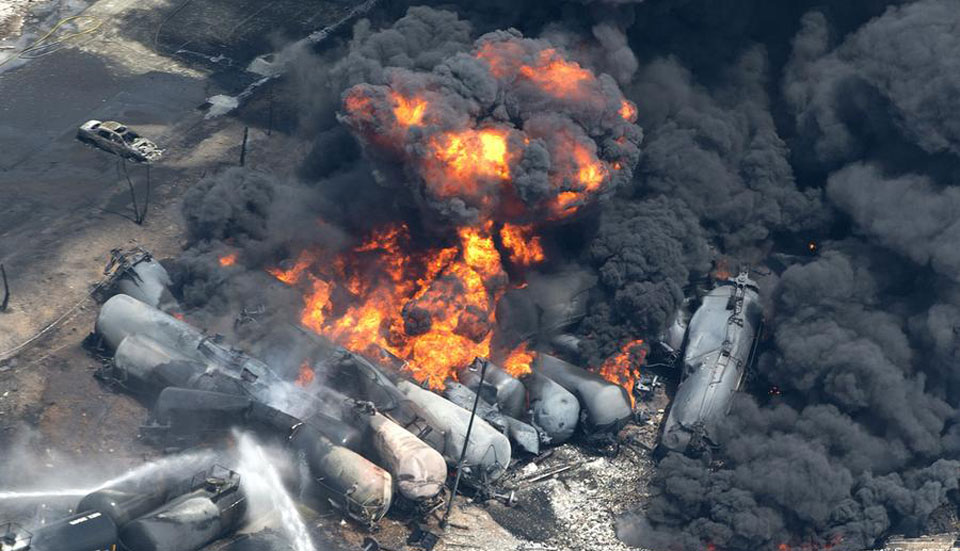
In Lac-Mégantic, a runaway train laden with volatile Bakken shale oil from North Dakota crashed in the heart of the small Québec community, killing 47 people, orphaning 26 children, spilling an unprecedented six million litres of oil and incinerating the town centre. It was the worst industrial disaster on Canadian soil in a century.
Both disasters were the deadly consequence of a decades-long trajectory of deregulation in the aerospace and railway industries. Safety precautions were systematically eroded to the point where the likelihood of an accident became a game of Russian roulette: not if, but when.
In both cases, regulatory agencies were captive to their regulated industries. A revolving door of senior agency officials — moving from industry to regulator and back to lucrative industry lobbyist positions — aided and abetted the deregulation process.
|
|
Article 4 -
RAIL SAFETY
Rail regulators intensify push to advance grade crossing safety
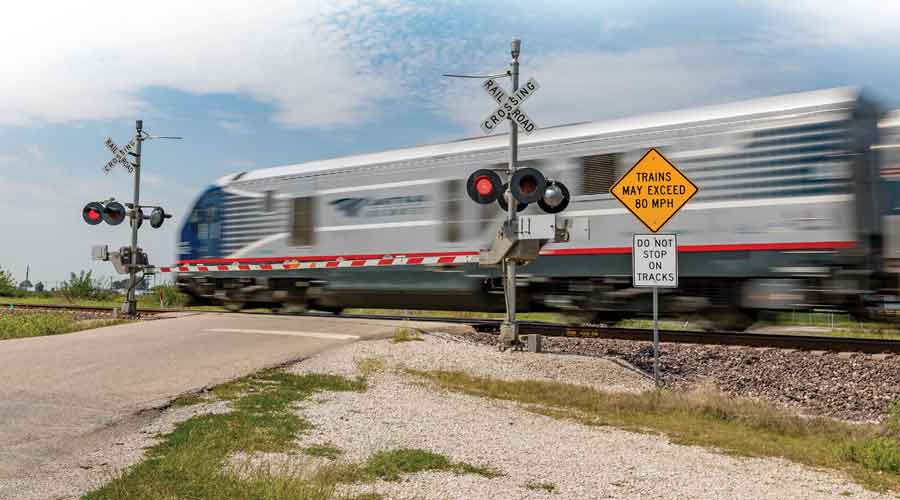
Grade crossing incidents and illegal trespassing on rail property continue to account for about 95 percent of all U.S. rail-related fatalities each year, according to the
Federal Railroad Administration
(FRA). Sadly, most of those incidents are preventable.
The FRA’s most recent data shows that in 2018, there were 2,217 collisions at public and private crossings in the United States, up from 2,123 in 2017, 2,049 in 2016 and 2,080 in 2015. While the number of fatalities resulting from collisions fell to 262 in 2018 from 271 in 2017, the deaths in 2018 outpaced the figures in 2016 (255) and 2015 (237) and tied 2014’s total.
Rail safety experts cite two factors that they believe caused the 2018 increase in collisions: a higher volume of train traffic and a greater number of distracted drivers and pedestrians.
In an effort to further drive down crossing-related incidents and deaths, U.S. Transportation Secretary Elaine Chao last month announced the
U.S. Department of Transportation
(USDOT) has “significant plans” to advance grade crossing safety around the nation. The announcement followed steps the FRA has taken over the past several years to raise crossing safety awareness.
“The department is committed to supporting infrastructure improvements, new communications tools and working to change driver behavior so that highway-rail grade crossings are safe environments for all transportation users,” Chao said in a press release.
The 10 states — Alabama, California, Florida, Georgia, Illinois, Indiana, Iowa, Louisiana, Ohio and Texas — were previously required under the Rail Safety Improvement Act of 2008 to develop crossing action plans, according to FRA officials. The agency proposed the rule in response to the Fixing America’s Surface Transportation (FAST) Act mandate that the FRA promulgate a regulation requiring states to come up with ways to reduce the number of collisions, fatalities and injuries at crossings nationwide.
|
|
Article 5 -
HEALTH CARE NEWS
Track Workers Union Leads the Way in Support for Medicare for All
(Editor's Note: Since we promulgated a Resolution in Support of Single Player Health Care at our Founding Convention in 2008, RWU has been at the forefront of the movement among rail workers to support "Medicare for All.")
EVERYBODY IN NOBODY OUT: THE CASE FOR SINGLE PAYER HEALTHCARE
The freight railroads' bargaining arm (the NCCC) has published its negotiation positions for the current round. As expected, health insurance benefits are chief among the issues where we remain far apart.
The railroads call our current healthcare benefits an "excessively rich plan." They say they are "unsustainable," the costs have been "exceeding for decades," the plan provides "very low member out-of-pocket costs," and is "inefficient."
They also say that railroad employees "are not engaged" in their health, "make poor healthcare decisions," "burden" the railroad companies by making poor "lifestyle" choices like smoking and drinking too much (20 percent higher than the non-railroad public).
You can read it for yourself here:
The railroads also got multi-billion dollar federal tax cuts under the revision of the tax code in 2017. CSX, for instance, received a $3.3 billion windfall from 2016 to 2017. That's just one example.
At the following YouTube link, Brother Mark Dudzic, a former Union president and Chairman of the United States Labor Party endorses and painstakingly explains an alternative to the current, broken healthcare system: a system that would tax corporations and wealthy people in order to ensure everyone -- men, women, children and elderly -- can see a doctor without worrying about financial ruin.
Rich people think that your health, and the health of your family, is just a line item on an accounting sheet. They do not care about you. At least not enough to ensure your affordable access to medical care.
|
|
Article 6 -
PASSENGER SERVICE
Fight Back Against White House Attack on Amtrak's National Network
The Trump Administration’s
proposed Fiscal Year 2021
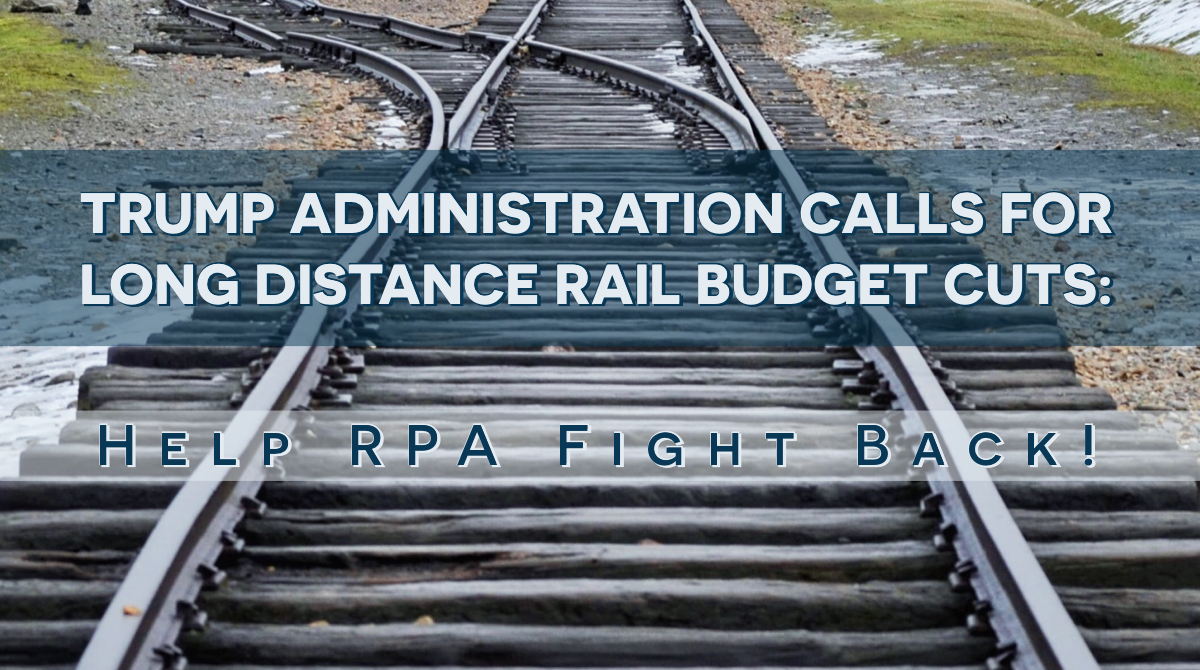
budget once again calls for the elimination of long distance trains, wiping out funding for almost all Amtrak trains except on the east and west coasts. If enacted, 220 cities and towns would lose train service completely and 140 million people will completely lose all access to passenger trains.
Rail Passengers has worked with Congress to successfully shoot down this proposal three years in a row. We need your help to make sure we go four for four this summer. And with the surface transportation reauthorization taking place this summer, we have a real opportunity to enshrine legal protections for the National Network into law, protecting this essential service from any future attacks.
Rail Passengers has been fighting for better passenger trains in America for over 50 years. We're only able to represent the voice of passengers in Washington, D.C. because of your generous support. Your donate today ensures that future generations of Americans are able to experience the joy of riding trains.
Thank you for your time and support,
Jim Mathews, President & CEO
Rail Passengers Association
It is essential that we defend and fight for a modern, national passenger rail network. The Rail Passengers Association advocates on behalf of America's rail passengers for improved, expanded, and safer train service.
|
|
Article 7 -
PSR NEWS
The Truth About Precision Scheduled Railroading
“Precision Scheduled Railroading” – The Real Story
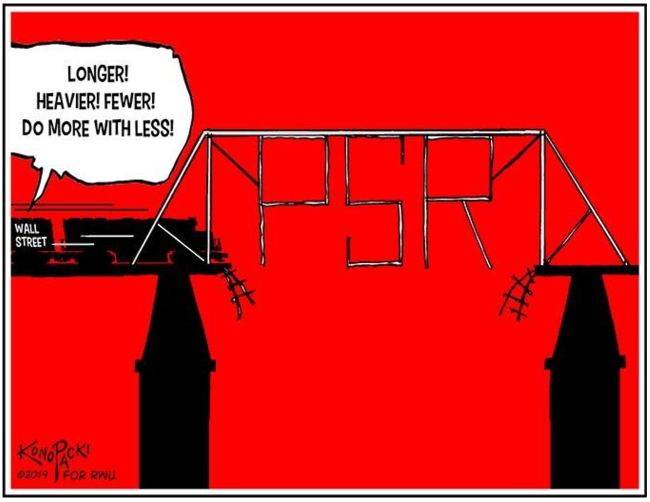
The current railroad industry is not operating with a business model that prioritizes the long term health and vitality of the US economy, environment, or even of the rail industry itself. “Precision Scheduled Railroading” (PSR) is a euphemism for a railroad industry practice that ensures short-term profits for the benefit of the “Wall Street Jackals”, at the expense of the safety and vitality of a great American railroad.
Despite its name, PSR:
- decreases the reliability of freight and passenger services
- drives some freight customers to ship by truck, allowing railroads to circumvent their common carrier obligations
- worsens working conditions; workers on PSR carriers describe a culture that is not conducive to safe operations
- reduces public safety; derailments, fatalities, and collisions have all increased because of PSR
- negatively impacts workers, shippers, communities; railroad investors and executives, however, receive significant financial benefits because of PSR
What is “Precision-Scheduled Railroading” (PSR) and what is its real impact?
PSR began as an industry practice around 2000 and has now expanded to most North American Class One railroad operations. PSR mandates freight trains run on a regular, set schedule. Of the six Class One railroad companies in the U.S., only BNSF has not adopted PSR – and BNSF is the only company whose safety record improved in 2018.
For shipping companies, PSR is not customer friendly. Shippers are now expected to adapt to the railroad’s strict schedules regardless of compatibility with shippers’ needs. When shipping companies are late, the railroad industry is allowed to fine them: in 2018, railroad companies levied a record $1.2 billion in fines against shippers.
|
|
Article 8 -
OPINION
Canada’s railways should stop investigating themselves
"Call it an artifact of history but both Canadian Pacific and Canadian National run their own police forces, with the same legal standing as the RCMP, the Ontario Provincial Police or a local police force and with the same responsibilities to uphold the law. It’s part of federal law."
I
magine if a fatal accident took place at an oil refinery and the police investigation into the causes of the accident was led by the company’s own employees. Or what if a mining company’s personnel was put in charge of investigating a mine collapse that led to the death of several miners?
Sounds ridiculous but that’s exactly what happens with Canada’s two major railways. Call it an artifact of history but both Canadian Pacific and Canadian National run their own police forces, with the same legal standing as the RCMP, the Ontario Provincial Police or a local police force and with the same responsibilities to uphold the law. It’s part of federal law.
Historically, it made some sense for the railways to have their own police. The railways own vast amounts of land and their tracks take them through thousands of kilometres of the Canadian wilderness where policing is rare or non-existent. To have railway police catch trespassers or fine motorists who cross illegally over level crossings doesn’t bother me.
But what in the world are railway police officers doing investigating fatal accidents where corporate negligence by the very company that employs them may be at issue?
|
|
|
|
|
|
|