|
"In 2022 I got the diagnosis of breast cancer. I first received radiation and chemotherapy. The doctors said it was very important that I continue to receive treatment for at least two years… My medicine was too difficult to afford. My doctors and I had to fight and wait until we could find someone who would donate it; I did not have any other option. It was a stressful time." – Anne*
Need and Waste in Oncology
Anne’s story is likely familiar to those who work in oncology. Sixty-one percent of cancer patients and survivors find it difficult to afford their care. Low-income patients are more likely to delay or skip filling a prescription to save money and are more apt to cut pills in half to reduce costs.
At the same time, an estimated $2 billion worth of oncology medication is wasted every year. Cancer patients regularly have extra medicine from prescription changes, adverse reactions, recovery, or other circumstances. Most of this surplus is currently going unused, either being disposed of or remaining in the hands of an individual until it expires.
Disposal isn’t only wasteful, it’s also harmful; there is no satisfactory disposal method for oncology drugs, and compounds are increasingly found in water sources, including drinking water. These compounds are harmful to the environment and living organisms, and there is risk of uncontrolled spread with no way to remove the contamination.
The Solution
Fortunately, an alternative exists.
SIRUM (Supporting Initiatives to Redistribute Unused Medicine) is a nonprofit that expands health care access for families in need by leveraging the $11 billion of surplus medicine wasted annually. Under state Good Samaritan drug laws, we help collect unopened, unexpired medications from medicine donors and provide them to patients through a network of community partners.
Through our donation platform for individuals, we’ve helped patients donate millions of dollars’ worth of medications, including expensive specialty and oncology drugs.
Donating medicine can be deeply rewarding. Patients are motivated by the opportunity to support others facing similar challenges, and families find comfort in being able to donate their loved one’s medications, paying it forward in their honor. As one donor told us, "I can’t describe the pleasure and satisfaction I am getting from being able to pass on this extremely expensive, yet unused medication."
Drug Repository Programs
SIRUM works hand-in-hand with local repository programs in many states with drug donation laws that allow for individuals and institutions to collect, donate, and distribute donated medications. The Ohio State University Comprehensive Cancer Center – The James is a great example of a cancer center that has taken advantage of the drug donation laws in its state to collect surplus medicine. They have redistributed millions of dollars’ worth of oncology medicine, saving medication from destruction while helping their patients in need.
However, sometimes a wider network is needed to match surplus with demand. Not every medicine donated at The James can find a home with a patient at the same hospital. This is where SIRUM can help. Leveraging our national network, we can match their surplus medicine with need elsewhere.
In fact, it was this exact situation that allowed us to get Anne the medicine she needed in Illinois. We connected her with surplus oncology drugs from The James in Ohio, giving her life-saving treatment when no other options were available.
"When I learned I would receive [my] medication for free, I was very emotional. It gave me hope that I would survive. Donating cancer medication is important because it gives patients like me the possibility of living longer and having more time with their family."
Referral Partner Program
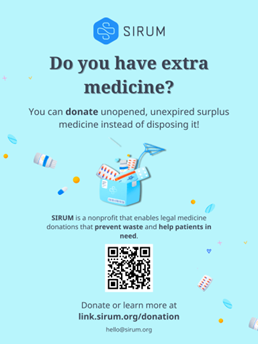
If you’re interested in promoting medicine donation but do not run your own repository program, we welcome you to join SIRUM’s network as a referral partner. You can simply share a flier (see image below) with patients who have surplus medicine, allowing them to donate their surplus medicine through SIRUM, and we’ll help get it to a patient in need. Supporting this program benefits people across the country. The more people who donate their medications, the likelier we are to be able to match surplus medicine with need.
|