Lawyers Committee on Nuclear Policy
April 2021 Newsletter
Happy New Year!

This spring marked one year since the beginning of the COVID-19 pandemic, and we continue to collectively face undeniable hardship--certain communities far more than others. Lawyers Committee on Nuclear Policy condemns all violence against the AAPI community and stands in solidarity with our neighbors and colleagues.

Even as vaccination rates are on the rise one year later, as President Biden nears his hundredth day in office, so much work remains. We continue to work hard for a more just and peaceful world--one without nuclear weapons and the omnipresent militaristic violence they represent. 

Biden made a promise to promptly rejoin the Iran deal, but this has yet to happen. The president himself said: “the only way out of this crisis is through diplomacy.” We urge Biden to prioritize rejoining the JCPOA and to fulfill his promise. This action will prove significant as we approach the rescheduled NPT review conference this August. In addition to preparing for the NPT review conference, we are also looking toward the first meeting of states parties to the TPNW, anticipated by January 2022. 

This spring, LCNP has been active in our education and advocacy efforts by participating in a number of important webinars, conducting analysis of developing issues in nuclear policy, and engaging emerging voices in the field as well as frontline communities. Take a look at some of LCNP's recent work below, connect with us across social media, and please consider supporting our peace-building work financially.

Your generosity sustains our abolition advocacy!
‌
Reckless Spending to Increase Nuclear Danger
LCNP Senior Analyst, John Burroughs was one of three panelists for this event hosted by the NGO Committee on Disarmament, Peace and Security. The conversation centered around an alarming upcoming US Congressional budget item: hundreds of billions of dollars devoted to building new nuclear weapons. Below is an excerpt from John Burroughs' remarks:

The picture for all nine nuclear-armed states is grim. Today we are talking about one nuclear-armed state, the United States, which has long served as a pacesetter.

The United States is planning to replace and upgrade essentially its entire nuclear arsenal, delivery systems and warheads.

From the Trump years, already a low-yield warhead has been deployed on submarine-launched missiles. And a submarine-launched cruise-missile is in development, which would replace a capability discontinued during the Obama years. Hopefully the Biden administration will withdraw the low-yield
warheads and end development of the submarine-launched cruise missiles, but those decisions have yet to be made.

Over the next three decades, the replacement program will cost on the order of $2 trillion dollars including maintenance of existing and replaced forces. The US currently spends more than $30 billion annually on its delivery systems
and warheads, with another roughly $20 billion spent on environmental management, health costs, and military and intelligence functions related
to its nuclear forces.

This program is contrary to US obligations under NPT Article VI, which requires good faith negotiations on nuclear disarmament. 2020 was the
50th anniversary of the NPT; 50 years was certainly a sufficient period for fulfillment of this obligation if pursued in good faith.

Yet the US is planning for at least several more decades of reliance on nuclear arms; time horizons reach into the second half of this century. Moreover, Article VI requires negotiations on cessation of the nuclear arms race at an early date. In certain respects, US plans definitely qualify as nuclear arms racing,
notably with respect to the planned air-launched cruise missile.

The legal obligation to disarm is not the only relevant legal element. The US is bound, and recognizes it is bound, by the law of armed conflict, international humanitarian law. In short, nuclear arms cannot be used in compliance with that law, or with human rights law. That means the US is relying for the indefinite future upon weapons that must not be used from a
legal standpoint or any standpoint.
***
Read John's full remarks here and panelist
Jacqueline Cabasso's remarks here.

The Enduring Nuclear Threat: A Deeper Look
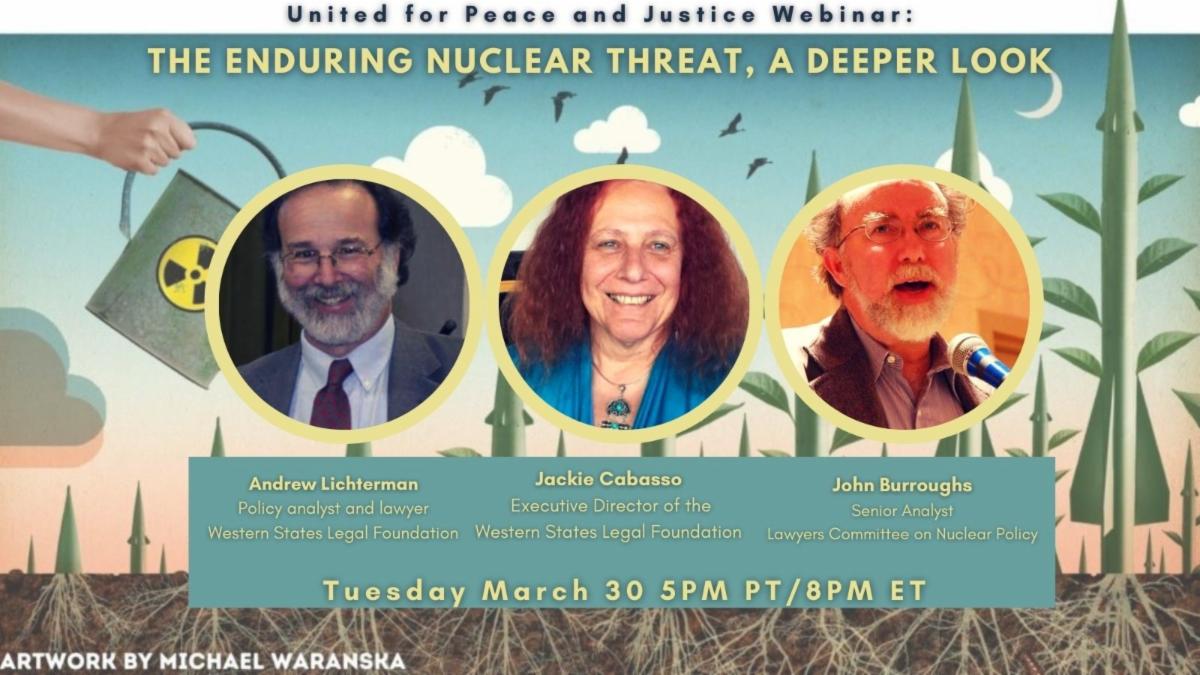
On March 30th, LCNP's John Burroughs was one of three panelists, alongside Jackie Cabasso and Andrew Lichterman of Western States Legal Foundation, on this webinar offering an update on nuclear weapons policies and programs as well as an overview of relevant developments in international law.

Panelists addressed the need to rethink familiar approaches to disarmament and to shift the focus of disarmament advocacy from recognizing the effects of nuclear weapons to analyzing the causes of nuclear arms racing and the risks of war among nuclear-armed countries.

United for Peace and Justice hosted this discussion and offers background reading on the issues here. A recording of the event is forthcoming.
LCNP's Newest Staff Member


We are pleased to announce that LCNP Fellow Danielle Samler is our new Administrative and Research Officer. She is excited to continue working with LCNP in this capacity and become a full member of the LCNP staff.

Danielle is a 2019 graduate from the University of Toronto where she received an Honors B.A. in Peace, Conflict, and Justice, with a double major in History.

Apart from her work with LCNP, Danielle works for the Women's Regional Network and performs contract paralegal services for attorneys representing indigent clients. Her areas of interest and research include, the arms trade treaty, Russian history, cybersecurity, and international humanitarian law.

We're so pleased to continue working with Danielle!
"Waking up Generation Z" published in the Peace Review Journal

LCNP Officer Danielle Samler co-authored an article with Christian Ciobanu of Nuclear Age Peace Foundation on the importance of youth mobilization, political engagement, and nuclear disarmament. This paper discusses how to revive the legacy of the bombings of Hiroshima and Nagasaki with today's youth. Please find an excerpt below and the full article here.

***
Introducing the synergy between law and the humanitarian impact of nuclear weapons will give youth the necessary tools to take on these issues practically. This legal analysis could take the form of guest lectures about the legacy of the atomic bombings within the context of international humanitarian law, international law, and the law of future generations. Students could study the International Court of Justice cases relating to nuclear weapons, including the 1996 Advisory Opinion on the Legality of Threat or Use of Nuclear Weapons and the nuclear disarmament cases brought by the Marshall Islands against India, Pakistan, and the United Kingdom. They could also study international treaties and their significance, analyze relevant legislation, and analyze states’ legal positions regarding nuclear weapons.

Another way to embed international law in the fight for nuclear disarmament is to analyze human rights bodies such as the UN Human Rights Council and the UN Human Rights Committee. These bodies frame human rights within the context of international law, further legitimizing the moral and ethical argument for human security over national security. One such example is paragraph 66 of the Human Rights Committee’s General comment 36 on article 6 of the International Covenant on Civil and Political Rights, on the right to life, published in October of 2018. Paragraph 66 states that nuclear weapons are incompatible with the right to life and may amount to a crime under international law.
***
Recommended reading:
  • A new study highlights the depth of France's lethal legacy of nuclear testing in French Polynesia. The investigation found that one particular 1974 atmospheric test affected the entire population, not just those in the immediate testing zone.

  • "China is the rationale du jour" for Biden's maintenance of an exorbitant Pentagon budget, estimated to be well over $700 billion pr year and due for release on May 3.

  • Democrats in congress are pushing new legislation to transfer $1 billion from a new ICBM to the development of a universal COVID-19 vaccine. The act is called "Investing In Cures Before Missiles" and would halt funding of the proposed new missile called the ground-based strategic deterrent. Read more here.

  • "The first step in eliminating nuclear weapons is realizing how speculative our ideas about them are, and therefore concluding that caution is necessary in accepting attitudes and assumptions born during the Cold War."
Lawyers Committee on Nuclear Policy