|
Hi Jerry,
I’ve always wanted to write a Fourth of July story, but I couldn’t come up with an idea that hadn’t been done by someone else before, or several someone elses, until I remembered Ernie Guest whom I used in a James Early story. Ernie was a Marine who came home at the end of WWII after surviving the fighting on Iwo Jima. He came home suffering from the horrors of war, telling only one person about it, the man who would become his best friend—Buck Thompson. I introduced Ernie and Thompson in an election day story—the story you read here last week—a story I wrote 15 years before I wrote this one.
This story is as appropriate for Veterans Day as it is the Fourth of July. Veterans Day, the day we honor all those who served.
The Man Left Behind
GLADYS MORTON leaned from her chair far enough that she could see into James Early’s office—Morton, the blue-haired secretary who believed she ran the sheriff’s department. “Sheriff,” she called out, holding her hand over her telephone receiver’s mouthpiece.
Early, his feet up on his desk, folded down the copy of the Drover’s Journal he had been reading. “Yeah, whatcha got?”
“Buck Thompson’s on the line. He won’t tell me why he’s calling.”
“And that bothers you?”
“Darn right. Says he’ll only speak to you.”
Early swung his feet down. He sprang from his chair to the door, closed it, then picked up the receiver from his desk telephone. “Buck?”
“Jimmy? You alone where no one can hear us?”
“Just a minute.” Early pressed his receiver’s mouthpiece to his chest and hollered toward the door, “Gladys? Hang up.”
He put his receiver back to his ear and heard a click on the line. “All right, Buck, it’s just you and me now.”
“Jimmy, Ernie Guest is dead. You need to get out here.”
Early snatched a pencil from the Campbell’s Soup cup in which he kept his collection of writing utensils and hunched over his desk pad, ready to write. “Where’s here?”
“The bluff behind Liloam School. And you come alone.”
________
EARLY TURNED OFF the county road onto the lane that led to the Liloam School and beyond, Liloam the country school where Buck Thompson had taught all eight grades when he came home from the war. Since, he had gone back to K-State for graduate work and had stepped up to teaching science classes at Leonardville High School.
Doc Grafton, in the shotgun seat of Early’s Jeep, squinted at the schoolhouse, its paint blistered and peeling, as they motored by. “He’s not going to like it that you brought me along.”
“Well, it’s a death,” Early said. “Kansas law says you have to do your job and determine and report the cause.”
“Yeah, maybe. My wife’s on me to give this up.”
“Doc, you’d get bored just being a doctor. You like a mystery.” Early pulled off at the base of a bluff and eased his Jeep in between a county road grader and a Studebaker sedan he knew Thompson drove. He stepped out onto the dirt turned to dust by weeks of a beating sun and looked up. Early gave a quick wave to a man above him, at the top of the bluff, the sky beyond cloudless and the merciless sun baking the day.
The man waved back but stopped when Grafton eased his bulk out of the passenger seat. “I thought I told you to come alone.”
“Sorry, Buck, the law says the coroner has to be here.”
“If he comes up, I’ll pitch him over the edge.”
Early shrugged and thumbed Grafton back in the Jeep. He then hiked around to a trail and made the climb to the top. There before him sat Thompson on a rock, at his feet a blanket that covered something Early assumed was a body. “Ernie?” he asked as he mopped the sweat from his face with his sleeve.
Thompson made a half-hearted gesture toward the blanket.
Early came closer. He knelt on one knee and lifted the blanket back, revealing the head and torso, the torso in a tee-shirt, the tee-shirt green and faded from too many washings. The way the upper part of the body laid, with the head turned to the side, Early could see it, a portion of the back of the skull gone—blasted away. He peeled the blanket back some more until he could see one of the man’s hands, in it a pistol. Early took note of the service insignia on the grip—Marines—the pistol a standard issue Colt Forty-five, this one a war souvenir. Early, too, had kept the Forty-five he’d lifted from a dead officer when he mustered out of the Army. He looked up at Thompson, Thompson’s eyes red, his hair disheveled. “What do you think, he ate his gun?”
“Jimmy, I never saw it coming. Ernie was such a quiet guy. You met him at the Grange hall last year. He was one of my election judges.”
Early pushed himself up. He took his time slapping the dust out of the knee of his tan trousers. “I remember him.”
“He drives—drove—drove that grader down there for the county. He was a Marine in the South Pacific, did you know that?”
“You told me.”
“Everyone in his platoon, Jimmy, they were all killed at Iwo. He was the only survivor, and he felt terrible about it. Guilt, you know. When the memories would get too much for him, he’d come up here and draw, scenics, never any people. Ernie got to be real good over the years.” Thompson held up an artist’s pad. “I found this over by the edge of the bluff, a stone on it and a note under the stone saying he wanted Eldora Wilson to have the pad. She was one of my election judges, too.”
“I remember her.”
Thompson rubbed at his leg where his artificial limb fit up around his stump. “Climbing up here twice raised hell with my stump. Man, it hurts.”
“Twice?” Early asked.
“I had to go down to get to a phone to call you, then climb back up here with the blanket from the trunk of my car, from my winter survival kit.”
“It’s nearly July.”
“I keep it in my car year round.” He straightened the fabric of his trouser leg before he stood up. “Jimmy, you can’t call this suicide.”
Early swept his hand over the body. “Everything here points to it.”
“You don’t understand.”
“Apparently not.”
“Ernie’s memory with his friends doesn’t need suicide hung on it. The talk it’d create, and he’d be denied military rites.”
Early moved away to think. He paced. After some moments, he went over to the edge of the bluff and called down to Grafton, “Doc? Come on up.”
Grafton waved, and Early went back to Thompson paging through Guest’s art pad. “How’d you know Ernie was up here?”
Thompson closed the cover and used the pad to fan himself. “When I drive by, I always look to see if the road grader’s here or Ernie’s pickup. If one is, I stop and come up and we talk for a while. This morning it was the grader.”
“He have any family I should notify?”
“Not really.”
“Meaning?”
“Ernie’s parents, they died some years back.”
“Brothers? Sisters?”
“He did have one sister.”
“Where’s she?”
“Don’t know. She moved away during the war and Ernie lost contact with her. By now, she could be married with six kids or be dead herself.”
“A wife?”
Thompson shook his head. “Never married. So for a family, about the closest he had was Eldora and I guess me.”
Grafton topped the bluff and huffed his way over, fanning himself with his hat. “That’s one helluva climb,” he said. “So what have we got here?”
When neither Early nor Thompson answered—both stood looking off at the horizon, in the direction of Fort Riley, the big Army reservation less than a dozen miles away—Grafton went over to the body. He gazed down at it, the top half exposed to the world. “Good Lord, he blew his brains out.”
Early sighted a red-tailed hawk circling, drifting toward the bluff. Had to be a red tail from its blunt profile. “Is that what you’re gonna put in your report?”
“Suicide? The evidence is right here.” Grafton gestured at the pistol.
Early turned around, his hands in his back pockets, sadness creasing his face. “Doc, Ernie, Buck, me and you, we were all in the war. The only ones who got any peace out of it were the dead. Those who came home, a lot came home damaged. Ernie was one, maybe you didn’t know that. Doc, he doesn’t deserve to be branded with suicide, so call it something else.”
“But people will know.”
“Only the three of us. Well, four. Brownie at the mortuary ’cause he’s gonna get the body. He won’t tell and neither will we.”
“But the funeral—”
“Closed casket.”
Grafton sighed. “Well, I suppose I could put down heart attack. That’s what kills most people who don’t die of old age, so nobody’ll question it.”
Early massaged Grafton’s shoulder. “Thanks.” He motioned to Thompson, waved for him to join him at the body. Together they lifted the blanket away and laid it on the dust.
The smell released by the air hitting the soaked trousers of the dead man—Early winced. “We sure do mess our britches when we die, don’t we?”
Thompson sat back on his heels. “We could strip off his pants—”
“No, this has been degrading enough for him. He doesn’t need to be half naked. You take his shoulders now. I’ve got his ankles. On three, we lift him onto the blanket.”
Early made the count, and, on three, he and Thompson hefted the body over to the blanket and wrapped it.
Early came up in a crouch. He worked his hands under the body and lifted, hoisted it up and across his shoulder. “I’ll tote him down,” he said as he straightened up under his burden. “We’ll put him in the back of my Jeep.”
________
EARLY DOODLED on the pad on his desk, his telephone’s handset pinched between his shoulder and the side of his head. “That’s it? You’re not gonna give us a caisson?”
A man’s voice came back over the handset, a rumbling baritone. “Can’t do it, Jimmy. He wasn’t Army.”
“Punch, you’re gonna quibble about that?”
“I don’t make the rules. I tell you what, I can detail an honor guard to be there.”
“Forget it. I’ll get some Marine vets to do the job.” Early hung up. He wanted to slam the handset into its cradle, but what good would that do? It’d still only be a click on the line.
Thompson, cleaning his fingernails with his pen knife, stared at Early. “No luck with the adjutant?”
Early shook his head.
“I didn’t have high hopes, but the casket on a caisson and a four-horse team pulling it to the cemetery, that would have been something.”
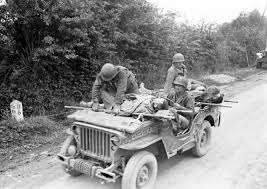
Early started a new doodle that took the shape of a Jeep. He continued it, adding a casket riding on the back and a flag draped over the casket. Early turned his doodle to Thompson. “How about this? A lot of the dead were brought off of battlefields on Jeeps.”
________
RED VOLMER, microphone in hand, elbowed his way through the crowd on the sidewalk to the curbing. He glanced back and up to the window of K-MAN’s second-floor studio and shot his pointer finger at his engineer.
“This is Red Volmer,” he said into his microphone, turning back to the street. “I’m here at curbside to bring you all the details of Manhattan’s Fourth of July parade in this, our station’s first live broadcast of this event.”
He held his microphone, the cord wrapped around his arm, above the heads of those around him and aimed it down the street, shouting up at his microphone, “You hear it now, the muffled drums? That’s the beginning of the parade. The first unit is moving this way.”
Volmer brought his microphone down, and, as he did, he stepped out into the street for a better view. “It’s a color guard,” he said to his microphone. “People jamming the sidewalks, as the flag gets closer, they’re taking off their hats and caps and putting their hands over their hearts. Some are saluting. I can see them now. The color guard is made up of Marine Corps veterans from the Second World War. Hard to believe that war ended only eight years ago, isn’t it, and we’re now in a war in Korea.
“Behind the color guard, I can see, is a drum corps. They’re from the Pearce-Keller American Legion Post, I know that. Behind them, oh, it’s a Jeep. And there are more Legionnaires. They’re marching on either side of the Jeep. I’m going to get closer to see if I can get you the story here.”
Volmer retreated, and the color guard and the drum corps passed by. After they did, he saw a break between the marchers who followed and shot through them to the Jeep. There he jammed his microphone in the face of the driver, James Early, Early in his Army dress uniform, a single chevron on the sleeve. “Sheriff, can you stop a sec?”
“No, but how about I slow down?”
“All right. Tell us about this. I see you’ve got what looks like a casket on the back of your Jeep, and that’s an American flag draped over it, right?”
Early motioned for his partner in the passenger seat—Buck Thompson, also in Army Class A’s—to take the question.
Thompson leaned into the microphone. “Ernie Guest died a couple days ago. He was a World War Two vet, a Marine in the South Pacific—Iwo Jima. You know the picture of the men raising the flag on Mount Suribachi? The company Ernie fought with made that possible, so we in the Legion post thought this was a good way to honor him. We’re gonna end up at the cemetery after the parade. Maybe you’ll want to be there.”
Volmer, at the end of his microphone cord, pulled away, not sure what he should say as the Jeep drove on, the honor guard keeping in step with it. The sound of a band blaring out Semper Fidelis, the Marine Corps march, caused him to turn. “It’s the high school band,” he said as he stepped back to the curb.
________
THE LEGION POST’S rifle squad triggered off their volley, the sound fading away among the trees that softened all sounds at the Sunset Cemetery. Two members of the honor guard, both wearing white gloves, took that as their cue to lift the flag from the casket and begin the slow, measured ceremony of folding the flag. Early and Thompson watched. When the guardsmen finished, one presented the flag to Thompson.
Thompson choked. After some moments, he stammered to the guardsman, “This, uhm, this flag . . . ah, this flag will fly in front of the Grange hall where—you know, I didn’t think this would be so hard for me, but it is.” He snuffled and passed the flag to Early.
Early, surprised, glanced at Thompson tearing up. He looked to the guardsman. “What Buck wants to say is that Ernie Guest served on his team of election judges. Their polling place was the Cottonwood Grange hall. He’s sure Ernie would be proud that this flag will be there.”
The guardsman stepped back one pace. He gave a slow, deliberate salute to Thompson and to Early, did an about face and, with his partner, marched in slow-step away.
The graveside service concluded, others drifted off, most of them war vets, Early knew, most in uniforms that still fit, some in battle fatigues, a few from World War One in their Sunday suits and Legionnaire overseas caps.
He and Thompson lingered. They watched a cemetery crew fill in the grave at the head of which was rooted a white cross with Guest’s name, dates, and service details carved into it, a white cross like those in the line to their right, most of them placed there as memorials to Riley County husbands, fathers, and sons killed overseas.
Early slipped the flag back to Thompson.
Thompson held it to his chest and gazed at the now closed grave, the soil mounded up, the cemetery crew walking away. “This is a good thing we’ve done, don’tcha think, Cactus?”
“Yeah. Just wish we could have gotten a caisson.”
“Really I think the Jeep was better.”
“Yes, it did work.”
With the toe of his shoe, Thompson pushed a crumble of dirt up onto the side of the mound over the grave. “Well, Ernie’s no longer the man left behind. He’s with his buddies, his platoon mates killed in that damn war that killed so many. Will we ever be able to forget it?”
Early put his arm around Thompson’s shoulders. “Not likely, Buck. No, not likely.”
Until next time, keep reading.
Jerry & the Sheriff
|