|
The Egret - Volume 42 - Issue 2 - June 2026 |
|
April Members' Meeting - Entomology!
By Sheila Laurin
| |
At the Wednesday meeting, 8 April 2026, Dr. Lauren Des Marteaux gave us a presentation about her role as a research scientist studying insects with the Department of Agriculture and Agri-Food Canada (AAFC), located at the Harrow Research and Development Centre. She is also the President of the Entomological Society of Ontario (ESO),Entomological Society of Ontario - ESO Homepage and encouraged us all to join the society and/or follow them on social media. The Canadian National Collection (CNC) of Insects, Arachnids and Nematodes is housed at the Ottawa Research & Development Centre, and there is a Montreal Insectarium, in Montreal, Quebec one can visit.
The study of insects is a specific branch of zoology and represents more than half of all animal species. There are many insect species identified (approximately one million in the world) and there are still more being discovered. They are a diverse group and vary in colour, size and behaviour. The website Bugguide.net is a comprehensive site to learn more about them and their identification. If interested more in insect identification citizen science, there are two phone applications - Seek and INaturalist which are very useful. Another interesting aspect of some insects is the sounds they make. The Singing Insects of North America (SINA) website and songsofinsects.com have more information about this particular topic.
Insects play a role in decomposition, nutrient cycling, pollination and are a key part of our ecosystem. Studies show that there has been a decline in insect populations and they are being monitored for trends. A species that can be detrimental to agriculture is the spotted lanternfly. The tree-of-heaven is one of its preferred host plants. The fact sheets regarding this insect show what it looks like in its various stages, from egg mass, nymph and adult.
Dr. Lauren, showed us some examples of the kind of projects she and her team work on. Some insects she has studied include the malt fly, hover fly, cereal leaf beetle and gall midges. Some of these insects have natural predators and can be identified down to the DNA level using a microscope.
|
| | |
Little River Spring Clean-up 2026 - Teedie Park #19
By Gina Pannunzio, Madison Dugdale and Ian Naisbitt
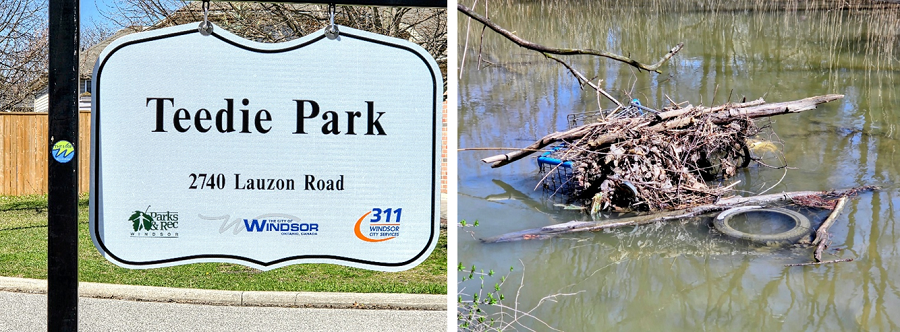
The area targeted for the Little River Spring Cleanup, Teedie Park, is not well known. It is located in the East Windsor area and is adjacent to the Canadian Tire Store on Tecumseh Road East. This section of river is between Lauzon Road and Tecumseh Road.
| |
The weather forecast: clearing this morning, high of 11 C, UV Index 6 or high.
Not surprisingly, this is the 19th time this area has been cleaned up. Frustratingly,
it seems to be the convenient dumping ground for shopping carts and automobile tires. Several times our volunteers have cleared the river of these items, only to have them reappear at the next river cleanup. The typical litter collecting along the natural area can be explained from the Winter winds blowing the litter across the adjacent parking lot.
Sixty-five volunteers came out to the Little River Watershed and participated in our annual litter cleanup. Together, we removed 1,553.5 lbs (706 kg) of litter and debris.
We are grateful to all the watershed partners who contributed to this event; we could not have made such an impact without you! A “Tip of the Cap” to the Essex Region Conservation Authority, Detroit River Canadian Cleanup, Little River Enhancement Group, and the City of Windsor for your support, partnership, resources and efforts!
| |
Wildlife observed by sight or sound were:
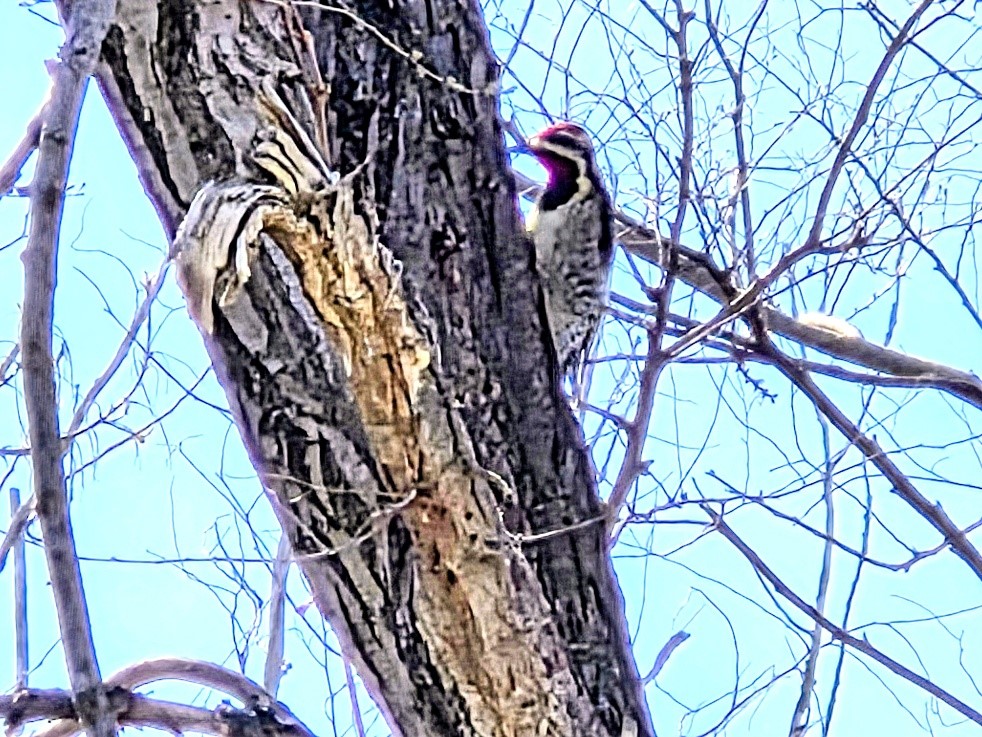
American Robin, Eastern Squirrel, Common Grackle, Northern Cardinal, Red-winged Blackbird, Downy Woodpecker, and Yellow-bellied Sapsucker (shown in photo).
|
| |
Acknowledging the Land of the Caldwell First Nation and Resources to Support
By Jeremy Hatt (Land Acknowledgment by Julie Read)
At the beginning of every Birding With Pride at Point Pelee, it’s important that we start the event with a Land Acknowledgment. This year, Julie Read, hike leader and volunteer at Birding With Pride, wrote a Land Acknowledgment that I would like to share. It includes a brief history of Caldwell First Nation in Essex County and ways to support and build relationships.
“I am deeply thankful to be gathering on this land, the traditional territory of the Anishinaabe Three Fires Confederacy: the Ojibwa, the Odawa, and the Potawatomi. This is the ancestral home of Caldwell First Nation, who have lived on the lands of Point Pelee and the surrounding area since time immemorial. This land is also part of the house of Walpole Island First Nation. In addition, this land has been walked on and cared for by the Attiwonderonk, Mississauga, and Myaamia/Miami peoples..."
- Click READ MORE below to see the entire acknowledgement.
Further information on the Caldwell First Nation Powwow at Point Pelee National Park will be updated on their website: https://caldwellpowwow.ca/. The Powwow will be held August 7, 8, and 9 just west of Caldwell Gas & Variety on Mersea Rd 1. Stay tuned to the website for more details.
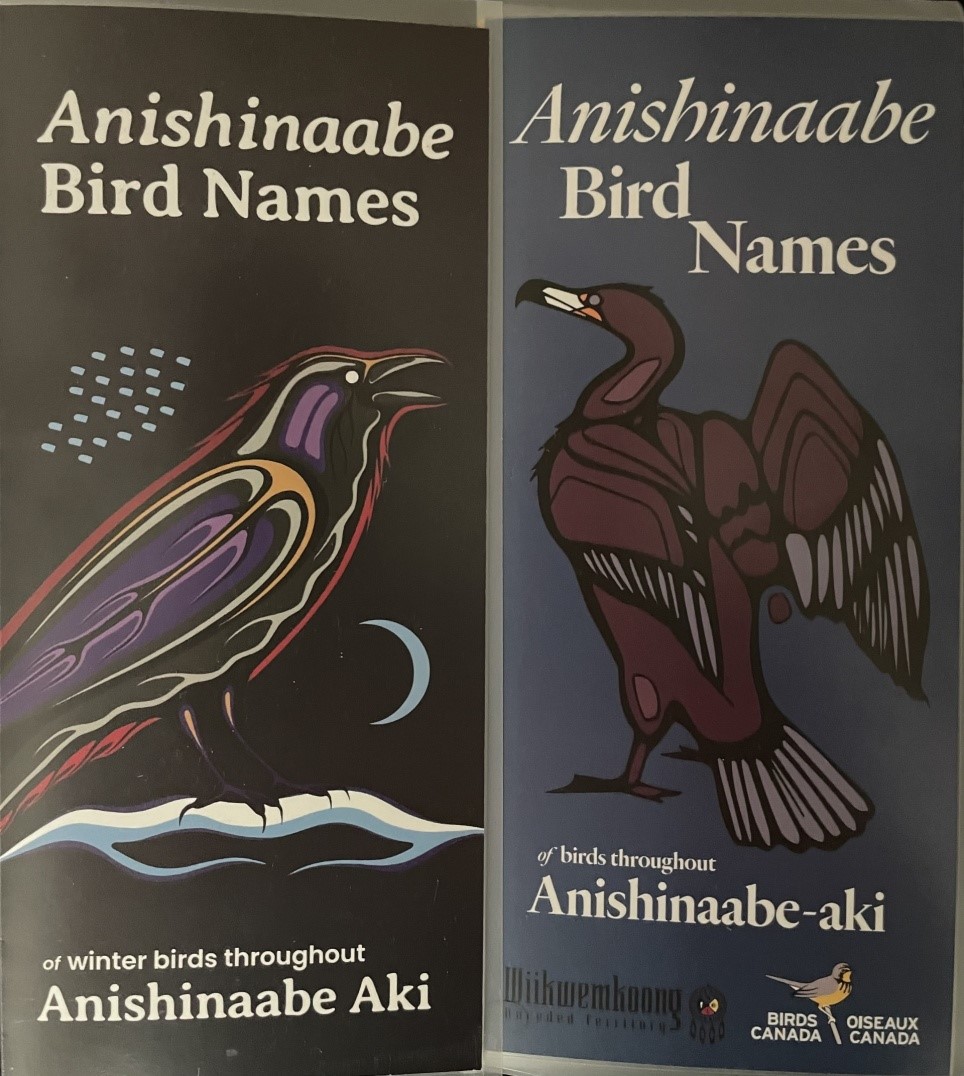
| | More information on Creator’s Garden Birds, inclding the two books to the right, can be found at https://www.creatorsgardenmarket.ca/general. Creator’s Garden Birds is made up of Joe Pitawanakwat (Founder and Director), Andrés Jiménez Monge, and Junaid Shahzad Khan who are “dedicated to regathering and the education of bird names and significant Indigenous bird knowledges, these knowledges that help us live the life The Great Lakes region has to offer, Mino Bimaadiziwin, A good life.” | | |
Birding with Pride 2026
By Jeremy Hatt
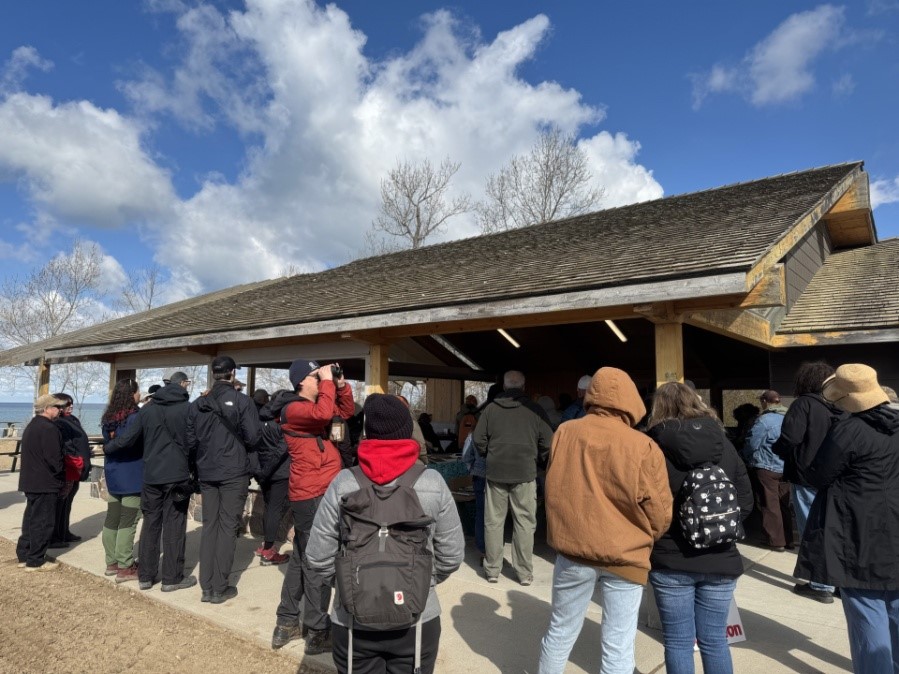
| | Birding With Pride at Point Pelee National Park continues to be one of the highest-attended annual events offered by the Ontario Field Ornithologists (OFO), and ECFNC was proud to be there to support again this spring. Kicking off the Festival of Birds on the first Saturday of May, the event was well-attended by well over 100 people celebrating the 2SLGBTQIA+ Community. | | Creating a respectful, welcoming, and accessible environment is always the priority of the event; a chance for members of the LGBTQ+ Community and allies to meet, bird, and build community. Now in its fourth year, Birding With Pride has become an annual tradition for plenty of birders, but continues to be the first time going birding for many! | | | |
Birding With Pride is held at Northwest Beach and offers morning and afternoon hikes on the Marsh Boardwalk, Centennial Trail, West Beach Birding Footpath, and the Blue Heron Seasonal Trail. Coffee, snacks, and refreshments are provided by OFO and this year, we even started a campfire next to the Northwest Beach Pavilion where attendees huddled together for warmth, made smores, and roasted marshmallows.
ECFNC members were on hand to help lead hikes and coordinate the event. This year the Club provided further support by coordinating transportation via the South Essex Community Council (SECC) to and from Leamington. This was coordinated with Diversity Dignity Leamington, a Spanish-speaking support group for the local 2SLGBTQIA+ Community that provides a safe, welcoming environment for newcomers and residents to connect, receive support, and access essential resources in their native language. 16 people attended the event as a result of these efforts, and for many them it was their first time visiting Point Pelee. Transit through SECC was funded by the Government of Canada’s Gender-Based Analysis Plus grant, which was awarded to ECFNC this year to “support programs and products that are more inclusive, accessible and effective for a wider range of people, ensuring fairness and equal opportunity for the peoples of Canada.”
| |
May Members' Meeting - Migratory Bird Day
By Chris Hart
| | |
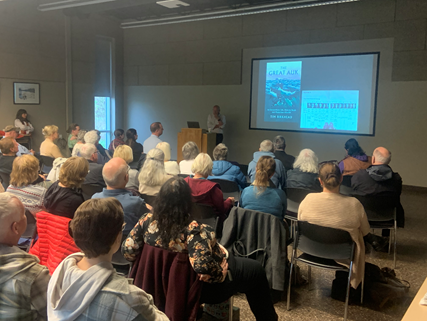
For the May members’ meeting, ECFNC partnered with Pelee Island Bird Observatory (PIBO) to host a special presentation in honour of World Migratory Bird Day – British ornithologist Dr. Tim Birkhead. World Migratory Bird Day, which is celebrated on the second Saturday of May, fell on May 9th this year, so the Club’s monthly meeting was pushed up a week, to May 6th, to line up with other talks and events at PIBO and around the county. Even with the change of schedule, there was a great turn out to hear Dr. Birkhead tell his interesting tales of avian research, which on the evening primarily focused on his work with remnant evidence of the Great Auk.
| |
Great Auks were a large flightless bird that once inhabited the islands of the North Atlantic but went extinct in the 1800s due to over hunting and exploitation. Despite their extinction, a select few number of eggs, non-viable of course, are still in existence. Dr. Birkhead told of his work to track down the specimens and the colourful characters he met along the way. Examining the characteristics of the eggs, along with preserved adult specimens from helpful museums, Dr. Birkhead was also able to correctly identify the incubation methods of the species.
Overall, it was an entertaining and educational evening filled with Great facts, anecdotes, and artwork, and we thank Tim for taking the time to share them with PIBO and our Club.
| |
Greenway Walk in May - Schwab Farms Entrance
By Sheila Laurin
| | |
The Greenway Trails are full of all sorts of nature, and with our monthly club walks we are learning to be able to identify some of what is out there. Some plant identification efforts have even included small things called bryophytes (moss), that are evergreen perennials. There are many types of native moss in our local area. While using Seek by iNaturalist, one can take photos to be able to quickly identify and record some of them. There are several species, with interesting names: Seductive Entodon Moss, Lindberg’s Hypnum Moss, Bonfire Moss, Catherine’s Moss, and Spoon-Leaved Moss. The Spoon-leaved Moss Bryoandersonia illecebra is endemic to eastern North America. There are documents that explain more about this particular moss and its protection in Ontario. .Spoon-leaved Moss (Bryoandersonia illecebra): amended recovery ...
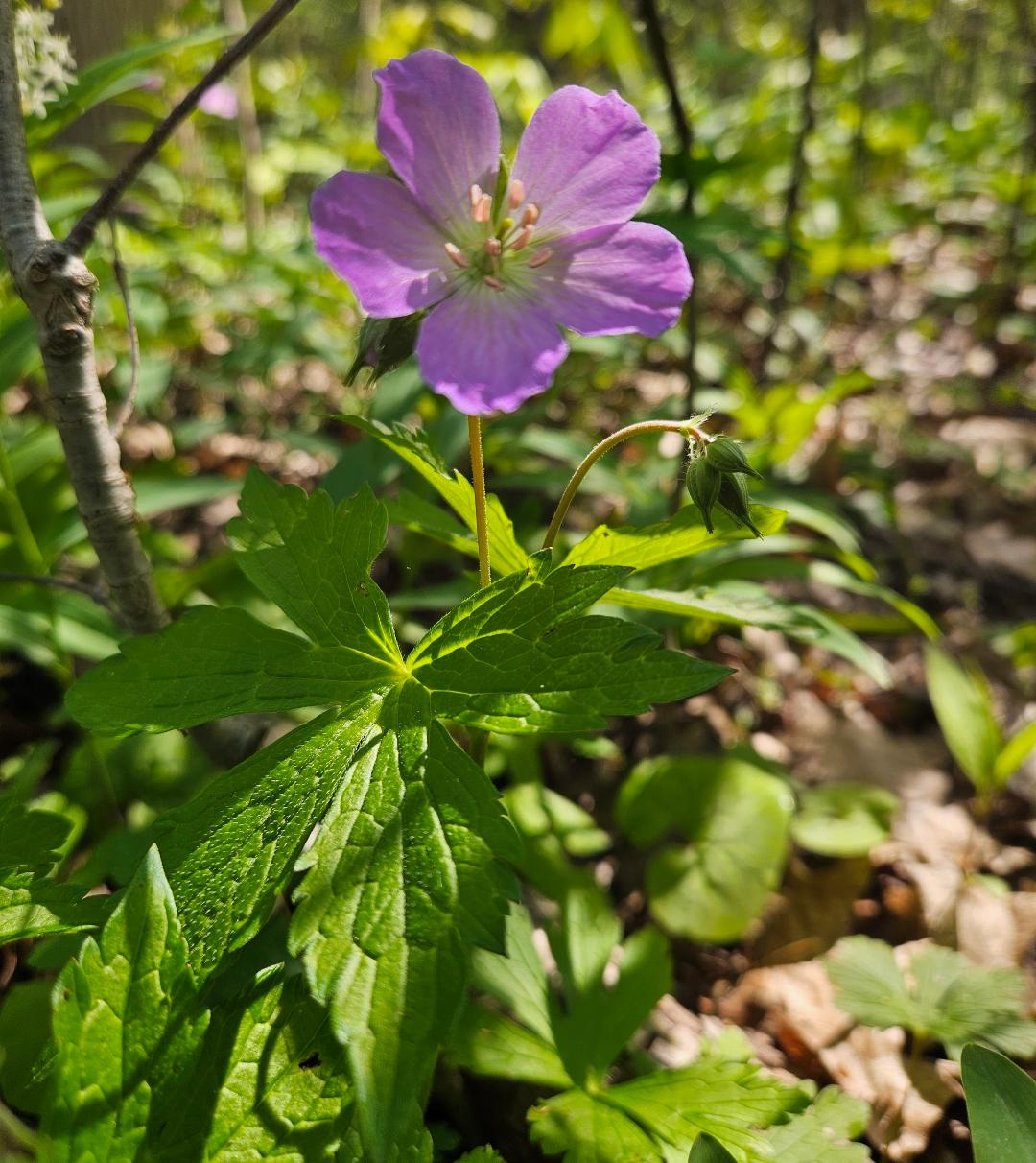
We also continue to see many wildflowers. Currently the trails are abundant with this native plant called Wild Geranium, Geranium maculatum (shown in photo).
| |
Memorial Trees Leaf Out for Spring
By Jeremy Hatt
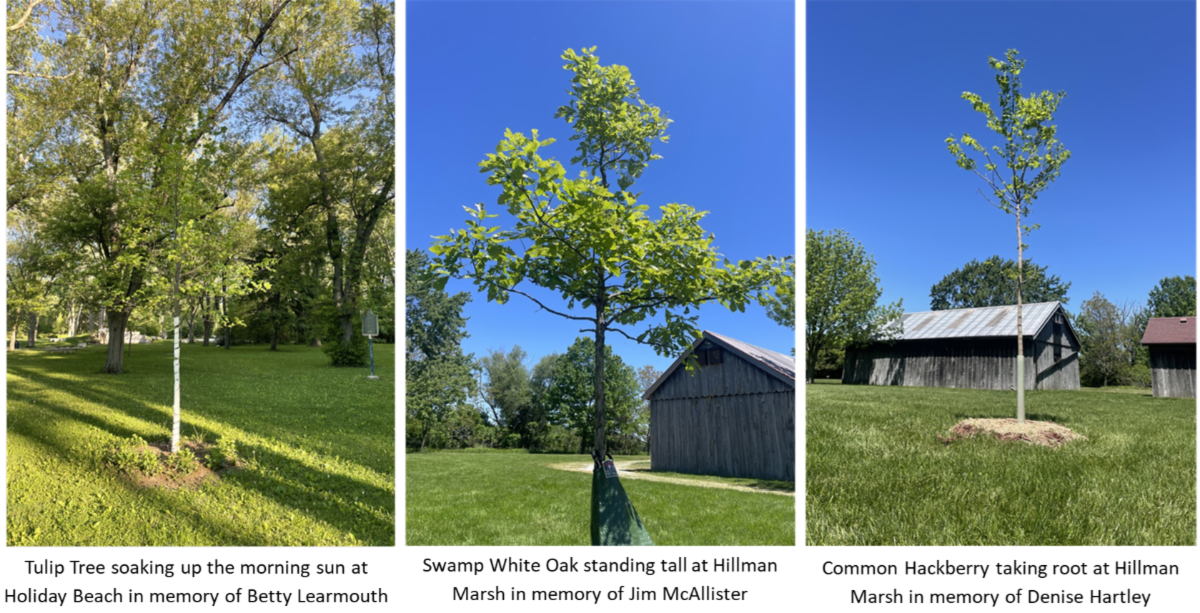
At the end of May, I paid a visit each of the recently-planted trees in memory of Betty Learmouth, Jim McAllister, and Denise Hartley by ECFNC. The trees stand in testament to the immeasurable contributions each of these members made to the Club. Tree dedications have been held for Betty Learmouth at Holiday Beach (Tulip Tree) and Jim McAllister at Hillman Marsh (Swamp White Oak). An upcoming outing will honour Denise Hartley at Hillman Marsh, where a Common Hackberry has been planted in her memory.
| |
Pollinators and Host Plants
By Jennifer Nantais
| | |
Monarchs are being sighted in more and more gardens thanks to the increased planting of native milkweed to support their populations, but many other native pollinators also depend on specific host plants to they lay their eggs and feed their growing larvae. So, when choosing plants for your property, it’s worth thinking beyond providing nectar for adult butterflies and bees.
If you have spotted any larvae or other native insects feeding on host plants in your garden, let us know at our monthly meetings! It might inspire others and help guide which plants to add to our gardens. Looking forward to a summer of blooms and life among the flowers!
| |
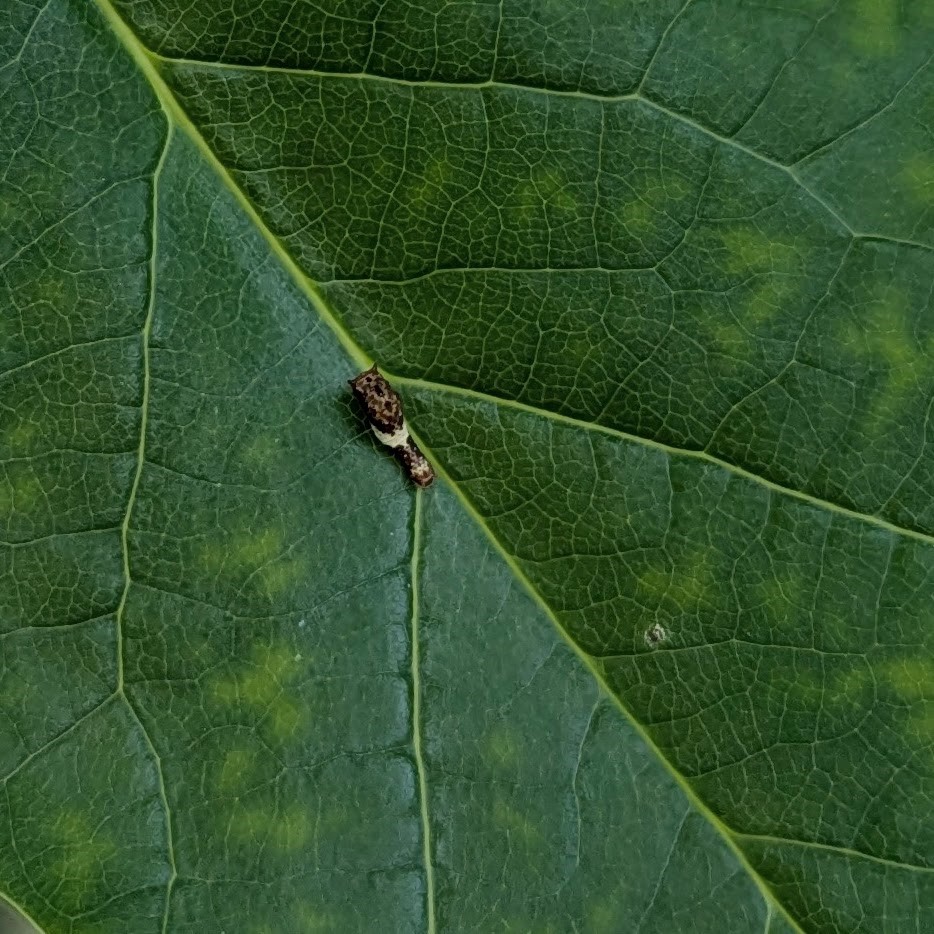
Native violets are essential host plants for the Great Spangled Fritillary butterfly. The native Hop Tree supports Canada’s largest butterfly, the Giant Swallowtail, while Tulip Trees and Black Cherry support the Eastern Tiger Swallowtail. Goldenrods host many native moth and beetle larvae while also feeding late-season pollinators and adding brilliant golden colour to the garden.
(Eastern tiger swallowtail caterpillar on tulip tree, photo Jennifer Nantais)
| | |
By planting native host species alongside nectar plants, we can help support pollinators through every stage of their life cycle and discover just how much more alive our gardens become when they provide habitat as well as beauty, while giving us plenty to watch for and enjoy through the season.
If you have spotted any larvae or other native insects feeding on host plants in your garden, let us know at our monthly meetings! It might inspire others and help guide which plants to add to our gardens. Looking forward to a summer of blooms and life among the flowers!
| |
Point Pelee in the 1960s
By Bob Curry (introduction by Jeremy Hatt)
"As we close the chapter on another Festival of Birds at Point Pelee National Park, what better time to reflect on the changes that have occurred over the years at Point Pelee, both with the birds and the people who watch them. Bob Curry is a lifelong Ontario birder who has been visiting Point Pelee since 1958 and currently has the highest species list of any birder in the province. He has contributed immeasurably to the study of birds and the birding community including writing The Birds of Hamilton and Surrounding Areas (2006). Please enjoy this retrospective on birding at Point Pelee in the 60's." -JH
| | |
In fact, my first visit to Pelee was in 1958. On the Victoria Day Weekend May 17 – 19, my father, Bill Curry drove four keen young birders: George Meyers of Grimsby Beach, John Olmsted of Hamilton, Dan Strickland of Burlington and me. George, a polymath, had a life-long passion for diurnal raptors and Carolinian Zone trees, John was my main birding companion for nearly 40 years and Dan became the World expert on the Canada Jay, including campaigning successfully to have it renamed just that.
I note with pride and gratitude that it was my father who took us on that first great birding adventure. He would drop us off at a birding site and then go looking for trout fishing opportunities. The closest he came to that form of angling in Essex County was catching Sheepshead off a pier. To a Scottish angler this is the equivalent of drinking root beer in lieu of a single malt.
In this my fourth full year of birding the weekend produced eight lifers. On Saturday we saw several Orchard Orioles. Bob Andrle and Richard Byron of Buffalo pointed out my first Blue-winged Warbler – Golden-winged was far more common in those days - and my first Kentucky Warbler. Three Yellow-breasted Chats were noteworthy as was an Olive-sided Flycatcher and a Sedge Wren.
By far the best bird of the weekend was a Bewick’s Wren. In 1958 there was no visitor centre but there was an open grassy area where the still functioning Aviation Inn stood. We saw the wren along the east side of the Aviation Inn clearing i.e., what today is the nature centre parking lot, essentially where the Schuster Trail begins. I remember the long tail which it "switched" from side to side, the white spots on out edges of the upper tail, the duller brown upper parts unlike the rufous of Carolina Wren and the grey underparts. This was almost certainly the individual found by the legendary George W. North of Hamilton on May 4, 1958 on the Schuster Trail (Alan Wormington, Birds of Point Pelee unpublished manuscript).
| |
What is eButterfly and How Does it Work?
By Olivia Galloway
eButterfly documents the presence or absence of species as well as abundance through checklist data. A web interface engages participants in submitting their observations through interactive questions and answers. eButterfly encourages users to participate repeatedly by providing tools to maintain their personal observations and photo records as well as providing tools to enable them to visualize data with interactive maps, graphs, and bar charts. All these features are currently available in English, French and Spanish; with other languages coming soon.
An eButterfly user logs into their account and enters when, where, and how they observed butterflies. Then they are prompted to create a checklist and counts of all butterflies seen or photographed during the outing. eButterfly provides several options for data gathering including transects, area searches, timed searches or even incidental observations. Just like in a museum with specimens, other users and experts help to verify the identity of each observation. Users can even discuss observations and checklists with each other.
Learn more here: eButterfly
Click the link below for a detail tutorial
|
New ECFNC Book Club Begins!
By Michelle Gordy
We're excited to announce the launch of the ECFNC Book Club! Before each quarterly meet-up (September, December, March, and June), members will be invited to read any book that fits a designated nature-related theme. At each gathering, participants can share what they read, discuss key ideas, and explore how their book connects to the theme. There will also be opportunities for book swaps, creating a group recommended reading list, and to share your ideas for the club.
Our first meet-up will focus on the theme of Traditional Ecological Knowledge. "Traditional Ecological Knowledge is a cumulative body of knowledge, practices, and beliefs about the relationship between living beings and their environment. Passed down through generations via oral traditions, TEK is deeply rooted in the cultural and spiritual practices of Indigenous communities. Unlike Western scientific approaches, which often compartmentalize knowledge, TEK embraces a holistic worldview. It recognizes the interconnectedness of all living things and emphasizes the importance of maintaining balance in nature." (Indigenousclimatehub.ca)
If you're looking for a good book recommendation or author to start with, check out Robin Wall Kimmerer's book "Braiding Sweetgrass". We recommend checking out your local library and local used and new bookstores, who can also offer some great suggestions.
Details on date, time, and location of the first meet-up will be shared soon. In the meantime, we hope you find a great book and can't wait to discuss it with you in September!
Interested in participating or helping lead the Book Club committee? Contact us at bookclub@essexcountynature.com
| |
Turtle Nesting Season is Underway!
The Turtle Conservation Committee has been busy responding to calls regarding injured turtles, nesting turtles and turtle nests around Windsor-Essex County.
If you come across a nesting turtle, please give her plenty of space (a minimum of 10 feet) to prevent any distress & call our Turtle Rapid Response Hotline!
226-348-2057
Want to get involved in the turtle fun? Send an email to: Turtles@Essexcountynature.com
Please note: All work is conducted with all appropriate & approved protocols, permits & registrations.
| | |
|
ECFNC June Members' Meeting
Butterfly Committee
Wednesday, June 10, at 7:00 p.m.
Ojibway Nature Centre
Join Jeremy Hatt and Cameron Chevalier for an update from the Butterfly Committee including notable recent records, where and when to look for butterflies locally, learning how to use eButterfly and the Ontario Butterfly Atlas, a case study on Broad-winged Skipper and its possible use of phragmities, and how to get involved in upcoming butterfly counts in the county.
|
| | |
|
Pride Nature Walk at Ojibway Park
Saturday, June 13, 8:30am
Ojibway Park
Meet 8:30 a.m. in the parking lot of Ojibway Park in Windsor to join OFO and the Essex County Field Naturalists' Club (ECFNC) for a Pride Month Birding Walk. This second annual walk is a celebration of the LGBTQ2S+ community, but all members of the birding community are welcome. We start by exploring the trails of Ojibway Park before crossing the street to follow the Titcombe path between the Tallgrass Heritage Prairie Heritage Park and the Ojibway Prairie Provincial Nature Reserve.
More info: https://ofo25.wildapricot.org/event-6575344
|
| | |
|
Breeding Bird Walk
Sunday, June 14th, 9:00am
Fish Point, Pelee Island
Experience nesting birds in their quiet period, with PIBO’s Sumiko Onishi.
Click here to register or check out the Pelee Buzz for a complete list of events happening on the Island.
|
| | |
|
Monthly Walks of the Greenway (#3)
Sunday, June 21, 10am
The Harrow Rotary Community Entrance
Located on Queen St/ County Rd 11 in Harrow, adjacent to Colio Winery. We are planning to walk East.
GPS - 42.03955970028254, -82.9165714491742
Most of the Greenway is a flat, gravel pathway. Although some parking lots have seasonal port-a-johns, not all sections of the greenway have access to washrooms.
Walks will be on the third Sunday of the month, at 10am, with future locations to be announced.
- #4 July 19th – Kingsville Entrance -
|
| | |
|
Festival of Hawks
September 19-20, 9:00am – 3:00pm
Holiday Beach Conservation Area
The Festival of Hawks is one of ERCA’s signature event that brings hundreds of visitors together to learn
about birds, nature, and conservation in our region. Stay tuned for more details.
Click HERE for more info on this and other ERCA events
|
| | |
|
Upcoming ECFNC Monthly Members' Meetings
Second Wednesday of the Month, 7:00pm
Ojibway Nature Centre
July – Moths
August - "Wildflowers" movie night
September - Blue Racers
Stay tuned for more information!
|
| | |
Mugs for Sale!
Next time you see us make sure to grab yourself some great bird friendly coffee and an ECFNC camp mug!
What is bird friendly coffee? Birds and Beans Coffee is roasted in Canada with beans grown and harvested with sustainable, ethical practices. It tastes great too. Available whole bean, ground or decaf. Tastes even better in one of our club mugs.
Proceeds support the Heritage Fund.
| | |
Join or Renew your Membership for 2026!!
Another year has come and gone. For those looking to join the club, or renew memberships, just tap the button below to pay online. (You don't need a PayPal account. Just tap "enter as a guest' and then "continue to payment" if you want to use a credit card.)
Annual membership fees are $10 for students, $20 for other individuals and $25 for families. If you have questions or can't remember when you last paid for your membership, contact membership secretary Janice Boussey
Please send cash or cheques by mail to:
Cathy Lapain, treasurer
Essex County Field Naturalists’ Club
c/o Ojibway Nature Centre
5200 Matchette Rd.
Windsor, ON, N9C 4E8
(*Cheques should be made out to the Essex County Field Naturalists’ Club. Please indicate on the cheque if it is a membership fee or a donation.)
| | |
Have you seen anything neat in nature lately? Did you happen to catch it on camera? If so, consider submitting it to egret@essexcountynature.com and we could include it in future articles or posts. Be sure to include your name and all relevant information about the photo (who/where/what/when). |
| | |
Stay tuned for more!
Any future events will be announced during monthly meetings and listed in our calendar.
Look out for email updates about any events.
Check out our Facebook page and subscribe to our YouTube channel for fun content updates!
Visit our website to view historical issues of The Egret (1984-present).
| | Essex County Field Naturalists’ Club is a non-profit, open-to-the-public volunteer organization that focuses on promoting the conservation and restoration of the diverse natural heritage of Essex County and the surrounding region. We also strive to provide educational opportunities for the people of Essex County to become acquainted with and better understand the natural environment. | | |
Contact Us
Essex County Field Naturalists’ Club
c/o Ojibway Nature Centre
5200 Matchett Rd.
Windsor On,
N9C 4E8
Except for our annual dinner in November, monthly meetings are held the second Wednesday of the month at 7:00 pm at Ojibway Nature Center, 5200 Matchette Road, Windsor. All are welcome! We also have monthly outings posted in the ‘Events’ section of this newsletter as well as on our website.
| | |
|
EXECUTIVE BOARD
President: Aileen Petrozzi (President@essexcountynature.com)
Vice-President: Chris Hart (Egret@essexcountynature.com)
Chair Person: Jennifer Nantais (jennifer.nantais@gmail.com)
Secretary: Michelle Gordy (secretary@essexcountynature.com)
Treasurer: Cathy Lapain (aclapain@gmail.com)
Membership Secretary: Janice Boussey (membership@essexcountynature.com)
Directors:
Membership Secretary: Janice Boussey (membership@essexcountynature.com)
Social Media Coordinator: Melanie Masse (melmasse3@gmail.com)
Dave Kraus (david.kraus@publicboard.ca)
Kory Renaud (koryrenaud@gmail.com)
Jeremy Hatt (hattjeremy@hotmail.com)
Kathleen Woodhouse (kathleen.woodhouse22@gmail.com)
Xander Campbell (xandercampbell777@gmail.com)
Vicki Rees (vickirees@hotmail.com)
|
| | |
|
CHAIRPERSONS/LIAISONS
Ontario Nature Liaison: Jennifer Nantais
ERCA Liaison: Gina Pannunzio
Ojibway Liaison: Chris Hart
Citizens Environment Alliance Liaison: Phil Roberts
Canada South Land Trust Liaison: Dave Kraus
Detroit River Canadian Cleanup Liaison: Gina Pannunzio
Climate Change: Jennifer Nantais
COMMITTEES
Egret Editorial: Chris Hart (egret@essexcountynature.com)
Junior Egrets: Jen Nantais, Carolyn Brown
Heritage: JoAnn Grondin, Dave Kraus, Gerry Waldron, Shirley Grondin, Cathy Lapain, Tim Shortridge, Aileen Petrozzi, Ellen van Wageningen
Little River Enhancement Group: Ian Naisbitt (chair)
Fish Book: Dave Kraus
Website & Social Media: Kory Renaud, Melanie Masse
Membership: Jeremy Hatt (chair), Carl Maiolani, Janice Boussey, Melanie Masse, Sheila Laurin
Bluebird: Don Bissonette (Chair), Joan Affleck, Graham Brown, Adam Batke
Grant Committee: Chris Hart, Jennifer Nantais
Phragmites Committee: Aileen Petrozzi (Chair), Heather Cohen, Rose Simard, Joan Murphy-Walker
Turtle Conservation Committee: Alexander Campbell, Kathleen Woodhouse
Butterfly Committee: Jeremy Hatt (chair), Cameron Chevalier, Olivia Galloway, Paula O'Rourke, Michelle Gordy, Marisa Pfautz
Native Plant Committee: Jennifer Nantais (chair)
|
| | | | |