|
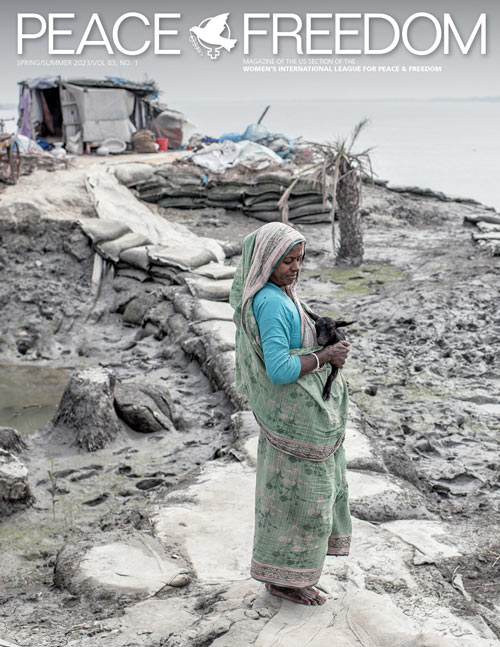
This issue focuses on the interlinking issues of climate crisis, militarism, and an unjust global economy. These realities are leading to unique challenges for women, and they are disproportionately impacting women in the Global South. As Earth Democracy Chair Nancy Price writes her introduction, the authors in this issue “detail clearly how much war costs us, destroying lives and communities, diverting funds that could be used to address climate change and its effects, and ravaging the planet. At the same time, they offer us multiple opportunities to educate ourselves and others, and provide actions that can be taken by issue committees, branches, and members.” Put this issue on your summer reading list and come away with a WILPF-specific understanding of the environmental crisis facing humankind right now.
In the Spring/Summer issue:
-
President Darien De Lu stresses the dangers of American individualism and corporate capitalism, at the same time acknowledging that climate chaos means we are “increasingly listening to and learning from the experience and knowledge of Indigenous peoples,” and that we are making new international connections and allies.
-
Nancy Price introduces the issue by giving a brief overview of the repeated unmet calls to address global warming, and providing a preview of the wide-ranging articles. She also includes a bulleted list of “Some Opportunities for Education and Action.”
-
Edwick Madzimure describes the “devastating impacts” climate change is having on Global South women, including “water scarcity, food insecurity, financial constraints, and more cases of gender-based violence.” She shares an example from her own country, Zimbabwe, where the “climate change-induced perennial droughts that are affecting rain-fed agriculture” are driving people to engage in artisanal mining, which is characterized by high militarism and is leading to food insecurity and discrimination against women.
-
Nick Buxton details the many ways that “militarism has a direct impact on the climate crisis.” He makes a clear and convincing case that climate activists need to start calling for demilitarization if they want “a climate safe and just future.” He writes, “Climate change has to be treated like it is a political emergency that is above all other domestic and foreign policy priorities or goals.”
-
As the convenor of WILPF International’s Environment Working Group (EWG), Tamara Lorincz is uniquely positioned to discuss WILPF’s call for the demilitarization and protection of our oceans. She shows how naval exercises and crafts are destroying the marine environment, introduces us to some of the activists who have been at the forefront of this important issue, and explains why the EWG is making “peace on the seas” one of its main areas of focus in the coming months.
-
At COP27, held in Sharm el Sheikh, Egypt in November 2022, Cindy Piester was “one of ten women honored to be part of WILPF’s delegation.” She reports here on the conference’s high points and failures, and on how WILPF had an impact, including with our handouts expressing “strong support for Loss and Damages and the Green Fund” and “our open-message to US Climate Envoy John Kerry calling for the DoD to fully and transparently report military greenhouse gas emissions to the UNFCCC.” She ends with necessary actions we must take, suggesting that WILPF US “create a workable climate resolution and hold our own government to account for its implementation.”
-
Cindy Domingo describes Cuba’s long-term climate plan of action Tarea Vida (Life Task), which “places human life at the center” and “brings together scientists, government officials, and the populations most impacted in Cuba…to implement, educate, and organize the different generations of Cubans to build their country’s response to climate change.” We have much to learn from this approach, but “one of the biggest barriers to Cuba’s fight against climate change is the 62-year-old US blockade against Cuba.”
-
Four WILPF US leaders had a Zoom conversation with Mazin Qumsiyeh, founder and director of the Palestine Institute for Biological Diversity and the Palestine Museum of Natural History, and the resulting Q&A goes in some interesting and unexpected directions. Dr. Qumsiyeh explains “there is no water shortage in the Fertile Crescent,” but there is “unequal distribution” as Israel engineers a water shortage for native peoples while their citizens and settlement dwellers live “with lush vegetation and swimming pools.” He notes that “the problem is money,” and says he centers his own efforts on “decolonizing minds.”
-
An article co-written by Marybeth Gardam and Nancy Price focuses on how public banking can be “a primary strategy to protect Mother Earth.” They point out that the private, commercial banks are mostly in bed with the fossil fuel industry, and share how public banks can “free up low interest loans…for small and mid-size businesses to help with weatherization projects, community solar energy investments, the transition of public buildings and infrastructure to ‘green’ sustainable energy, and more.”
-
“The climate crisis is…a threat multiplier,” writes Jenaina Irani. “Women and girls in conflict-affected regions…experience the disastrous consequences of unmitigated climate degradation, in the form of rising mental, physical, and sexual violence.” She highlights how “women environmental human rights defenders have become increasingly targeted for their efforts.” In spite of these attacks, women “continue to put their lives at risk to defend human and environmental rights,” and the author stresses that women’s “meaningful participation in policy and decision-making is vital.”
In other contributions:
-
Odile Hugonot Haber reports on the third annual session on establishing a Weapons of Mass Destruction Free Zone (WMDFZ) in the Middle East which took place November 14-18, 2022, at the United Nations Headquarters in New York. The meeting was promising, she writes, with 21 Arab states in attendance, and four nuclear states as observers (the United States did not attend, as usual). Participants affirmed their commitments and attendees suggested “that an infrastructure for the treaty can be built as an alternative pathway for a future treaty.”
-
H Patricia Hynes provides a personal account of building a passive solar house in 1981, her master’s thesis project. “Along the way, many opportunities to spread the gospel of solar energy arose,” she writes. Pat shares that she “offered a course for women builders…on the structural design of our home and gave many public slideshow presentations, including one for my EPA colleagues.”
-
Enjoy a Summer Reading List of books on environmental issues recommended by the following WILPF leaders: Nancy Price, Earth Democracy Committee; Lib Hutchby, Triangle Branch; Katrin Geyer, WILPF International Secretariat; Marybeth Gardam, Women Money & Democracy Committee; and Tura Campanella Cook, Middle East Peace & Justice Action Committee.
-
Meet Martha Collins, WILPF’s new development chair, who comes with vast experience as a peace and justice advocate, human rights activist, and nonprofit leader. Martha has also actively served in various leadership positions with her local WILPF Milwaukee Branch and on the national Advancing Human Rights and Women, Money & Democracy committees. “Martha’s contributions to our current board will be important and powerful as we seek ways to engage younger, more diverse members” and “her professional fundraising experience will be essential,” writes Marybeth Gardam.
-
Jan Corderman’s Treasurer’s Report describes several important developments in 2022, including hiring professional fundraising staff, increasing issue committee allowances, and adding a new initiative, Building Branches from the Inside Out. She notes that “it was necessary to drawn down our cash reserves to cover the deficit” but there was “enough cash on hand,” and WILPF US began 2023 “with reserves in cash, bequest savings, and investments.”
-
Mildred “Millee” Livingston is remembered lovingly by Ellen Swartz of the Sacramento Branch, who writes, “I think of her as ‘Millee Appleseed’ because she started WILPF branches wherever she lived.” Ellen details the “tireless energy” Millee brought to promoting WILPF, and explains how she “started the first children’s Peace Camp in Auburn in 1987.” Millee also “worked to bring the community together to celebrate the life and work of Martin Luther King Jr.” She was the recipient of many awards for her efforts and activism.
- The branch round-up shares some of the recent activities by WILPF branches to press for disarmament and environmental justice. This includes efforts in seven cities picketing outside congressional rep offices to say “No to Nukes” October 14-16, 2022, and nine different locations where WILPFers commemorated the second anniversary of the entry into force of the Treaty on the Prohibition of Nuclear Weapons (TPNW) January 20-23, 2023.
|