Rail Workers Weekly News Digest
November 5, 2019
|
|
Railroads, Labor Trade Contract-Change Demands
Collective bargaining between most of the nation’s largest railroads, represented by the National Carriers Conference Committee (NCCC), and their 12 craft-specific labor unions commenced Nov. 1 with the two sides exchanging broadly defined demands in preparation for face-to-face talks to amend contracts setting wages, benefits and work rules. Some two-dozen smaller railroads also are participating.
Railroad labor-management relations are governed by the 1926 Railway Labor Act (RLA), recognized as a manual of peace rather than war—its provisions intended and proven effective at preventing work stoppages via strikes or lockouts in favor of voluntarily negotiated settlements. There has not been a national railroad strike in almost three decades.
As RLA-governed labor agreements never expire, but are periodically amended, there is no clock ticking toward a date-specific settlement lest there be a work stoppage. Should negotiations falter, either side may invite guidance from the National Mediation Board (NMB). Both sides are barred from taking independent strike or lockout action until formally released by the NMB, and then only after following statutorily mandated procedures.
More specifically, should the NMB declare a bargaining impasse, the parties must consider accepting binding arbitration. If not, the White House has opportunity to appoint a Presidential Emergency Board to make non-binding recommendations—with built-in cooling-off periods—before a work stoppage can occur, meaning the public will have significant advance notice.
|
|
SMART TD, TTD ASK NATION’S TRADE REPRESENTATIVE TO PROTECT U.S. RAIL JOBS
A letter co-signed by SMART Transportation Division President Jeremy R. Ferguson and AFL-CIO Transportation Trades Department (TTD) President Larry Willis asked the United States’ chief trade representative to re-examine policies that leave American rail workers at a disadvantage.
The United States–Mexico–Canada Agreement (USMCA), planned to be a trade pact to replace the North American Free Trade Agreement (NAFTA), does not address certain issues covering cross-border traffic between Mexico and the U.S., the union leaders wrote.
|
|
Instead of fall 'peak' for intermodal traffic, it’s fall 'bleak'
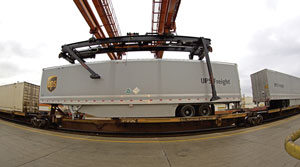
The traditional fall peak in intermodal traffic, which typically hits full stride in October, has not materialized this year.
And on Class I earnings calls this month, not one executive said their railroad expected the usual seasonal surge in intermodal volume.
“Normally, October is the busiest month for intermodal. And last week was lower than late February, and that is crazy,” says intermodal analyst Larry Gross. “It’s not good.”
Several factors inside and outside the railroad industry are behind intermodal’s struggles this year.
Among the rail-related factors: Changes related to the implementation of Precision Scheduled Railroading, including demarketing of domestic service in lower-volume lanes, and railroads holding the line on pricing.
|
|
Rail Unions Stand Together, Collective Effort Results in Major Past Practice Win on Long Island Railroad
Just before the 2018 holiday season, LIRR revoked its long standing practice of allowing early release for all non-essential employees on Christmas Eve and New Year’s Eve. TCU & IAM, along with SMART-TD, NCFO, IRSA, and BRS all grieved this issue.
SMART TD brought the case before an arbitrator, who has just ruled in favor of the union. All of the unions who grieved this issue will benefit from this arbitration decision.
The standing practice was restored, and payment was directed to be paid to affected employees who took unpaid leave, and leave was restored to any employees who took paid leave on both days.
|
|
SMART-TD Conducts an Informational Demonstration in Kansas City
An incredible show of support from the local community for SMART members at an informational demonstration at Union Pacific offices in Kansas City.
SMART TD members employed at the Neff Yard were given 2 days notice prior to furlough which sparked mass outrage and support for these members across the Kansas City community.
SMART GP Sellers and TD President Ferguson both came to show their support.
|
|
High Speed Rail In America Is Alive And Well
Ever since the approval by California Voters of Prop 1A which contained an almost 10 billion dollar bond issue in the November 2008 election, there has been an ongoing campaign to oppose the California High Speed project, mostly for political reasons.
As with any large complex project, California High Speed Rail with the high costs of construction in the United States, have also seen delays and opposition from “NIMBY’s”.
Despite the problems, work continues to build High Speed Rail service between Bakersfield and Merced.
The California High Speed Rail Authority is planning a $1.65 billion contract bid to lay 119 miles of track, install signals and electrification between roughly Wasco and Madera. The plan is to award this contract in the summer of 2020 with construction completed by 2022.
|
|
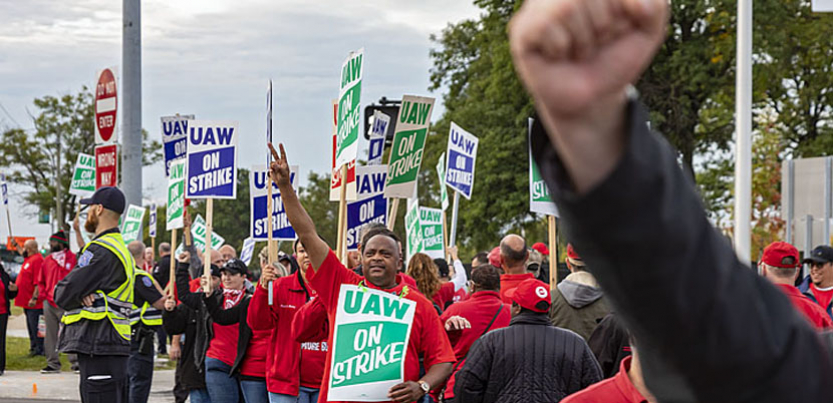
Six-week UAW strike cost GM nearly $3 billion
The first two weeks of the strike by the United Auto Workers cost General Motors Co. $1 billion in lost earnings, and overall losses from the six-week walkout will rise to nearly $3 billion for the year, the automaker said Tuesday.
GM production resumed this week after the longest strike against the automaker since 1970 ended on Friday. While the automaker won't be able to make up all of the lost production and dollars this year, company leaders believe the new four-year contract with the UAW allows the company to remain competitive and still gives employees a fair share of the profits.
"From the outset, our goal was to reach an agreement that works for our shareholders, our employees, and our company as we confront the reality of a rapidly transforming industry," GM CEO Mary Barra said on a call with investors Tuesday after the company released third-quarter earnings. "Our contract does the right thing for our employees without comprising competitiveness or flexibility."
|
|
|
|
|
|
|