|
American College of Vedic Astrology
The ACVA Newsletter 2025-09 (September 2025)
|
| |
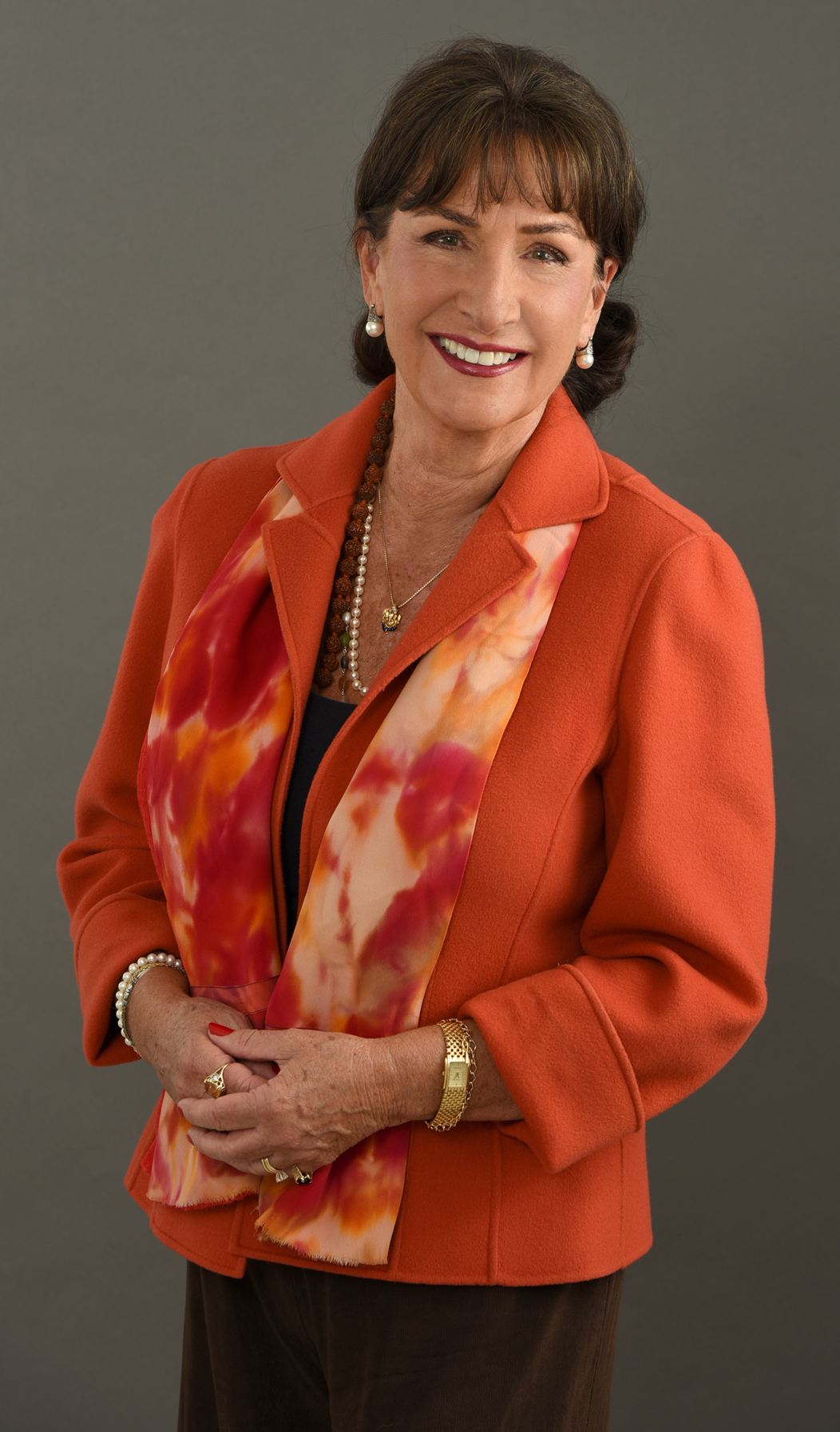
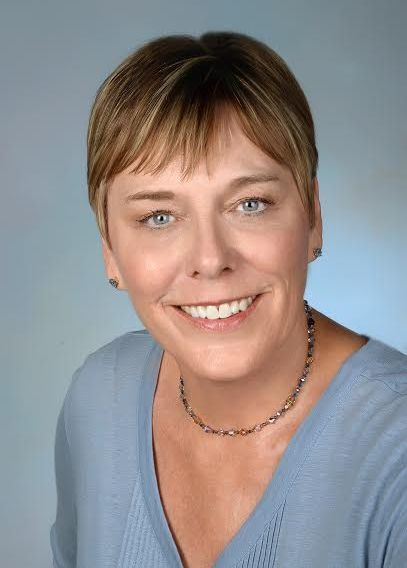
Note from the President of ACVA
By Professor Charlotte Benson (Jyoti Devi)
President, ACVA
September 2025
Dear Readers,
We’re pleased to announce two significant new developments with respect to ACVA’s continued expansion in Jyotish education:
ACVA has established a collaborative partnership with Kepler College, one of North America’s longstanding (25 years) and leading providers of astrological education. Our common goal is to deliver a series of courses under the Kepler online classroom model that will introduce western students to Vedic astrology and thereby provide them a classical education in the philosophy, techniques and best practices of Jyotish.
Our Editor-in-Chief Alan Annand, with the support of ACVA’s leadership team, is leading the development of these courses, the first of which will be offered in 2026. In addition to acting as Kepler’s “Ambassador of Jyotish,” Alan will also be the lead instructor for the online program. Although examination and certification are not mandatory for Kepler students, the proposed Jyotish curriculum will provide sufficient detail to prepare students for examinations at the Ratna level of certification.
ACVA has also entered into a collaborative agreement with Dharmavedas, a Vedic astrology school operating in Turkey and the EU, with the aim of providing ACVA-accredited Jyotish courses to Turkish-speaking students. Although Dharmavedas, under the stewardship of ACVA tutor Gizem Heukelom, will run its operation autonomously, ACVA will provide oversight to ensure that the curriculum and testing for certification requirements will meet the high standards already established by ACVA in the international Jyotish community. Formal certification of Turkish-speaking students under Dharmavedas will become available in 2026.
On the ACVA “people in the news” front, congratulations are in order for the family of ACVA Vice-President, Dr. Sisira Amarasinghe, who welcomed his third grandchild recently.
And congratulations also to ACVA President Emeritus, Dr. Dennis Harness, on his 70th birthday, which we celebrated at the Astrology Weekend conference in Sedona, Arizona in mid-September.
It was a wonderful experience to be able to join my long-time friends and colleagues in person at two separate conferences recently. In August, I spoke on Vedic Astrological Poetry at the Sedona Vedic Astrology conference in Arizona. Dr. David Frawley, ACVA’s first president, made a rare public appearance there. Also, in attendance was ACVA’s Dean of Students, Dr. Lynn Bootes, emerita faculty Komilla Sutton, along with ACVA alum Joni Patry, Dr. Dennis Harness, and other luminaries.
Thank you, dear Ksanati and Dennis for your labor of love in organizing this for us!
Another in-person, Western Astrology conference took place in Sedona in mid-September. I had the opportunity to showcase the enriched information that Jyotish offers about what is contained in the bhavas. It was an interesting experience to see young attendees begin to understand the value of Jyotish. Or of at least considering the sidereal placements of their planets. Eyes and minds were opened! As I mentioned there more than once – the stars of the constellations exert specific, well-defined, empirically-evidenced influences. I was encouraged to see so many younger students eager to understand more about the Sacred Science.
ACVA also hosted part two of Mr. Marc Boney’s brilliant webinar on “Effects of Planets from Karakamsa Lagna” recently. He did a great job of explaining the relevancy of this specific technique. Thank you, dear Marc, for offering your profound wisdom and experience!
Please consider becoming an ACVA member. This will entitle you to free admission to our Jyotish Masters series of webinars, and to many other valuable member benefits.
Until next month, enjoy the positive potential of Mercury exalted, and Jupiter vargottama!
With every best wish for you and your families,
Click here for more ...
| |
Professor Charlotte Benson (Jyoti Devi)
President, American College of Vedic Astrology
| | |
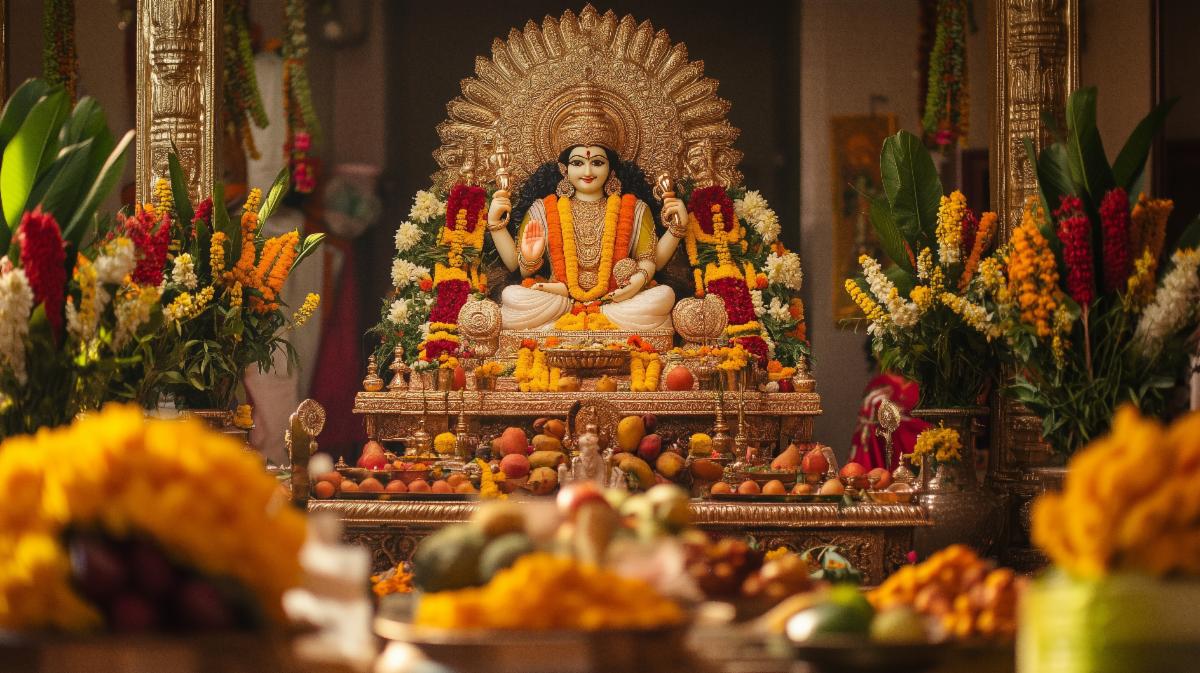
Navaratri, the Nine Nights of Mother Divine
By Professor Juliana Swanson
ACVA Provost and Dean of Academics
The first night of the Vedic festival of Maha Navaratri, the “Great Nine Nights” of Mother Divine, began on September 22. This blessed festival will extend through October 2 this year around the world, with Vijayadashami or the Victory Day of the Goddess occurring on October 2.
The word Navaratri (or Navratri) literally means” Nine Nights” in Sanskrit — with Nava (or Nav) meaning nine, and ratri meaning night(s). There are actually nine nights and also ten or eleven days included in the celebration of Navaratri.
| | Navaratri occurs four times a year. Two of these more minor festivals are observed in winter (January or February), and summer (June or July), known as the Gupta Navaratris. These are less celebrated with public festivities and tend to be observed more privately by yogis and tantrics (as gupta means hidden, secret, or private) The other two more significant festivals occur in the fall and spring. They occur relatively near the equinoxes, which are crucial astrophysical turning points when our bodies and minds undergo dramatic energetic and physical readjustment. | | |
The fall festival of Navaratri is known as Shardiya, Sharad, or Ashwin Navaratri. This one is the main or “maha” (great) Navaratri of the year which occurs at the close of monsoon season and immediately after Pitru Paksha, the Fortnight of the Ancestors. It is the most important also because it is celebrated during Dakshinayana, the half of the solar year spanning from the summer to winter solstice in the northern hemisphere, a time that is dedicated to spiritual purification.
In Vedic culture, this is a very joyful and also a profoundly sacred time. During this festival, celebrants fast, pray, and chant. It's also common to meditate, attend a yatra (go on a pilgrimage), offer charitable donations or service, participate in Vedic fire ceremonies (havans, yagyas, and pujas), and to take holy baths (dipping in sacred rivers).
| | |
The Observatory
By Dr. Lynn Bootes, MD
ACVA Dean of Students and Registrar
registrar@acvaonline.org
Late September 2025 Edition
Dear Readers,
Seasonal Changes
The spring and fall equinoxes always bring change to life on Earth as the Sun shifts its illumination to the Southern Hemisphere. During September 13-21, we had a solar eclipse and four planets changing signs, bringing dramatic changes to the world in a short time. Such changes seem magnified to those of us living on the planet, but they’re only blips in the great cycles of time which the Rishis of Jyotisha explain to us in the Vedic traditions.
Thus begins the season of fall festivals in the Northern Hemisphere, too numerous to name them all. Yom Kippur, the beginning of the Jewish High Holy Days, falls on the New Moon on September 20. The nine days of Navaratri, honoring the Goddess Durga, are celebrated from September 22 to October 2. Dusshera honors the victory of Rama over Ravana on October 2. Diwali, celebrated on the five days of the New Moon in Libra, climaxes on the night of the New Moon October 20-21 (in the USA). Many in Western countries look forward to Halloween.
The New Moon in Libra, October 21, will take place at 8:25 am in New York City. This is the day of the market new year in India – an accurate measure of the economy at the end of the harvest season. This year, Mercury and Mars join up with the Sun and Moon in a Libra Lagna for New York, with Lagnesh Venus in the 12th house in Parivartana Yoga with Mercury. This seems generally favorable for the markets in the United States, although there may be hidden factors at work.
Summer daylight time ends October 26 in much of Europe and parts of the Middle East. The USA, Canada and western Mexico switch back to standard time November 2. Meanwhile, Australia begins daylight time on October 5. People attending our ACVA Webinars should plan accordingly.
Click here for more ...
| | |
Sherlock of the Skies discovers Ed Sheeran (Part 2)
By Pratik Mehta
Vedic Astrologer
| | |
In Part 1 of this mini-series, we made a note of the Graha configurations (clues) in Ed Sheeran’s chart that pop out at us as soon we look at it. We also made a note of his major life events and, last but not least, identified the specific tools from the otherwise formidable Jyotiṣa toolkit that would be most effective in discovering his rising sign/Lagna. In this second and concluding part, we’ll try and do just that.
However, this undoubtedly naïve attempt at condensing a Harry Porter multi-volume saga into an Edgar Allan Poe short story can be bit of a freefall, so hold onto your Jyotiṣa hats! In the interest of brevity and practicality, the various charts used in the following analysis (especially in Step # 1) haven’t been reproduced here, but you need only use your favorite software to generate the required charts.
The following process for Ed Sheeran’s chart can be used as a template for resolving other time-unknown charts. But since this template is not exhaustive, ideally it should be augmented with additional steps for a more thorough analysis and conclusion.
| | |
Step 1: Sleigh ride around the Zodiac
Starting with the Lagna (rising sign) at 12.00 am on his DOB (17th Feb 1991) and progressing through each rising sign till we reach 11.59 pm, we examine the condition of the Lagneśa (ruler of the ascendant) for each Lagna. The condition of the Lagneśa for each Lagna is in turn evaluated based on its strength/weakness and Bhāva placement.
The Lagneśa is strong when exalted, in its own sign and/or retrograde, and/or with Digbala. A Graha is considered weak when debilitated, combust, or in planetary war. In all other conditions it’s considered ordinary i.e. neither strong nor weak.
The Lagneśa is unfavorably placed when in the 3rd, 6th, 8th or 12th Bhāvas. All other Bhāva placements are favorable. A strong and well-placed Lagneśa in turn puts its respective Lagna (rising sign) at the top of the heap for further analysis.
Click here for more ...
| | |
By Alan Annand,
Editor-in-Chief, ACVA Publications
| | |
At some point in our mathematical education, we learned that two negatives can make a positive. For example, if we multiply two negative numbers, the product is positive. Logically, it doesn’t make sense, but mathematicians who know better say it does.
Who are we to argue?
The phenomenon of Viparita Raja Yoga demands a similar leap of faith, something along the lines of, if you can just counter-balance the right amount of misfortune in your chart, you’ll come out ahead. That doesn’t make sense either, but we’re a lot happier to buy into it than we were back in high school, doubting the utility of negative numbers in general.
Viparita Raja Yoga
Most practitioners of jyotish are familiar with the broad definition of Viparita Raja Yoga: that when a trik lord (a bad thing) goes to a trikasthana (a bad place), it creates a net benefit for the owner of that chart. This is analogous to the way society approves when we put a criminal in prison, a virally contagious person in a hospital isolation ward, or a psycho in a mental institution.
Many students apply this quite liberally, citing the creation of Viparita Raja Yoga whenever the above occurs. But a careful reading of Parasara, Phaladeepika and Uttarakalamitra reveals a more stringent set of conditions for the formation of Viparita
Raja Yoga:
· Type A: The lord of a trikasthana must go to another trikasthana not its own. Having a trik lord in its own house doesn’t qualify. Therefore, this requires one or more of the following: 6th lord in the 8th or 12th, and/or the 8th lord in the 6th or 12th, and/or the 12th lord in the 6th or 8th.
· Type B: Alternatively, instead of trik lords moving to other trikasthanas, Viparita Raja Yoga can also be formed when any two or three trik lords form sambandha via association, mutual aspect or Parivartana yoga between trik lords – and this can occur in any house(s).
· Strength: In both types described above, the participating planets must have strength. In particular, at least one of the yoga-forming planets should have a first-class dignity, by which we mean swa rashi (own sign), exalted, retrograde, dig bala, or swa nakshatra.
In either type, there must be no involvement via association or aspect with any other (non-trik) planets, else there will be collateral damage. On the other hand, the association of any participating planet with the Rahu/Ketu axis is not a spoiler, since the nodes don’t own any houses via which to spread any misfortune.
Click here for more...
| | |
Coming Attractions at ACVA
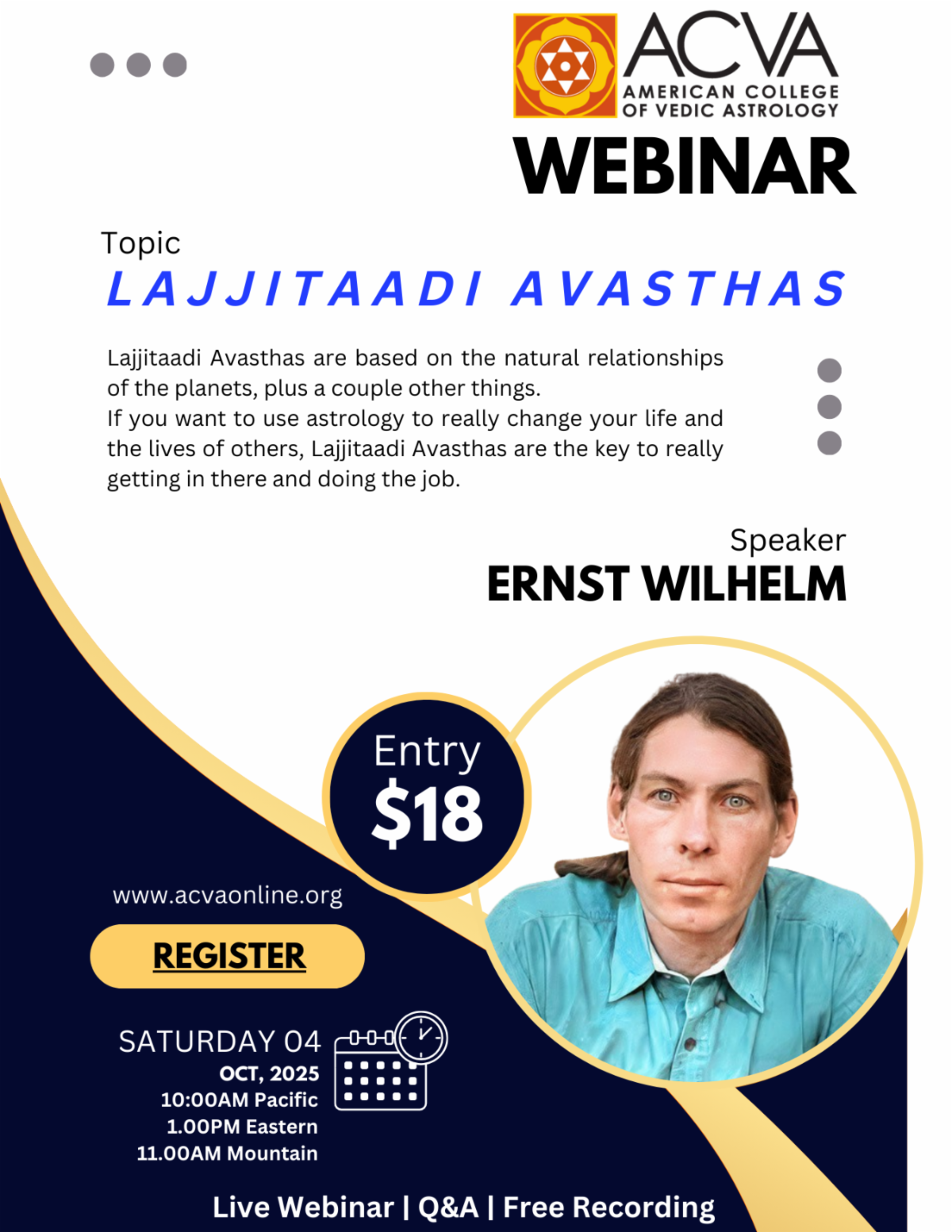
1. ACVA webinar – 4 October 2025 – Ernst Wilhelm
SATURDAY 10am Pacific, 11am Mountain, Noon Central, 1pm Eastern
Topic: Lajjitaadi Avasthas
Lajjitaadi Avasthas are based on the natural relationships of the planets, plus a couple other things. They’re very simple to see in the chart, and endless in their ramifications. They are my favorite technique of Vedic astrology. The first time I taught a course on Lajjitaadi Avasthas, many students, who had been studying astrology for 30 plus years made the similar comment, “This is the missing link we have always been looking for!” I have taught more hours on this than any other subject, and it has become my belief that if we’re not using Lajjitaadi Avasthas, we’re not playing with a full deck and so not experiencing the full brilliance of Parashara Astrology.
In this introductory course I’ll teach the formations of these Avasthas and give basic interpretations as to what they’re doing. The depth of these Avasthas is profound. I’ve taught three courses each of over 100 videos long on Lajjitaadi Avasthas, and I could do another two such courses – they’re that deep. If you want to use astrology to really change your life and the lives of others, Lajjitaadi Avasthas are the key to really getting in there and doing the job.
Webinar Registration link:
https://us06web.zoom.us/webinar/register/WN_cugF7jkJSmW4T1wra_Ftkg
| | |
Speaker: Ernst Wilhelm
Ernst Wilhelm has been diving into classical astrology texts from India for 30 years, seeking the best of what astrology has to offer in predictive accuracy. He has extensively researched Jaimini and Parashari Astrology, and developed Kala Vedic Astrology software to facilitate further research into Vedic Astrology. Coming from a healer background, he believes that if astrology isn’t healing, it’s not worth doing. He’s convinced that the depth of human, psychological and spiritual truths known by the ancient jyotish rishis of India is beyond that found in any other system of knowledge.
| | |
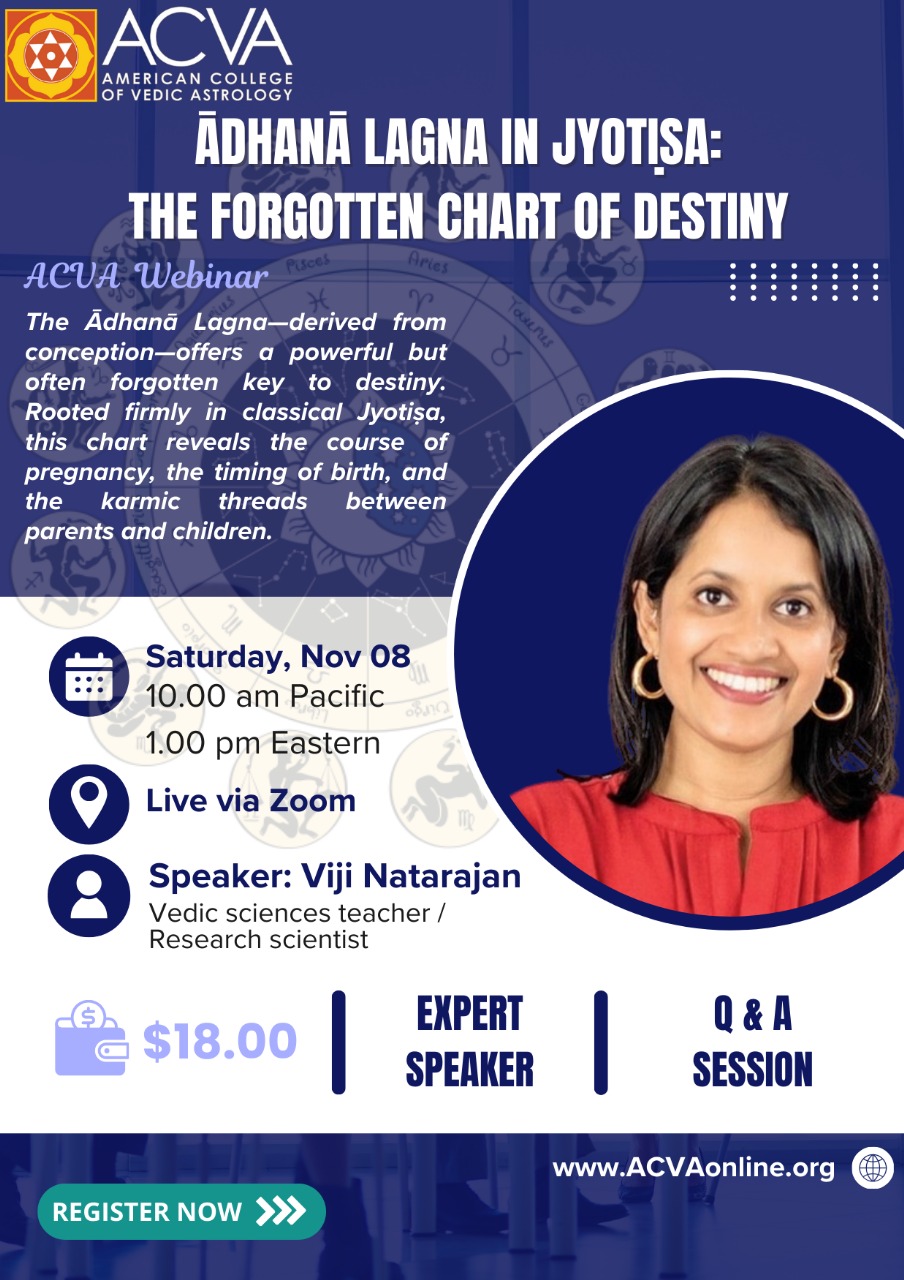
2. ACVA webinar – 8th November 2025 – Viji Natarajan
SATURDAY 10am Pacific, 11am Mountain, Noon Central, 1pm Eastern
Topic: Ādhanā Lagna in Jyotiṣa: The Forgotten Chart of Destiny
Jyotiṣa teaches that every soul’s journey begins before birth, when karmic seeds take root at conception. The Ādhanā Lagna—derived from conception—offers a powerful but often forgotten key to destiny. Rooted firmly in classical Jyotiṣa, this chart reveals the course of pregnancy, the timing of birth, and the karmic threads between parents and children. Alongside references to Ayurveda and Vedic ritual, we see how conception has always been viewed as sacred and time-sensitive. In this talk, we will explore how to calculate and interpret the Ādhanā chart and how it complements the Janma chart in practice.
Webinar Registration link:
https://us06web.zoom.us/webinar/register/WN_PSgWkAePQjeLkflGl00OsQ
| |
Speaker: Viji Natarajan
Vijayalakshmi Natarajan is a research scientist, Jyotiṣa practitioner, and Vedic sciences teacher dedicated to women, birth, and healing. Her passion is supporting mothers through the sacred journey of birth, from conception to postpartum, and her life’s work integrates her training in biology, chemistry, physiology, and healing with Ayurveda, Yoga, and Jyotiṣa as complementary sciences of life. She earned the title of Acharya under the guidance of her main teacher, Souvik Dutta, yet embraces the path of a perpetual student. She has written two books to share her perspective, offering Jyotiṣa as a tool for self-discovery, self-improvement, and alignment with the wisdom of the stars.
| | |
It is due to the generosity of our patrons that ACVA can continue to offer its current special tuition rates. Thank you.
ACVA is a 501-C3 not-for-profit educational institution that provides a very valuable service to learners of Vedic astrology.
It is due to the generosity of our volunteers and patrons that ACVA can continue to thrive. If you choose to press the "donate" button, your donation will be tax-deductible.
To donate, Visit our Website!!
https://acvaonline.org/donate/
In gratitude,
The Leadership Team
| | American College of Vedic Astrology | | |
ACVA Leadership Team
-
Prof. Charlotte Benson (Jyoti Devi) - President, ACVA’s External Relations Leader
-
Dr. Sisira K. Amarasinghe, Ph.D. – ACVA Vice President, Executive Director of Corporate Strategy and Technology
-
Prof. Juliana Swanson - ACVA Provost and Dean of Academics
-
Dr. Lynn Bootes, M.D.- Registrar, and Dean of Students
-
Julene Louis – Curriculum Leader
-
Arjun Kodikannath – ACVA Corporate Communications Officer
-
Alan Annand – ACVA Editor-in-Chief of Publications
ACVA Staff
-
Dr. Arjuna de Silva, MBBS (ACVA LMS & IT Operations Manager)
-
Sudath Mudalige (IT Administrator)
- Susheel Erramilli (Social Media and Digital Marketing Coordinator)
To contact any one of us
| | American College of Vedic Astrology Inc, 2675 W. S.R. 89A #190, Sedona, AZ 86336 | | | | |