Happy Halloween! This evening will bring kids to your door seeking tricks or treats. Mostly, their costumes will reflect cultural themes, like characters from movies or comics. And often, those characters and costumes have some unfortunate tie to science.
Much to the chagrin of those of who care about and support research, science is the vehicle by which many people scare themselves silly. There’s the mad scientist. The botched or out-of-control lab experiment. The apocalyptic climate disaster. The bizarre genetic mutation. The deadly leaked—or worse, weaponized—virus. The artificial intelligence that develops a mind of its own....
It’s well known that we fear what we don’t understand. Hello, science! People’s lack of understanding of science—be it climate science, genetics, virology, epidemiology, machine learning—can easily become the stuff of nightmares. And that fear can impede progress.
But as evidenced in the work reflected in this newsletter every month, despite what Hollywood (and Halloween) shows us, science is more commonly a force for good. In the grape and wine industry alone, research has helped grow yields and reduce resource use. It’s helped us be more sustainable, lowering our impact on the environment, and being both better employers and stewards of the land. It’s helped us thwart threats and adapt to change. It’s helped us broaden the footprint of our industry, deliver greater economic impact and produce more—and more delicious—products.
That’s why it’s incumbent upon the community of grape researchers and supporters to communicate clearly about science—and all its benefits. I often ask speakers to ditch the dendrograms and acronyms, and speak in plain language that most people (non-scientists) can understand. Give people an “in” to scientific concepts so they can see what can be achieved…and/or what’s at stake if we don’t try.
Because, if you're a grape (or grape grower or wine producer or juice processor), a world without science truly is terrifying!
|
|
|
|
|
*ABOUT THE PHOTO:
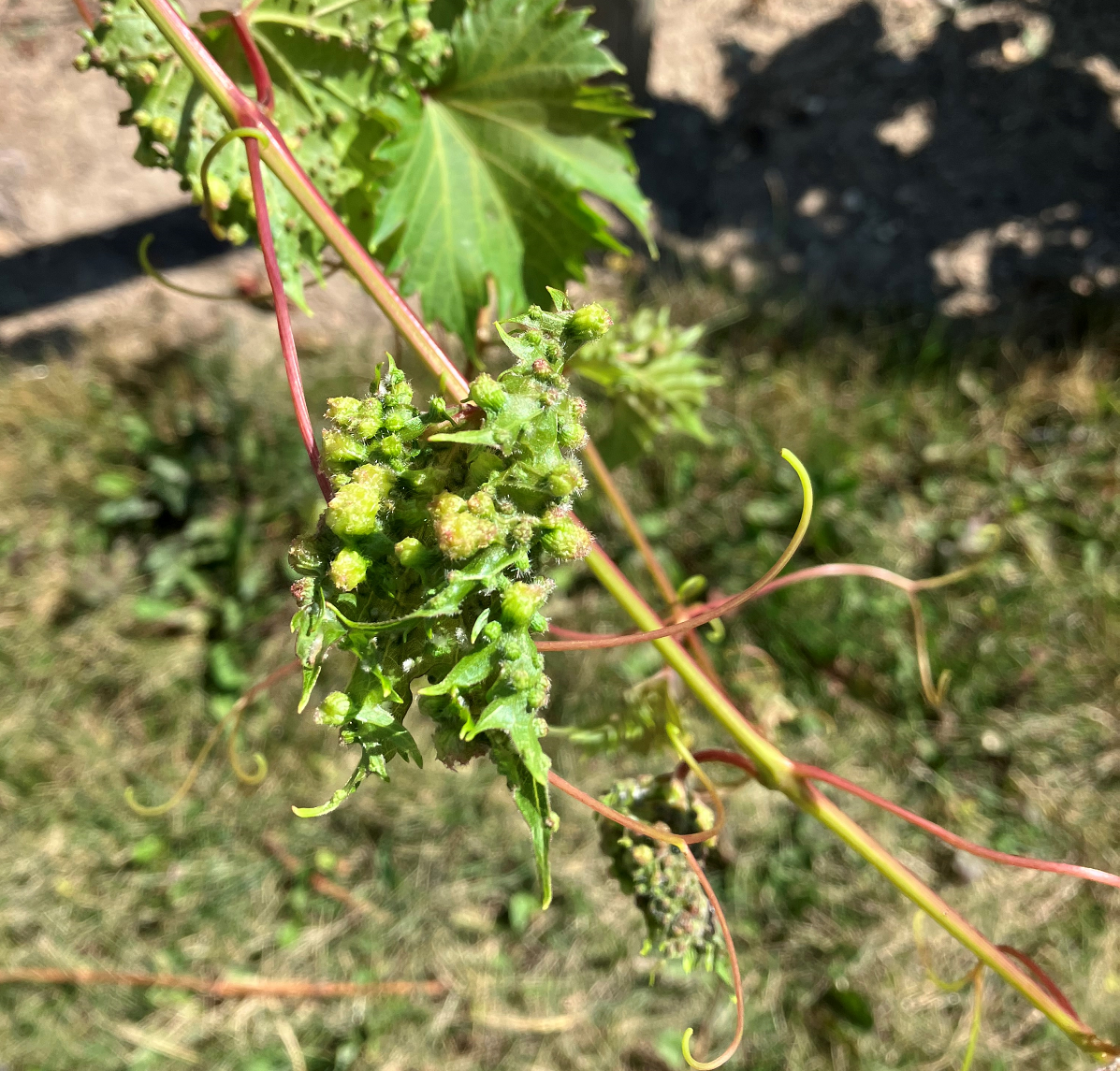
The native grape species Vitis riparia and some cold-hardy hybrid grapes with it in their parentage are particularly susceptible to foliar phylloxera, which causes galls, as shown here. Scroll down to the In the News section to learn about a breakthrough in grape breeding and galling.
|
|
Rich Smith Award Nominations Due November 16
|
|
Richard (Rich) Smith, founder of Valley Farm Management, Paraiso Vineyards and Smith Family Wines in California’s Santa Lucia Highlands wine region, was first and foremost a family man, and also a successful grape grower, winery owner and respected colleague. He was a highly effective, collegial and tireless leader whose significant and selfless contributions of time, energy and funds helped to shape public policy and scientific research to advance the American grape and wine industry. He passed away in December 2015.
Three of the organizations Rich helped to establish— NGRA, WineAmerica and Winegrape Growers of America (WGA)—annually join with the Smith Family to bestow the Rich Smith Distinguished Service Award. It recognizes an industry representative who exemplifies the passion, commitment and collaboration Rich was known for and who has had a similarly positive impact on the industry. For each organization, it is our highest and most coveted award.
|
|
2022 SCRI Awards Announced |
|
USDA’s National Institute of Food and Agriculture (NIFA) announced this month its $70 million investment in 25 awards via the Specialty Crop Research Initiative (SCRI). Arguably the most important grant program for larger-scale specialty crop research, SCRI addresses key challenges of national, regional and multistate importance in sustaining all components of food and agriculture, including conventional and organic food production systems.
Among the 25 winning projects, two are for grape research:
-
“Through the Grapevine: Building Research and Extension Potential Between Subgenera Vitis and Muscadinia for the U.S. Grape Industry,” a one-year planning grant, $50,000, led by Drs. Renee Threlfall and Margaret Worthington, both of University of Arkansas
-
“Completing the Grapevine Powdery Mildew Resistance Pipeline: From Genes-on-the-Shelf to Sticks-in-the-Ground,” Coordinated Agricultural Project, $10 million (first year funding, $2,538,437), led by Dr. Matthew Clark, University of Minnesota – See more on this project in the Research Focus below
NIFA also has released its request for applications (RFA) for the 2023 SCRI program. See more on the RFA below.
RELATED: Sign up to Speak up!
USDA-NIFA has scheduled a listening session on November 2, 2022, to solicit comments on the agency’s research, extension and education priorities. NIFA welcomes stakeholder input on the challenges, needed breakthroughs, and priorities, solutions and opportunities that will facilitate long-term sustainable agricultural production, research, education and extension. This listening effort will focus on the agricultural science that NIFA invests in, not on NIFA processes or procedures. Register to attend and/or secure five minutes to speak.
|
|
Partnerships for Climate-Smart Commodities Awards Announced |
|
USDA is investing up to $2.8 billion in 70 projects under the first Partnerships for Climate-Smart Commodities funding pool, which includes proposals seeking funds ranging from $5 million to $100 million. Five projects include grapes among the commodities covered: those led by Texas A & M AgriLife Research ($65 million), Elevated Foods Inc. ($20 million), The Meridian Institute ($20 million), International Fresh Produce Association ($15 million) and County of Sonoma ($10 million). See the list of project summaries. Projects from the second funding pool will be announced later this year.
|
|
$50M Pledge Supports Sustainability Research at UC Davis |
|
The University of California - Davis this month announced that Lynda and Stewart Resnick, co-owners of The Wonderful Company (parent of JUSTIN Wines, Landmark Wines and Lewis Cellars, among other brands) have pledged $50 million to support the school’s commitment to addressing challenges in agriculture and environmental sustainability. The historic gift will establish the Lynda and Stewart Resnick Center for Agricultural Innovation on campus at UC Davis, with $10 million set aside for annual competitive research grants through the Resnick Agricultural Innovation Research Fund.
Design on the Resnick Center is expected to begin in 2022, with construction slated for completion by 2026. Once built, the new 40,000-square-foot, LEED-certified, state-of-the-art hub will house classrooms, research and lab spaces, and student career and advising support. The Resnick Agricultural Innovation Research Fund will provide grants to promote cross-collaboration and strengthen the network among research faculty, agricultural producers, food companies, pharmaceutical companies, commodity boards and other key stakeholders. Beginning this year, competitive research grants will be awarded annually to UC Davis faculty and Cooperative Extension specialists focused on identifying value-added properties in pistachio, almond and pomegranate byproducts.
|
|
CA Joins with NZ to Further Climate Resilience in Agriculture |
|
California Department of Food and Agriculture (CDFA) Secretary Karen Ross (previously president of the California Association of Winegrape Growers) and New Zealand Minister of Agriculture Damien O’Connor this month signed a Letter of Intent to lower emissions, expand market opportunities, and further climate resilience in agriculture through research, innovation, agricultural technologies and nature-based solutions. The signing took place as New Zealand announced a pilot project for agricultural emissions pricing, which will make the country the first in the world to establish a financial system to mitigate emissions from livestock. “Minister O’Connor and I agree on many things,” says Secretary Ross, “including the fundamental understanding that we cannot have healthy farms without healthy ecosystems.” Their letter of intent builds on a memorandum of understanding signed by California Governor Gavin Newsom and New Zealand Prime Minister Jacinda Ardern in May.
|
|
CA Table Grape Commission Forms Science & Tech Division
|
|
The California Table Grape Commission, an NGRA member-organization, this month announced the formation of a new Science and Technology division to underscore its long-term commitment to scientific innovation. The new division unites three important areas—mechanization and advanced automation, patenting and licensing, and viticulture research—under the leadership of Senior Vice President Ross Jones, who will serve as Chief Science and Technology Officer. Three other staff members have new related responsibilities, too:
- Dr. Maha Afifi has been promoted to Director of Viticulture Research and will now lead production research.
- Dr. Franka Gabler, an NGRA Board member, has been named Director of Science and Technology to emphasize her work in mechanization and advanced automation.
- Julie Mercado will administer viticulture research agreements and related grant requirements with scientists as part of her work as Director of Grant Management.
|
|
Lodi Welcomes New Viticulture Research Specialist |
|
To keep up with the region’s many research collaborations and to conduct more on-farm research in Lodi, the Lodi Winegrape Commission (LWC) created a new position: Viticulture Research Specialist. Will Kerner started in this exciting new role last month. He will be working closely with Grower Research & Education Director Dr. Stephanie Bolton, an NGRA Board member, and with the LWC’s committees, growers, industry and affiliated scientists to design and analyze cohesive, replicated trials across the region on topics of interest for Lodi winegrowers. All research will be designed to lead to meaningful and practical results that can be broadly disseminated through the Commission’s robust outreach activities. Will’s new position is part of the LWC’s enviable and expanding research vision.
|
|
Weigh in on Digital Integration Hub for Climate-Smart Ag |
|
AgMission™, a collaboration of the Foundation for Food & Agriculture Research and the World Farmers’ Organisation to unlock agriculture’s potential to reduce greenhouse gas emissions, seeks input into the possible development of a digital integration hub to enhance collaboration between agricultural producers and researchers to achieve net zero emissions for the ag sector and bolster global adaptation and resilience to climate change. AgMission believes that farmers must have direct involvement in the development of climate-smart practices so that solutions are practical, actionable and scientifically robust. So, its proposed digital integration hub would promote direct communication between and among producers and researchers. Help shape their thinking by responding to their request for information by November 23, 2022.
|
|
These terrific grape research opportunities are now open:
California Polytechnic State University (Cal Poly) in San Luis Obispo, CA, invites applications for two full-time, academic year, tenure-track positions, both starting either January 9, 2023, or September 14, 2023:
Reviews begin for both Cal Poly roles on November 3, 2022. Applications received later may be considered.
Virginia Tech seeks applicants for a Viticulturist/Assistant Professor to be located at the Alson H. Smith Jr. Agricultural Research and Extension Center near Winchester, VA. This tenure-track position has equal appointments in research and extension. Applications will be reviewed November 14, 2022.
The USDA-ARS Crop Diseases, Pests and Genetics Research Unit in sunny Parlier, CA, is recruiting for two permanent grape scientists:
-
Research Plant Physiologist/Molecular Biologist – Conduct independent and team-oriented innovative basic research with the overall goal of reducing losses to crop yield and quality that result from diseases, pests and abiotic factors that stress infected plants—grapevines in particular. Apply by November 18, 2022.
-
Plant Pathologist (Virologist) – Conduct research to help reduce losses of grapevine yield and fruit quality that result from viral diseases. Apply by November 28, 2022.
|
|
Serve as a Grant Reviewer |
|
The Northeast IPM Center seeks grower/farmer/industry integrated pest management (IPM) experts located outside of the Northeast Region to serve as review panelists for its IPM Partnership Grants program. Panelists will review about 10 to 12 proposals, typically on extension, plant pathology, field crops and other IPM projects. There will be a one-hour Reviewer Training webinar on November 29, 2022, and reviews will be due by January 2, 2023. The review panel will hold at least one virtual review meeting on January 12, 2023. In appreciation for serving on the review panel, the Center will provide an honorarium. If you are outside the Northeast and interested in serving on the panel in 2023 or future years, or would like to suggest someone, email Jana Hexter by November 10, 2022. (Looking to apply for an IPM Partnership Grant? Scroll down for info.)
|
|
$10 MILLION SCRI PROJECT SEEKS TO DEFY DISEASES |
|
A team of researchers received the first round of funding from a $10 million grant awarded by the USDA National Institute of Food and Agriculture’s Specialty Crop Research Initiative (SCRI) to begin a multi-disciplinary, collaborative project focused on cultivating disease-resistant grapes that can be grown sustainably with reduced pesticide and fossil fuel use.
The national, multi-institutional project team is led by University of Minnesota’s Dr. Matthew Clark. The project was built with strong industry support and guidance, especially from the National Grape Research Alliance, which has been involved in this research from its initiation with the first VitisGen project in 2011.
Remarkable advances from VitisGen, led by Dr. Bruce Reisch of Cornell University, yielded more sources of disease resistance in five years than were discovered worldwide in the previous 50. New tools developed in VitisGen2, co-led by Bruce and Dr. Lance Cadle-Davidson of the USDA-ARS Grape Genetics Research Unit, will continue to accelerate the pace of discovery. Under Matt’s continued leadership (he was a PI in VitisGen2), this third installment will allow researchers to understand and share how to best deploy the genetic resources to bring more than a decade of work across the finish line—with Bruce, Lance and many previous and new researchers enthusiastically involved.
The project, officially titled “Completing the Grapevine Powdery Mildew Resistance Pipeline: From Genes-on-the-Shelf to Sticks-in-the-Ground” and known informally as VitisGen3, aims to use cutting-edge technologies to advance grape breeding and sustainable grape production, completing the pipeline for disease-resistant vines from genes to vineyards to consumers. An important primary objective for this work is to conclusively test candidate genes to confirm the resistance or susceptibility they confer. This often-overlooked step in molecular breeding will remove the guesswork from breeding using these genes—it’s what’s meant by “genes on the shelf” in the project title. New tools for in-field, AI-enabled phenotyping will help breeders objectively analyze infinite numbers of vines for individuals with traits of current or future interest. This high-tech phenotyping info also will help vineyard managers to detect diseases early (before visual symptoms appear), estimate crop load and quantify vineyard variability. Plus, knowing that being “resistant” to disease does not mean “immune,” the team will develop epidemiologically based management programs that effectively and sustainably keep vines clean. A robust extension objective will train vineyard managers and extension agents across the U.S. in their use.
“We hope to use current technologies to resolve our understanding of how specific genes in grapes overcome powdery mildew, a common fungal disease that can reduce photosynthesis, defoliate vines and increase the risk of winter damage,” Matt says. “A collaborative approach to solving—and preserving—powdery mildew resistance in grapevines brings scientific and Extension expertise from around the country together for synergistic, sustainable benefits for farmers and consumers.”
In addition to studying the genetics of disease resistance, the researchers also will explore consumer behavior to effectively encourage the purchase of sustainably produced grape and wine products. By employing eye tracking technology, they seek to learn what features customers use in decision-making, especially in environments with a lot of information inputs, like wine shops. What does it take to effectively engage consumers and nudge them toward sustainable choices? Ask this team in four years.
The VitisGen3 project mobilizes more than two dozen scientists from institutions across the country, including the USDA’s Agricultural Research Service and Breeding Insight, and these 12 universities: Cornell University, Michigan State University, Missouri State University, North Dakota State University, South Dakota State University, University of Arkansas, University of California - Davis, University of Georgia, University of Maryland - Eastern Shore, University of Minnesota, Virginia Tech and Washington State University.
This article was adapted from the University of Minnesota’s October 7, 2022, press release announcing this new SCRI project. Read it here.
|
|
The Specialty Crop Research Initiative (SCRI) makes available three types of grants: planning grants, coordinated agricultural projects, and standard research and extension projects. Projects must address at least one of five focus areas:
- Research in plant breeding, genetics, genomics and other methods to improve crop characteristics
- Efforts to identify and address threats from pests and diseases, including threats to specialty crop pollinators
- Efforts to improve production efficiency, handling and processing, productivity, and profitability over the long term (including policy and marketing)
- New innovations and technology, including improved mechanization and technologies that delay or inhibit ripening
- Methods to prevent, detect, monitor, control and respond to potential food safety hazards in production efficiency, handling and processing
Note that an industry match (which can be in-kind) is in effect for FY 2023 awards. Pre-applications are due January 12, 2023.
Projects funded through the IPM Partnership Grants Program must further the mission of the Northeastern IPM Center, address or identify integrated pest management (IPM) priorities for the Northeast, and benefit the region at large. Funded projects are expected to contribute significantly to the adoption and/or development of IPM in one or more of the Center’s six Signature Programs while addressing one or more cross-cutting issues, all outlined in the RFA. The deadline to apply is November 15, 2022.
|
|
RELATED: Applying for a grant? Request a letter of support!
NGRA is pleased to provide letters of support for research projects that directly address our industry-set research priorities. Request a letter by completing our online request form at least two weeks prior to the grant deadline (or any internal deadline you may have). Requests are reviewed and approved by NGRA Research Committee leadership, so processing times may vary. |
|
October 24, 2022 | SevenFifty Daily
The practice of agroforestry is defined by the USDA as “the intentional integration of trees and shrubs into crop and animal farming systems to create environmental, economic, and social benefits.” It’s coming into vogue as climate emergencies and soil science have collapsed the belief in a required separation between farm fields and natural habitats.
October 20, 2022 | Penn State
While heavy infestations of spotted lanternfly on grapevines—especially in successive years—can kill them, most may be able to survive lighter infestations, according to a new study from a team of Penn State scientists. They add, though, that more research is needed.
October 19, 2022 | American Vineyard Magazine
From 1980 to 2014, California grape growers increased production by 38% and decreased water consumption by 14%. As drought deepens and policymakers look to ag to reduce water use, technology may help. Variable rate drip irrigation shows promise, as do sensors and analytics for irrigation management and automation.
October 19, 2022 | Stuff
The new federally funded New Zealand Wine Centre is establishing an indoor, controlled-environment experimental vineyard. Seventy four-ton potted grapevines planted with different kinds of soils “will allow scientists to potentially shave decades off their research,” which will focus on climate impacts. “In the field, it might take 20 years or 30 years to see a difference in soil carbon, whereas, if we can measure more finely, we might be able to see that in three years,” said research leader Damian Martin.
October 14, 2022 | WTOP DMV Download (podcast)
Although the effects of climate change can feel far away (melting polar ice), winemakers in Virginia find hotter, wetter growing seasons directly impact their craft. The Virginia Wine Board, an NGRA member-organization, has initiated a grape-breeding project in coordination with the USDA-ARS to develop grapevines that ripen well in the region, make good wine and are resistant to common diseases there. In this podcast, winemaker Ben Jordan explains the goals to grow grapes with, “a lot lower inputs, a lot less risk and higher-quality wines at the end of the season.”
October 12, 2022 | Good Fruit Grower
Engineers at Washington State University are working to optimize a “spray drone” for vineyards. Like an airblast sprayer, the drone’s propellers create the air movement that can push spray droplets into the canopy, but deposition isn’t yet well-directed. But with a 20-liter payload and 12 minutes of flight time per charge, it may be considered a tool for specific applications such as edge rows.
October 11, 2022 | Western Farm Press
A five-acre $1.5 million Solar Harvest agrivoltaics project is being installed at Oregon State’s North Willamette Research and Extension Center. With solar panels that can rotate to near-vertical to allow farm equipment to pass, it will allow researchers to optimize agrivoltaic systems for co-developing land for both solar power and agriculture. Research by PI Chad Higgins shows that agrivoltaics farms could generate 20% of the U.S.’s electricity with an investment of less than 1% of the country’s annual budget.
October 8, 2022 | The Big Vin Theory (podcast)
Dr. Chris Chen is the UCCE Integrated Vineyard Systems Advisor, serving growers and their 85,000 acres of vineyards across California’s North Coast. In this interview, he talks about the three main considerations for rootstock selection: soil, pests and vigor control. It can be difficult to select the right rootstock for specific growing conditions and objectives. But the real goal, Chris says, “is to avoid choosing the wrong one.”
October 4, 2022 | Brock University
Brock University’s Cool Climate Oenology and Viticulture Institute (CCOVI) in Ontario, Canada, has a new program to help wine producers better manage red wine tannins. Called TanninAlert, it invites producers to submit grape samples to assess tannin levels in skins (needed for structure) and seeds (which can lead to bitterness) at harvest. It is available for 6 red varieties—Cabernet franc, Cabernet sauvignon, Pinot noir, Merlot, Gamay noir and Syrah—and was co-developed with industry to optimize red wine quality.
October 3, 2022 | Well + Good
There’s a science to keeping table grapes crunchy. Store them in the fridge and don't wash them till time to eat. As Nick Nakashian of the California Table Grape Commission, an NGRA member-organization, explains, “Grapes have a natural powdery-white coating called bloom (that) protects them from moisture loss and decay. Storing grapes unwashed and dry allows the bloom to keep them fresh, crunchy and juicy longer.”
October 1, 2022 | NBC
Spotted lanternfly made an appearance on Saturday Night Live...and likely provided Halloween costume inspiration for fans. A first for pest management outreach?
October 2022 | American Journal of Enology and Viticulture
In a five-year, first-ever experiment in a Cab franc vineyard in NY’s Finger Lakes region, as a treatment for leafroll, Cornell University scientists tested the efficacy of spatial roguing (eliminating virus-infected vines and their two immediate within-row neighbors on each side) and spatial roguing plus insecticides. What they found was, spatial roguing was very effective! Insecticides not so much.
September 29, 2022 | UC Davis
A six-year study from scientists at UC Davis finds that vertical shoot positioning (VSP), the most common trellis system, yields the least benefit for cabernet vines, especially as growing conditions get hotter. The study, just published in the journal Frontiers in Plant Science, finds that, for a number of reasons, single high-wire trellis systems are a better bet.
September 28, 2022 | Good Fruit Grower
With antibiotic-resistant bacterial diseases becoming more difficult to control, scientists are looking to naturally occurring bacterial killers called bacteriophages, or simply phages. They are viruses that have evolved to specifically target and destroy individual bacteria, like Xylella fastidiosa, which causes Pierce’s disease in grapes. A few phage cocktails (collections of several phages) are commercially available.
September 24, 2022 | CNN
Think the next cold snap could take care of your spotted lanternfly problem? Think again. Says Penn State’s Julie Urban, “It typically takes not just the first hard freeze, but a couple of hard freezes to kill them, and so cold snaps certainly aren’t going to knock back the population.”
September 23, 2022 | ABC News (Australia)
Grapevine red blotch virus has been found in wine grape collections in three states in Australia. Though the collections are used for propagation, there is no evidence of spread to commercial vineyards or nurseries. And although the find is recent, Australian authorities believe the virus has probably been lurking undetected for 10 to 15 years.
September 19, 2022 | Smithsonian Magazine
After an extreme cold snap—from 80 degrees to 14—in Colorado's Grand Valley AVA in October 2020, 70% or more of vinifera planted there died. What survived was the cold-hardy grapevines some growers were experimenting with. Thanks to their resilience in the face of climate impacts—not only cold, but heat, humidity, drought, disease, wildfire, depending on geography—newly developed varieties are catching on. In Colorado, for instance, hybrids made up just 1% of the state's overall wine grapes planted in the state in the early 2000s. Today, they represent 20%," says Colorado State University's Horst Caspari.
September 10, 2022 | American Vineyard Magazine
When the glassy-winged sharpshooter (GWSS) feeds on grapevines, they stimulate a defense mechanism by which the vines emit an olfactory signal that attracts parasitoid wasps. In this brief interview, Fresno State Lab Technician Julie Pedraza explains the research she and USDA-ARS scientists are doing to amplify this signal to help keep GWSS out of vineyards and thereby stop the spread of Pierce’s disease.
September 2022 | America’s Seed Fund
This NSF-funded small business innovation (recently acquired by SpaceX) offers a unique workaround for farms where cell coverage—and therefore access to data applications—is poor: Swarm Technologies provides low-cost connectivity to Internet of Things (IoT) devices in remote areas with no cell phone or Wi-Fi coverage using tiny low-orbit satellites. More than 150 Swarm satellites now orbit the Earth.
February 20, 2022 | Horticulture Research
The native grape species Vitis riparia and some related cold-hardy hybrid grapes are particularly susceptible to foliar phylloxera. Genetic studies had detected the locus of resistance, but it was too broad for effective marker-assisted breeding. New research has identified a novel resistance mechanism related to the formation (or not) of galls (a symptom of the disease) on a single gene. It could be a breakthrough for foliar phylloxera resistance in cold-hardy grape breeding. (See photo above.)
|
|
Find these stories and more, published every weekday, on our Facebook and Twitter feeds. Use #graperesearch to grow the conversation!
|
|
November 2, 2022
NGRA End-of-Year Board Meeting
Fredericksburg, TX
November 2-4, 2022
Dripping Springs, TX
November 7, 2022
Davis, CA
November 8, 2022
Turlock, CA
November 10, 2022
Springdale, AR
NGRA President Donnell Brown speaking
November 11, 2022
Fresno, CA
November 14-16, 2022
San Luis Obispo, CA
November 14-16, 2022
Kennewick, WA (Virtual option available)
November 17-18, 2022
Grandview, WA
November 17-18, 2022
Napa, CA (Virtual option available)
January 11, 2023
Easton, CA
January 13-18, 2023
San Diego, CA
January 23, 2023
NGRA Annual Meeting of the Members and First-of-Year Board Meeting
Sacramento, CA
January 24-26, 2023
Sacramento, CA
January 25, 2023
Sacramento, CA
February 14-15, 2023
Portland, OR
|
|
The monthly NGRA Update is provided as a service to the U.S. grape and wine industry.
|
|
|
|
|
|
|