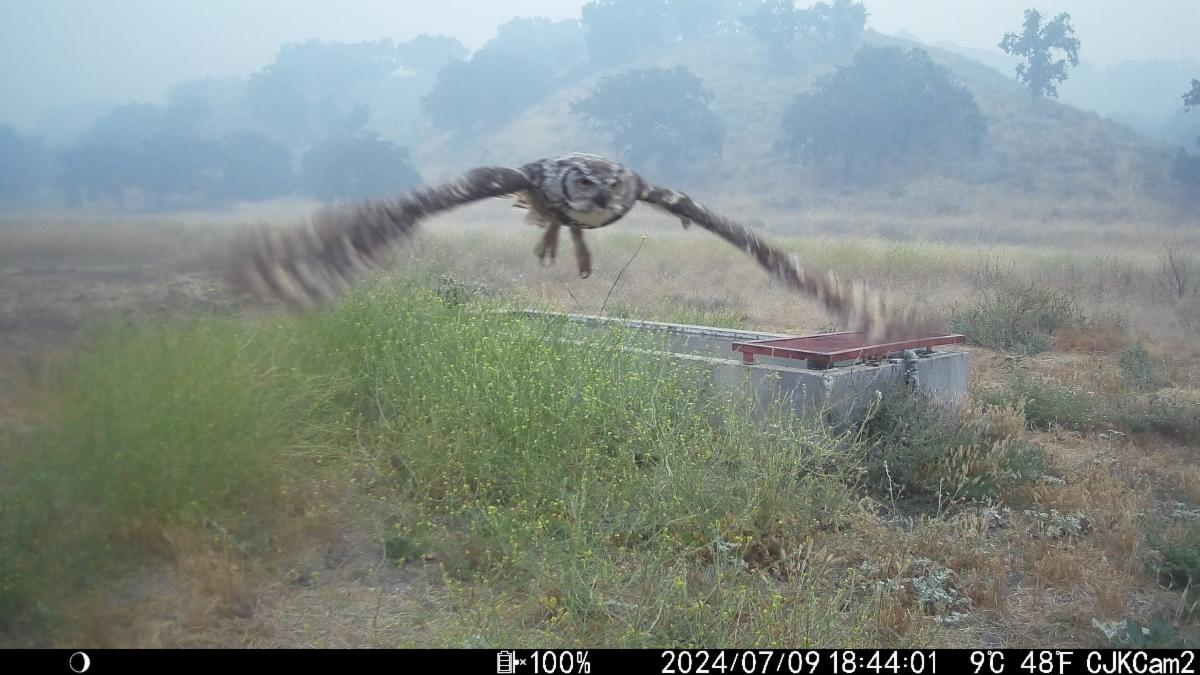
Image 1:Great Horned Owl flying towards the camera. Image by Angela Giordani. | |
|
In this newsletter:
Reserve Highlight
Docent Training in 2025
Research Highlight
Researchers unite to explore post-Lake wildfire impacts
Research Highlight
7,000 wildfires burned across California in 2023 alone. The solution is to fight fire with fire
Natural History Highlight
Mule Deer Meditation
| |
|
Research Highlight
Researchers unite to explore post-Lake wildfire impacts
By Kristen Zumdahl
Manager of the La Kretz Research Center at Sedgwick Reserve
| |
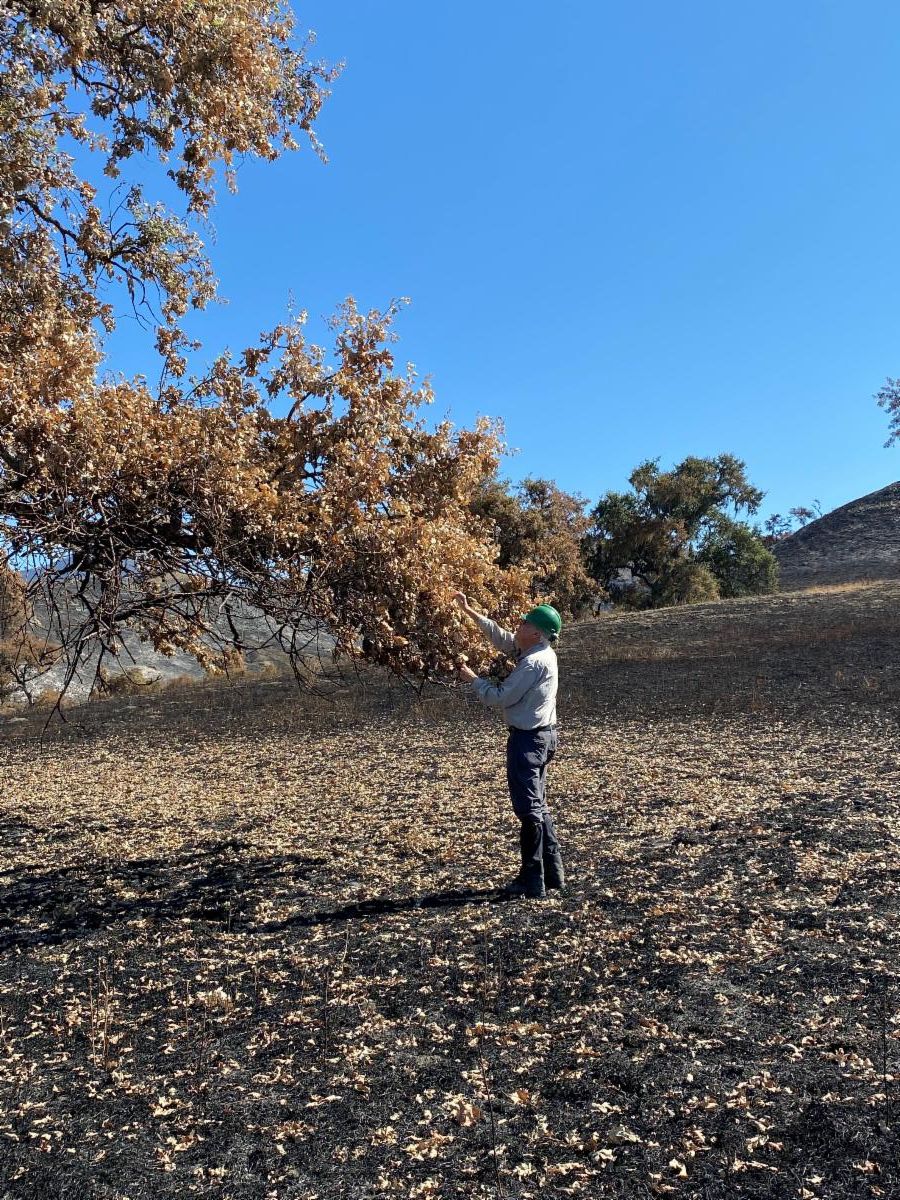
Image 2: Research Assistant and Sedgwick Docent, Andy Lentz, assessing a Lake Fire-burned oak that is part of a preexisting long-term study led by UCLA's Dr. Victoria Sork | |
|
In the wake of the Lake Fire, the La Kretz Center swiftly mobilized to assess the fire’s effects on Sedgwick Reserve. Organizing meetings with over 70 researchers, the Center spearheaded a collaborative effort to understand the fire’s impact and identify potential research opportunities. This dynamic response has seen many researchers eagerly dive into investigating the fire’s consequences and explore innovative projects.
Researchers are contributing their expertise to several key areas of study stemming from the Lake Fire:
-
Fire Ecology: Investigations focus on how fires interact with species and ecosystems, including fuel dynamics, fire behavior, and ecological impacts.
-
Fuels and Fire Behavior: Research into the characteristics of combustible materials and their influence on fire dynamics.
-
Restoration and Remediation: Studies aimed at rehabilitating fire-affected areas and evaluating methods for ecosystem restoration.
-
Remote Sensing: Utilizing advanced technologies to monitor fire conditions and behavior.
-
Meteorology: Research into the importance of heatwaves amongst different fire severities and impacts of the fire on energy budgets.
-
Hill Slope Hydrology and Geomorphology: Examining how fire impacts water flow and landscape changes.
-
Biogeochemistry and Soil Science: Analyzing the effects of fire on soil properties and biogeochemical cycles.
These collaborative efforts are paving the way for a deeper understanding of wildfire impacts and advancing the science of fire management and ecological restoration in California. Please contact Kristen Zumdahl (kazumdahl@ucsb.edu) or Frank Davis (frankdavis@ucsb.edu) if you are a research scientist and would like to get involved.
| |
Research Highlight
7,000 wildfires burned across California in 2023 alone. The solution is to fight fire with fire
By Izzy Sofio & Katie McElroy
Originally published in the UC Natural Reserve System Newsletter
| |
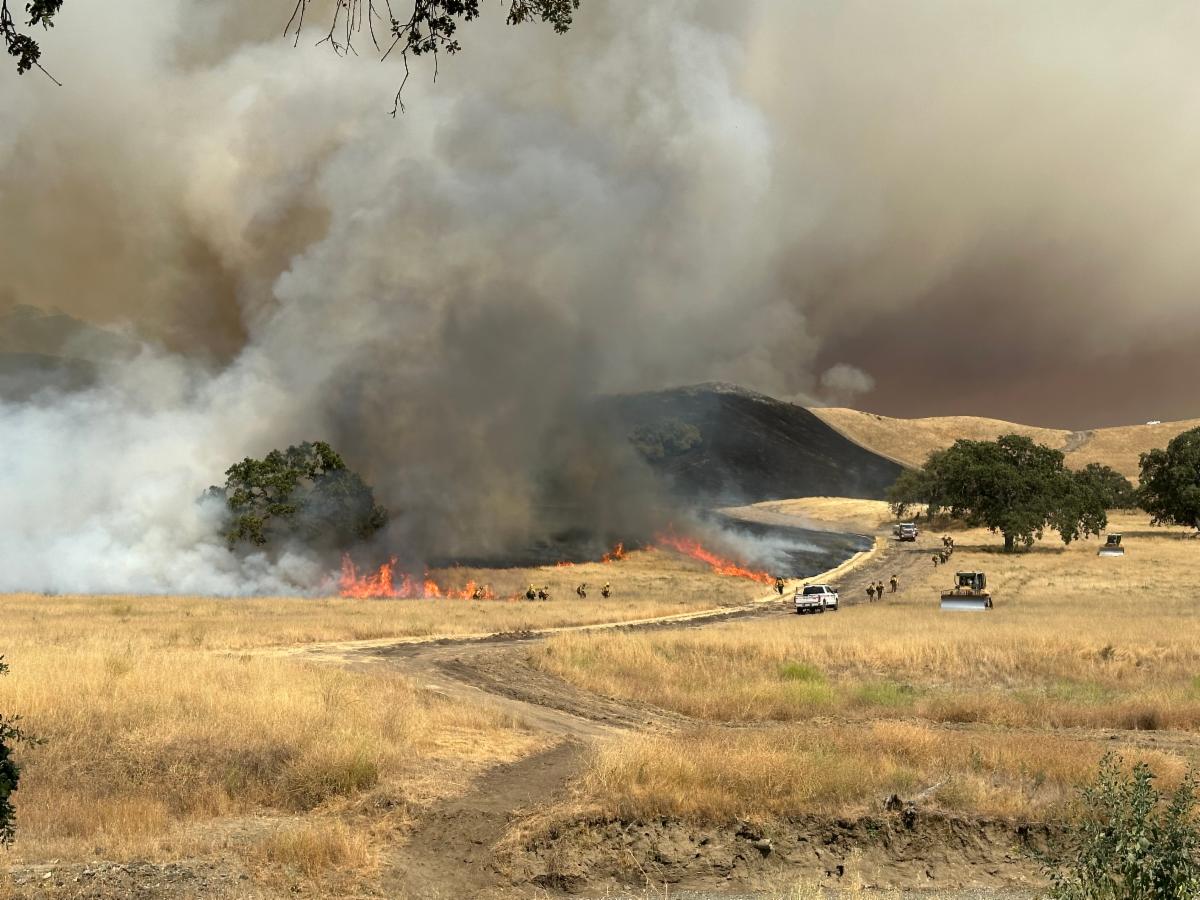
Image 3: Controlled back burn at Sedgwick Reserve | |
The mere mention of wildfire likely brings back vivid memories— whether it’s the Woolsey Fire, Camp Fire, Witch Fire, or another one that impacted your life most. Every year, fires seem to be bigger, more frequent, and closer to home. We’re not imagining this—researchers confirm that it’s true. And the best way to fight back against fires? More fire.
So how do we fight fire with fire? Through a practice known as prescribed burning. A prescribed burn is intentionally set to reduce the risk of a larger wildfire. They can also achieve other management goals like improving habitat for native species or rangeland, or for cultural purposes. And while it may sound illogical, these smaller, controlled fires really help, especially when implemented across all communities, not just those with economic or political influence. They burn off plant growth like the crisp, dried shrubs that act as fuel to a wildfire.
In fact, the practice of prescribed burning is centuries old. Indigenous communities used burning as a tool to cultivate crops, like acorns from oak trees, and to renew medicinal and practical materials. Colonization of Indigenous Californians by the Spanish and U.S. governments, along with suppressive laws like the 1850 Act for Government Protections of Indians, severely diminished Indigenous burning practices. On top of that, the U.S. Forest Service (USFS) made fire suppression its main priority in the early twentieth century. This caused a buildup of fuel and fostered a fear of fire reinforced by the endearing, yet misleading, Smokey Bear...
Read the full story here.
| |
|
Natural History Highlight
Mule Deer Meditation
By Nikki Evans
| |
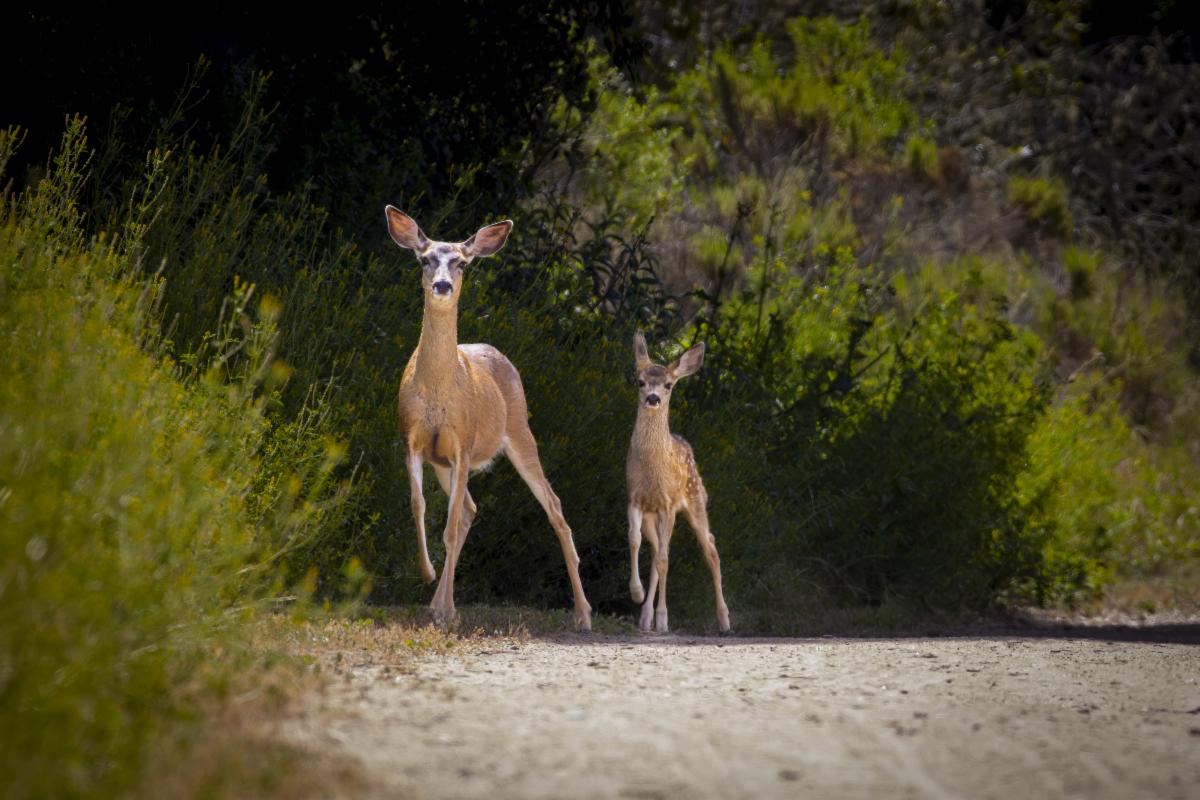
Image 4: Doe and fawn in matching pose. Image courtesy of Nikki Evans | |
|
While most people associate fall with changing leaves, pumpkins (and their delicious lattes), and cooler temperatures, naturalists will note other special things happening in nature during this time. Here at Sedgwick, the return of wintering birds, the moving shadows of tarantula season, and the plunk! of valley oak acorns hitting the picnic tables indicate a fall well underway. However, one of the most prominent phenomena in the fall is the seasonal movement and behavior of our local mule deer during this time. Perhaps you have noticed that deer are more visible in the fall. This is for several reasons. Deer are driven to different areas as new food sources become available. And currently, thousands of acorns are strewn beneath the oaks, offering a variety of shades of greens and browns to choose from. (Side note: If you are looking to entertain a small child, try taking them under one of these oak trees. My toddler has discovered acorns, to her delight, collecting them and trying different loose caps on different nuts.) These calorie-dense morsels are perfect for wildlife packing on the pounds before winter; while we're eating our Halloween leftovers of fun-sized candy bars, the deer are eating acorns of equivalent calories (thanks to Angela Giordani for this fun fact).
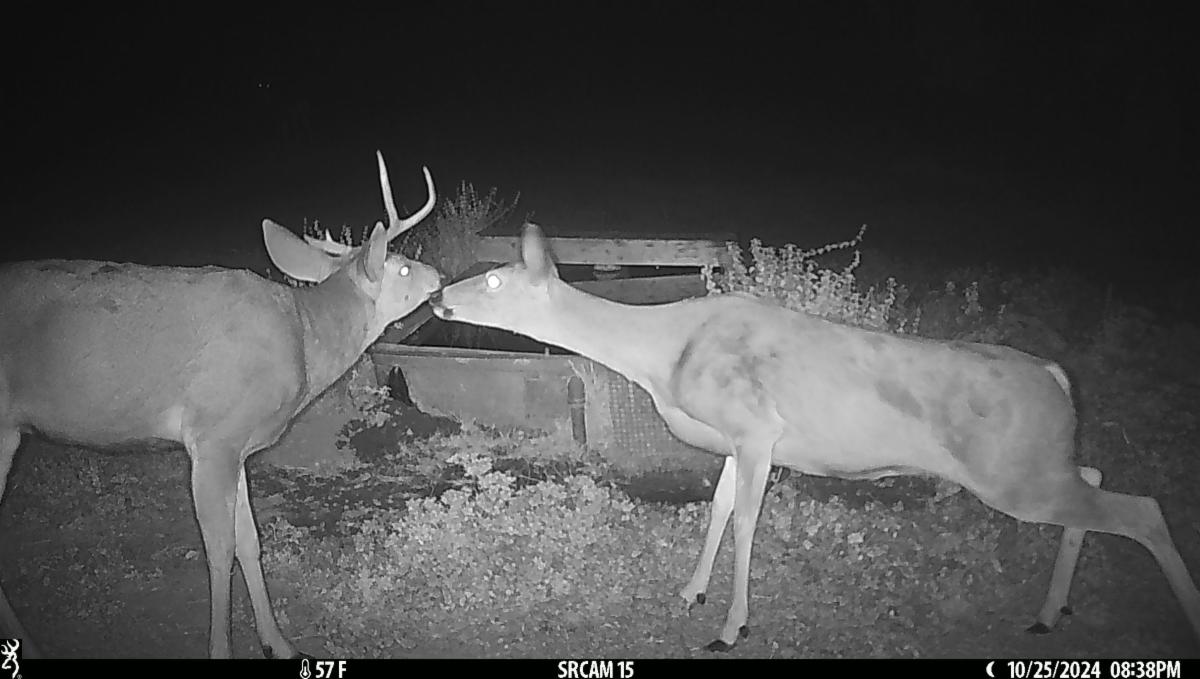
At the same time, deer are entering the rut. Bucks may fight with other males, locking antlers in an attempt to prove strength. The desire to mate drives bucks across fields and roads as they follow the chemical trails of females. Deer have a Jacobson’s organ, a sensory organ in their nasal cavity that senses pheromones. Just as a snake sticks out its tongue to gather pheromones, a buck will raise its head and curl its top lip gathering this important chemical information. Once encountering a desired female, a buck may follow her for miles and days, hoping she will give him an opportunity. Many sources on deer biology indicate that males win the right to mate by fighting other males, but anyone who has seen a buck following desperately behind a doe to the point of breathlessness knows the truth: It is the females who ultimately permit the right to mate.
| |
Image 5: A female pays attention to a lucky buck. Image courtesy of Angela Giordani | |
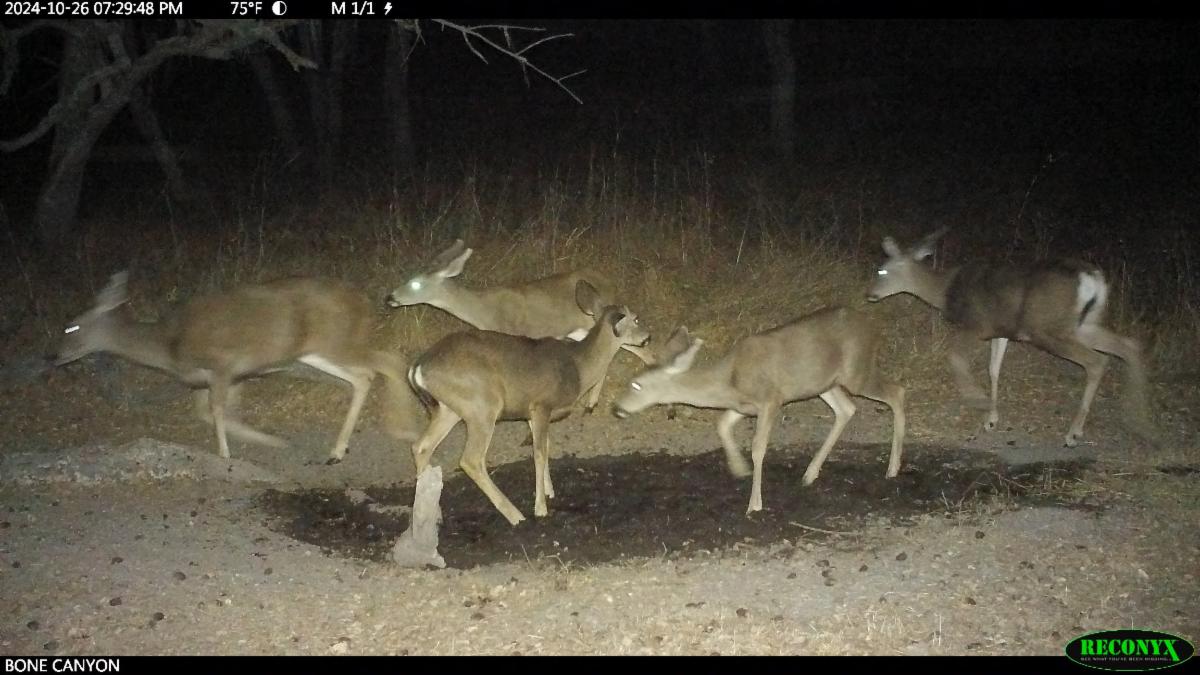
Image 6: An odd moment captured in the lives of these does. Any theories of what may be going on here? Image courtesy of Angela Giordani | |
|
In Touching the Wild, naturalist Joe Hutto recollects seven years spent living with a herd of mule deer. He shares the stories of individual deer he knew personally. In doing so, he reminds us that deer are complex beings who experience struggles and triumphs, have social lives, and approach life with unique personalities, just as we do. He observed that they can be emotionally damaged by loss, sometimes never recovering and that the life of a mule deer is one of hardship and, occasionally, victory. To think of all the deer out there living out their dramas, victories, and successes is to appreciate the beauty of the natural world.
It can be easy to lose a sense of wonder and curiosity towards commonly encountered animals such as deer, but learning about their lives can help us get there. The word sonder refers to the profound realization that everyone around you is experiencing a life just as vivid as your own, with their own ambitions and emotions, the central character in their own story. I wonder if we might try to intentionally cultivate this feeling towards non-human animals.
Next time you encounter deer, if you have the chance, pause and watch. Spend some time with them. Ask yourself what their day might be like, and what challenges this deer might have overcome in her/his life. Remember that this moment you are spending with them is just one small snapshot in their continued life (and likely a muted one if they are also watching you). Pause, take a breath of the cool fall air, and enjoy the mule deer. Happy fall!
| 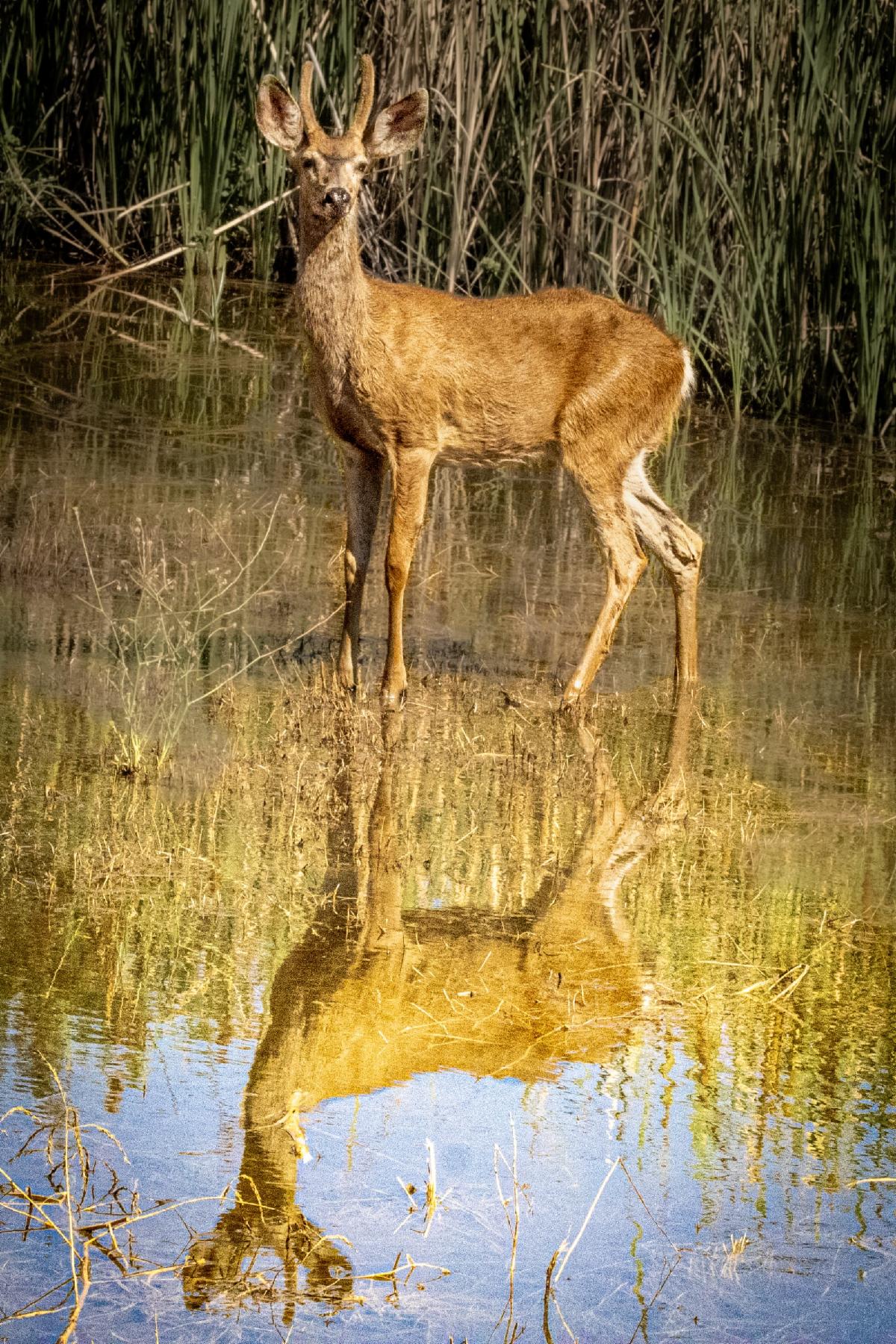 | |
Image 7: A buck with velvet antlers reflecting in the Sedgwick pond. Image courtesy of Nikki Evans | |
Sedgwick Reserve depends on the support of our donors to fund our docent program, support researchers, and offer community-focused public events. Your gift ensures our ability to continue supporting world-class research and education with global impact. Support Sedgwick Reserve Today! | | | | |