|
Palm Beach County State Legislative Update
Week of February 2nd
| | UPDATES FROM THE EXECUTIVE BRANCH | | |
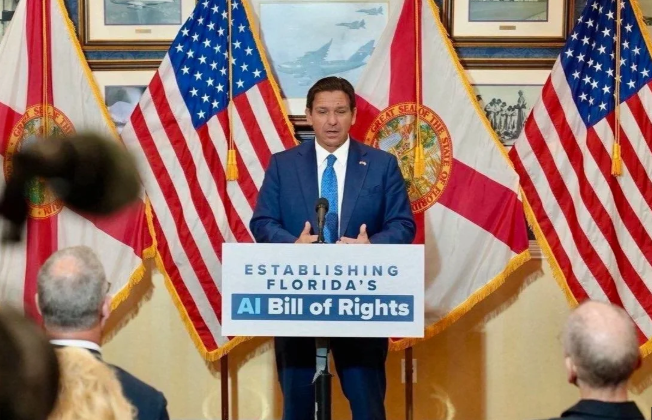
AI BILL OF RIGHTS
Governor Ron DeSantis held a roundtable discussion Wednesday morning at New College of Florida regarding the use and proliferation of artificial intelligence. Back in December 2025, the governor unveiled a key proposal that aims at shielding Floridians from the growing power of artificial intelligence. SB 482 by Senator Leek includes many of the suggestions in the governor's proposal. The bill unanimously cleared its first committee and continues to its final committee of reference in Senate Appropriations.
According to the governor’s office, the proposed bill would seek to:
- Reenact protections Florida has already passed against “deep fakes” and explicit material, including those depicting minors.
- Prohibit any state or local government agency from utilizing DeepSeek or any other Chinese-created AI tools to protect American data.
- Prohibit AI from using an individual’s Name, Image, Likeness (NIL) without their consent – tie it to harm or sale of a product (political ads, schemes to defraud already in law).
- Require a notice to consumers when interacting with AI (Company chatbots).
- Prohibit entities from providing “licensed” therapy or mental health counseling through artificial intelligence. This can be expanded to include use of AI to imitate a licensed professional.
- Provide parental controls for minors which will allow parents to access the conversation their child has with a large language model, set parameters for when the child can access the platform, and notify parents if their child exhibits concerning behavior.
- Ensure data inputted to AI is secure and private.
- Prohibit companies from selling or sharing personal identifying information with third parties (deidentified) and mirror data privacy protections in current law.
- Limit insurance companies from using AI for insurance claims. Require that AI cannot be used as the sole determination in adjusting or denying a claim. Insurers that use AI for claims must detail the use and allow the Office of Insurance Regulation to inspect the AI model to ensure it does not violate unfair insurance trade practices.
The bill would also allow state and local government to restrict the development of hyperscale data centers Florida, and to keep utilities from charging Florida residents more to support these centers, including electric, gas, and water utilities.
| |
PRESS CONFERENCE IN LAKE WORTH BEACH
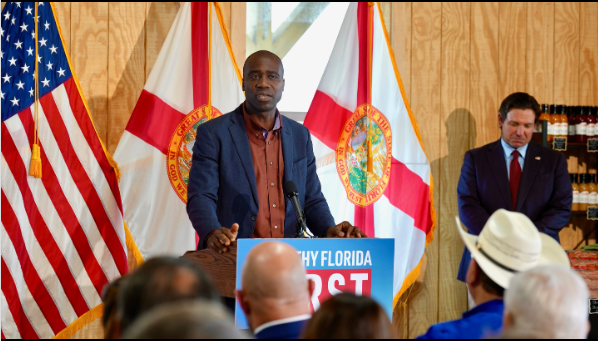
On Thursday, February 5th, Governor Ron DeSantis, First Lady Casey DeSantis, and Florida Surgeon General Dr. Joseph Ladapo announced new food safety findings.
Florida’s Department of Health, under the Healthy Florida First initiative, released the results of independent testing of bread products sold in the state. The testing analyzed eight bread products from five national brands for chemical contaminants and found glyphosate, a commonly used herbicide, in six of the products. The initiative is intended to provide families with information about potential chemical exposures in everyday foods and support informed decision-making.
This effort builds on earlier testing of infant formula and candy products, which identified certain heavy metals, including arsenic, mercury, cadmium, and lead, in some products. The Healthy Florida First initiative aims to increase transparency, promote accountability for widely consumed foods, and give consumers accessible information about potential health risks in everyday food products.
| | UPDATES FROM THE LEGISLATURE | | |
The Florida Senate has delayed releasing its budget proposal until February 12, citing an effort to keep both chambers aligned. Senate Appropriations Chair Ed Hooper said the Senate aims to maintain the tradition of introducing budget proposals in the same week as the House, while both bodies work to agree on the total resources available for the upcoming fiscal year. The delay comes amid ongoing discussions over key budget areas, including Medicaid spending, property tax relief, and overall fiscal priorities.
Senate President Ben Albritton and Chair Hooper said that factors such as Medicaid growth and other external variables continue to create uncertainty in the budgeting process. Both leaders indicated a desire for budget proposals to start close to or below last year’s levels, while noting that even small changes in spending priorities affect the state’s overall budget, which exceeds $100 billion.
However, there is speculation about potential tensions between the chambers, as House Budget Chair Lawrence McClure emphasized that the Senate’s delays are not related to the House’s actions. In a post on X, he stated, “Any timing issues they are having in pulling together their Senate budget have absolutely nothing to do with the Florida House.”
| | MONDAY COMMITTEE MEETINGS | | |
Senate Government Oversight & Accountability
SB 526: Construction Regulations - This amended bill by Senator Grall has cleared its second committee stop and moves ahead to its final committee. The bill creates provisions governing public works projects construction contracts to render void and unenforceable contract provisions that bar certain remedies or contractor’s rights to extensions when the governmental entity that has awarded the contract causes or contributes to a delay.
The bill also amends the Florida Building Codes Act to require the Florida Building Commission, in consultation with the Department of Business and Professional Regulation, to create uniform commercial building permit acceptance standards to identify the information required for acceptance of a commercial building application for statewide use by enforcing agencies. The minimum contents of the standards are specified. Local enforcement agencies are allowed to require supplemental plans and documentation to demonstrate compliance with the Building Code or applicable ordinances and land development code.
For commercial construction projects, the bill requires local enforcement agencies to reduce permit fees by at least 25 percent of the amount attributable to plans review or building inspection services when a private provider is used, and at least 50 percent of the amount otherwise charged if a private provider performs all required plans review or building inspection services. A local enforcement agency is allowed to reduce its fees more than the required reductions, and an agency that doesn’t reduce its fees forfeits the ability to collect any fees for the commercial construction project. The bill expands the list of categories of products for which the Florida Building Commission must develop an approval system for statewide use in construction to include mitigation products.
SB 1072: Antisemitism Task Force - This bill by Senator Calatayud creates the Antisemitism Task Force (Task Force) for the express purpose of combating antisemitism in Florida. To this end, the Task Force has a range of responsibilities, including providing assistance, conducting studies and assessments, and engaging with local Jewish communities.
The Task Force must annually “submit a report and policy recommendations” to the Governor and legislative leaders. The Task Force is composed of 18 members serving two-year terms and is adjunct to the Office of Civil Rights in the Department of Legal Affairs. The Department of Legal Affairs will provide administrative and staff support to the Task Force. The Task Force is automatically repealed on October 2, 2029, unless reviewed and saved by the Legislature. The bill passed unanimously and continues to its second committee stop in Senate Appropriations Committee on Criminal and Civil Justice.
| | |
House Ways & Means
HB 4071: Palm Beach County - This county local bill being carried by Representative Snyder has cleared its second committee stop with unanimous support and advances to it final committee stop in State Affairs. The bill revises the impacts of annexation within Palm Beach County to avoid adverse health and safety impacts to the citizens and visitors of the county. It provides a method to allow the Palm Beach County Fire/Rescue Municipal Service Taxing Units ("PBFire MSTU") to avoid adverse financial impacts associated with annexations within its boundaries, while at the same time not restricting municipalities' ability to annex. Members primarily questioned how projected annexations would affect fire and emergency services and whether municipalities were actively engaged in resolving their concerns.
| | TUESDAY COMMITTEE MEETINGS | | |
Senate Community Affairs
SB 0484: Data Centers - This amended bill by Senator Avila has passed its second committee and advances to its final stop in Senate Rules. The bill revises Florida law governing large-scale data centers and other major electricity users. The bill prohibits state agencies from entering into nondisclosure agreements that limit public disclosure of information related to potential data center developments and affirms local governments’ authority over comprehensive planning and land development decisions involving large load customers.
The bill establishes and clarifies key definitions and directs the Public Service Commission to develop minimum tariff requirements for large load customers served by public electric utilities. These requirements must ensure that large load customers, including large data centers, pay their full cost of service and that other ratepayers are protected from financial risk. The bill also prohibits utilities from providing electric service to large load facilities owned or controlled by foreign countries of concern.
Additionally, the bill creates separate consumptive use permit requirements and application processes for large-scale data centers and authorizes water management districts or the Department of Environmental Protection to require partial use of reclaimed water as a condition of approval. Any modification to a consumptive use permit involving a large-scale data center must be treated as a new application. Members questioned whether nondisclosure agreements would suppress local public input, and they debated the need to prevent shifting costs to ratepayers while sustaining Florida’s technological growth. The discussion reflected broad support for striking a balance between consumer protection, environmental safeguards, and future economic development.
SB 0698: Onsite Sewage Treatment and Disposal System Permits - This amended bill by Senator Martin provides that if a building or plumbing permit is issued for a single-family residence that requires the use of an onsite sewage treatment and disposal system (OSTDS), a municipality or political subdivision of the state may not require an owner or builder to obtain a construction permit for the OSTDS as a condition of issuing the building or plumbing permit. The bill also provides that any new rules relating to the use and installation of an OSTDS that are adopted by the Florida Department of Environmental Protection will not apply to permit applications submitted within 120 days after the date the rules are adopted. No members posed questions on the bill and the bill passed its second committee unanimously. It now proceeds to its final committee stop in Senate Rules.
SB 0706: Commercial Service Airports - This amended bill by Senator Mayfield has cleared its second committee and moves onto its last committee stop in Senate Rules. The bill preempts to the state the naming of major commercial service airports, which are defined as commercial service airports classified by the Federal Aviation Administration (FAA) as large or medium hub airports. The bill codifies in law the names of Florida’s seven major commercial service airports. The only name being changed from its current name is “Palm Beach International Airport,” which the bill renames as the “Donald J. Trump International Airport.” Last week, the county's amendment was added to the bill to account for expenses due changes to signage, brand identity, and implementation of changes. Members raised questions about local control, with Senator Jones clarifying the scope of legislative preemption and Senator Sharief expressing concerns about renaming airports. The sponsor noted that any future name changes would require legislative approval.
SB 0968: Home Backup Power Systems - This bill by Senator McClain prohibits local governments from requiring building permits, adopting technical amendments to the Florida Building Code that would require permits, or adopting or enforcing any measure more stringent than the Building Code for backup power systems.
A “backup power system” is defined under the bill as equipment and associated components installed at or serving a one- or two-family dwelling or townhouse for the purpose of providing onsite electrical power during utility outages, load management, resiliency, or other similar purposes that is capable of providing no more than 50 kilowatts of output to the residence or has an aggregate storage capacity of no more than 100 kilowatt-hours, if the system includes energy storage. The bill specifies requirements related to inspections of backup power systems. The bill also exempts work valued at less than $7,500 on single-family dwelling lots from building permit requirements. No questions were asked by members, and Senator McClain indicated he is refining amendments related to generator permit requirements and window and door installations; after brief discussion, the committee reported the bill favorably. It now advances to its second committee in Senate Regulated Industries.
SB 1134: Official Actions of Local Governments - This bill by Senator Yarborough prohibits counties and municipalities from funding, promoting, or taking official actions such as adopting ordinances, resolutions, rules, regulations, programs, or policies, related to diversity, equity, and inclusion. A county or municipality may not expend any funds, regardless of the source, or establish, support, sustain, or staff a diversity, equity, and inclusion office or officer.
The bill provides that a member of a county or municipal governing body acting in their official capacity who violates the prohibitions commits misfeasance or malfeasance in office. An action may be brought against a county or municipality that violates the bill’s provisions by a resident of the county. The bill does not prohibit official action required for compliance with general or federal law or regulation, and includes a series of exceptions. Further, the bill requires any potential recipient of a county or municipal contract or grant to certify before such award that they do not and will not use local government funds to require employees, contractors, volunteers, vendors, or agents to ascribe to, study, or be instructed using materials related to diversity, equity, and inclusion. Members questioned the scope of prohibiting local DEI efforts, with several worrying it could invalidate existing contracts or celebrations and impose harsh penalties on local officials. Debate focused on refining definitions and exceptions to avoid unintended discrimination while preserving merit-based standards.
SB 1320: Tax Referenda - This bill by Senator Martin requires a local government spending analysis developed by the Department of Financial Services (department) to be included on a county referendum proposing an increase in taxes, if the department has created such an analysis. “Local government spending analysis” is defined by the bill as a statement prepared by the department or one of its agencies analyzing the spending of a county government. The bill grants the department rulemaking authority to implement the newly created section, including standards and requirements for the local government spending analysis. Members questioned whether the proposed spending analysis was redundant with existing performance audits and debated the benefit of providing additional voter information, with Senator Pizzo questioning its necessity. Despite concerns, the bill passed 5-3 and continues to its next committee in Senate Banking and Insurance.
SB 1342: Transportation Infrastructure Land Development Regulations - This amended bill by Senator Rouson creates the “Transit-Oriented Development Act,” a framework for preempting how local governments approach zoning in the vicinity of transit stops. Under the bill, a local government must adopt new zoning for all lots partly within one-half mile of a permanent transportation stop, authorizing mixed use residential and commercial development. For affected lots, a local government may not impose any limitation, restriction, or prohibition regarding any type of single-family or multifamily use, including maximum density or minimum dwelling unit size, and the bill provides limits on local land use regulations such as height, setbacks, and parking. The bill contemplates standards for judicial proceedings under the bill, and entitles a prevailing plaintiff to attorney fees and costs. The bill also provides legislative intent and a framework for public investment in transit-oriented development zones.
SB 1548: Affordable Housing - SB 1548 revises and clarifies several provisions of the Live Local Act, which was enacted in 2023 to require local governments to approve certain affordable housing developments when specified conditions are met. The bill expands and refines how those preemptions apply, with the goal of reducing barriers to affordable housing construction at the local level.
The bill provides that the Live Local Act’s affordable housing development preemptions apply to property owned by counties, municipalities, and school districts. It also limits local governments’ ability to indirectly restrict authorized developments by prohibiting the use of alternative dimensional standards, such as setbacks, to effectively reduce a project’s allowed height. In addition, SB 1548 clarifies that farming and farm-related operations are not considered commercial, industrial, or mixed-use zoning for purposes of triggering mandatory approval of affordable housing projects.
Further, the bill allows the Live Local Act to be used near airports when approved by the airport’s governing authority. It also clarifies the prohibition on local governments discriminating against affordable housing developments in land use decisions and waives sovereign immunity for claims arising from such discrimination, allowing affected parties to pursue legal remedies. No member posed questions, and debate was limited to the bill sponsor’s explanation about allowing live local projects on publicly owned land and strengthening fair housing protections. The bill passed unanimously and moves to its second committee in Senate Fiscal Policy.
SB 1614: Florida Building Code - This amended bill by Senator Leek provides that a local government may not receive state funds through a local funding initiative request if the local government has been subject to a legislative committee’s audit within one year after such request, or if the local government does not submit an affirmation with its local funding initiative request to its legislative delegation stating that it is no longer the subject of a state audit. Each appropriate legislative committee must report a list of all local governments that have been subject to an audit or which have not submitted an affirmation to the presiding officers of both chambers and the chairs of the legislative appropriations committees.
The bill also removes a current law provision that authorizes a local government to use excess funds received from enforcing the Florida Building Code for the construction of a building or structure that houses a local government’s building code enforcement agency. No members asked questions and the sponsor briefly described SB 1614’s aim to prevent local governments with excess funds or pending audits from receiving state money. The bill faced little debate, and passed with an amendment to tighten eligibility requirements. It now advances to its second committee in Senate Appropriations Committee on Agriculture, Environment, and General Government.
| | |
Senate Rules
SB 594: Local Housing Assistance Plans - This bill by Senator Burton has unanimously passed its final committee and now heads to the Senate Floor. The bill provides that a county’s or municipality’s local housing assistance plan under the State Housing Initiatives Partnership (SHIP) Program must include a strategy for providing program funds to mobile home owners, including lot rental assistance. The bill specifies that lot rental assistance is considered home ownership activity for purposes of allocating program funds, while rehabilitation and emergency repairs for mobile homes is considered construction, rehabilitation, or emergency repair of affordable, eligible housing. The bill allows local governments to expend funds from their local housing distribution on lot rental assistance for mobile home owners not to exceed 6 months’ rent.
| | |
Senate Regulated Industries
SB 1498: Community Associations - This amended bill by Senator Bradley primarily revises statutes governing condominium and homeowners’ associations. It aims to prohibit unfair mandatory membership fees and enhance homeowners’ rights. The bill modifies requirements related to structural integrity reserve studies (SIRS) and turnover inspection reports, clarifying that these requirements apply based on “three habitable stories or higher” and, in some cases, to all buildings on condominium or cooperative property regardless of height. These changes may be relevant to local governments in their roles related to building safety coordination or constituent inquiries.
The bill expands record access and enforcement provisions by requiring condominium and homeowners’ associations to provide requested records to law enforcement and prosecuting agencies in response to subpoenas or written requests, and to assist investigations to the extent permitted by law. It creates criminal penalties for association officials or managers who willfully fail to provide such records, which may affect local law enforcement and prosecutorial activities.
Other provisions address internal governance of condominium and homeowners’ associations, including electronic voting, official records access, and restrictions on developer-controlled assessments. These provisions do not impose new regulatory duties on counties or municipalities but may affect residents and associations within local jurisdictions. There were no formal questions about the bill. Senator Boyd applauded Senator Bradley’s work on hidden fee structures. The bill passed unanimously and continues to its second stop in Senate Appropriations Committee on Agriculture, Environment, and General Government.
| |
Senate Environment and Natural Resources
SB 1422: Surface Waters - This amended bill by Senator Garcia sets forth legislative findings recognizing the important role coral reefs play in protecting coastal communities. The bill acknowledges that coral reefs help reduce damage from storms, flooding, sea level rise, and other climate- and disaster-related impacts by attenuating wave energy and protecting coastal property. It also recognizes coral reef restoration as an active, nature-based strategy to strengthen reef structure and reduce coastal flooding, and notes the role of the Federal Emergency Management Agency in disaster response and hazard mitigation.
Based on these findings, the bill designates coral reefs as critical natural infrastructure and as a nature-based solution for mitigating climate change and disaster risks. It further declares that protecting corals, coral reefs, and associated hardbottom in Broward, Martin, Miami-Dade, Monroe, and Palm Beach counties is in the public interest. Senator Harrell asked about the amendment’s deletion of dredging and turbidity monitoring requirements, and Senator Garcia explained the bill’s updated emphasis on designating coral reefs as critical natural infrastructure. Members supported the measure, which passed favorably without opposition. The bill now advances to its second committee stop in Senate Appropriations Committee on Agriculture, Environment, and General Government.
| |
Senate Transportation
SB 1220: Transportation - This amended bill by Senator Massullo has passed its first committee stop. The bill makes wide-ranging changes to state transportation policy, expanding the authority of the Florida Department of Transportation (FDOT) and addressing emerging technologies, infrastructure planning, and funding. The bill updates provisions related to trails, ports, airports, maritime infrastructure, and aviation, while also responding to advancements such as drone delivery, autonomous vehicles, and advanced air mobility.
The bill revises the Shared-Use Nonmotorized (SUN) Trail program by requiring updated prioritization of regionally significant trails, allowing additional surface materials, and permitting FDOT to consider sponsorship agreements. It strengthens transportation system planning by requiring seaports and commercial service airports to include strategies for maintaining critical infrastructure resources, directing FDOT to identify key maritime supply chain components, and focusing aviation investments on efficiency, passenger experience, and supply-chain performance. FDOT is also authorized to coordinate with airports on reviewing federal security policies to improve operations.
CS/SB 1220 addresses new transportation technologies by authorizing personal delivery devices in certain rights-of-way, limiting local governments’ ability to block drone delivery services at commercial properties, and clarifying that drone operations do not affect minimum parking requirements. The bill expands FDOT’s authority related to advanced air mobility, including defining new transportation corridor connection points, allowing FDOT to acquire and operate airports, and designating FDOT as the lead agency for LiDAR mapping.
The bill further expands FDOT’s role in research, economic development promotion, and coordination of federal transportation funding, including approving local requests for federal funds related to state-owned facilities. It increases the share of turnpike toll revenues programmed for projects in Palm Beach, Broward, and Miami-Dade counties, creates new felony offenses for damaging or shooting into autonomous vehicles, and repeals statutory authority related to digital driver licenses. Finally, the bill requires FDOT to study the impact of alternative fuel vehicles on transportation revenues and provides a $300,000 appropriation for that study.
| |
Senate Agriculture
SB 962: Affordable Housing - This bill by Senator Bradley provides that for the purposes of the Live Local Act, passed during the 2023 Regular Session, farms or farm operations, including the packaging and sale of those products raised on the premises, are excluded from the definitions of commercial, industrial, or mixed use zoning which would require the local government to approve certain affordable housing developments. The bill advances to its final committee in Senate Rules.
| |
House State Affairs
HB 441: Conservation Lands - This bill by Representative Kendall increases notice and transparency when the state or water management districts are considering selling or exchanging state or district-owned conservation lands by creating specific statutory notice requirements when such actions are being formally considered. The bill requires at least 30 days’ notice before formal consideration and requires publication of certain information related to the proposed sale and exchange, including the parcels involved and why such lands are no longer needed for conservation purposes or how the proposed land exchange will result in a conservation benefit, as applicable. The bill also requires that when state-owned land is being considered in a land exchange, at least one appraisal must occur.
HB 4035: Palm Beach County - This county local bill being carried by Representative Edmonds has cleared its final committee stop with unanimous support and is ready for the House Floor. It revises the Palm Beach County Construction Industry Licensing Board’s (Board) process for issuing certificates of competency by requiring applicants to pass the required examination before their application is reviewed by the Board. The bill requires applicants to submit preliminary paperwork to ensure certain requirements are met before the examination is scheduled. No questions were asked in committee.
HB 103: Local Business Taxes - This bill by Representative Botana has passed its final committee and is ready for the House Floor. It repeals Chapter 205, in Florid Statute, removing the authority for local governments to levy a local business tax and makes conforming changes. The bill allows municipalities that impose a business tax on merchants measured by gross receipts to continue to impose the tax and counties that levy an additional county business tax under current law to continue to levy such tax. Members questioned a carve-out for economic development and how local governments would track businesses without the tax, while supporters called it an unnecessary burden and opponents warned that it funds essential services and compliance.
| |
House Commerce
HB 919: Commercial Service Airports - This amended bill by Representative Weinberger has cleared its final committee and is ready for the House Floor. The bill preempts to the state the naming of major commercial service airports, which are defined as commercial service airports classified by the Federal Aviation Administration (FAA) as large or medium hub airports. The bill codifies in law the names of Florida’s seven major commercial service airports. The only name being changed from its current name is “Palm Beach International Airport,” which the bill renames as the “Donald J. Trump International Airport.” Last week, the county's amendment was added to the bill to account for expenses due changes to signage, brand identity, and implementation of changes. Members raised questions about local control, with Senator Jones clarifying the scope of legislative preemption and Senator Sharief expressing concerns about renaming airports. The sponsor noted that any future name changes would require legislative approval.
| |
House Civil Justice
HB 657: Community Associations - This amended bill by Representative Porras makes several changes to Florida law governing homeowners’ associations and condominium associations, with a focus on governance, enforcement, and dispute resolution. It requires newly created HOAs and condominium associations to include “Kaufman” language in their governing documents, ensuring that the associations are subject to current and future community association laws. Existing associations must vote on whether to amend their governing documents to add this language.
The bill also revises association governance and operations by allowing HOAs to be terminated through a specified plan of termination and providing that the governing documents of a dissolved HOA are void and unenforceable. It establishes a duty of loyalty for HOA directors, officers, and committee members, defines conflicts of interest, and removes presuit mediation requirements for community association disputes.
In addition, the bill authorizes circuit courts to create community association court programs to hear disputes under the Condominium Act, Cooperative Act, and Homeowners’ Association Act, with funding provided through a general revenue appropriation to the Department of Business and Professional Regulation. The bill also clarifies statutory definitions by defining “financial statements” within the Homeowners’ Association Act. Members debated the creation of a specialized court for HOA disputes and the removal of presuit mediation, expressing strong support for increased accountability but concern about administration and costs.
| |
House Insurance & Banking
HB 1221: Department of Financial Services - This amended bill by Representative LaMarca enacts comprehensive reforms across multiple Department of Financial Services (“DFS”) administered programs and statutes. The bill revises eligibility standards, qualifying mitigation measures, and application procedures and statuses for the My Florida Safe Home Program. The bill authorizes DFS to independently procure insurance contracts, restructure coordinating council operations, and enter into multiyear software licensing agreements. It extends the deadline for health care providers to challenge carrier payment adjustments from 45 days to 60 days and requires public adjusters to respond to informational claim requests within 14 days.
The bill establishes new disqualification standards and enforcement penalties for DFS licensees, updates criminal background checks for licensees, and creates a transition framework for individuals transferring licenses into Florida. Additionally, the bill modernizes the Florida Disposition of Unclaimed Property Act by renaming it the “Abandoned Personal Property Act” and by substantially revising definitions, holder duties, notice, reporting and verification requirements, dormancy and unclaimed triggers, the Unclaimed Property State Fund, claimant representative and purchase agreement procedures, and state transparency and notification obligations. No members asked questions, and the only debate centered on an amendment allowing relatives to serve as firefighters, with Representative Alvarez supporting the exemption from nepotism rules as a way to preserve family traditions in firefighting. The bill ultimately passed without opposition.
| | WEDNESDAY COMMITTEE MEETINGS | | |
Senate Floor
SB 48: Housing - This amended bill by Senator Gaetz contains provisions related to accessory dwelling units, and density bonus incentives for land donation. The bill requires each county and municipality to enact an ordinance, by December 1, 2026, to allow accessory dwelling units (ADUs) in all single-family residential areas. Under current law, local governments are authorized, but not required, to enact such ordinance. The bill expressly allows local governments to regulate the permitting, construction, and use of ADUs, with specified exceptions.
The bill also allows certain land donated to a local government for affordable housing to be used to provide affordable housing to military families receiving the basic allowance for housing, and directs the Office of Program Policy Analysis and Government Accountability to evaluate the efficacy of using mezzanine finance, or second position short-term debt, to stimulate the construction of owner-occupied affordable housing, and evaluate potential for tiny homes to meet affordable housing needs. No members posed substantive questions on the bill or its amendments, and debate focused on the urgent need to address Florida’s housing shortage by allowing accessory dwelling units as a flexible, cost-effective solution, with no expressed opposition
| | |
Senate Banking and Insurance
SB 1706: My Safe Florida Condominium Pilot Program - This bill by Senator Pizzo has passed its first committee stop. The bill expands the existing Pilot Program for My Safe Florida to operate statewide by removing the current geographic limitation that restricts eligible condominium properties to those located within 15 miles inland of the coastline. While broadening eligibility geographically, the bill narrows participation by limiting it to condominium associations with buildings constructed before January 1, 2008, and where at least 80 percent of occupied units are owned and occupied by households earning no more than 80 percent of the area median income, adjusted for household size and county.
The bill also revises how Pilot Program grant funds may be used. Grant funds are restricted to mitigation improvements affecting the common elements of a condominium property. It removes the prior requirement that funded improvements generate insurance mitigation credits or rate reductions. Instead, it requires recipient associations to complete all opening protection improvements recommended in the final hurricane mitigation inspection report. This change maintains the program’s focus on strengthening buildings against hurricane damage while also allowing grants to fund water intrusion mitigation measures, which typically do not qualify for insurance mitigation credits but still enhance structural resilience.
| |
Senate Commerce and Tourism
SB 422: Automatic Dependent Surveillance-Broadcasts - This amended bill by Senator Wright estricts airports from using data collected through automatic dependent surveillance-broadcast (ADS-B) systems to calculate, generate, or collect fees from certain aircraft owners or operators. Specifically, an airport may not rely on ADS-B information to impose fees related to aircraft departures or landings, including touch-and-go operations, or for fees based solely on an aircraft entering the airport’s airspace.
These prohibitions apply only to aircraft with a gross weight of 12,499 pounds or less that are operating under the Federal Aviation Administration’s general operating and flight rules. As a result, the bill primarily affects smaller, general aviation aircraft and limits how airports may use surveillance data to assess fees for their operations. Members asked whether the sponsor would consider lowering the weight limit for smaller airports and debated whether restricting ADS-B data for fee collection helps ensure pilot safety or burdens airport finances. They acknowledged that ADS-B is primarily a safety tool and feared pilots might power it down if airports rely on the system for billing. The bill passed and continues to its final committee in Senate Rules.
SB 1356: Handling of Animals - This amended bill by Senator Garcia establishes state oversight of dog breeding by requiring the Florida Department of Agriculture and Consumer Services (FDACS) to adopt rules and best management practices for breeders. Dog breeders must obtain a certificate of registration from the Department of Business and Professional Regulation (DBPR) to operate, and DBPR is tasked with investigating noncompliance and enforcing penalties against breeders who fail to follow best practices.
The bill also strengthens consumer protections in the sale of cats and dogs. Pet dealers are required to ensure that financing arrangements are canceled without penalty if an animal is found to be unfit for purchase due to illness or disease, and all financing terms must be fully disclosed with a three-day waiting period before the buyer takes possession of the pet.
Additionally, pet dealers must provide consumers with copies of medical records, give written notice of their rights under existing law, and retain these records for seven years. Violations of these requirements are treated as violations of the Florida Deceptive and Unfair Trade Practices Act, and consumers are authorized to bring civil actions to enforce their rights. No members asked questions, and the brief debate focused on Senator Arrington’s concerns about Florida’s high animal euthanasia rates and her support for the measure, particularly acknowledging the amendment removing state oversight of local shelters. The bill now proceeds to its second committee stop in Senate Appropriations on Agriculture, Environment, and General Government.
| |
Senate Appropriations Committee on Health and Human Services
SB 96: Veterans Dental Care Grant Program - This amended bill by Senator Sharief revises the Veterans Dental Care Grant Program established within the Florida Department of Veterans’ Affairs (FDVA). Specifically, the bill provides that the grant program requires an additional qualification for veterans to be eligible for the Veterans Dental Care Grant Program. The additional qualification for veterans provided by the bill is an income of up to 400 percent of the federal poverty level. The bill appropriates $500,000 in recurring funds from the General Revenue Fund to the FDVA for the Veterans Dental Care Grant Program. The bill passed unanimously and continues to its final committee in Senate Appropriations.
| |
Senate Appropriations Committee on Agriculture, Environment, and General Government
SB 302: Nature-based Solutions for Improving Coastal Resilience - This amended bill by Senator Garcia has passed its expands the types of dredging, filling, and shoreline stabilization allowed in aquatic preserves, authorizing projects aimed at restoring natural habitats in areas such as Biscayne Bay. It permits the use of nature-based approaches, including living shorelines, vegetation plantings, living seawalls, and wave-attenuation devices, to protect and enhance coastal areas.
The bill also directs the Department of Environmental Protection (DEP) to establish statewide design guidelines and a consistent permitting process for coastal resiliency projects by 2027. Additionally, DEP and local governments are required to educate the public on the benefits of nature-based solutions for enhancing coastal resiliency and protecting aquatic ecosystems. Members did not ask any questions; the sponsor clarified the amendment removed workforce training due to fiscal concerns and authorized limited dredging for restoration efforts. The proposal passed favorably without voiced opposition.
SB 546: Conservation Lands -This amended bill by Senator Mayfield requires the Division of State Lands (division) within the Department of Environmental Protection and water management districts to provide 30 days’ notice before any meeting to review the proposed sale or exchange of conservation lands. The bill requires the notice to contain certain information, such as the parcels proposed for sale or exchange, the portions of lands which will be preserved in a permanent conservation easement, a statement explaining why the lands are no longer needed for conservation purposes or how the exchange will result in a conservation benefit to the state, and any applicable recommendations. The bill also provides that, for exchanges involving state-owned lands, each parcel proposed for exchange must have at least one appraisal that follows board-approved appraisal criteria, techniques, and methods. Members had no questions. The sponsor explained the bill’s intent to strengthen public notice requirements for proposed land disposals, and the committee voted favorably without voiced opposition. The bill now moves to its final committee in Senate Rules.
SB 636: Beach Management - This amended bill by Senator Leek provides that, in designating beaches as critically eroded, the Department of Environmental Protection (DEP) must review data related to beaches that have been preemptively and repeatedly repaired to avoid complete erosion and for which private funding, local government funding, and state and federal grants have been expended to stop or mitigate such erosion. The bill also provides that, if a local government with jurisdiction over a beach has a financial plan that ensures funding for inclusion in the state strategic beach management plan, such beach must be designated as critically eroded if: (1) there is a perpetual easement requiring the local government to maintain shoreline parcels and ensure high value inland developments are protected; and (2) the beach has geological features that result in repeated inland flooding or structural damage.
The bill allows the DEP to require coastal local governments to develop local strategic beach management plans and specifies what must be included in such plans. In addition, the bill expands the types of areas that may be designated as an area of critical state concern to include low elevation sections immediately inland of the dune and beach which have been repeatedly breached or overtopped by seawater flowing into an interconnected stormwater system or which have been designated in a local emergency declaration for a prolonged period.
SB 1120: Water Management Districts - This bill by Senator Brodeur has passed its first committee and advances to its final committee in Senate Rules. It makes comprehensive changes to how Florida’s water management districts are funded, budgeted, and governed. It restricts districts from using state funds as a local match for state grant programs unless the Legislature expressly authorizes it and allows districts to levy voter-approved ad valorem taxes to finance capital improvement projects related to water supply, water quality, flood protection, floodplain management, and natural systems. The bill also caps annual district spending on projects within the Statewide Flooding and Sea Level Rise Resilience Program at 25 percent of available funding.
In addition, the bill increases legislative oversight and transparency in district budgeting and operations. It requires more detailed capital improvement planning in preliminary and tentative budgets, including specific Everglades-related reporting requirements for the South Florida Water Management District (SFWMD). The Legislative Budget Commission is authorized to reject certain district budget items funded with state appropriations, with an exception for projects fully funded by voter-approved ad valorem taxes. The bill also tightens business practices by prohibiting lobbying expenditures to district officials, clarifying quorum requirements for governing boards, and establishing stricter procurement standards for large capital projects. Finally, it enhances accountability in Everglades restoration by requiring clearer reporting of remaining project costs and identifying whether restoration projects rely on recurring or nonrecurring state funding sources. No members asked questions; the sponsor highlighted minor updates to last year’s version, emphasizing oversight, transparency, and restricted use of state funds. The bill passed without voiced opposition or further debate.
SB 1230: PFAS (Perfluoroalkyl and Polyfluoroalkyl Substances) - This amended bill by Senator Harrell has unanimously passed its second committee and continues to its final committee in Senate Fiscal Policy. The bill phases out the use of aqueous film-forming foam (AFFF) containing intentionally added PFAS in Florida. Beginning July 1, 2026, AFFF may not be used for nonemergency training, instruction, or testing, and all entities must report existing inventories to the Department of Environmental Protection (DEP). The bill then bans the sale, purchase, and distribution of AFFF starting July 1, 2027, requires disposal plans for remaining supplies, and fully prohibits the possession and use of AFFF by July 1, 2028, with limited exceptions for certain federal, military, and emergency firefighting uses.
The bill directs DEP to adopt rules for the safe handling and disposal of AFFF, maintain a registry of PFAS-free firefighting foam alternatives, and provide technical and financial assistance to support the transition away from PFAS. Violations are subject to significant civil penalties and injunctive relief. The bill also requires larger public wastewater facilities to annually test biosolids for PFAS and report the results to DEP.
SB 1682: Local Administration of Vessel Restrictions - This amended bill by Senator Trumbull allows counties and municipalities to administer and enforce laws related to vessels at risk of becoming derelict, derelict vessels, and long-term anchoring permits within their jurisdictions, provided they adopt local ordinances and coordinate with the Florida Fish and Wildlife Conservation Commission (FWC). Local governments that opt in may designate code enforcement officers to determine whether vessels meet at-risk or derelict conditions and to investigate and cite long-term anchoring permit violations.
The bill clarifies that code enforcement actions are administrative, not criminal, and that such officers may not exercise law enforcement powers, though their determinations are treated as equivalent to those of law enforcement for specified purposes. Local governments must follow state law and FWC rules before taking corrective action, may coordinate with law enforcement on criminal matters, and may pursue administrative enforcement alongside law enforcement. The bill also authorizes the FWC to adopt rules to implement these provisions. This bill received unanimous support and continues to its final committee stop.
| |
House Floor
HB 967: Electronic Payments Made to Units of Local Government - This amended bill by Representative Buchanan has passed the House Floor 110-0. The bill requires each unit of local government, including all municipalities, special districts, counties, and county constitutional officers, to accept payment by the use of credit cards, charge cards, bank debit cards, and electronic funds transfers for financial obligations owed to the local government, except when another form of payment is required by law. The bill also requires each local government to have a method for accepting electronic payment online.
HB 199: Veterans Affairs - This amended bill by Representative Maney has passed the House Floor 110-0. The bill revises eligibility and placement procedures for veterans treatment court (VTC) programs by removing the current requirement that a defendant must apply to and be approved by the state attorney to participate. Instead, it authorizes the court, in consultation with a multidisciplinary team, to determine a defendant’s eligibility, while still requiring the court to consider any recommendation made by the state attorney.The bill also expands the use of VTC programs by allowing sentencing courts to place certain defendants into postadjudicatory VTCs. This authority applies to servicemembers or veterans convicted of specified nonviolent felonies who otherwise qualify for participation. In addition, the bill grants postadjudicatory VTCs jurisdiction to adjudicate violations of probation or community control committed by participants.
| |
House Agriculture & Natural Resources Budget Subcommittee
HB 433: Department of Agriculture and Consumer Services - This amended bill by Representative Alvarez addresses numerous matters related to agriculture and the Florida Department of Agriculture and Consumer Services. Among other provisions, the bill revises provisions related to fairs, preempts local governments from restricting gas-powered farm and landscape equipment, revises provisions that relate to biosolids, amends provisions relating to signal jamming devices, revises provisions related to state owned lands, repeals the Babcock Ranch Advisory Group, creates a Food Animal Veterinary Medicine Loan Program, and makes permanent the Farmers Feeding Florida Program. It also amends provisions relating to health studios, commercial solicitation, and disparagement of non-perishable products.
HB 1019: PFAS (Perfluoroalkyl and Polyfluoroalkyl Substances) - The bill phases out the use of firefighting foam containing intentionally added PFAS (AFFF), with limited exceptions. Beginning in July 2026, AFFF may not be used for nonemergency training or testing, and entities must report existing inventories to the Department of Environmental Protection (DEP). The bill then bans the sale, purchase, and distribution of AFFF in July 2027 and fully prohibits its possession and use by July 2028, except for certain federal, military, and emergency firefighting purposes.
The bill also requires certain public entities that dispose of domestic wastewater biosolids and treated effluent to conduct quarterly PFAS sampling and submit the results to DEP.
| | |
House Economic Infrastructure
HB 1217: Prohibited Governmental Policies Regulating Greenhouse Gas Emissions - This bill by Representative Snyder has passed 12-3 its first committee stop and continues to its second committee in House Intergovernmental Affairs. It provides a legislative finding that net zero policies, carbon taxes and assessments, and carbon emission trading programs are detrimental to the energy security and economic interest of the state; establishes certain prohibitions on a governmental entity adopting, implementing, using government funds to support, or imposing any tax or assessment to advance such policies; and defines terms related to such prohibitions.
Specifically, it defines “net-zero policies” as any targets, requirements, initiatives, or frameworks aimed at reducing or eliminating the use of carbon-intensive products or activities. This includes government-imposed mandates requiring statewide, regional, or geographically specific greenhouse gas emissions to reach net zero—either through complete elimination or by balancing emissions with removals over a defined period of time. It also includes policies that require individuals or businesses to achieve net-zero emissions, comply with the goals of the Paris Agreement or similar international or federal initiatives, or support regional or multistate commitments to net-zero emissions.
Additionally, net-zero policies encompass restrictions or prohibitions on carbon-intensive activities or products—such as limits on their use, sale, purchase, or exchange—when imposed solely to meet net-zero objectives. Members questioned the bill’s broad ban on local net zero policies, focusing on potential conflicts with current grants, First Amendment implications, and the balance of local autonomy vs. statewide uniformity. They debated whether this measure stifles innovation and raises costs for local programs or preserves affordability under a single policy framework.
HB 1323: Railroad Crossing Safety - This amended bill by Representative Tuck has passed its first committee and continues to its second committee in House Transportation & Economic Development Budget Subcommittee. The bill sets out legislative findings emphasizing that improving safety at railroad crossings is essential to protecting pedestrians, motorists, railway workers, and the general public. It notes that advanced detection and monitoring systems could help reduce collisions and improve situational awareness, but that further analysis is needed to assess their effectiveness, feasibility, and cost.
The bill directs the Florida Department of Transportation to conduct a statewide study on the potential use of these systems at public railroad crossings. The study must evaluate available technologies, safety effectiveness, technical and operational considerations, deployment costs, criteria for identifying high-risk crossings, funding options, legal and regulatory issues, and the roles of state, local, and railroad entities. FDOT must consult with relevant stakeholders, including railroad owners, local governments, safety experts, academic institutions, and federal agencies.
FDOT must submit a report with its findings and any policy recommendations to the Governor and legislative leaders by December 1, 2026. The report may present policy options but may not mandate the installation or upgrading of technology at railroad crossings. Representative Eskamani asked if the amended language effectively replaced the original proposal with a DOT study, and the sponsor confirmed it would focus on emerging technology and cost efficiency. In debate, members generally supported the measure, citing the urgent need to address frequent rail crossing tragedies.
HB 1233: Transportation - This amended bill by Representative Griffitts makes a range of changes to state transportation policy, addressing areas such as the duties of the Florida Greenways and Trails Council, seaport planning and expansion of the state’s maritime industrial base, and airport investment, security, and planning. It also expands where personal delivery devices may operate, clarifies the use of paratransit services, and considers the effects of drone delivery services on commercial parking requirements.
Additionally, the bill expands the Florida Department of Transportation’s authority related to advanced air mobility, including corridor connection points, development promotion, review of local government federal funding applications, operation of research facilities, and LiDAR procurement and cost sharing. It limits the consideration of nonpecuniary factors in taxpayer-funded project development and environmental studies and establishes new criminal penalties for shooting at or damaging autonomous vehicles, with offenses classified as second- or third-degree felonies depending on the conduct. Members focused on FDOT’s expanded authority for economic development, clarified criminal penalties for targeting autonomous vehicles, and addressed local concerns on drone deliveries; debate largely supported the bill’s effort to modernize transportation infrastructure and adapt to emerging technologies.
| |
House Natural Resources and Disasters
HB 1285: Biosolids Management - This amended bill by Representative Boyles has passed its first committee and advances to its final committee in House State Affairs. The bill prohibits the Department of Environmental Protection from issuing or renewing permits for land application sites that allow the disposal or land application of septage as Class B biosolids when certain conditions are met. Specifically, a permit may not be issued or renewed if there is a permitted wastewater treatment facility within 50 miles of the proposed site that can accept septage for higher levels of treatment, is owned or operated by a federal, state, or local government entity, and is not defunct, repurposed, or operating at capacity. Members questioned the definition of septage and whether the prohibition applies if local facilities do not accept it, while supporters argued that the bill would protect water bodies and address potential long-term costs. They emphasized the importance of moving toward better treatment options despite concerns about short-term expenses and capacity limits.
HB 1297: Beach Management - This amended bill by Representative Greco requires the Department of Environmental Protection (DEP) to review certain information when designating critically eroded beaches and requires beaches meeting certain criteria to be designated as critically eroded. The bill authorizes DEP to require coastal local governments to develop local strategic beach management plans and specifies what must be included in such plans. The bill also authorizes these local strategic beach management plans to be incorporated into the state strategic beach management plan. The bill includes coastal inland areas meeting certain requirements to the areas that may be designated as an area of critical state concern. No members posed questions and the bill passed unanimously. It now heads to its second committee stop in Senate Appropriations on Transportation, Tourism, and Economic Development.
| | THURSDAY COMMITTEE MEETINGS | | |
House Intergovernmental Affairs
HB 0387: Automatic Dependent Surveillance Broadcasts - This amended bill by Representatives Bankson and Kendall prohibits airports from using information derived from automatic dependent surveillance broadcast (ADS-B) systems to calculate, generate, or collect fees from certain aircraft owners or operators within the state. For purposes of this prohibition, the bill defines “aircraft” to include general aviation aircraft operating under Federal Aviation Administration rules with a gross weight of less than 12,500 pounds and provides definitions for ADS-B and “touch-and-go landing.” Under the bill, airports may not rely on ADS-B data to assess fees for aircraft departures, landings, including touch-and-go landings, or for an aircraft’s entry into airport airspace. It has passed unanimously and continues to its final House committee in Commerce.
HB 0803: Building Permits and Inspections - This amended bill by Representatives Trabulsy and Overdorf has passed its second committee and continues to its final committee in House Commerce. It revises state law to streamline the building permitting process, reduce regulatory burdens for minor construction projects, and expand the use of private providers. It limits local government authority to require permits for certain small-scale projects, minor hurricane or flood protection walls, and specified retaining walls, and provides that building permits for single-family dwellings expire one year after issuance or upon the effective date of the next Florida Building Code, whichever is later. The bill also clarifies that contractors are not subject to disciplinary action for proceeding without a permit when otherwise authorized by law and prohibits homeowners’ associations from requiring a building permit before beginning their own architectural or construction review.
The bill further reduces permitting costs by requiring lower local government permit fees and prohibiting additional administrative or punitive fees for property owners and contractors who use private providers. It establishes a mandatory registration process for private providers, restricts local governments from modifying approved forms or requiring extra documentation, and requires faster access to audits and reviews. Additionally, the bill sets uniform deadlines for local governments to process permit applications, directs the Florida Building Commission to develop standardized commercial and residential permit applications, and establishes clear timelines to improve consistency and predictability in the permitting process statewide.
HB 0979: Infill Redevelopment - This amended bill by Representative Borrero creates the Infill Redevelopment Act to facilitate residential development on certain environmentally impacted urban parcels while limiting local regulatory barriers. The act applies to qualifying parcels of at least five acres located in large counties and requires local governments to allow specified residential densities and intensities. Development must occur at the highest adjacent residential density and intensity, or at a minimum threshold where no adjacent residential zoning exists, and proposals meeting the act’s criteria must receive administrative approval. The bill preempts and voids any local laws, ordinances, or regulations that impose stricter standards or procedures, while requiring developments to comply with applicable concurrency requirements.
The bill also adds protections and mitigation requirements. It mandates a 20-foot buffer between qualifying developments and adjacent single-family residential properties and requires developers to pay double impact fees to offset the loss of recreational facilities. For parcels containing certain inactive recreational uses, adjacent property owners must be notified and provided a 90-day option to purchase the land to preserve it as open space. Members questioned whether local governments could deny or add extra requirements to proposed rezoning and whether residents would have a meaningful say, with the sponsor clarifying that if all conditions are met, approval would be mandatory. Supporters emphasized potential benefits of redeveloping environmentally impacted parcels to address housing shortages, while others raised concerns about limiting local input.
HB 1001: Official Actions of Local Governments -This bill by Representative Black has passed its first committee and advances to its second committee in House Civil Justice & Claims. It prohibits counties and municipalities from funding, promoting, or otherwise engaging in diversity, equity, and inclusion initiatives. This includes barring local governments from adopting or enforcing ordinances, policies, programs, or rules related to diversity, equity, and inclusion, as well as from spending any funds on diversity, equity, and inclusion offices or officers.
The bill also requires recipients of county or municipal contracts or grants to certify that public funds will not be used for diversity, equity, and inclusion materials. County and municipal officials who violate the bill while acting in their official capacities are deemed to have committed misfeasance or malfeasance in office, and residents are authorized to bring actions in circuit court against local governments that violate the bill. The bill includes exceptions allowing recognition of state and federal holidays, compliance with state or federal law, and actions taken by bodies composed solely of nonelected volunteers. Members questioned the bill’s broad definitions, potential for legal liability, and impact on local autonomy; supporters argued DEI efforts are divisive and waste taxpayer dollars, while opponents contended such initiatives are critical for recognizing and serving diverse communities.
HB 0927: Local Land Planning and Development - This amended bill by Representative Sapp requires each county and municipality to create a program to conduct pre-application reviews of plans, permits, or plats submitted as part of compliance with a local government’s land development regulations. After completing a pre-application review on work in their respective field, a qualified contractor completes an affidavit that the work is in compliance with the local government’s requirements, which is then reviewed by the local government. The bill requires each local government to establish a registry of qualified contractors and provides requirements for those contractors. The bill also revises the process for the expedited approval of residential building permits prior to plat approval by expanding its applicability to planned unit developments and one or more phases of a community or subdivision and establishing procedures for when a local government has failed to establish an expedited permitting process. Members asked no direct questions but expressed concerns about potentially elevating pre-application reviews and about broad environmental preemptions. The sponsor agreed to collaborate further, and the bill was supported by most members with one dissent. It now moves to its second committee in House Commerce.
HB 1329: Local Government Spending - This amended bill by Representative Benarroch has passed its first committee with a 8-4 vote and continues to its second committee in House State Administration Budget. It is titled the “Local Government Financial Transparency and Accountability Act,” and requires counties and municipalities to post their budgets online in a specified format that is accessible to the public. Local governments must also conduct an annual budget-cutting exercise, identify specific reductions, and publish the results on their websites to enhance transparency.
The bill updates the length of time that counties, municipalities, and special districts must keep certain budget information available online. Additionally, it requires counties to provide at least seven days’ public notice before holding a hearing on any proposed budget amendment.
HB 1427: Public Safety - This amended bill by Representative Alvarez was temporarily postponed.
The bill requires each county to establish an emergency communications center (ECC) to serve as a single point of contact for all 911, emergency call, and dispatch services. The bill provides that each county must convene an executive board by October 1, 2026 to determine which entity shall operate the county’s ECC and requires each county and every public safety agency in the county to provide 911, emergency call, and dispatch services using the ECC by January 1, 2029. If a county has not established an ECC by July 1, 2029, the bill provides that sheriff of that county will be designated as the entity to establish and operate the countywide ECC.
The bill prohibits an ECC from transferring an emergency call to another public safety answering point outside of the unified system unless the ECC dispatches at least one emergency response unit to the emergency call. The bill provides that ECCs must maintain interoperability with all other ECCs in the state. The bill provides that the Florida Highway Patrol and Fish and Wildlife Conservation Commission may voluntarily integrate their 911 or dispatching services with a county’s ECC. The bill also provides that two or more counties may form a multijurisdictional or regional ECC to provide regional 911, emergency call, and dispatch services by interlocal agreement.
| |
House Agriculture & Tourism
HB 0399 – Land Use and Development Regulations - This amended bill by Representative Borrero revises land use and development regulations by requiring that application fees for development permits and orders be reasonably related to the costs of review and processing, prohibiting fees based on a percentage of project costs. It also establishes that amendments to the future land use element of a comprehensive plan must be adopted by a majority vote of the governing body present at the hearing, regardless of any county charter provisions. Additionally, local governments are required to include factors for assessing the compatibility of residential uses in their comprehensive plans and land development regulations, and to consider these factors when reviewing development applications.
The bill also directs the Office of Program Policy Analysis and Government Accountability (OPPAGA) to study the potential effects of removing Urban Development Boundaries or similar boundaries in Miami-Dade and other counties. The study must address specified elements and report its findings by December 1, 2026, providing insight into the impacts of such boundary changes on local development and planning. Members questioned whether removing or easing urban development boundaries would harm natural areas and override local charters, while the sponsor stressed that simplifying compatibility standards and ensuring majority-vote approval of land use amendments would address housing affordability and empower local governments. Several members supported the bill’s intent to lower development costs, and several opposed it due to concerns about environmental impacts and local control. The bill ultimately passed with a 11-4 vote and continues to its final committee stop in State Affairs.
HB 0691 – Agricultural Enclaves - This amended bill by Representative Botana repeals the existing procedure allowing the owner of an agricultural enclave to apply for an amendment to a local government’s comprehensive plan and replaces it with a new public hearing and review process that allows for development of the parcel without a comprehensive plan amendment. The revised process applies to development plans for single-family residential housing on the parcel that are consistent with the land use requirements, or future land use designations, including uses, density, and intensity, of one or more adjacent parcels or an adjacent development. Members had no substantive questions for the sponsor and focusing instead on adopting amendments for areas of critical state concern and the Florida Wildlife Corridor without debate. No member voiced opposition, and the bill passed favorably. It now advances to its final committee stop in State Affairs.
HB 1139 – Impact Fees - This amended bill by Representative Gentry revises how impact fees are calculated and collected, requiring that transportation-related impact fees be determined using a plan-based methodology and localized data. It also clarifies how extraordinary circumstances are considered in fee calculations and limits certain interlocal agreements for mitigating transportation impacts, preventing extensions beyond October 1, 2031, for agreements entered into on or before October 1, 2024.
The bill places limits on how much local governments, school boards, and special districts can increase impact fees. Fee increases cannot exceed 100 percent and must be phased in evenly over four years, and extraordinary circumstances cannot be used to justify increases beyond the established phase-in limits. The bill also allows for the payment of interest and attorney fees to prevailing petitioners in cases involving overpayment of impact fees. No members posed questions and the sponsor highlighted the bill’s plan-based methodology with members praising the legislation as a “great bill,” giving it unanimous support with no voiced opposition. It now advances to its final committee stop in State Affairs.
HB 1245 – Biosolids Management - This amended bill by Representative Shoaf has passed unanimously and advances to its final committee stop in State Affairs. The bill establishes new regulations for the use and distribution of Class AA biosolids, including fertilizer and compost products. It prohibits land application from exceeding specified agronomic rates and requires operators of application sites to maintain detailed records. The bill allows bulk Class AA biosolids and compost products to be marketed, distributed, and land-applied as fertilizers or soil amendments, provided they meet certain regulatory requirements. Products not sold or marketed through a bona fide sale may only be applied at Department of Environmental Protection–approved sites.
Additionally, the bill directs the University of Florida’s Institute of Food and Agricultural Sciences to publish recommended agronomic rates for the beneficial reuse of bulk Class AA biosolids fertilizer and compost products on a biennial basis. These guidelines are intended to ensure safe, effective, and environmentally responsible use of biosolids in agriculture and land management. No members posed questions, and the sponsor briefly explained the bill’s intent to regulate biosolid disposal.
| | | | |