Serving Your Family's Estate Planning Needs for Over 15 Years |
|
 |
Part I: Five Tips to Accelerate the Release of Frozen
U.S. Accounts Owned By Deceased Non-U.S. Residents
|
When a non-U.S. resident passes away owning U.S. based bank or brokerage accounts, surviving family members typically have no idea where to start when trying to recover their deceased loved one’s assets. This is because the process for liquidating and distributing frozen foreign-owned account funds can be quite complicated as surviving family will encounter several hurdles in order to release the account. For family residing abroad, this process can become time consuming and costly if Florida probate laws are not properly considered and U.S. tax laws are not timely addressed. Before engaging foreign counsel or contacting the financial institution holding funds, family members should speak with Florida probate counsel and consider these five planning tips that will help them expedite probate and estate administration of their loved one’s estate and receive timely court authorization transitioning foreign-owned U.S. based assets to rightful legal heirs. Read more.
|
Examine the Decedent’s Family Tree and
Identify the Beneficiaries
When someone dies, it is not uncommon for different family members to contact their respective attorneys for legal guidance. Before you know it, there are multiple attorneys in different countries giving out conflicting information and recommendations which can become overwhelming. Florida probate counsel’s role is to analyze the facts and advise the family so as to eliminate any confusion. After an initial conference with the family’s primary point of contact, U.S. probate counsel’s first job is to review the decedent’s family tree and identify the surviving family members of the decedent. Read more.
|
Obtain, Review and
Analyze the Death Certificate
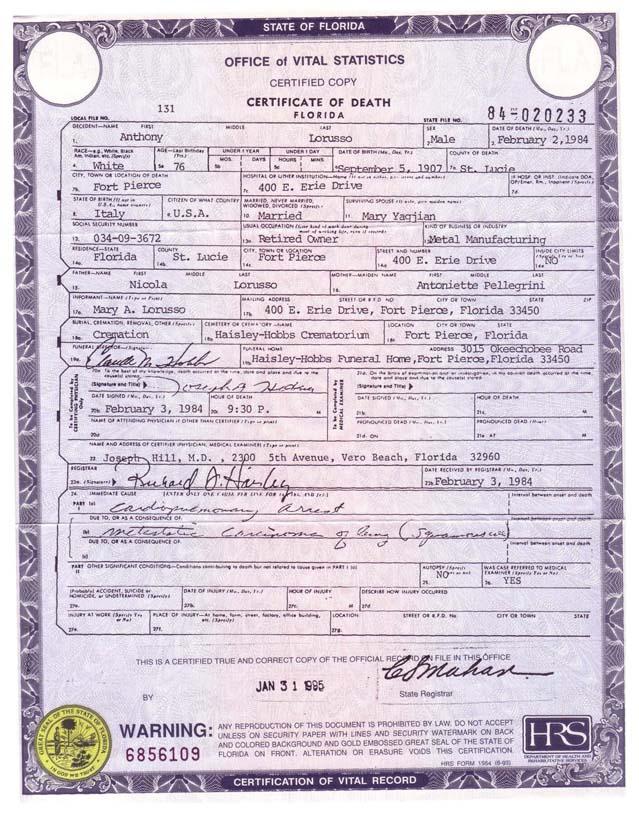
Because probate assets are determined from those assets titled in the decedent’s individual name at date of death, obtaining an original certified copy of the decedent’s death certificate is needed to firmly establish the decedent’s date of death. While Florida Probate Rules specify that the death certificate should be deposited with the probate clerk within 3 months of the date of publication of notice to creditors, immediate review of the details within the death certificate in required before petitioning the court to assess whether the death certificate is accurate or if any corrections need to be made to it before petitioning the court. Additionally, the death certificate may need to be translated into English or certified by a foreign probate court before it is deposited with the Florida probate clerk. Read more.
|
Locate and Review
Original Last Will and Testaments
Whether executed in the U.S. or abroad, an original copy of decedent’s Last Will should be reviewed to assess whether it is valid under Florida law or in the foreign country where decedent permanently resided at time of death. Whether the Last Will (domestic or foreign) complies with the laws of the State of Florida depends on whether it was properly witnessed at the time of execution. While Last Wills do not need to notarized under Florida law, in order to make the Last Will "self-proving" and speed up the impending probate adminstration process, the notary of the Last Will must attest to both the decedent and witnesses executing the document. Read more.
|
Establish Decedent’s Domicile and Where to Initiate the Domiciliary Probate
Quite often non-U.S. persons die owning U.S. based accounts while residing in both the State of Florida and a foreign country. While the decedent may reside in more than one place, they can only have one legal domicile which is the place they intend to reside permanently. Though it depends on the circumstances, the decedent’s place of domicile is typically where they own real estate and intend to reside permanently. That being said, the decedent’s domicile may be determined by the jurisdiction of their passport or driver's license, the place where they vote or the state or country in which they pay income taxes. Read more.
|
Choose the Best Person to
Act as Personal Representative
With proper guidance from Florida probate counsel, the surviving family members will know which court to petition and which person is best to petition the court to be appointed as PR with legal authority to administer the estate. While the decedent’s Last Will may state otherwise, family members residing outside the State of Florida are not necessarily qualified to act as a PR. In the absence of an available family member who is eligible and willing to serve as PR, surviving family members residing abroad can request their Florida probate counsel serve in the capacity as the PR (professional PR) in any Florida probate proceeding to be initiated. Read more.
|
|
|
|
Contact Florida Probate, Trust and Estate Counsel Today
To expedite release of foreign-owned U.S. assets, it is of paramount importance to consult tax and probate counsel for guidance. If you would like to schedule a telephone or ZOOM videoconference consultation with an experienced Fort Lauderdale tax, probate and estate attorney to review your need to probate a non-U.S. resident family member's estate, please (i) take a moment to complete the Firm’s Probate Intake Questionnaire and (ii) then contact The Wealth Protection at (954) 332-2342 or by email at info@wealthprotection.us.
|
|
Locksley A. Rhoden, Esq., LL.M. founded The Wealth Protection Firm as a boutique personal services law firm specializing in preparing integrated trust and estate plans and business succession plans for small business owners, licensed professional, real estate investors and domestic and foreign high-net worth individuals and their families. More recently, the Firm’s practice has expanded to include probate and estate administration/litigation, domestic and international wealth transfer planning and legal structuring of integrated trust and estate plans for purposes of asset protection, wealth preservation, tax minimization and building family harmony.
|
|
401 E. Las Olas Blvd. Suite 1400
Fort Lauderdale, FL 33301
Phone: (954)-332-2342
Email: info@wealthprotection.us
|
|
|
|
|
|
|
|