|
At the most recent meeting of the African Organisation for Research and Training in Cancer (AORTIC) in Senegal, an attendee asked, “What’s the difference between collaboration and partnership?” It’s a good question, especially coming from an African physician-researcher likely to have been involved in these types of relationships.
Africa is home to about 18 percent of the world’s population. By 2050, the United Nations projects that Africa’s population will reach 2.5 billion and comprise over 25 percent of the global population. There is a disproportionate increase in the incidence of—and mortality from—cancer in low- to middle-income countries (LMICs) of Africa and the world. Indeed, 70 percent of new cases of cancer worldwide occur in LMICs where the mortality rates are often 3-5 times higher than in high-income countries (HICs).
Underscoring the apparent global indifference to cancer equity is the paucity of clinical trials conducted within Africa and in LMICs around the world. One of the most powerful influences for advancing cancer outcomes is clinical trials. In approximately 8,000 National Cancer Institute (NCI)-sponsored clinical trials conducted from 2012 through 2021, only 37 (0.46%) were conducted solely in LMICs. Of 86,969 cancer clinical trials open worldwide, only 1,335 (1.5%) are in Africa, with 90 percent of these trials conducted in just two countries (Egypt and South Africa). Even when LMICs participate in these clinical trials, their recognition is spotty. In a review of 186 HIC-led randomized clinical trials published between 2014 and 2017, which enrolled patients in LMICs and upper middle-income countries (UMICs), 33 percent (62) had no authors from a participating LMIC or UMIC.
True Collaboration is More Than a Transactional Relationship
Institutions from HICs and LMICs often work together with a declared aim of improving cancer outcomes in LMICs through clinical care, research, education, population health, and other projects. The low-hanging fruit for an HIC investigator is to seek out a LMIC investigator to share tissue for comparison. Such studies might include obtaining pathologic samples of breast cancer or prostate cancer from sub-Saharan African patients, which are shipped and processed in HICs, and then comparing immunohistochemical staining or genomic sequencing with specimens of African Americans, followed by a publication.
These are illustrations of collaborations, some of which, unfortunately, can be reduced to transactions. For example, studies are conducted, results are presented, and papers are written (typically by investigators from HICs). Afterwards, the study goal has been accomplished and academic "partners" are free to go their separate ways. But is the LMIC in which the study took place any better off? The patients may have drugs provided while on trial, but after the trial is completed, do these patients have access to therapy? (Hint: in most cases, no.) Did these research efforts make a meaningful impact on decreasing the global burden of cancer?
Without conducting contextually relevant research and addressing issues surrounding concurrent social determinants of health, LMICs are unlikely to experience major changes in cancer-related mortality. With this backdrop, the renewed Biden Cancer Moonshot proposes to reduce the death rate from cancer by at least 50 percent over the next 25 years, by "ending cancer as we know it." If ever there were a time to address the global cancer burden by building ties between LMICs and HICs, between health care professionals and patients, and between industry and academia, it is now.
A recent report by Garton et. al. revealed that over 90 percent of NCI-Designated Cancer Centers engage in global oncology activities. Sustained partnerships with LMICs have emerged from several of these centers, including the UCI-Fred Hutch Collaboration, UNC Project-Malawi, Botswana-UPenn Partnership, Dana-Farber Cancer Institute Center for Global Cancer Medicine’s Partners in Health-Rwanda, UCSF-Tanzania, St. Jude Global Alliance, and Indiana University’s AMPATH-Kenya Partnership. These and others have demonstrated inter-institutional commitment focused on research, education, and, to a lesser degree, clinical care. With few exceptions, most can be considered "limited partnerships" in which one institution typically partners with another individual or institution in another part of the world in a research and educational exchange.
Though these activities are laudable, we must coordinate efforts on a larger scale to meaningfully decrease the global burden of cancer. Rather than working as individual cancer centers, AACI member institutions can effectively work together, sharing lessons learned on global oncology curricula, research coordination, and health policy to create a strategic plan to optimize partnerships with LMICs and to formalize the field of global oncology in the United States. Similarly, AACI members might serve as advisors for developing partnerships of regional LMIC cancer centers who seek to conduct contextually relevant, pragmatic clinical trials that are led by investigators from their own countries.
Collectively, these efforts can provide a partner’s platform to create a sustainable clinical research workforce with a suitable research infrastructure to reverse the trends of incidence and mortality seen in LMICs. Integration of social determinants of health with the prevention, screening, and treatment of cancer in the underpinnings of global oncology will create a lasting impact on all patients – whether they live in the underserved rural and urban areas of the Americas or in villages and cities across the world. This model is a true partnership, not just a transaction or transient collaboration.
Defining AACI’s Role in the Global Oncology Field
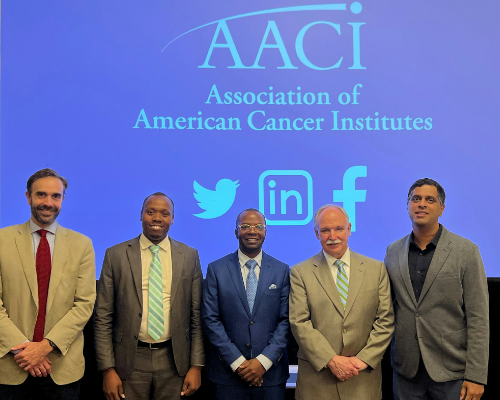
Last fall, we hosted a panel discussion, "Expanding the Impact of Global Oncology," at the 2023 AACI/CCAF Annual Meeting. Feedback was overwhelmingly positive and indicated a strong desire among AACI members to expand such efforts at their cancer centers.
AACI President Robert A. Winn, MD, established the AACI Global Oncology Working Group as a component of his presidential initiative, Inclusive Excellence. The working group’s charge is to define the scope of activities for AACI and its members, which will foster the field of global oncology through inter-institutional and international collaborations.
An important task of the Global Oncology Working Group is to identify methods for bidirectional communication to maximize resources and avoid redundancy in global oncology programs. AACI is working with the NCI to collect qualitative feedback from stakeholders in HICs and LMICs on the current state of global oncology and identify opportunities for long-term partnerships. The feedback will help shape the working group’s goals, which currently include:
- Amplifying the experiences of patients from LMICs
- Engaging LMIC cancer centers to inform strategic partnerships and activities undertaken by AACI member institutions in global oncology
- Developing shared global oncology curricula and other sponsored activities to enhance training within fellowship programs
- Defining contextually relevant topics to address health inequities as research and health policy priorities for AACI member institutions working in LMICs and in underserved areas of the U.S.
- Developing metrics to measure success for AACI cancer centers that support and sustain global oncology
- Suggesting strategic partnerships among AACI, LMIC cancer centers, and other entities to meaningfully impact the global burden of cancer
- Supporting clinical, translational, and public health research and research capacity at LMIC cancer centers
With its focus on fostering partnerships regionally, nationally, and internationally, the Inclusive Excellence Initiative provides an opportunity to advance health equity worldwide. AACI’s Global Oncology Working Group is eager to leverage this platform to reduce the global cancer burden.
|