|
Sr. Vice President for Research & Economic Development
Proposal Services & Faculty Support
August Funding Focus Newsletter #2
| | |
What is a Limited Submission?
A limited submission solicitation places a cap on the number of proposals Auburn may submit to a sponsor. Auburn coordinates limited submissions with notifications via this newsletter and competitions created in the Auburn University Competition Space (InfoReady). To apply to any limited submission posted in this newsletter, click on the link within the announcement. Please refer to the Limited Submission Procedures page for a general list of requirements.
| | If you find an opportunity of interest contact the PSFS office sooner than later so that an internal competition can be created for a timely, university-wide, fair and equitable selection process that allows for ample time for review, feedback and revisions. | | For a list of current and forcasted Limited Submission Opportunities in Pivot
Click Here. | | Limited Submission Announcements | | |
FY26 Defense Established Program to Stimulate Competitive Research (DEPSCoR) - Capacity Building
The aim of DEPSCoR is to improve the research capabilities at institutions of higher education (IHE) in eligible States/Territories to perform competitive basic research in science and engineering that is relevant to the DoD mission and reflect national security priorities.
This funding opportunity (awarded by the Air Force Office of Scientific Research) aims to
- Jumpstart capability development in the State/Territory through increased human, technical, and management resources.
- Achieve excellence in a DoD-relevant basic research area through funding to support equipment, education, research, and other relevant activities.
- Applications must address one or more of the technical basic research areas outlined in broad agency announcements (BAAs) from the Army Research Office, Office of Naval Research, and Air Force Office of Scientific Research.
Applications must address one or more of the technical basic research areas outlined in broad agency announcements (BAAs) from the Army Research Office, Office of Naval Research, and Air Force Office of Scientific Research.
For the websites detailing the basic technical research areas outlined by the Services, refer to the FOA: Page 8, DoD Relevant Areas.
Institutional Limit: One (1) Application
Internal Deadline: September 3, 2026, 4:45pm
Funder Whitepaper Deadline: October 12, 2026, 11:59pm ET
| |
|
Brain Research Foundation: 2027 Seed Grant Program
Brain Research Foundation funds innovative neuroscience research that expands understanding of how the brain works, and provides educational programs for researchers, families struggling with debilitating brain disorders and the general public.
The purpose of the Seed Grant Program is to provide start-up money for new research projects and innovative programs that have the potential of becoming competitive for an NIH grant or other external funding sources. The Foundation's goal is to have this initial effort succeed in opening future opportunities for research, collaboration, and scientific advancement.
To be eligible, PI must be a full-time Assistant or Associate Professor in the field of neuroscience, neurology, neurobiology, physiology, psychiatry, psychology, or related disciplines, proposing scientific projects with a focus on brain health and disease, including cancer. The grant proposal must detail a new research project that is not funded by other sources. This grant is not to be used as bridge funding.
Institutional Limit: One (1) Nomination
Internal Deadline: September 9, 2026, 4:45pm
Funder LOI Deadline: November 3, 2026, 4:00pm CT
| | |
Limited Submission Update
EPSCoR Research Infrastructure Improvement Program: Focused EPSCoR Collaborations (FEC)
Although NSF 24-573: EPSCoR FEC lists confirmed December 2026 and January 2027 LOI and Full Proposal due dates, respectively, for this popular limited submission opportunity, a program officer has confirmed that a new solicitation with new deadlines is in the works. Therefore, an internal competition for this opportunity will be postsponed until the updated RFP is published.
| | |
Rolex Explorers Club Grant
The Rolex Explorers Club Grant sends extraordinary explorers into the field, advancing science, deepening our understanding of the environment, and connecting our history to our future.
This grant is open to explorers conducting fieldwork that addresses a novel scientific, environmental, or historical question in any discipline. In addition to demonstrating a spirit of exploration, candidates must submit a project or research proposal with a clear scientific rationale, original work, and the potential for significant impact or new understanding.
Submissions Due: September 14, 2026, 6:00pm ET
| | |
Library of Congress: Lewis-Houghton Civics and Democracy Initiative
This initiative supports the development of educational projects leveraging the Library of Congress's music and creative arts digital collections to teach history, civics, and democracy. Projects emphasize arts-based pedagogies, inquiry-driven learning, civic skill-building, and innovative tools for middle and high school educators and learners.
Applications Due: September 18, 2026, 2:00pm ET
| | |
NSF: Mathematical Foundations of AI
The overall goal of this program is to establish innovative and principled design and analysis approaches for AI technology using creative yet theoretically grounded mathematical and statistical frameworks, yielding explainable and interpretable models that can enable sustainable, socially responsible, and trustworthy AI. Specific research goals include:
- Establishing a fundamental mathematical understanding of the factors determining the capabilities and limitations of current and emerging generations of AI systems
- Development of mathematically grounded design and analysis principles for the current and next generations of AI systems
- Rigorous approaches for characterizing and validating machine learning algorithms and their predictions
- Encouragement of new collaborations in this interdisciplinary research community and between institutions
Proposals Due: October 9, 2026, 5:00pm CT
| |
DOD: FY26 Defense Established Program to Stimulate Competitive Research (DEPSCoR) - Research Collaborations
The aim of DEPSCoR is to improve the research capabilities at institutions of higher education (IHE) in eligible States/Territories to perform competitive basic research in science and engineering that is relevant to the DoD mission and reflect national security priorities.
This funding opportunity (awarded by the Air Force Office of Scientific Research) aims to create basic research collaborations between a pair of researchers:
1) Applicant/Principal Investigator (PI) - a full-time faculty member who has never served as a PI on a prior DoD directly funded research Prime award and
2) Collaborator/co-Principal Investigator (Co-PI) - an investigator who will provide mentorship to the Applicant/PI and has served as a PI on a DoD directly funded research Prime award actively between 1 October 2018 and 30 September 2026.
This structure is aimed at introducing potential applicants to the DoD’s unique research challenges and its supportive research ecosystem.
Research Topics
Topic 1: Space Bioscience
Topic 2: Dynamic Data & Information Processing
Topic 3: Condensed Matter Physics
Topic 4: Unsteady Aerodynamics & Turbulent Flows
Topic 5: Earth Materials & Processes
Topic 6: Dynamical Influences on Performance
Topic 7: Wireless Communications Networks
Topic 8: Electrochemistry
Topic 9: Nonlinear Transforms for Dynamical Systems
Topic 10: Social Cognition in Local Communities
Topic 11: Fundamental Mechanisms & Material for Shock Mitigation for Warfighter Protection
Topic 12: Fundamental REsearch on Efficient Packaging & Deployment of Unmanned Aircraft Systems
White papers Due: October 12, 2026, 11:59pm ET
| |
USDA Grants
Higher Education Challenge Grants Program
The purpose of HEC is to strengthen institutional capacities, including curriculum, faculty, scientific instrumentation, and student recruitment and retention. The HEC program is focused on developing and improving formal master’s or doctorate degree-level food and agricultural sciences education and first professional degree-level education in veterinary medicine, such as a doctorate in veterinary medicine.
Projects must focus on one or more of the Educational Need Areas listed below and engage more than a single course or individual instructor:
- Curriculum Development for Promoting Student Career Opportunities
- Faculty Preparation and Enhancement for Teaching
- Facilitating Interaction with Other Academic Institutions
Food and Agricultural Sciences National Needs Graduate and Postgraduate Fellowships
The purpose of the NNF program is to provide funding to support new graduate (master’s, DVM, or doctoral) student training and completion of degree programs to develop human capital to participate in meeting the mission of the USDA to increase the pipeline of domestic agricultural students.
The objectives of the NNF program are to:
- Support the training of new students at the master’s, DVM, or doctoral levels to fill nationally identified expertise shortage areas in the food and agricultural sciences.
- Increase the number and quality of students in the food, agricultural, and related sciences by recruiting outstanding students to enter and complete graduate training in these areas.
- Ensure Fellows build science competencies through research and extension/outreach activities and experience and engagement within areas of focus in the food and agricultural sciences.
Proposals for Both Due: October 15, 2026, 5:00pm ET
| | |
NSF: Unlocking Dataset Value for AI-Enabled Scientific Discovery
This program will advance scientific community datasets to enable scientific discovery and innovation using AI and other methods. Its goal is to increase the value that can be derived from existing scientific datasets by leveraging novel methods and artificial intelligence.
Investigated topics may include, but are not limited to:
- The use of novel feature extraction, metadata generation, and data integration techniques that make previously generated datasets more usable by AI for testing new hypotheses.
- Next-generation data pipelines that create more powerful, comprehensive, or interdisciplinary datasets ready for automated analysis and AI training.
- Strategic augmentation and/or harmonization of existing datasets that significantly expand their scientific utility and usability by AI tools.
- Automated platforms that discern the readiness of legacy datasets at scale.
- Expanding broad availability of enhanced scientific community datasets through NSF data platforms, accelerating AI-driven inquiry and interdisciplinary discovery.
Proposals Due: November 4, 2026, 5:00pm CT
| |
|
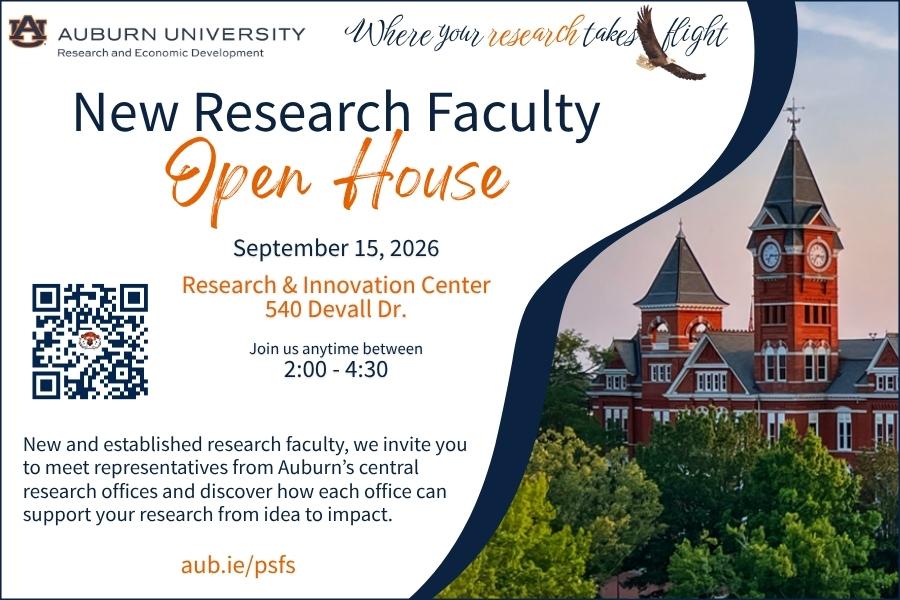
All Research Faculty - new or established - are welcome to attend this come-and-go event and have your questions answered about the research administrative process. Participating offices include -
OSP * IRB * IACUC * IBC * Research Integrity & Compliance * Research Security * ERA * IPX * PSFS * CGA * University Foundations * AU Libraries!
Light Refreshments Served
| |
USDA-ARS Research Meeting
August 26, 2026
9:00am -11:00am
Melton Student Center, Room 2222
USDA-ARS Acting Director of the Southeast Area, Dr. Bhinu Pillai, and Dr. Phillip Owens will meet with USDA-ARS funded researchers and administrators from across Auburn to share information about ARS funding, administration pressure to ensure compliance with award Terms and Conditions, and Congressional and Administration intent for the funds Auburn receives.
Dr. Owens will also discuss the importance of the Form 115 Manuscript Review Process and will address any other specific issues AU researchers might have during a Q&A session.
Registration not required.
| |
Hanover Research Webinars
AI in Grant Prospecting & Development
Thursday, August 27, 2026
11:00am CT
AI is rapidly changing the way organizations identify and pursue grant funding, offering tools that can save time and enhance your strategy if used thoughtfully. This session provides an overview of key areas where AI can be leveraged in the grant prospecting and proposal development process.
Register Here.
| | |
NASA and SciENcv
Pursuant to Grant Information Circular 26‑02, NASA now has the capability complete required disclosure forms (biographical sketches/current and pending) via SciENcv. The schedule is as follows:
1. Current – August 31, 2026: Applicants have the option to submit disclosure forms via either:
a. Word fillable forms downloaded from the GOM website or
b.SciENcv-generated forms
Effective September 1, 2026: NASA will only accept the NASA-specific, SciENcv-developed forms. Word-based forms will no longer be accepted.
| | |
Hanover Research Queue Proposal Review Availability
Slots available September 11 - 25 and after October 19
Auburn University has partnered with Hanover Research for a number of grant development solutions including Pre-proposal Support; Proposal Development; and Capacity Building. Hanover's full-service grant development solutions are available to set goals, build strategies to achieve key grant-seeking objectives, and develop grant proposals that are well-planned, researched, and written.
For information regarding Hanover’s core capabilities and project timelines, click here. If you are interested in a slot in the queue, please e-mail Christine Cline.
| | |
Hanover GLC Modules for NIH, NSF-CAREER & Grant Development
The Hanover Research Grants Learning Center (GLC) on-demand grant development training portal offers faculty enrollees the unique opportunity to receive targeted training through self-paced, interactive modules with step-by-step guidance and templates for prospective applicants to develop compelling proposals. In addition to NIH, NSF-CAREER and Non-Federal funders, AU faculty now have access to a variety of new modules on grant seeking, development and revisions.
Auburn faculty interested in signing up for this training should contact Christine Cline for registration information.
| | |
Free CITI Training Modules
Auburn subscribes to several training modules via the CITI Program website that may be of interest to researchers and research administrators. Each module is self-paced and can be finished in one or multiple sessions. Click on the link above to read descriptions.
- Essentials of Grant Proposal Development
- Essentials of Research Administration
| |
Proposal Services & Faculty Support
| | | | |