| |
|
Arizona Legislature Heads Into Recess Amid Budget Stalemate
As the Arizona Legislature prepares to step away for the month of May, the timing could not be more consequential—or more controversial. With Katie Hobbs expected to veto the latest Republican-backed budget, lawmakers are leaving the Capitol with critical negotiations unresolved and taxpayers left watching from the sidelines.
At the center of the impasse is funding for Empowerment Scholarship Accounts (ESAs), a program that has become one of the most debated education issues in the state. Republicans have largely supported expanding or maintaining ESA funding, while the Governor and many Democrats have pushed back, citing concerns over cost and accountability. The result? A budget deadlock with no clear resolution in sight.
Rather than continuing negotiations, the GOP-controlled House has chosen to recess for the entire month of May following today’s session. The Senate has recessed as well. It’s a move that raises serious questions about priorities, accountability, and leadership.
This is not just a scheduling decision—it’s a strategic one. And it’s fair to ask: why now?
May marks the beginning of campaign season. Legislators will be back in their districts, attending events, meeting voters, and making their case for reelection. But for many Arizonans, that raises a frustrating contradiction. Lawmakers are campaigning for jobs they are currently holding—jobs that, at this moment, remain unfinished.
Budgeting is not optional. It is one of the most fundamental responsibilities of elected officials. Walking away from the negotiating table, especially during a stalemate, sends a message—whether intended or not—that politics may be taking precedence over governance.
Some legislators have argued that recessing will save taxpayers money by reducing per diem costs. Seriously? Arizona is dealing with an approximately $18 billion state budget, yet the justification for halting legislative work is saving on per diem expenses? That explanation is difficult for many taxpayers to accept.
Everyone knew Governor Hobbs would likely veto the Republican budget proposal. But that should have been viewed as the beginning of negotiations, not the end of the process. The Governor has already proposed her own budget framework. Whether Republicans agree with it or not, it provides a starting point for compromise and discussion.
Some lawmakers insist that “Hobbs will not negotiate.” Yet history tells a different story. Last year, negotiations happened. Agreements were reached. Government continued functioning. That is how the process is supposed to work.
The public expects elected officials to produce results, not engage in partisan standoffs. With the entire Legislature now in recess, there are no active floor debates, no meaningful negotiations, and no visible attempts at compromise. Meanwhile, the Governor remains publicly engaged, creating the perception that she is staying at the table while Republican lawmakers went home.
That perception matters.
This political stunt may energize portions of the Republican base, but it also risks alienating independent voters and moderates who simply want government to function responsibly. This is not about siding with Hobbs or Republicans—it is about recognizing how this situation appears to everyday Arizonans who expect their elected leaders to stay and do the work.
Supporters of the recess may argue that time away allows for cooler heads and behind-the-scenes discussions. Critics, however, see it differently: as a delay tactic that postpones solutions while major issues—education funding, fiscal planning, and state operations—remain unresolved.
This bold move by Republican leadership will likely become a central issue in upcoming campaigns. Voters will ultimately decide whether stepping away during a budget impasse reflects strategic leadership—or a failure to govern.
One thing is certain: when lawmakers return, the problems they left behind will still be waiting.
| | | | |
|
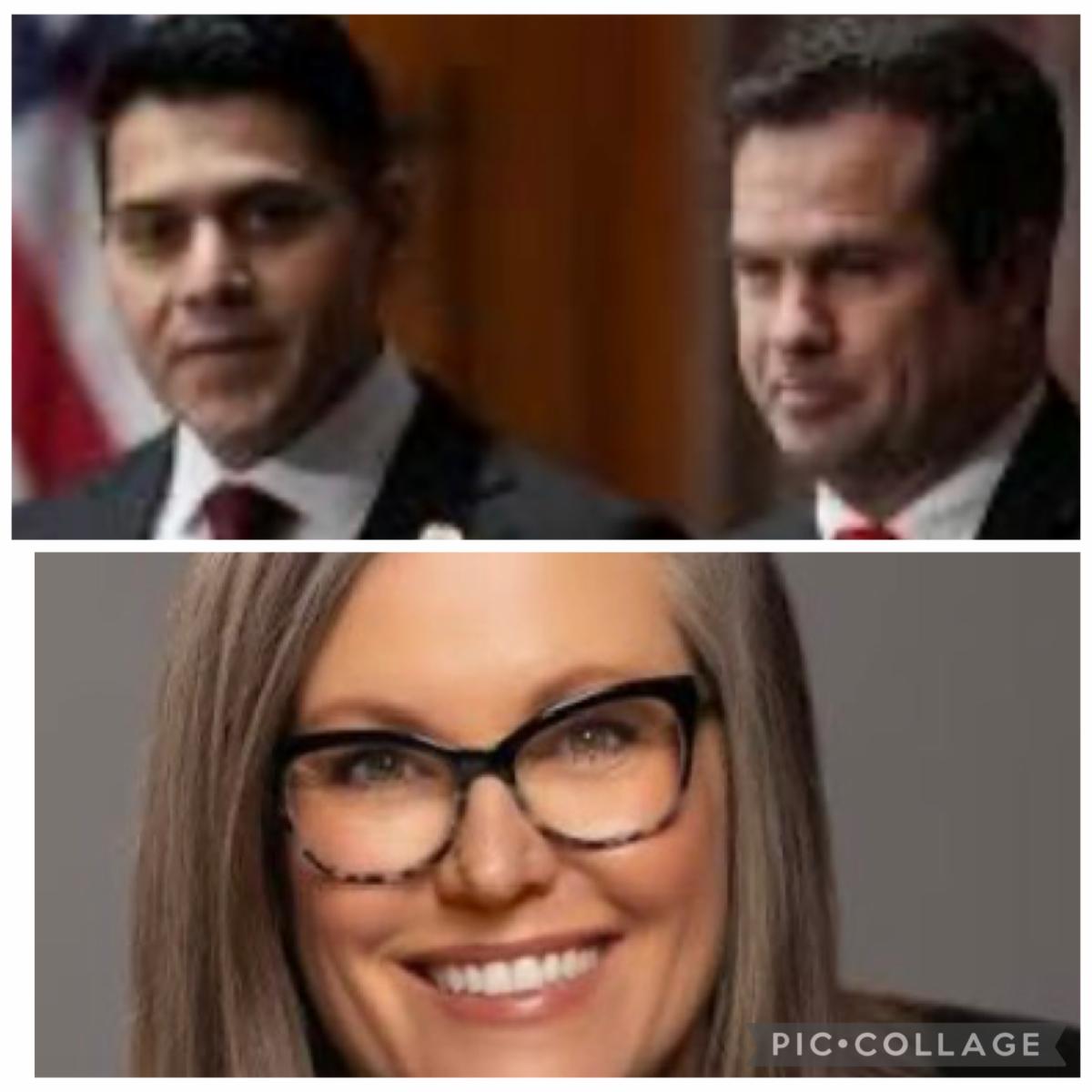
Maricopa County Supervisor Mark Stewart Calls for Court-Ordered Mediation in Election Dispute
Maricopa County Supervisor Mark Stewart has formally requested immediate court-ordered mediation in an ongoing legal dispute over election responsibilities, signaling a continued push for a more collaborative and time-bound resolution.
In a recent court filing, Stewart made clear that he does not support an open-ended stay in the case without a defined path forward. Instead, he has advocated for a targeted, short-term pause in proceedings that would allow mediation to move forward under the guidance of a court-appointed mediator. His proposal includes a structured timeline aimed at bringing all involved parties together within the next two weeks.
At the same time, recent developments show growing alignment among county leadership. The Maricopa County Board of Supervisors is now united in requesting a stay from the court, citing the proximity to upcoming elections and the need to avoid last-minute changes that could disrupt administration. Central to this position is the Purcell Principle, a legal doctrine cautioning courts against making significant election-related changes too close to an election due to the risk of voter confusion and administrative complications.
Stewart’s filing also underscores the importance of including technical experts in the mediation process. He argues their participation would allow operational concerns to be addressed in real time and help prevent further delays in resolving the dispute.
The legal conflict, involving the division of election duties between the Board of Supervisors and Recorder Justin Heap, has been the subject of ongoing litigation in the case Heap v. Galvin. A recent court ruling provided clarity on aspects of the Shared Services Agreement governing those responsibilities.
While Stewart acknowledged that the ruling offered needed guidance, he reiterated his longstanding view that these issues should have been addressed through negotiation rather than extended litigation. Earlier in 2026, he retained independent counsel and sought a middle ground amid disagreements, at times diverging from his colleagues’ approach—including casting a lone dissenting vote on certain procedural steps related to an appeal.
Despite those differences, Stewart has emphasized that all parties share a common goal: ensuring Maricopa County elections remain reliable, secure, and transparent. He has also expressed appreciation for the work of his fellow Board members and Recorder Heap in navigating what he has described as a complex and high-stakes issue.
His latest filing reflects both that spirit of cooperation and a sense of urgency—calling for a structured mediation process while recognizing the practical constraints imposed by the election calendar.
| | | | |
Support the Work Behind Patriotnheels
If you find value in the weekly Patriotnheels Newsletter, please consider supporting the work that goes into bringing you timely, local information.
Each week, I dedicate time and resources to attend meetings, research issues, and provide updates that keep our community informed and engaged. There are also ongoing costs, including maintaining our email platform through Constant Contact, that make consistent communication possible.
My goal is simple: to cover these expenses so I can continue delivering reliable, fact-based information without interruption.
A one-time or recurring donation to the Patriotnheels PAC would be greatly appreciated. Your support helps ensure that important local issues remain accessible to everyone in our community.
Thank you for being part of Patriotnheels—and for helping keep our community informed.
| | | | |
|
Project Baccara Moves Forward After Maricopa County Board of Supervisors Vote
The Maricopa County Board of Supervisors voted 4-1 on Wednesday to approve a military compatibility permit for Project Baccara, a major data center and power generation project planned near Surprise and Glendale in the West Valley. The vote marks another significant milestone for the controversial development, which has generated both strong support and vocal opposition throughout the approval process.
Project Baccara will include two data centers and a natural gas power generation facility on approximately 160 acres located near Olive Avenue and Litchfield Road in unincorporated Maricopa County, adjacent to Luke Air Force Base. State law requires a military compatibility permit for projects located near military installations.
Importantly, Wednesday’s vote was not a rezoning case or a decision about whether the land should remain vacant. The property was already zoned heavy industrial. The Board’s role was narrowly focused on determining whether the project complied with Luke Air Force Base compatibility requirements and whether the developer agreed to meet the conditions established by the military.
Supervisor Debbie Lesko emphasized that point during the hearing, stating, “We’re not here today, really, to discuss ... ‘Should this remain vacant land?’ We’re here for this military compatibility permit.” Supervisor Mark Stewart agreed, noting that the central issue was whether the military was comfortable with the project being located near Luke, and Luke ultimately approved the project with stipulations the developer agreed to follow.
The lone “no” vote came from Supervisor Steve Gallardo, who argued that too many questions remain unanswered regarding the project.
Throughout the process, opponents raised concerns about noise, water usage, air quality, safety, and the growing number of data centers in the West Valley. However, many of the claims circulating online have become more urban legend than fact.
For example, critics often claim data centers “heat up the area.” In reality, urban heat is already significantly impacted by existing infrastructure such as asphalt roads, parking lots, rooftops, and sidewalks throughout the Valley. Others have raised concerns about excessive noise, despite the fact that the site is located within Luke Air Force Base’s existing noise contour area, where aircraft activity already dominates ambient sound levels.
Maricopa County also maintains strict monitoring standards for both air quality, lighting, and noise. Project Baccara was required to address those concerns during the permitting process, and the Arizona Corporation Commission previously reviewed environmental compatibility issues before unanimously approving the project earlier this year.
Another major concern has been water use. Project representatives repeatedly explained that the project will utilize a closed-loop cooling system designed to dramatically reduce water consumption compared to traditional cooling methods. In addition, the project plans to partner with local industry to use reclaimed water, significantly reducing reliance on potable groundwater supplies.
Supporters also point out that the project addresses one of the public’s biggest concerns regarding data centers: energy demand. Rather than relying entirely on the existing electrical grid, Project Baccara will generate its own power on-site through natural gas turbines. Even more notably, the facility is expected to produce excess electricity that can be sold back onto the wholesale market, helping provide additional power resources for the rapidly growing West Valley without directly increasing costs to existing ratepayers.
Project representatives described the development as a major economic investment that will support jobs, infrastructure, and long-term economic growth in Maricopa County. According to developers, the project is part of the growing digital infrastructure needed not only for the economy, but also for national defense and modern communications systems.
Opposition to the project remains strong among some nearby residents, many of whom packed the Board of Supervisors meeting and submitted hundreds of emails opposing the project. Critics argue the project is too close to homes and worry about long-term environmental and health impacts.
Still, with Luke Air Force Base approving compatibility conditions, the Arizona Corporation Commission granting environmental approvals, and the Board of Supervisors now approving the military compatibility permit, Project Baccara continues moving forward through the final stages of the approval process.
The debate surrounding Project Baccara reflects a broader conversation happening across Arizona and the nation: how to balance economic growth, technological infrastructure, energy needs, and neighborhood concerns in one of the fastest-growing regions in the country.
| | | | |
|
The Real Effects of Tax Cuts
For years, Republicans have championed lower taxes and smaller government. Most conservatives, myself included, believe taxpayers should keep more of their hard-earned money whenever possible. Recent efforts to cut taxes in Arizona, including the shift to a 2.5% flat income tax and the elimination of the residential rental tax, were rooted in that philosophy. At the same time, the work of the Department of Government Efficiency (DOGE) has exposed enormous amounts of wasteful spending at the federal level, reinforcing the belief that government often spends too much.
But that raises an important question: Is there really widespread waste in our local city governments?
As a resident of Surprise, I would argue that there is not.
Unlike the federal government, city governments are generally forced to live within very real limits. Cities provide the services residents rely on every single day: police and fire protection, road maintenance, parks, libraries, recreation programs, water infrastructure, and community development. These are not abstract government programs in Washington, D.C. These are the visible, tangible services that directly affect our neighborhoods and quality of life.
The challenge is that recent Arizona tax cuts have significantly reduced the revenues cities depend on to provide those services. Arizona municipalities receive a portion of state income tax revenue through urban revenue sharing. When the state lowers income taxes, cities receive less money. On top of that, the Legislature’s elimination of the residential rental tax, which takes effect in 2025, is expected to remove roughly $230 million from city budgets statewide.
In the effort to save taxpayer dollars, Republicans at the Arizona Legislature have reduced the revenue cities rely on to provide essential services. As a result, residents may experience longer wait times for police response, delayed road and pothole repairs, and fewer community events and programs than in years past. These changes are the direct result of cities having less funding to provide the quality services residents have come to expect.
Cities across the Valley are already feeling the pressure. Some municipalities have reported losing millions of dollars annually, forcing difficult conversations about delaying infrastructure projects, reducing capital improvements, or scaling back future services. In some cases, cities are becoming increasingly dependent on sales tax revenue to make up the difference. The problem with that approach is that sales taxes often impact lower-income families the hardest.
At the same time, communities throughout the Valley continue to grow rapidly. More residents mean greater demand for roads, public safety personnel, parks, and other city services. Growth requires investment. You simply cannot continue adding population while simultaneously reducing revenue without eventually feeling the effects.
Many taxpayers may look at an extra $100 saved each year and feel grateful for the relief. That is understandable. But it is also important to ask what services may be affected in the long run. Will road projects be delayed? Will park improvements be postponed? Will police and fire departments struggle to keep pace with growth?
I subscribe to what I call the “Goldilocks philosophy” on taxes. I do not want taxes that are too high, and I certainly do not want government waste. But I also do not want taxes cut so deeply that cities cannot provide the services residents have come to expect. The goal should be balance — paying the “just right” amount necessary to maintain safe, thriving, and well-functioning communities.
Good government is not about spending the most money. It is about spending responsibly while still delivering the services that matter most to the people who live there.
| | | | |
|
Over the past week, media coverage surrounding the Hantavirus has started sounding eerily familiar to many Americans. Headlines, social media posts, and nonstop speculation have caused some people to wonder if this could become “the next COVID.” The short answer is no.
Hantavirus is not new. Arizona and other western states have seen cases of hantavirus for years, usually connected to exposure to rodent droppings, urine, or nesting materials. It is rare, but it does occur periodically in rural areas, cabins, sheds, and places where mice are present. Public health officials have monitored it for decades.
What has created renewed attention is discussion surrounding a strain known as the Andes virus, which has shown limited human-to-human transmission in South America. However, experts continue to emphasize that this type of transmission requires very close contact, typically among family members or caregivers. This is not something spreading casually through grocery stores, schools, or everyday public interaction. This is why it spread on the cruise ship - people in very close proximity.
Unfortunately, fear sells. Many media outlets learned during COVID that alarming headlines generate clicks, ratings, and advertising revenue. That does not mean people should ignore health concerns, but there is a difference between awareness and panic.
This weekend, I noticed more people wearing masks again. That is their personal choice, and everyone should do what makes them feel comfortable. But Americans should also remember how powerful fear can be and how quickly it can spread when amplified constantly through television and social media.
There is already discussion in scientific circles about future treatments and vaccines for hantavirus strains, which is normal whenever infectious diseases are studied. But there has been no serious discussion of mandates or mass vaccination campaigns similar to what occurred during COVID.
People should use common sense: avoid rodent exposure, clean safely, and stay informed from reliable sources. But there is no reason for widespread panic. Fear can become more contagious than the virus itself if we allow it.
Disclaimer: I am not a fan of vaccines. I am not a doctor. In 2021, I was hospitalized with the COVID Delta strain. I was diagnosed with bilateral pneumonia, hypoxia with oxygen levels in the 70s, tachycardia, sepsis, I had clots, and kidney failure. I spent four weeks on a BiPAP machine, six weeks in the hospital, followed by rehab, and underwent two emergency surgeries.
Even knowing what I would go through, I still would not have chosen to get the vaccine because I simply do not trust them. That is my personal decision and belief.
At the same time, I respect everyone’s right to make their own medical choices. I encourage others to show the same respect, even when we disagree. We can support personal freedom and still treat one another with dignity and compassion.
| | | | |
|
What Has Happened to Decorum?
Across the country, public meetings are increasingly being disrupted by individuals who refuse to follow basic rules of decorum and civility. Whether at city council meetings, school board meetings, county hearings, or legislative sessions, productive discussion is often overshadowed by shouting, personal attacks, and intentional disruptions. Citizens absolutely have the right to voice concerns, disagree with elected officials, and passionately advocate for their beliefs. However, there is a significant difference between passionate public comment and behavior designed to create chaos. When decorum breaks down, it not only disrupts government business, but it also discourages respectful community members from participating in the public process. The following op-ed focuses on what is happening in the Surprise, but the concerns raised could apply to many public meetings taking place across the nation today.
The proposed U.S. Immigration and Customs Enforcement detention facility has undeniably created tension in Surprise. Emotions are high, opinions are strong and residents are paying close attention.
I want to be clear: I do not support placing this facility in Surprise — or anywhere else. At the same time, I stand firmly behind our mayor and City Council as they navigate a situation that is, in many ways, beyond local control.
Understanding how government works matters. Federal decisions don’t always align with local preferences and city leaders often are left managing the consequences.
That reality, however, does not justify what we are now seeing at our City Council meetings.
Recently, meetings have been repeatedly disrupted by outbursts so severe that they forced adjournment. This is not productive. It does not advance the conversation, nor does it help our community find solutions. In fact, it undermines the very process that allows residents to be heard.
Even more concerning, many of those causing the disruptions do not appear to be Surprise residents. They are showing up for attention, not for constructive engagement. Their goal seems to be chaos, not dialogue.
There is a clear difference between passionate disagreement and unacceptable behavior. Civil debate is not only welcome, it is essential. But violating decorum, shouting over others, and preventing meetings from continuing crosses a line that should not be tolerated.
Our city deserves better. Our elected officials deserve the opportunity to conduct the public’s business without interference. And residents deserve a forum where their voices can be heard respectfully.
| | | | |
|
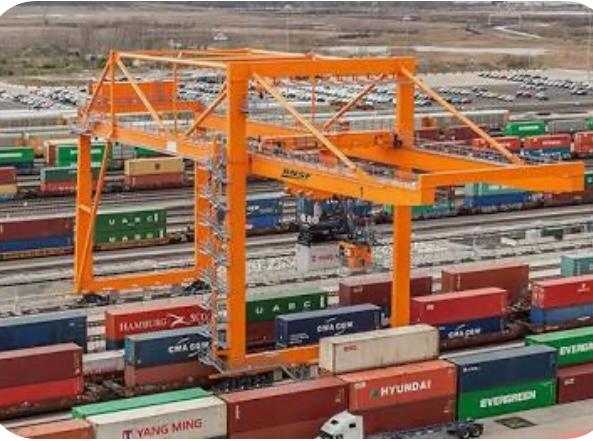
Debating the Reality of the Proposed BNSF Intermodal Hub in Wittmann
A recent guest column in the left leaning West Valley View by Ulises Anzures Lima attempted to paint opposition to the proposed BNSF intermodal hub in Wittmann as “cartoonish.” But for the thousands of West Valley residents who have spent months researching, attending meetings, speaking with officials, and organizing their communities, there is nothing cartoonish about their concerns.
The article proudly touts claims that the project would create 76,000 direct and indirect jobs. What it fails to explain is that well over 74,000 of those jobs are projected to be temporary construction jobs tied to the building phase of the project. Those are not permanent careers that will sustain the community for decades. Once construction ends, the long-term employment numbers shrink dramatically. BNSF admits they will only provice less than 150 jobs.
Even more importantly, the article ignores the rapidly changing reality of warehouse and logistics employment. Robotics, automation, and artificial intelligence are already replacing large numbers of warehouse positions across the country. Modern logistics hubs increasingly rely on automated systems, robotic sorting, autonomous equipment, and AI-driven inventory management.
Pretending this project will create tens of thousands of stable, long-term jobs for local residents simply is not an honest representation of where the industry is heading.
The opposition to this project is also far from fringe. On November 5, 2025, the Maricopa County Board of Supervisors voted unanimously against BNSF’s request to amend the County Comprehensive Plan for the project. Unanimous votes at the Board of Supervisors level are not common, especially on a project of this magnitude. That vote reflected widespread concerns from residents, local leaders, community organizations, and surrounding jurisdictions.
Traffic concerns alone are substantial. Anyone who regularly drives through the West Valley understands the challenges already facing our road infrastructure. The intersection of Loop 303 and Grand Avenue is already heavily congested. Those concerns are not simply emotional arguments from opponents—they have been recognized by the Maricopa Association of Governments itself. MAG’s own traffic projections show massive increases in vehicle volume in the coming decades, even without a major industrial rail hub bringing thousands of additional truck trips into the area.
Curiously absent from the article was any mention of recent train robberies in Northern Arizona connected to cartel-related criminal activity operating along BNSF rail lines originating out of California. There was a robbery just last week. Residents in the West Valley are understandably concerned about introducing additional criminal opportunities into a rural community like Wittmann. Those concerns deserve discussion, not dismissal.
BNSF often points to its railroad police force as reassurance. However, the reality is that the region that includes Maricopa County reportedly has only two BNSF police officers assigned to it. That is hardly the robust security presence many residents envision when discussing a massive intermodal rail facility covering thousands of acres.
Perhaps most concerning to many residents is the growing perception that BNSF does not truly care about the community itself. Critics point to actions already viewed as disregarding local concerns and county processes. Residents have repeatedly voiced concerns about water usage, air quality, noise, traffic, school safety, emergency response capabilities, and preserving the rural character of Wittmann. Yet many feel those concerns are brushed aside in favor of corporate talking points and economic projections.
The people opposing this project are not “cartoonish.” They are homeowners, parents, business owners, retirees, veterans, and taxpayers who simply believe their community deserves careful planning and honest conversations about the long-term consequences of industrial expansion on this scale.
The debate over the proposed BNSF intermodal hub is not about opposing growth. It is about asking whether this particular project, in this particular location, is truly in the best interest of the West Valley and the families who already call it home.
| | | | |
|
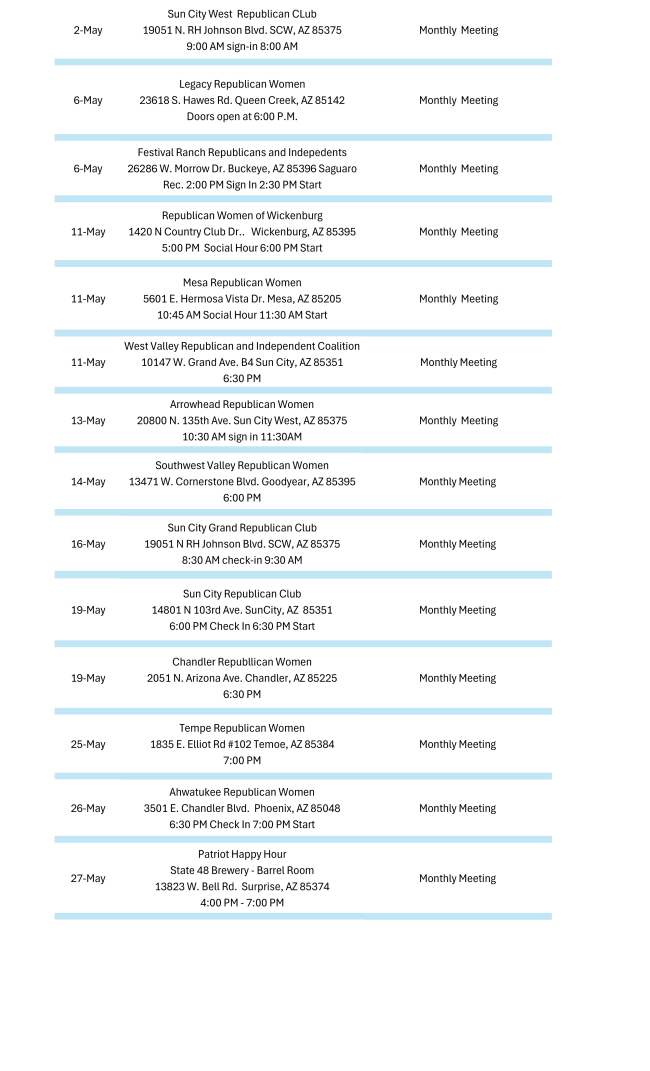
PATRIOT HAPPY HOUR WITH FELLOW REPUBLICANS!
Join Us for Another Great Evening!
Due to overwhelming demand, we’re bringing back our Patriot Happy Hour at State 48 in Surprise! Last month’s gathering was a fantastic success, with great food, drinks, and, most importantly, meaningful conversations with fellow conservatives. Let’s do it again!
Where: State 48 Brewery - 13823 West Bell Road, Surprise, AZ 85374
When: Wednesday, May 27, 2026
Time: 4:00 PM – 7:00 PM
This is the perfect opportunity to connect with like-minded individuals, get to know fellow PATRIOTS, and strengthen our local Republican community. Whether you're a seasoned PC, new to our LD, or simply want to make new friends everyone is welcome!
Bring a friend and join us for an evening of camaraderie, networking, and fun. Let’s keep the momentum going!
Patriot Happy Hour is always the last Wednesday of the month.
| | | | |
IF YOU WOULD LIKE YOUR CLUB LISTED PLEASE CONTACT ME | | | | |
| |
Thank you,
Lisa Everett
www.patriotnheels.com
Follow me on:
X - @patriotnheels
Facebook - @patriotnheels
Instagram - @patriotnheels
| | | | | | |