Children and Adults with Trisomy 18
In recent years, there have been significant advances into how best to support the life and health of newborns with Trisomy 18. The result is that a higher percentage can live beyond their first birthdays. Several studies have looked at the longevity of these so called “long term survivors,” but none have looked at their chronic health issues, their medical support systems, and their ultimate causes of death in those who have died at over 1 year of age.
The Chromosome 18 Clinical Research Center (C18 CRC) sent a survey to the families of individuals with Trisomy 18 who had lived beyond their first birthdays. Respondents for this survey were ascertained through social media distribution by the Chromosome 18 Registry and Research Society and by the Support Organization for Trisomy 18 and 13 (SOFT).
The survey respondents included the families of 174 individuals with full Trisomy 18. Twenty-two of the 174 were deceased at the time of the survey and passed away at an average age of 5.2 years. The first part of the data analysis focused on the factors impacting the death of those 22 individuals. Many studies have documented the causes of death for infants with Trisomy 18, but none have looked at the causes and contributing factors in children and adults with Trisomy 18. This information could be quite valuable for the families and healthcare providers who care for who those have graduated from infancy to childhood.
The cause of death was compared between our cohort to those with Trisomy 18 under 1 year in the existing literature. We found that individuals with Trisomy 18 over 1 year of age had a decreased incidence of cardiac-contributing causes of death and an increased incidence of infectious and postoperative complications contributing causes of death. This observation suggests that a predisposition to infections plays a larger role in the mortality of older children than cardiorespiratory issues which are paramount in the early infancy period. These findings demonstrate that long-term survivors with Trisomy 18 have unique medical needs.
These data were analyzed with help of a very talented medical student, Justin Mehl; John Carey, Medical Director of SOFT and member of the Registry’s Scientific Medical Advisory Board; Dr. John Gelfond, Associate Director of the C18CRC and Jannine Cody, Director, C18CRC.
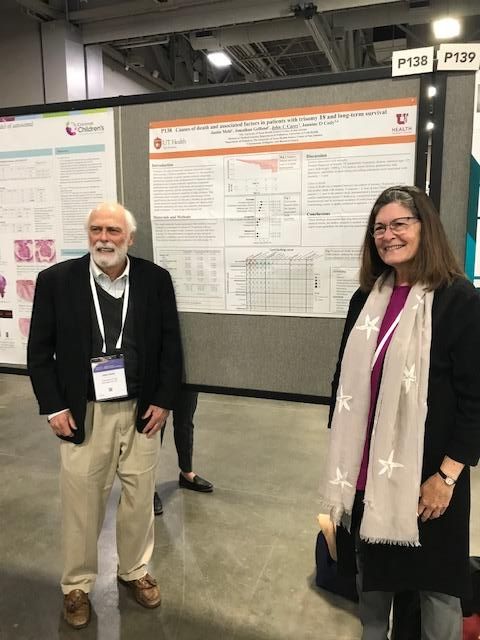
A poster summarizing the findings was presented at the American College of Medical Genetics Annual Meeting in Salt Lake City in March. Presenting a poster or talk at a research meeting such as this is always a good way to show your research findings to an interested audience and, in a more general sense, to spread the word about Trisomy 18 and the work we are doing on the chromosome 18 conditions. A manuscript containing the detailed analysis has been submitted for publication. This project was supported by both the Registry and SOFT.