Volume 3 I March 2021
PSCU is the Credit Union of Choice for ALL walks of Life.
We’re open to serving all professions and anyone who is interested in charting a financial future.

We serve everyone, not just Public Officers. We offer extremely competitive rates for savings and loans, so invite your family and friends to join our Credit Union today.

OUR BOARD SECRETARY'S STORY IS A LESSON IN ENTREPRENEURSHIP AND SELF SUSTAINABILITY!
Born and bred in Tobago, Mr. Oje Alexander has been involved in agriculture for at least ten (10) years with a predominant focus on crops. He decided to start a farm after realizing the lack of fresh, quality and consistent produce being grown in Tobago. He also gravitated to this field as he saw it as an excellent avenue to apply his acquired business skills and knowledge gained through the acquisition of his BA (Hons) in Business Management, and a subsequent MBA specializing in Entrepreneurship, Leadership and Innovation. He is certified in Food Safety Management Systems (FSMA) – from the United States Department of Agriculture (USDA) via Tobago House of Assembly and has also undertaken a number of short courses related to varying aspects of agriculture hosted by CARDI and EUROCHAM.  Mr. Alexander is also proud member of the Board of PSCU Credit Union in the capacity as Board Secretary

Mr. Alexander is currently a full time farmer and sells his produce via contracted arrangements with restaurants, hotels and supermarkets. He is the creator of Happy Farmly Products Ltd (HFP), a startup venture which was birthed out of a previous farming operation using conventional farming methods. 

Realizing his interest in food production in 2012, as a farm manager for a reputable NGO in Tobago, the founder capitalized on this knowledge and experience to create HFP in September of 2013.  HFP was fueled by a passion to innovate within the Agriculture industry while suppling food, providing employment, and generating an income. At that time, lettuce cultivation was the main focus, and the produce was supplied to various small restaurants and cafés located around Scarborough. After two years, the business widened its clientele to include ‘higher-end’ restaurants, hotels and the ‘health junkie foodie’. 

Mr. Alexander transitioned HFP to a more futuristic and efficient means of producing food by adopting a vertical and soil less style of production. This business augmentation was as a direct result of continuous personal and professional development, and an analysis of the socio-economic scenario of Tobago with respect to food production, entrepreneurship and innovation. 

Today, HFP grows an assortment of exotic and nutrient dense leafy greens and herbs. Some of its highest demanded produce are Kale, Arugula, Gourmet Salad Mix, Microgreens, Basil, Chadon Beni and Mint. Recently, in an effort to diversify the business and to satisfy the need of increasing food production in Tobago, HFP has become a distributor of hydroponic systems and supplies to persons who are interested in growing their own food. He currently runs a distribution outlet where this arm of the business is facilitated.

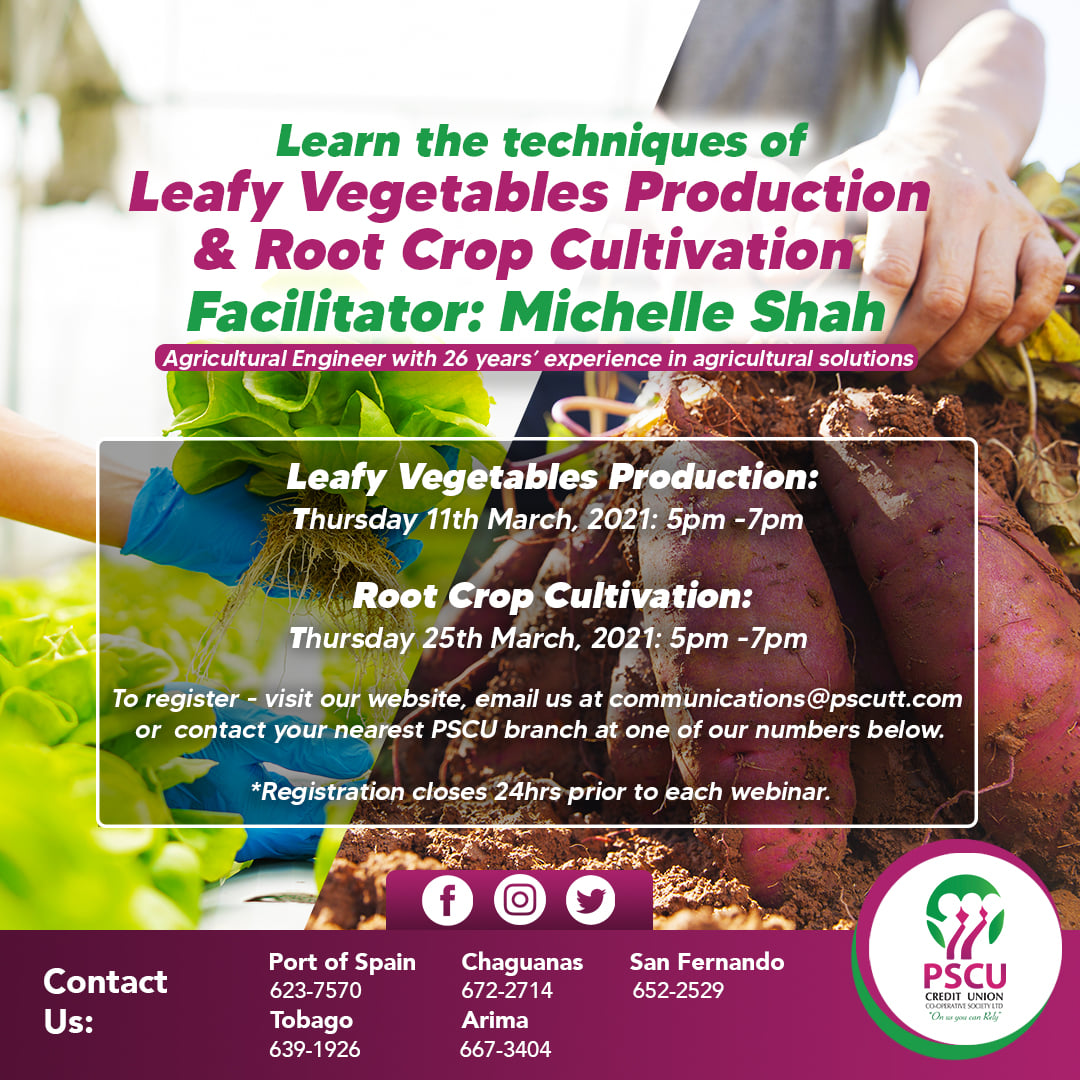
Mr. Alexander unequivocally endorses the PSCU Webinar Series on Agriculture as there are endless opportunities to succeed in the Agriculture industry. PSCU Credit Union will continue to provide the tools to assist members who wish to start their Agriculture business or venture into Agriculture/farming business.
 
BENEFITS OF GROWING YOUR OWN FOOD
It tastes so GOOD!
There’s nothing quite like a fresh tomato from the vine. The vegetable is picked fresh when you’re ready, there’s no transportation involved, it’s not sitting on the shelves for days. So you get to taste that wonderful freshness and juiciness. 

SAVES you money 
Growing your own food can save you money as buying produce (organic or otherwise) at the supermarket can be very expensive. By spending a few dollars on seeds you’ll produce vegetables that will yield pounds of produce. 

It is CLEAN
By choosing organic gardening, you ensure that your crops are safe for you and your family. Plus, organic vegetables have more nutrients than commercially grown foods because the soil is nourished sustainably.

It’s GOOD for the planet 
Having your own vegetable garden helps the environment in so many ways. If you grow your food without pesticides and chemicals, you don’t contribute to the unnecessary water and air pollution. You’ll also reduce the use of fossil fuels that results in pollution due to the transport of produce from gardens to the supermarket. It may seem like a small thing but no effort is too small. 

It’s good for the ECONOMY 
When you buy seeds from local garden centers, you’re supporting your local economy. By choosing to buy locally, you’ll most likely find a variety of plants suitable for your area. 

It’s good for the KIDS 
Exposing your kids to gardening can help them connect with nature while bonding with them.Teaching your children about gardening can change their relationship with food. Learning where their food came from, how to grow and care for it and how to harvest it, will teach them how to be more responsible when it comes to food.

You get to SHARE it 
Owning a garden means that most likely, you’ll always have more than enough for yourself leaving plenty to share with friends, neighbours and even with the community.

It’s a good EXERCISE 
When you garden, you are breaking a sweat. Whether you’re digging, lifting or weeding, these activities involve using different muscle groups. When you garden, you become fitter.

It’s a STRESS RELIEVER
We know that it’s healthy to take a break from all the stress that life throws at us and gardening is a good outlet for many people. By focusing your attention to planting, you are taking the time to shift away from your day to day stressors for a little while. 

It’s good for your HEALTH 
Vegetables keep your body running efficiently protecting you from chronic ailments such as heart disease and cancer. When you’re growing your own vegetables, you’are more likely to eat them.

EARN by selling your produce 
If it is legal in your community to set up a roadside stand and sell your extra fruits or vegetables, go ahead and earn extra money. You can even sell your produce to your local restaurant.

It’s FUN 
For long time gardeners, tending a garden provides enjoyment. Watching your garden bloom with a beautiful produce provides a sense of satisfaction. You can even make it a social interaction by inviting your neighbour who also garden. Growing your own produce is easy, satisfying, fun and healthy.
To register, please click HERE.

HELPING YOUR CHILDREN COPE WITH THE STRESS OF THE PANDEMIC
Kids deal with stress in both healthy and unhealthy ways. While they may not initiate a conversation about what's bothering them, they do want their parents to reach out and help them cope with their troubles.
But it's not always easy for parents to know what to do for a child who's feeling stressed.

Here are a few ideas:
Notice out loud. Tell your child when you notice that something's bothering him or her. If you can, name the feeling you think your child is experiencing. ("It seems like you're still mad about what happened at the playground.") This shouldn't sound like an accusation (as in, "OK, what happened now? Are you still mad about that?") or putting a child on the spot. It's just a casual observation that you're interested in hearing more about your child's concern. Be sympathetic and show you care and want to understand.

Listen to your child. Ask your child to tell you what's wrong. Listen attentively and calmly — with interest, patience, openness, and caring. Avoid any urge to judge, blame, lecture, or say what you think your child should have done instead. The idea is to let your child's concerns (and feelings) be heard. Try to get the whole story by asking questions like "And then what happened?" Take your time. And let your child take his or her time, too.

Comment briefly on the feelings you think your child was experiencing. For example, you might say "That must have been upsetting," "No wonder you felt mad when they wouldn't let you in the game," or "That must have seemed unfair to you." Doing this shows that you understand what your child felt, why they felt that way, and that you care. Feeling understood and listened to helps your child feel supported by you, and that is especially important in times of stress.
Put a label on it. Many younger kids do not yet have words for their feelings. If your child seems angry or frustrated, use those words to help him or her learn to identify the emotions by name. Putting feelings into words helps kids communicate and develop emotional awareness — the ability to recognize their own emotional states. Kids who can do so are less likely to reach the behavioural boiling point where strong emotions come out through behaviours rather than communicated with words.

Help your child think of things to do. If there's a specific problem that's causing stress, talk together about what to do. Encourage your child to think of a couple of ideas. You can start the brainstorming if necessary, but don't do all the work. Your child's active participation will build confidence. Support the good ideas and add to them as needed. Ask, "How do you think this will work?"
Listen and move on. Sometimes talking and listening and feeling understood is all that's needed to help a child's frustrations begin to melt away. Afterward, try changing the subject and moving on to something more positive and relaxing. Help your child think of something to do to feel better. Don't give the problem more attention than it deserves.

Limit stress where possible. If certain situations are causing stress, see if there are ways to change things. For instance, if watching the news about the pandemic causes anxiety, switch the channel.

Just be there. Children don't always feel like talking about what's bothering them. Sometimes that's OK. Let your kids know you'll be there when they do feel like talking. Even when kids don't want to talk, they usually don't want parents to leave them alone. You can help your child feel better just by being there — keeping him or her company, spending time together. So if you notice that your child seems to be down in the dumps, stressed, or having a bad day — but doesn't feel like talking — initiate something you can do together. Take a walk, watch a movie, shoot some hoops, or bake some cookies. Isn't it nice to know that your presence really counts?

Be patient. As a parent, it hurts to see your child unhappy or stressed. But try to resist the urge to fix every problem. Instead, focus on helping your child, slowly but surely, grow into a good problem-solver — a kid who knows how to roll with life's ups and downs, put feelings into words, calm down when needed, and bounce back to try again.
Parents can't solve every problem as kids go through life, but by teaching healthy coping strategies, you'll prepare your kids to manage the stresses that come in the future.
adapted from Johns Hopkins All Children's Hospital

We can help. PSCU Credit Union has partnered with PEAPSL to provide free counselling services to help cope with stress and anxiety. Please call PEAPSL directly at 658-1291 or visit their Facebook page @peapslconsultancy

THE PSCU CREDIT UNION SHARE ACCOUNT

At PSCU our shares account is the building block for any member to access and enjoy the products and services available. In addition, this account makes you part owner of the Credit Union. Therefore, you are entitled to an equal distribution of any profits that are declared in the form of dividends, based on your shares.

Check out the details below!
THE PSCU CREDIT UNION ORDINARY DEPOSIT ACCOUNT

Our Ordinary Deposit account allows you to save, as well as provides you with easy access to your funds, while earning interest up to 0.25% quarterly.

Check out the details below!
For more information, please click HERE.
Let us help you create a plan to save.
Call, visit and click on www.pscutt.com TODAY!
PSCU Credit Union Cooperative Society Limited