Please spread the word about the
PEDReady website
and newsletter with your ED, EMS and pediatric colleagues! The
P
E
A
R
L
can be used by training officers, medical directors, nurse educators, Pediatric Emergency Care Champions/Coordinators (PECCs) and others to provide weekly pediatric education.
Don't forget:
Email
pedready@jax.ufl.edu
with your suggestions, upcoming pediatric courses or requested content.
|
|
Encourage others to sign up for the PEDReady listserve & weekly newsbrief, the PE
2
ARL, by sharing this link:
http://bit.ly/flpearl
|
|
Focus | Pediatric Drowning
|
|
(Special thanks to Drs. Andrew Schmidt and
Jim Buscher
for contributing!)
Did You Know...
- Florida leads the country in drowning deaths of children ages 1-4 years.
- In 2013, Florida had the highest unintentional drowning rate in the nation for children ages 1–4 years with a rate of 7.54 per 100,000 population.
- Annually in Florida, enough children to fill 3-4 preschool classrooms drown before their fifth birthday.
- Drowning has only three outcomes:
- fatal drowning
- nonfatal drowning with injury or illness, or
- nonfatal drowning without injury or illness
- The term “submersion” is synchronous with “drowning.” Submersion is actually part of the drowning definition (the process of experiencing respiratory impairment due to submersion or immersion in a liquid). However, “drowning” is preferred to keep uniformity.
- There is no such thing as near drowning or dry drowning. You either drown or you don’t, and drowning is never dry. Use the right terminology!
|
|
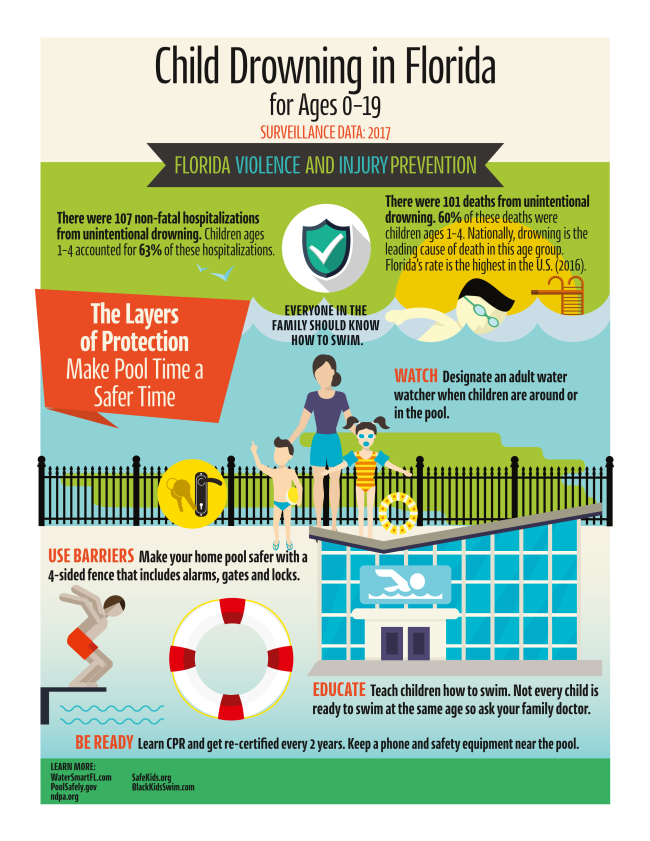
Child Drowning in Florida
Infographic
|
By Florida Department of Health
|
|
|
Key Drowning Pearls:
- The primary focus of drowning resuscitation and treatment is reversal of hypoxemia—any amount of oxygen is better than none!
- Cervical spine injury is rare and maneuvers to protect the spine should not take priority over proper oxygenation. Suspect spine injury in diving accidents or submersion with obvious signs of head injury.
- CPR MUST include ventilations in any form possible. Compression-only CPR is not adequate.
- Prolonged attempts to clear the airway of foam/vomit delays ventilations. Keep removal attempts quick and try to provide positive pressure ventilations.
- Remember to obtain a core temperature, as hypothermia can occur even when the weather is warm outside.
- Be aware of other situations that may have caused the submersion. Risk factors for drowning can include seizures, cardiac dysrhythmias, hypoglycemia, hyperventilation, intoxication, etc. Sadly, there are even cases of cardiac or respiratory arrests caused by child abuse that are claimed to be a result of drowning.
- Remember to ask all parents and caregivers:
- Do you know CPR?
- Have you and your child taken swimming lessons?
- Do you have a water safety plan?
Pediatric Drowning Resources:
|
|
Florida EDs and EMS agencies are eligible to receive a
free
PEDReady Resource Bag! Contact us at
pedready@jax.ufl.edu
or
904-244-8617.
|
|
|
2. Upcoming Pediatric Emergency Conferences
|
|
Emerald Coast Conference 2019
June 3–6, 2019 |
Destin, FL
Hosted by: Alabama ACEP
Designed for physicians, nurses, nurse practitioners and physician assistants engaged in the practice of emergency medicine. Check out the speaker list of Florida PEDReady Champions!
Access Brochure
Pediatric Emergency Workshop: Neonatal Emergencies, PEM Literature Update, Pediatric Fever and More!
June 2, 2019 (pre-conference workshop)
Limited to 40 participants
|
|
|
The Forensic Investigation in Child Physical Abuse:
Making a Difference Together (new!)
June 13–14, 2019 |
Gainesville, FL
Hosted by: The Shaken Baby Alliance
This conference is designed for multi-disciplinary teams that investigate cases of child physical abuse. CME available!
|
|
|
Kid Care Trauma Conference
(new!)
July 9, 2019 |
Jacksonville, FL
Hosted by: UF Health Jacksonville
Approved for 8 nursing hours and 7 EMS hours
|
|
|
CLINCON 2019
(new!)
July 17–19, 2019 |
Orlando, FL
Hosted by: EMLRC
Designed for the entire spectrum of emergency care providers. General conference lectures include
The Pregnant Patient Skills Lab, Tips & Tricks for Blue & Barely Breathing Baby
and more!
Access Brochure
Pre-Con Workshop:
Managing Pediatric Cardiac Arrest
July 17, 2019 | 8:00-12:00 pm
|
|
|
Symposium by the Sea 2019
August 1-4, 2019 | Boca Raton, FL
Hosted by: Florida College of Emergency Physicians (FCEP)
FCEP's annual meeting & educational conference, Symposium by the Sea, is designed for emergency physicians, residents, students, physician assistants, nurses and allied health professionals interested in emergency care.
Pediatric Trauma Workshop
August 2, 2019 | 9:00 am to 12:00 pm
|
|
|
Pediatric Care After Resuscitation (PCAR) Course
Dec 2-3, 2019 | Jacksonville, FL
The mission of TCAR (Trauma Care After Resuscitation) Education Programs is to expand the knowledge base and clinical reasoning skills of nurses who work with injured patients anywhere along the trauma continuum of care, particularly in the post-resuscitation phase.
|
|
|
Thanks for being a Pediatric Champion!
|
|
The Florida PEDReady Program
|
|
|
|
|
|
|
|