Black Girls Speak Out About Anti-Black Racism in Public Schools
We are thrilled to share with you our groundbreaking new report on the experience of Black girls in public schools. We are devoting this issue of our monthly newsletter to sharing the report and its highlights with you.
In 2015, ELC began to prioritize work focused on Black girls as a part of our commitment to advance education justice. Our efforts, now known as our “Black Girls Education Justice Initiative,” are rooted in the belief that Black girls must be fully and holistically supported, affirmed, celebrated, and provided with every opportunity to thrive at school. We aim to address the educational barriers that arise for Black girls at school due the intersections of anti-Black racism, sexism, and other forces of oppression. And our work includes development and implementation of unique legal strategies to address these barriers. Our current efforts are led by award-winning ELC staff attorney Paige Joki, alongside ELC colleagues committed to education justice for Black girls.
In the creation of this report, ELC has been working closely with Black girls, who are the experts on real-time conditions in schools. Their experiences and recommendations have given us a roadmap for change and have framed this report.
Public schools should be supportive and affirming places where Black girls are championed in their academic and personal growth and have every opportunity to learn and thrive.
Our report makes clear that this is not the current reality in Pennsylvania. Rather, Black girls are subject to daunting educational barriers.
Black girls consistently spoke to the pervasive anti-Black racism that shapes all aspects of their educational experience and spoke to the grave harm that it causes, which is preventable. (Scholar Altheria Caldera defines anti-Black racism as “any attitude, behavior, practice, or policy that … reflects the belief that Black people are inferior.”)
Black girls say that school rules and policies as well as their enforcement reflect and further reinforce anti-Black racism. They cited discriminatory codes of conduct that punish students subjectively for vague or undefined behaviors — and illegal bans on protective and culturally expressive hairstyles that racially discriminate against students and send a message that students are unwelcome.
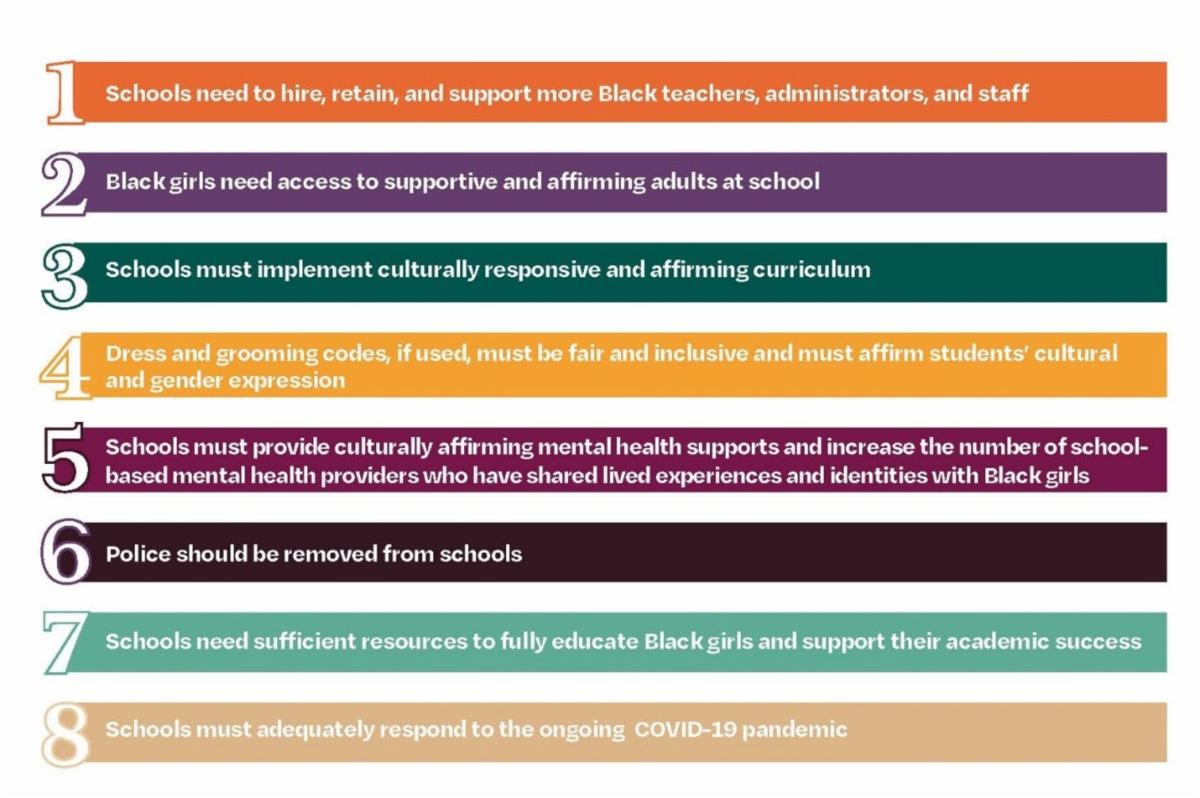
Here are the recommendations developed and supported by the Black girls we worked with.