|
That frank assessment was provided by Councilman Scott Aspenlieder, colorfully describing the need to ensure that proposed capital improvement plan (CIP) numbers reflect the totals from City Council's approved budget during last week's Budget & Finance Committee meeting. It was serious but not denigrating, drawing chuckles from attendees.
Honestly, it's a breath of fresh air—not the metaphorical crap sack—to hear the candid and open policy conversations our local elected officials have during their committee meetings, hashing out big policy discussions. I highly encourage everyone to attend at least one of City Council's committee meetings and see them working together—not necessarily in agreement—towards a common goal of good governance.
Now that the Budget & Finance Committee has had a few chances to work through the $557 million CIP, it goes before the full City Council tonight. As a brief reminder, the CIP is a gameplan for all the major spending (anything over $25,000 with a useful life longer than one year) the City is expecting over the next five years. It details each individual capital project, such as rehabbing more of the interior at the airport, how much it will cost ($32.8 million), when it’s planned to be done (FY27), and where the money will come from. In this case, funding for the interior rehab will come from airport user fees ($19 million), a Federal Aviation Administration (FAA) grant ($12.8 million) and $2 million of Passenger Facility Charges (PFC). If you're interested in airport funding, we wrote a Council Bulletin on Aug.14.2023 that might be worth checking out!
The CIP includes projects from six city departments, totaling over $500 million over the next five years. That’s not to say the City is allocating the entire half-billion, but they are identifying and planning for future spending. Tonight, City Council will discuss the projects in the CIP, their prioritization, data needed for decision making, and consider how policy changes could affect particular projects. But they won’t approve the CIP until December, and CIP projects for FY 2027 will be budgeted/funded via next year’s budget adoption in June 2025.
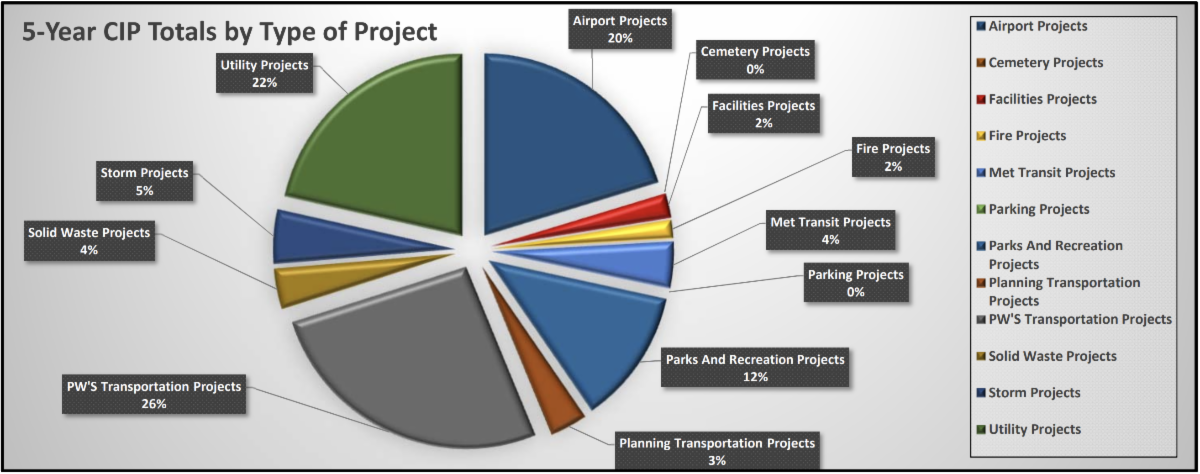
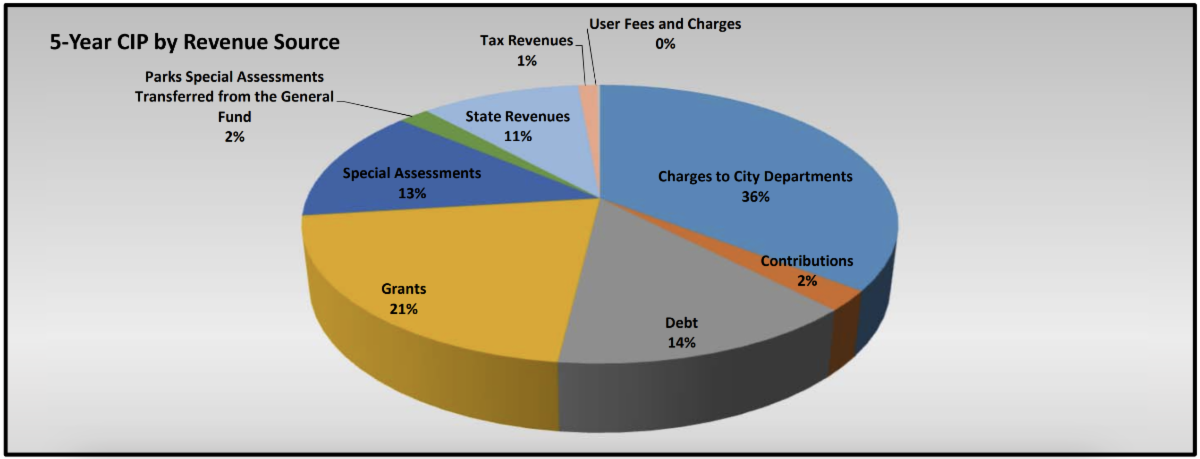
The biggest buckets of CIP spending (pg. 4) are for Public Works Transportation Projects, Utility Projects, and Airport Projects which account for two-thirds of all CIP spending. Most of that money comes from charges to city departments and grants like the FAA grant mentioned above. You'll notice that only a tiny fraction of funding (pg. 6) comes from tax revenue.
|