Editor’s Note: As 2020 draws to a close, we highlight our choices for the Top 10 stories that impacted the asphalt industry in California over the past year. Click HERE for our Top 10 stories of 2019. Look for our 2021 predictions in next week’s issue of this newsletter.
No. 1. Global pandemic sweeps across California
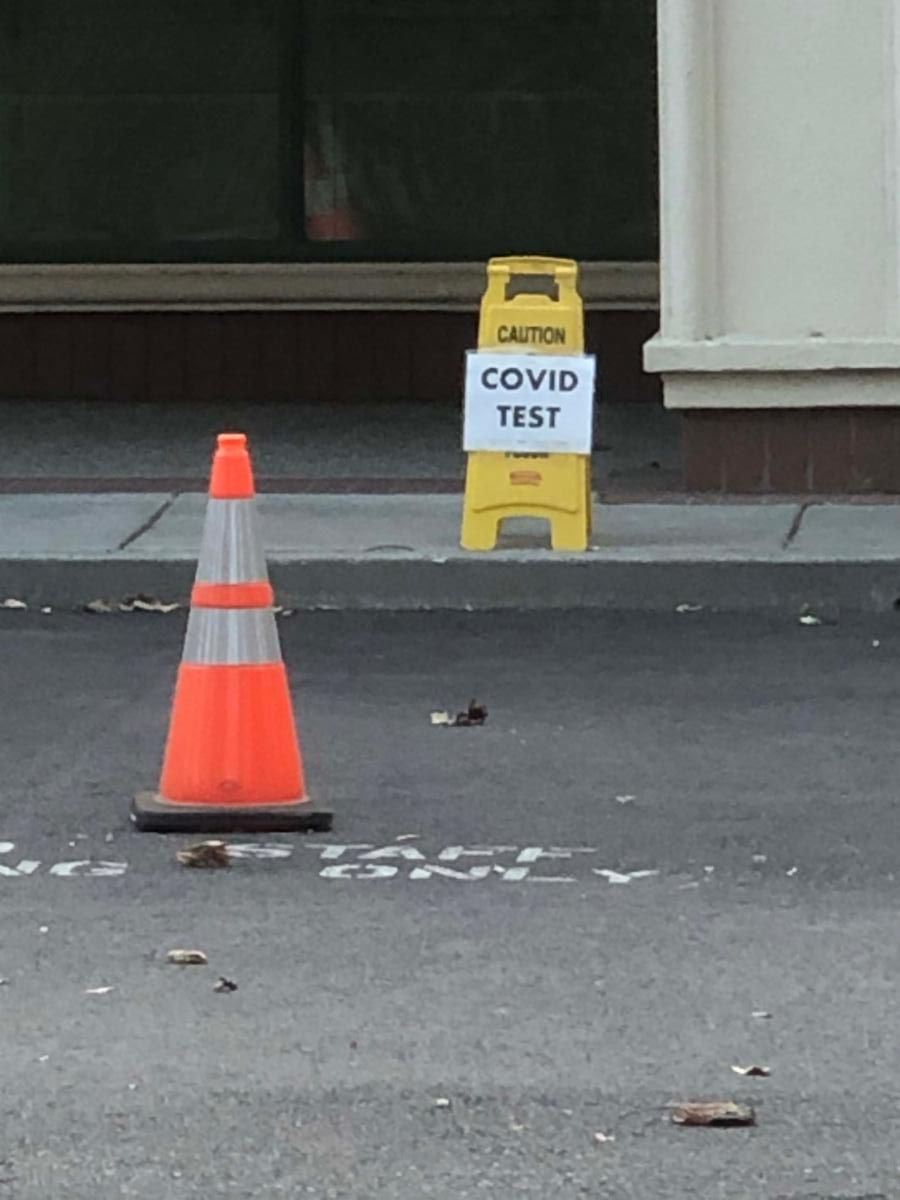
No surprise here. This will be on the top of everyone’s list when they look back at 2020 for generations to come. The year started out like normal, with an industry gearing up for what was expected to be another busy construction season. Then news reports about a mysterious virus in China began to surface, followed by sudden illnesses and deaths in the United States. A series of “stay at home” restrictions imposed in March plunged the economy into recession and threw millions out of work. In California, officials designated construction activity in general, and construction materials production in particular, as an “essential” activity and allowed to continue through the pandemic, albeit with numerous and sometimes conflicting safety protocols in place. The asphalt pavement industry proved resilient, however, and largely kept producing asphalt, and paving crews placed asphalt all around the state. In the public works space, in particular, tax dollars accumulated through state and local transportation measures, including SB1, continued to be converted into projects that were bid on and constructed by the industry. As the year drew to a close, most companies in CalAPA surveys were grateful to have salvaged the construction season from what appeared in the Spring to be potentially disastrous. CalAPA member surveys also indicated that, overall, there was relatively little disruption to operations from the pandemic. Bright spots in the year were the many charitable works done by the industry, from donating PPE and buying lunch for health-care workers, to donating to local charities and food banks. By year’s end, however, there was no escaping the grim statistics: more than 2 million COVID-19 cases in California, resulting in more than 23,000 deaths and many hospitals filled to capacity.
No. 2. Pandemic impacts the state’s economy
The state’s economy heading into 2020 was robust, building on the nation’s longest economic expansion on record. That all changed in March, however, when a series of restrictions brought about by the coronavirus pandemic caused the economy to plunge into a recession on par with the previous “Great Recession” from 2007 to 2009. While public works projects largely continued to be built in 2020, private work in some areas experienced a sharp pull-back. As restrictions were lifted over the summer, the economy appeared to be responding from the shock of the Spring, but a surge in COVID-19 cases in November and December sent shudders through the economy anew. Construction employment in California in 2020, according to the Bureau of Labor Statistics, was off 4 percent from pre-pandemic levels. Most economists expressed cautious optimism that the state would slowly crawl out of the economic doldrums in 2021 as COVID-19 vaccines become more widely available.
No. 3. Transportation and politics intersect
Politics loomed large in 2020, a presidential election year, and could portend changes to transportation funding and other areas that impact company bottom lines. At the top of the ticket, Republican President Donald Trump was defeated by Democrat challenger, Joe Biden, who included as his vice-presidential running mate Sen. Kamala Harris from California. Transportation advocates were hopeful that a new administration would make good on its campaign promises to rebuild America’s infrastructure.Many local measures that included funding for road repair fared well at the ballot box. An analysis by the American Road & Transportation Builders Association counted 39 measures in California that devoted at least some money to transportation, and tallied that they passed at an 87 percent rate, generating an estimated $692.3 million. Democrats kept a firm grip on the Legislature, but Republicans won back four heavily contested seats in Congress, bringing the Congressional delegation in California to 40 Democrats and 11 Republicans. As prominent Californians join the Biden administration, Gov. Gavin Newsom was presented with the opportunity to make a number of high-profile appointments, creating a bit of a domino effect. On Dec. 22, for example, he named Secretary of State Alex Padilla to fill Harris’ seat, and followed that up with an announcement that he would nominate Assemblywoman Shirley Weber (D-San Diego), to replace him. Padilla is the first Latino Senator representing California in the state’s 170 history, and Weber would be the first African-American Secretary of State in California history. California Air Resources Board Chair Mary Nichols and Los Angeles Mayor Eric Garcetti were reported to be in the running for Biden administration posts, but the jobs went to others. The political landscape will continue to be difficult for the asphalt pavement industry, however, as environmentalists and social justice advocates have increasing influence in policy.
No. 4. Environmental regulations remain at forefront
Despite a pandemic, environmental regulations continued to be a top issue for the asphalt pavement industry in 2020. Climate change continued to be at the forefront of policy-making in Sacramento, and a devastating wildfire season choked the skies in California with smoke, cited by environmentalists as further proof that more aggressive action on climate change was needed. The California Air Resources Board on Nov. 19 moved forward with rule-making for additional restrictions on stationary sources of air pollution, the first changes to the so-called “toxic hot spots” law since 1996, and also continued with implementation of local community air pollution panels, creating confusion for asphalt producers as well as local air districts. Gov. Gavin Newsom issued an executive order on Sept. 23 requiring sales of all new passenger vehicles to be zero-emission by 2035, and for light- and heavy-duty trucks to be zero-emission by 2045. In a new twist to the environmental movement, a summer of “Black Lives Matter” protests in cities across the United States and in California added a “social justice” element to the environmental movement, with additional attention being paid to air quality in poorer neighborhoods that often are located near industrial facilities.
No. 5. Major commercial property tax measure defeated at the ballot box
California’s venerable Prop. 13 of 1978, which capped property taxes and sparked a nationwide tax revolt, was partly back on the ballot in 2020 in the form of Proposition 15, which sought to hike commercial property taxes an estimated $11 billion. A spirited campaign ultimately resulted in Proposition 15 going down to defeat in the Nov. 3 election. A broad coalition that included CalAPA came together to campaign against the measure. The measure would have raised property taxes on asphalt plants and other facilities substantially, adding additional costs to the industry.
No. 6: Hamburg Wheel Track test for RHMA-G mixes is revised by Caltrans
The Caltrans-industry Pavement & Materials Partnering Committee’s prioritized effort to evaluate variability in the Hamburg Wheel Track testing of Rubberized Hot Mix Asphalt-Gap Graded (RHMA-G) mixes bore fruit in 2020, building upon interim guidance issued by the department in 2019. Caltrans acknowledged that test variability issues have been persistent, and issued interim guidance to district construction field personnel on how to address the variability. Caltrans published changes to California Test 389 in its standard specifications released April 17, and on Aug. 21 issued a Construction Procedure Directive providing guidance to Caltrans field personnel on how to implement the changes. Coming on the heels of a major industry-agency effort to rewrite Caltrans pavement smoothness specifications, the changes were a further indication of the success of the collaborative approach to review and improve specifications and test methods.
No. 7: Continuing gridlock in Washington over long-term transportation funding
in an election year, Congress made no meaningful progress in developing a long-term plan to address transportation infrastructure, punting the issue to 2021 and a new administration. As the year drew to a close, however, Congress did approve funding the federal government for the remainder of the fiscal year, which ends Sept. 30, 2021. President-elect Joe Biden selected former South Bend, Ind., Mayor Pete Buttigieg as U.S. Transportation Secretary and pledged to make transportation infrastructure a top priority of his administration. The current surface transportation act expires on Sept. 30, 2021 and the asphalt industry is already pressing the incoming administration to provide adequate, long-term investment to modernize the surface transportation infrastructure network. The only silver lining was Congressional action on Dec. 21 on an omnibus appropriations bill that included extended funding levels for highway and airport programs, plus funding for highway materials research and innovation. It passed on a bipartisan vote along with a $900 billion COVID-19 stimulus package, although not without drama as the president threatened a veto.
8. Long-life asphalt pavement project on I-5 moves into high gear
A major long-life asphalt pavement project on Interstate 5 near Sacramento moved into high gear in 2020. A joint venture of Granite Construction and Teichert Construction, the $370 million Interstate 5 Corridor enhancement Project will ultimately result in the rehabilitation of 67 lane-miles of pavement, ramps and connectors utilizing a long-life asphalt pavement design that will last 40 years or longer with minimal maintenance. The project is expected to utilize 600,000 tons of asphalt. Previous long-life asphalt pavement projects built in recent years have won recognition for excellence and innovation. The design strategy was a culmination of another collaboration between industry, Caltrans and the University of California Pavement Research Center.
9. Oil prices plunge, then stabilize; Caltrans revisits crude oil index
The global pandemic and resulting restrictions on travel pushed traffic and fuel consumption sharply down early in 2020, leading to a plunge in crude oil prices and the resulting ripple effect on asphalt prices in California. Caltrans, which maintains a statewide crude oil price index, and CalAPA held a statewide meeting to assess the impact of the price fluctuations on projects. Ultimately, prices stabilized and Caltrans elected to make no changes to the Crude Oil Price Index that is used to adjust asphalt prices to compensate for wide swings in the market.
10. Caltrans names personnel to key positions
The California Department of Transportation saw a number of high-profile retirements at the end of 2019 and into 2020, and filled a number of key positions that have a direct impact to the asphalt industry in California. Chief among them was the promotion of Tim Greutert as chief of the Materials Engineering & Testing Services branch, otherwise known as the state materials engineer. As the year drew to a close, Rachael Falsetti, longtime chief of the Caltrans Division of Construction, announced her retirement. She was replaced by Ramon “Ray” Hopkins, who previously served as deputy division chief of the Division of Construction. Both Greutert and Hopkins play a prominent role in overseeing the activities of the industry-agency Pavement & Materials Partnering Committee that review and proposes changes to Caltrans specifications, test methods and construction procedures as they relate to asphalt and other construction materials. As 2020 to a close, Caltrans Chief Engineer Mike Keever observed that the Caltrans-industry relationship was as positive and productive as it had been in many years.
Honorable mention: The essential worker.
While health care workers and other first-responders, rightly, got most of the attention in 2020 for helping those afflicted by COVID-19, there were a host of other workers designated as “essential” who continued to go to work and keep our state functioning in a pandemic. Among them were asphalt pavement industry workers, who staffed asphalt plants, worked on paving crews, performed tests in materials labs, drove trucks to deliver materials and a host of other activities to keep construction work humming along. Public agency personnel also ensured that projects continued to be put out to bid and were not disrupted, construction sites inspected and work accepted.
Think we missed a significant story? Click HERE to send us some feedback.