|
Monthly newsletter from the City of Chula Vista
Sustainability Team
| |
South Bay Earth Day is Almost Here – Join Us April 18!
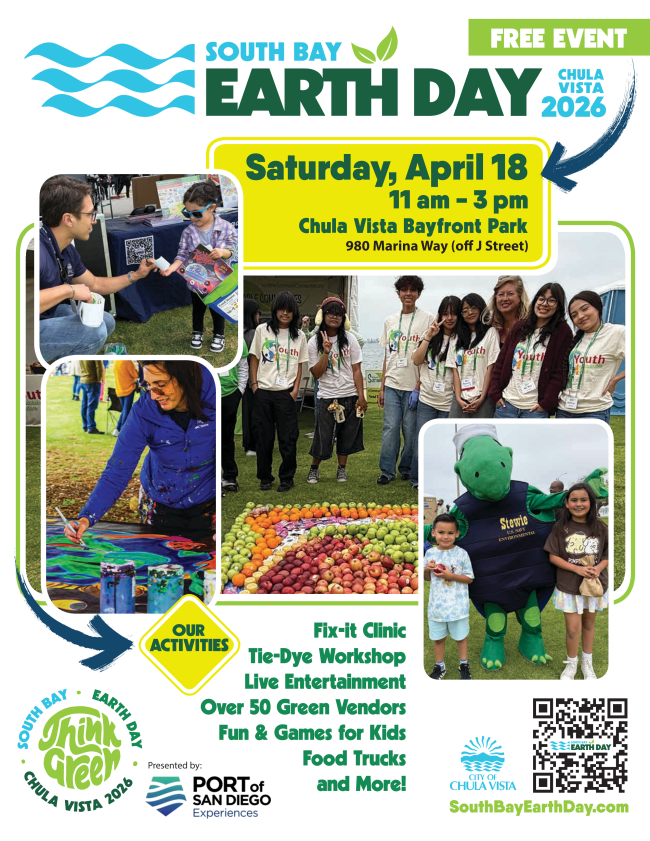
South Bay Earth Day is just 2 weeks away! Mark your calendar for Saturday, April 18 from 11 a.m. to 3 p.m. at Chula Vista Bayfront Park and get ready for a free, family-friendly celebration of sustainability, community and hands-on fun.
This vibrant, zero-waste event is designed to inspire simple, practical ways to reduce your environmental impact. Explore interactive exhibits featuring green energy, water conservation and food waste composting, and connect with local organizations and eco-friendly vendors making a difference in our region.
Have something broken at home? Bring it to our popular Fix-it-Clinic! From small electronics and minor sewing repairs to small mechanical items, skilled volunteers will help you diagnose and repair your items—keeping usable goods out of the landfill.
Be sure to bring an old white t-shirt for our crowd-favorite tie-dye workshop. Instead of discarding worn or plain tees, give them a colorful new life and head home with a one-of-a-kind Earth Day creation. It’s a fun and creative way to reduce textile waste—so check your closet and bring those shirts along!
Planning to attend? Make it Earth-Day style by riding your bike and taking advantage of our complimentary bike valet. With live and interactive entertainment, delicious food options and engaging activities for all ages, there’s truly something for everyone.
This FREE event, organized by the City of Chula Vista, in partnership with the Port of San Diego, welcomes residents and visitors alike. Gather your friends and family and join us in showing Mother Nature some love this Earth Day.
Interested in becoming a vendor or sponsor? There’s still time to get involved. Visit www.SouthBayEarthDay.com for more information or to register.
| |
Celebrate Easter with Purpose, Joy, and Sustainability
Easter is a time of renewal, celebration, and connection, but it can also generate unnecessary waste. This year, you can keep the traditions while making more environmentally conscious choices that benefit both your community and the planet.
Sustainable Easter Tips:
1. Ditch Plastic Eggs
Swap single-use plastic eggs for reusable wooden eggs, paper eggs, or even decorate real eggs. These options reduce waste and can become part of your yearly traditions.
2. Skip disposable grass and plastic fillers by choosing more sustainable alternatives:
● Use reusable baskets (fabric totes, wooden crates)
● Fill with consumables (snacks, chocolates)
● Add long-lasting gifts (books, plants, wooden toys)
This keeps the fun while avoiding clutter and waste.
| | |
Why It Matters
Easter celebrations often involve single-use plastics, excess packaging, and food waste.
By making simple swaps, you:
● Reduce landfill waste
● Support ethical and local businesses
● Promote long-term sustainable habits
Even small changes, when adopted widely, can create meaningful environmental impact.
Sustainability isn’t about removing joy; it’s about celebrating more intentionally. This Easter, focus on experiences, traditions, and choices that last beyond the holiday.
Spring is here and it’s time to prepare the soil by adding compost to replenish the organic content and keep your soil healthy. The next free compost event is Saturday, May 9.
| |
New Addition to May 2 Movie Day – Meet the Filmmaker
Filmmaker Nathan Dappen, who created the movie that will be shown, will be attending a Q&A after the movie. Please plan to join us for this exciting FREE event to learn about San Diego wildlife and prepare any questions you would like to ask to learn more.
| |
Chula Vista Electrification Fair May 16 at Norman Park Senior Center
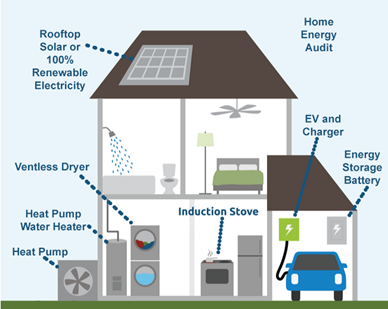
San Diego’s second Home Electrification Fair will be held on Saturday, May 16, 2026 from 9:30 a.m. to 12:45 p.m. at the Norman Park Senior Center (270 F St) in Chula Vista. Residents are invited to attend this free event focused on strategies for reducing energy costs, enhancing air quality, and decreasing environmental impact through home electrification. The program will provide an overview of fundamental concepts in home electrification and energy efficiency, including heat pump systems, induction cooktops, electric vehicle charging, ventless electric dryers, and solar energy solutions. Representatives will be available to share details about the health advantages and cost savings of electrification, as well as guidance on choosing 100 percent renewable electricity. Attendees will be provided with resources regarding the planning, implementation, and financing of home electrification projects, including guidance on obtaining rebates.
Representatives from equipment suppliers, service providers, building contractors, utilities, incentive programs, community programs, and local governments will be available to explain how home or building electrification can benefit you. Individuals with experience electrifying their homes will be available to share their knowledge and explain what electrifying means in practical terms. There will also be seminars by an expert from the Home Energy Academy from 9:30 – 10:15 am and 12:45 – 1:30 p.m. With activities for kids and a free drawing for prizes, all are encouraged and welcome to attend this electrifying event! More information about the event is available at electrificationwg.org.
| |
Energy Benchmarking Season has Begun
Do you own or manage a building in Chula Vista that is 20,000 square feet or greater? If so, you are required to report your energy use data to the City of Chula Vista annually by May 20.
Reporting energy use, otherwise known as benchmarking, helps building owners understand how they can improve their energy efficiency to save money and reduce greenhouse gas emissions.
The City is updating how it is accepting benchmarking data this year. Please visit chulavistaca.gov/benchmark to learn more and view the updated "How-to-Comply" document or email benchmark@chulavistaca.gov with any questions.
| |
Stormwater Smarts: Greener Yards, Cleaner Water
Earth Month is the perfect time to rethink your landscaping and its impact on local waterways. Traditional lawns and high water landscapes often require frequent irrigation, fertilizers, and pesticides. When overwatering or rain occurs, these chemicals can wash off your yard, flow into storm drains, and enter our creeks, bays, and ocean untreated.
Fertilizers and pesticides can support plant health, but when misused, they become major contributors to stormwater pollution. Excess nutrients—especially nitrogen and phosphorus—can fuel algal blooms that deplete oxygen and threaten fish and other aquatic life. To reduce these impacts, choose slow release or organic fertilizers, apply only what your plants truly need, and always follow label directions. Sweep any granules off sidewalks and driveways so they don’t wash away. For pest control, consider integrated pest management approaches such as selecting the right plants, encouraging beneficial insects, and limiting chemical use. If fertilizer or pesticide use is necessary, apply sparingly and never before rain if it is in the forecast.
A simple way to protect water quality is to transition to native or drought tolerant plants. These species are naturally adapted to Southern California’s climate, needing far less water and maintenance than traditional turf. With minimal irrigation, they reduce runoff, conserve water, and support local pollinators.
Finally, check your irrigation system for leaks, overspray, or runoff. Adjusting watering schedules seasonally and watering in short cycles helps water absorb into the soil instead of flowing to the street.
By making small, thoughtful choices in your yard, you can support healthier landscapes, conserve resources, and help keep our waterways clean—not just during Earth Month, but all year long.
| |
Join the Chula Vista Climate Action Challenge and Help Drive Real Change
Climate change can feel overwhelming, but local action is one of the most powerful ways to create meaningful impact. The Chula Vista Climate Action Challenge brings the community together to build sustainable habits and work toward a cleaner, healthier future.
What is the Chula Vista Climate Action Challenge?
The challenge encourages residents to take simple, meaningful actions that reduce environmental impact. By participating, individuals and households contribute to larger city-wide sustainability goals.
How is Chula Vista Doing?
The city is already making strong progress toward its climate goals:
● 438 households participating, with a goal of 500 households by December 2026
● 52% progress toward reducing 250 tons of CO₂ emissions by December 2026
This shows that the community is actively taking steps towards reducing our carbon footprint, but there’s still room to grow.
How Can You Make an Impact?
Small actions add up. Through the challenge, you can:
● Reduce waste and limit single-use plastics
● Conserve energy and water at home
● Support local and sustainable businesses
● Advocate for environmental awareness in your community
These everyday changes help build a more sustainable lifestyle while contributing to larger environmental goals.
Get Involved
Ready to make a difference? Visit the official site to learn how to participate, join a team, and start your climate action journey at https://www.cvclimatechallenge.com/
| |
Can Recycling Our Electronic Waste Help Power America?
In the race to secure the critical mineral supply chain, the U.S. government has pursued to ramp up production of rare earths and rare earth magnets. Now, authorities say the key to securing these supplies may not lie simply in opening new mines, but also in reusing what has already been extracted.
Rare earths, a group of 17 metallic elements on the periodic table, are essential for many modern technologies, from smart phones and laptops to wind turbines. Their unique properties enable super-strong magnets, amplify fiberoptics and lasers, and help speed up chemical reactions.
In recent decades, other countries have built up their rare earths industry and cornered the market on these materials critical to U.S. manufacturing and the defense industry. Contrary to what their name suggests, rare earths are not actually scarce in nature. What makes them rare is finding deposits concentrated enough to make mining and processing necessary. But according to experts, there may be another way. Preview: The old laptop in your closet and the several obsolete cellphones in your drawers might be the solution.
Less than 1% of the rare earths that we consume are recycled, which means we've been accumulating rare earths in our waste for decades. Rare earth elements are embedded in countless everyday devices. "There's not a day that goes by where you don't interact with rare earth magnetics," said Matt Sloustcher of MP Materials, which operates the only active rare earth mine in the United States at Mountain Pass, California.
From the vibration of a smartphone to the acceleration of electric vehicles, rare earth magnets make the modern world move. Yet once products reach the end of their life, most of the valuable rare earth elements inside of them are lost. Every year, rare earth elements are thrown away in items like outdated electronics, retired airplanes, and decommissioned ships. Even more of these elements remain buried in thousands of mining waste sites.
Why not recycling?
The idea of recycling rare earths is straightforward, but the implementation is not. Devices often contain only tiny amounts, meaning large volumes of material must be processed to recover meaningful quantities. Extracting them can also be technically complex but recycling is more environmentally friendly than opening new mines. Therefore, efforts to scale up rare earth recycling are beginning to take shape. As the U.S. invests in rare earths recycling initiatives that were not economically feasible ten years ago, they are now a game-changing reality.
As an example, we can point at Apple’s partnerships with recycling companies as part of a $500 million commitment to use U.S.-made rare earth magnets. The collaboration aims to create a recycling system at the Mountain Pass (CA) refinery, where recycling of end-of-life and other magnet materials will take place. Those recovered materials will be sent to their factory in Texas to be made into magnets for Apple to use in future products. Apple has also developed its own robot called Daisy that disassembles iPhones to recover materials that traditional recycling often misses. Those recovered rare earths can then be processed and turned into magnets for new devices, creating what industry leaders call a "closed loop" supply chain.
A circular economy
For experts, this approach represents more than just a technical solution. It's a potential paradigm shift as new mines are not the only option because the feed stock we need is all around us. Until now, we misrecognized this feed stock as waste. If scaled successfully, rare earth recycling could strengthen supply chain security and lessen dependence on foreign sources, all while transforming how critical materials are sourced in the modern economy.
For more information on electronic waste recycling and where to find your nearest collection center, please visit the CalRecycle website at www.calrecycle.ca.gov/electronics/collection/
| |
Looking for Non-Profit Organizations to Help with Extreme Heat
Attention nonprofit organizations – is your organization working in the San Diego County region and delivering K-12 after school programs and/or programming for older adults (55+)? The search is on for nonprofit organizations to join the Solution for Heat Adaptation and Equity in San Diego (SHADE SD) Community-Driven Extreme Heat Adaptation Solutions Design Series!
Led by San Diego Regional Climate Collaborative (SDRCC) and SHADE SD team, the goal of the Design Series is to enable a cohort of local, community organizations with the capacity to develop heat mitigation and reduction strategies for their programs. Through the Design Series program, participating organizations will work alongside SDRCC, project partners, and Design Series cohort members to co-develop solutions and community projects that will reduce the harmful impacts from extreme heat. Design series cohort members will receive compensation of $5,000 per organization for their time and community expertise.
Learn more about the program and apply today - applications close on Friday, April 17 at 11:50 PM!
| | | | |