Volume 6 Issue 8 | August 2025 | | August pause: A time to be still, to observe, to enjoy. A time to savor awe-filled moments. | | The Root of It newsletter ends with our monthly quotation. If you find your newsletter has been clipped by your email provider please click HERE for a webpage version of the newsletter. | | |
Who doesn’t love zinnias—tough, beautiful flowers that go from cottage gardens to formal settings? I line my front walkway with them, red Profusion, salmon Zahara, and a smattering of Cut and Come Again. While meandering up the that walk one morning last July, I noticed that some of the zinnia blooms looked distorted, missing whole sections of petals, and I wondered if eriophyid mites were the culprits. I have had experience with their damage on coneflower blooms, and I made a note to destroy the distorted blooms to stop the spread.
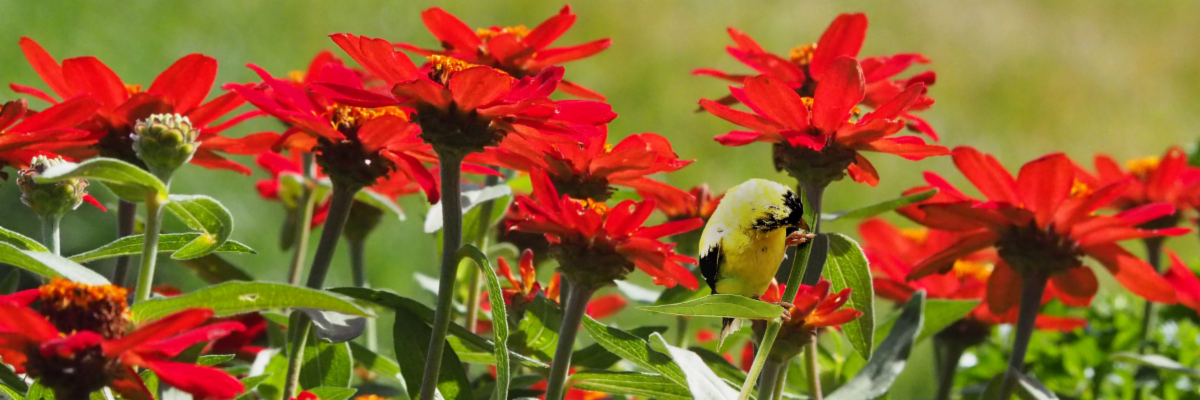
The next day, as I sat at my dining room table, a flash of yellow out the front window caught my eye. I crept to the window, not wanting to startle the yellow creature, and was delighted to see one, then two, then three goldfinches perched atop zinnia blooms, feasting on the developing flower seeds. What beauty as the blooms swayed in the breeze with their goldfinch passengers!
During the following weeks the goldfinches made my front flower bed a regular refueling stop, and I enjoyed a front row seat as they fed. Half the zinnia blooms were “disfigured,” but it was a very acceptable loss to the beautiful finches. The zinnias went on to flower well into late fall, when the goldfinches moved on to a more abundant winter locale.
As I reflected upon my goldfinch visitors, two thoughts came to mind:
A garden is so much more than fancy plants, and show-stopping flowers. Sacrificing zinnia blooms to goldfinches or parsley leaves to black swallowtail caterpillars or maple leaves to bladder or spindle galls is a small price to pay for their contribution to the beauty and function of the garden ecosystem.
Going with my initial assumption that the zinnia blooms were disfigured by eriophyid mites meant removal of the blooms. Being a plant diagnostician takes knowledge and research, but the first step to understanding plant “problems” is observation, which leads to a better perspective and a clearer understanding. I resolved, once again, to Look Around!
CONEFLOWER CONUNDRUMS: SPIKY HAIRDOS, FREAKY FLOWERS, AND DANGLING HEADS: Buckeye Yard and Garden
K Edgington
| | |
Leaf Brief
Spectacular Species
| | |
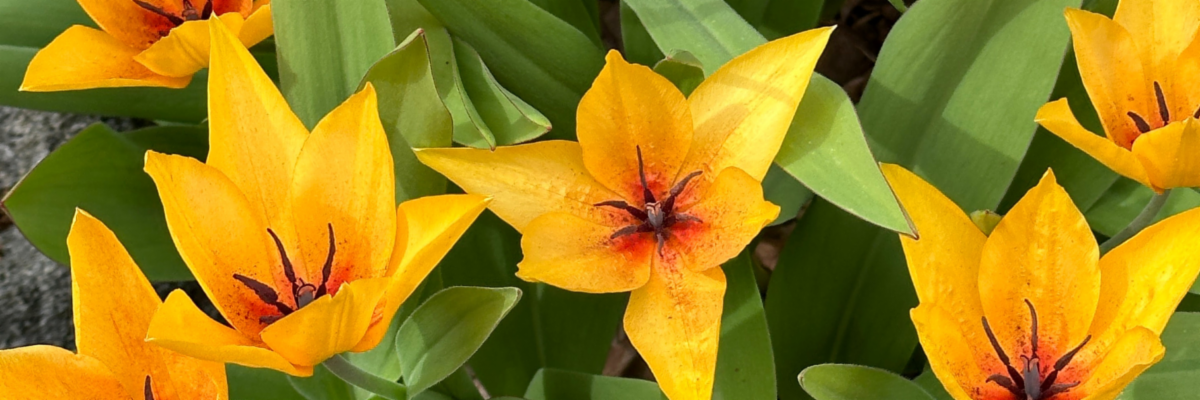
Tulipa praestans 'Shogun': a 12" species tulip that makes a statement
photo by E Barth-Elias
| | |
It’s the dog days of summer, and a gardener’s mind inevitably turns to mums, fall leaves, and—tulips? Well, maybe not, but perhaps it should. August is the time for bulb catalogs, and to plan your spring plantings and select the best options. Now is the moment to get those creative juices flowing!
Everyone is familiar with hybrid tulips that display their vibrant colors from March to May, signaling the end of a bleak winter. Hybrids can be breathtakingly beautiful, but they tend to lose their vigor or fade in color after a year or two, making them reluctant annuals. You may want to consider underused species tulips.
Species tulips, also known as wild tulips, are the ancestors of hybrid tulips and are typically smaller, with more delicate blooms. A member of the lily family, Liliaceae, they continue to bloom and naturalize year after year. Most people associate tulips with Holland, but they are actually native to mountainous areas of southwestern Europe, North Africa, and central Asia—exotic locales such as Kazakhstan (and the other ‘stans), Iran, and Turkey. As such, they are well-suited to cold winters, hot summers and rocky slopes.
When planting tulips consider bloom time and flower height to create an impressive display. Companion plants can enhance flower colors and conceal fading foliage. Plant early-blooming tulips alongside other early bloomers like crocuses and snowdrops. Grape hyacinths also contrast nicely with many tulip shades. Mid-season bloomers can be planted among allium and daffodils. Imagine red flowers amid lavender and yellow! Pair late bloomers with hostas and daylilies to hide yellowing leaves. Salvia and coreopsis also work well because they thrive in similar conditions. You can aim for a burst of color all at once or stagger bloom times to enjoy a continuous display over several weeks. Don’t let deer keep you from planting—there are ways to protect your garden. Click HERE to learn more.
According to the Cambridge University Botanical Garden (UK), there are 76 types of species tulips, of which they have 60 on display. Here are a few types you can consider adding to your spring show:
-
Tulipa humilis Only reaching 4-6” in height, this mid-season bloomer with star-shaped petals is mostly in vibrant shades of pink.
-
Tulipa kaufmanniana Also called water lily tulips, at 8-10” tall, they work well in rock gardens or the middle of the border. Flowering early to mid-spring, they have star-shaped blooms that close at night. The foliage of some varieties is streaked or mottled in maroon.
-
Tulipa fosteriana Red Emperor, fiery red with a yellow base, is the most popular of this species. These iconic bulbs are the parents of many popular cultivars and grows 6-20” tall.
-
Tulipa greigii This early blooming variety grows about a foot tall, featuring bowl-shaped blooms and two-toned color patterns. One of the first to bloom in the spring, they can produce up to three blooms per bulb. Try pairing with crocus, hellebores, or lungwort.
-
Tulipa sylvestris This taller, late spring variety naturalizes easily. It’s bright buttercup-yellow with green ribs and pointed petals, and tops out at 14”. It’s known for being cultivated by Thomas Jefferson at Monticello.
Is it possible to get bored with big, beautiful hybrid tulips? Perhaps not, as there are always new varieties around the corner, but species tulips offer interesting choices to mingle with the big guys, go it alone, or mix with other spring bulbs and perennials. It's never too early to gather inspiration, plan and shop to create that wow spring display. Just think, rather than diminishing returns as with the hybrids, these will only get better with time.
THINK TULIPS ARE BORING? THESE SPECIES TULIPS ARE SMALL BUT AMAZING: Gardens Illustrated
J Gramlich
| |
|
CREATURE FEATURE
The Best Nests...
| |
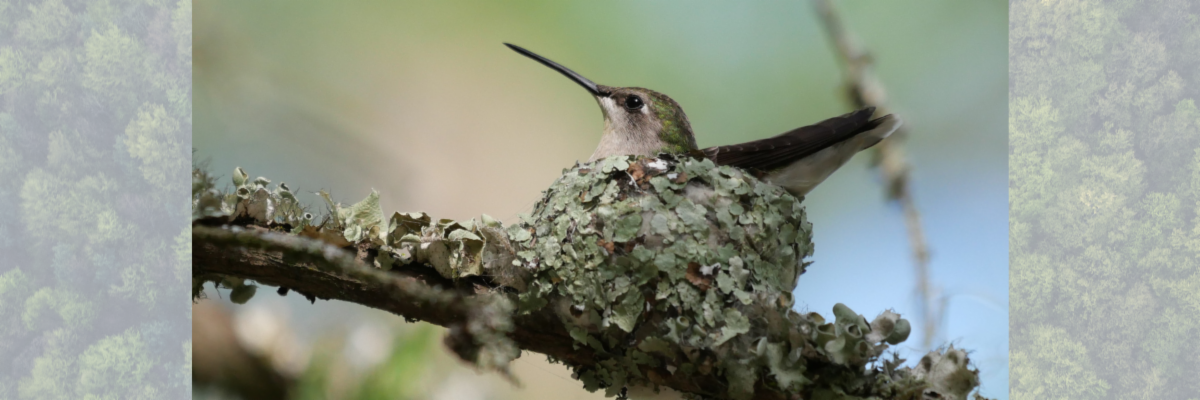
A beautiful lichen-covered hummingbird nest
Photo by Bethany Kays
| |
Garden tours provide a peek into beautiful landscapes and the personalities of the gardeners who created them. The Summit County Master Gardener 2025 Tour of Gardens did exactly that. As I toured each uniquely gorgeous, well-feathered nest, I caught a glimpse of other uniquely gorgeous nests tucked in the trees—ones built by birds.
Humans live in homes (usually built by someone else) that reflect our style, wealth, status. Birds build their own nests via instinct (they do improve with practice) and use them to lay eggs and raise young—not to make personal statements. Bird nests, however, contain clues about their owners just as human homes do.
Consider the bald eagle’s palatial nest (aerie). Bald eagles have big personalities and big wingspans (up to 8 feet), so lots of square footage makes sense. Their nests are HUGE—5-6 feet in diameter, 3 feet deep, weighing 1,000+ pounds, and are located at least 50 feet up, generally in mature trees with easy access from the air near their favorite fishing spots. (FYI, bald eagles are thriving in Ohio; over 1,000 of their birdy mansions have been recorded this year.)
Eagles mate for life, and the pair builds their nest together, a process that can take three months. First, they weave large sticks and branches to form a platform, then cover the interior with grasses, stalks and moss. The bole (nest cup) is lined with softer materials such as feathers for maximum cushion and insulation. Herbs or other strong-smelling greens are sometimes tucked inside, perhaps to deter insects. Eagles generally return to their nests each season, often remodeling to add space. The largest recorded eagle’s nest was 9.5 feet across and 20 feet deep!
Fun fact—the longest continually occupied bald eagle nest in the US was located in Vermilion, OH. (34 years!) Learn more HERE.
Big eagle, big nest; tiny hummingbird—tiny nest. The ruby-throated hummingbird builds a true “tiny house”— the size of a thimble. Real estate is all about location, and Mom likes limbs on the outer edges of deciduous trees about 10-20 feet in the air. (Dad has already moved on to the next chicky.) Mom prefers waterfront property, but nests are also found in random places like garden art and Christmas lights. Mom gathers bud scales, wrapping each one with spider webs to attach it to her nest. (She may use pine rosin as glue to secure the nest to a branch.) Additional building materials include silk from tent caterpillar nests and dandelion and thistle down. Mom lines the interior with plant down, stomps on the bottom to stiffen it, and covers the outside with lichen, more likely for camouflage than decoration. You think automated window shades are cool? A hummingbird nest stretches as the eggs and babies grow. Watch HERE. No wonder these teensy nests are referred to as Mother Nature’s crown jewels!
Baltimore orioles, on the other hand, build hanging nests that kinda look like socks. As always in real estate, location is key, and Mom prefers an upper branch of an American elm, maple or cottonwood tree inside Dad’s territory. She gathers strips of bark, grass, horsehair, yarn and fishing line (Dad may help with this), wraps them around branches, and pokes the strips in and out with her beak, eventually tangling them. She doesn’t deliberately tie knots, unlike the weaver bird who really does! Watch it HERE.
Mom uses fibers to create an inner bowl, then adds feathers and downy fibers to insulate and protect her eggs. (She may recycle materials from an old nest.) The finished home is 2 - 3 inches wide at the top, 3 - 4 inches wide at the bottom, and 3 - 4 inches deep. Building takes 7 – 15 days depending on weather. The nest hangs below the branch or is tied along an upright tree trunk, well-camouflaged in summer but easily visible in winter. See it HERE.
Of course, this is just a tiny sample of the nests in our neighborhoods. Humans build colonials, ranches, bungalows, etc.; birds build cup, cavity, platform, pendant and ground nests—each home suited to its builder. Feathered or not, our nest is best.
C Christian
| | |
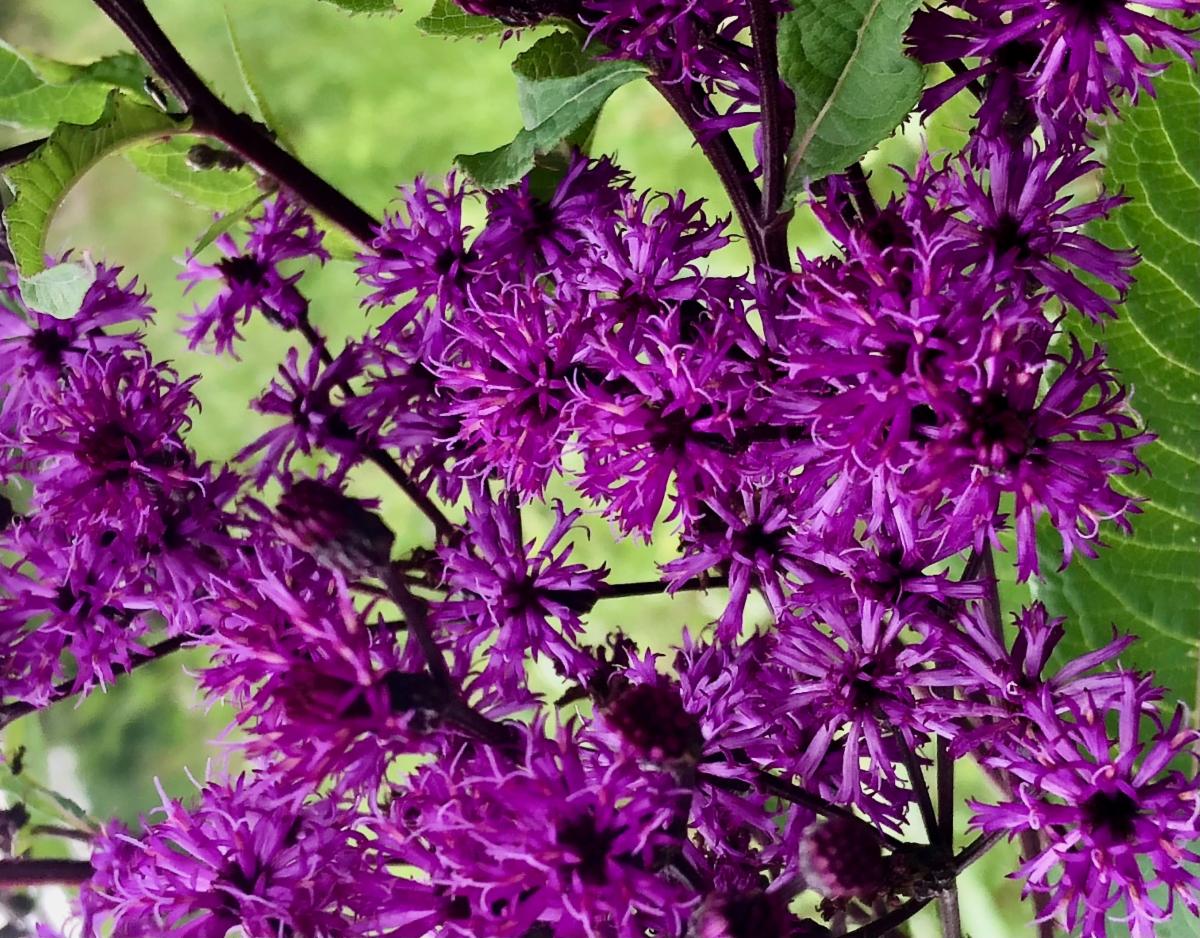
Vernonia gigantea
photo by E Barth-Elias
| | |
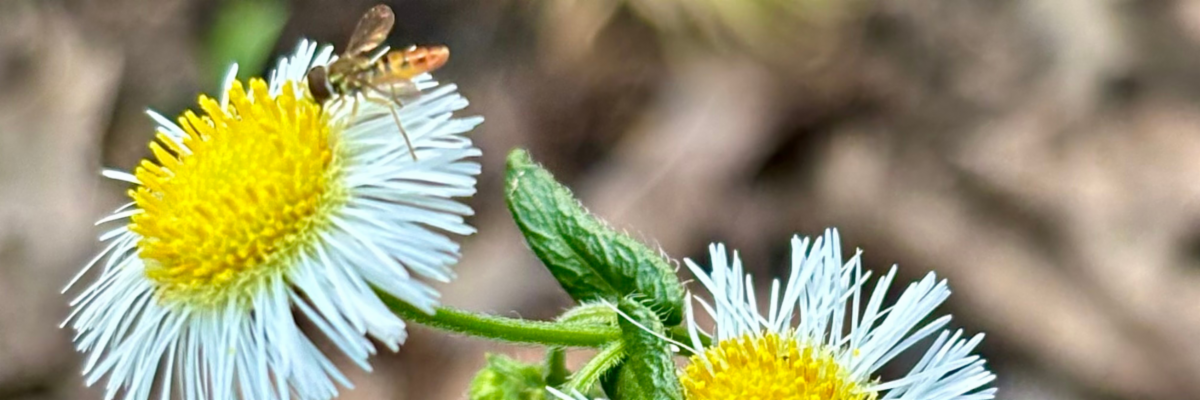
A close look at this syrphid fly on an Erigeron philadlephicus (fleabane) flower filled the author with awe.
Photo by S Vradenburg
| | |
Mark Twain once wrote that, while training as a riverboat pilot on the Mississippi River gave him invaluable skills, it also robbed him of the poetic vision of his beloved river. One might say knowledge killed awe.
So, it is with so much in nature. Once we know the mechanics of photosynthesis, it is difficult to view a green leaf as a miracle. Instead, we learn that the green is the chemical chlorophyll’s reaction to light. Once we know that a pearl is an oyster’s response to a foreign body, that pearlescent orb loses a bit of its mystery.
Ironically, just as science is replacing our sense of the miraculous with bare facts, it is now demonstrating that awe is essential to our sense of well-being.
It has been shown that a feeling of amazement short-circuits our inner critic. That, in turn, relieves the stress brought on by such self-criticism. We live in stressful times; it’s important that we quiet that negative inner dialog. Relief from stress benefits our cardiovascular system by reducing the amount of cortisol in our bloodstream, a stress-related hormone that raises the heart rate and constricts blood vessels. Awe is good for our hearts.
Try as we might, it is almost impossible to separate awe from nature—those evolutionary ties aren’t easily broken. Asian cultures, particularly Japanese and Koreans, practice forest bathing, often prescribed by physicians. There is not only the physical relaxation produced in the presence of trees, but trees release chemicals that boost the immune system. Research in Japan has found that being in a forest produces a 50 percent reduction in cancer-enhancing proteins in the bloodstream.
Research by the University of California at Berkeley with Army veterans and at-risk youth, both groups that experience PTSD, found that time in nature, specifically white-water rafting, evoked a sense of awe that had positive, long-lasting results. Their PTSD symptoms lessened and never returned to their pre-rafting levels. No other positive emotion – joy, contentment, amusement and others – was able to evoke the same, long-lasting sense of well-being.
Awe is, in essence, a spiritual experience. This is not referring to religion but to the sense that we are tied to something larger. Awe forces us out of our heads. By slowing down and really looking at a flower, we begin to see the way a petal curves from the center, the yellow pollen carried in bags on tiny bees’ legs, the smallness of the insect. When we step away from the busyness of life, and focus on the wonder of nature, we get in touch with what is truly important. Just what the doctor ordered.
THE SCIENCE OF AWE: Greater Good Science Center
AWE AND HUMILITY: National Library of Medicine
THE NEUROLOGY AND HEALTH BENEFITS OF EXPERIENCING AWE AND WONDER: Nuvance Healthline
S Vradenburg
| |
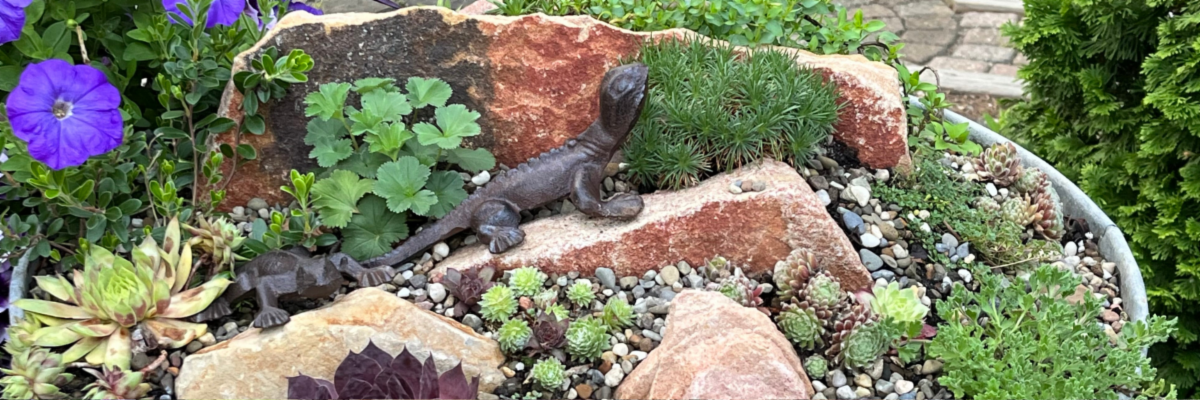
Like bell-bottom pants or fancy fondue, garden trends come and go. Some have staying power—they become the classics. Crevice gardens are all the buzz these days. They recreate alpine conditions in which vertical, narrow rocks or boulders laid parallel to each other protrude from the soil, with a lean, gritty planting medium in between. The plants growing in the crevices send long, healthy roots down to the soil beneath the rocks. Plants that love good drainage thrive in these conditions, creating interesting and picturesque gardens. I suspect crevice gardens are here to stay.
If you lack space, or prefer small-scale gardening, you can make a crevice garden in a container. A largish container works best, but a smaller version can be created using small, thin rocks. Here’s the container crevice garden how-to:
INGREDIENTS:
-
Largish container Stone or faux stone troughs work very well and are appropriate for this mountainside vignette, but any container will do. I used a 24” galvanized wash tub. The container MUST have drainage holes. If there aren’t any, make some.
-
Gritty potting medium This can be made by combining builder’s sand, good garden soil, and aggregate (pea gravel, chicken grit, etc) or perlite (if you want to make the container lighter) in a 7/1/2 ratio. The mix should be on the lean side (low in organic matter and nutrients).
-
Thin pieces of rock The rocks should be similar in type and color, as they would be in nature. They should graduate down in size.
-
Alpine or xeric plants Size matters here. Choose plants that are dwarf and low growing, and have the same water and sunlight requirements. Make sure to include an assortment of textures and leaf colors.*
-
Pea gravel, turkey grit, or other small aggregate Any small stone product can be used to top dress the container.
STEPS TO SUCCESS:
- Place your container where it will remain, as these gardens are very heavy and can be difficult to move.
- Put a layer of your planting medium at the bottom of the container.
- Arrange your rocks so that they are well above the sides of the container with the tallest in the center. Keep in mind that they should look like they occurred naturally over time from a large rock that split vertically.
- Place potting medium in the crevices between the rocks, forming channels of soil, and filling the top of the rocks. The result should have good vertical appeal, looking like a rock-embedded mound.
- Think through the arrangement of your plants, placing larger plants near the container rim level and accounting for color combination and spread.
- Use a bucket of water to root-wash each plant before planting, removing most of the potting medium.
- Use a table knife or other narrow tool to create a pocket in the planting medium in which to plant each plant, allowing the roots to extend down into the crevice. Fill in with planting medium and tamp in place.
- Cover the soil surface with a layer of aggregate.
- Place additional scree, rocks, or doo-dads as accents. (I used iron salamanders.)
- Water thoroughly and afterwards when rains don’t saturate the soil weekly or temperatures are high.
- Prune if needed to keep plants in scale and your beautiful rocks visible.
There you have it—the illusion of a beautiful mountaintop outcropping.
* There are many alpine and dwarf xeric plants to choose from, but some are only available from online vendors. Here’s a list of plants I used in my container: Achillea ‘King Edward (yarrow), Veronica ‘Tidal Pool’, Saponaria x oliviana (soapwort), Origanum ‘Bristol Cross’ (oregano), Alchemilla erythropoda (lady’s mantle), Arctostapylos uva-ursa ‘Little Leaf Massachusetts’, Armeria ‘Victor Reiter’ (thrift), Sempervivums (hens and chicks), and Sedum album var. chiorotium ‘Baby Tears’. Feel free to use repeats of fewer plants for a more natural appearance.
DEEPER IN THE GARDEN: THE CREVICE GARDEN: JC Raulston Arboretum
K Edgington
| | |
August Checklist:
- Rejuvenate tired annuals by deadheading and fertilizing. REVIVE ANNUAL FLOWERS: Purdue University
- Reseed turf by mid September so it has time to establish before cold weather. INTRODUCING THE TURFGRASS ESTABLISHMENT SERIES: OSU CFAES
- Water the garden if there has not been an inch of rain in the previous week.
- Fertilize roses for the last time.
- Keep weeding before plants go to seed.
- Clean up and deadhead perennials to prolong bloom time, leaving occasional seed heads as food or habitat for pollinators.
- Maximize your garden’s bounty by freezing or canning fruits and vegetables and drying herbs.
- Sow leftover lettuce, radish, kale, turnips and carrot seeds for a fall harvest.
J Gramlich
| | |
More learning opportunities:
| | |
I like gardening—it's a place where I find myself when I need to lose myself.
Alice Sebold
| | We invite you to share The Root of It with your friends and family. If you would like to subscribe to our mailing list please visit our website, scroll to the bottom, and follow the link under Join our email list. | | The Root of It staff: Karen Edgington (Editor), Emma Barth-Elias (Photo Editor), Carolyn Christian, Jennifer Gramlich, Sarah Vradenburg, and Geoff Kennedy (Technical Advisor) | |
We Would Like your Feedback
Contact us at: newsletterscmg@gmail.com
To discontinue receiving this newsletter please click on the UPDATE YOUR PROFILE link below. You may then choose what types of information you would like to receive from us.
| | | | |