Nonprofit Policy Update of the North Carolina Center for Nonprofits

September 12, 2025

In this week's issue... 

This week’s policy update shares the Center’s public comments on the proposed federal rule that could limit eligibility for the Public Service Loan Forgiveness program (and reminds other nonprofits that there is still time to submit your own public comments). We highlight a demand letter that state legislative staff sent to a nonprofit with significant state funding, and forthcoming (and significant) increases in costs for ACA Marketplace health plans in 2026. In follow up on one of last week's items, we share good news that the Combined Federal Campaign has been restarted.

Center Submits Public Comments on Proposed Rule on PSLF Eligibility


This morning, the Center submitted public comments on the U.S. Department of Education's proposed rule on eligibility for the Public Service Loan Forgiveness Program (PSLF). Under PSLF, student loan borrowers who work in public service jobs – including positions with 501(c)(3) nonprofits – for 10 years while paying off their student loans are eligible to have the remainder of their federal student loans forgiven. PSLF has enabled many young professionals to afford careers in the nonprofit sector. The proposed new rule would exclude employers – potentially including some 501(c)(3) nonprofits – from being eligible employers for PSLF if they are engaged in “substantial illegal purposes.” 


The Center’s public comments highlight the importance of PSLF to North Carolina nonprofits, their employees, and their communities. Our public comments explain why the proposed rule is inconsistent with the statute authorizing PSLF, which provides that all 501(c)(3) nonprofits are eligible employers, and why the proposed rule approach to identifying “substantial illegal purposes” of nonprofits is overbroad. The Center’s public comments provide 10 suggestions for ways the Department of Education can improve the proposal when it develops its final rule later this year.


Nonprofits and other interested groups or individuals can submit public comments on the proposed rule through Wednesday, September 17. The Department of Education will then review the public comments and potentially make changes based on submitted comments. The Center’s experience is that public comments are most helpful if they: (a) share real-world experience and/or data; and (b) provide specific, constructive feedback on potential changes to the proposed rule. The National Council of Nonprofits has a helpful comment guide for nonprofits and nonprofit employees interested in submitting public comments.

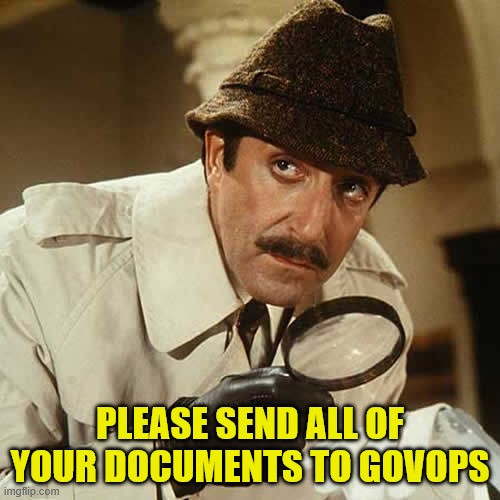
The character Inspector Clouseau from the Pink Panther TV series holding a magnifying glass and giving side eye. Meme text reads 'Please send all of your documents to GovOps.'

GovOps Demands that NC Innovation Provide Significant Reporting on Operations and Finances


On Tuesday, staff from the NC General Assembly’s Joint Legislative Oversight Committee on Governmental Operations (GovOps) sent a demand letter to NC Innovation requiring the nonprofit to submit a wide range of reports and documents by next Monday at noon. NC Innovation received a $500 million appropriation in the FY2023-25 state budget, and this funding was accompanied by a wide range of reporting and governance requirements.


The demand letter is one of the first public examples of GovOps demanding information from a nonprofit receiving state funding. A provision in the 2023-25 state budget gave GovOps broad authority to investigate any nonprofit receiving state funding and to have access to these organizations’ records and facilities. The GovOps demand letter to NC Innovation may be justified because of the unprecedentedly large appropriation that the organization received and because of the reporting and governance requirements that legislators included with that appropriation. However, it is important for nonprofits with state grant funds or appropriations to be aware that GovOps has the authority to issue similar demand letters to their organizations, particularly if they engage in activities that draw negative attention from lawmakers.

ACA Marketplace Health Plan Costs Set to Increase in 2026


Since 2021, many individuals and families in North Carolina have received enhanced premium tax credits on their Affordable Care Act (ACA) Marketplace health plans. Because Congress has not extended these enhanced tax credits, they will end after this year. This means that the cost of ACA Marketplace health coverage will increase significantly for many North Carolinians in 2026, including for many people who are clients of nonprofits and employees of nonprofits that do not offer employer-provided health coverage. With open enrollment for ACA Marketplace plans starting on November 1, BlueCross BlueShield of North Carolina has a helpful blog post and one-page fact sheet explaining what these changes will mean for North Carolinians.

Dramatic ceiling stage lights in a black space and shining bright white light on fancy text 'Coming Soon.' Meme text reads 'Federal Government Shutdown[question mark]'.

Federal Government Shutdown Looming in Less Than Three Weeks


Congress has until the end of the month to pass appropriations legislation for the new federal fiscal year (which begins on October 1) or to approve a short-term continuing resolution to avoid a partial shutdown of the federal government. Either measure would require bipartisan support in the U.S. Senate, where 60 votes are needed to consider most legislation. 


Health care policy issues could create complications for the appropriations process. This week, congressional Democratic leaders signaled that they may not support appropriations legislation that does not offset some of the significant cuts to Medicaid in the One Big Beautiful Bill Act and extend the ACA Marketplace premium tax credits beyond this year (see the previous item for more details).

DOPM Restarted Combined Federal Campaign


This week, the U.S. Office of Personnel Management (OPM) re-opened the Combined Federal Campaign, the workplace giving program that enables federal workers to donate to nonprofits through payroll deductions. Last week, OPM had directed federal agencies to pause the CFC with the possibility of ending it altogether. OPM’s change of direction comes after the National Council of Nonprofits and United Way Worldwide sent a letter to OPM urging the agency to not eliminate the program and instead work with stakeholders to build on the program’s legacy of success.


In 2023, federal employees gave more than $1 million to nonprofits in the Carolinas (out of more than $70 million in contributions nationwide) through the CFC. Nearly half of all CFC contributions go to Washington, DC area nonprofits, since that area has the greatest concentration of federal workers in the country.

Lack of State Budget Has Implications for Nonprofits


More than two months into the state’s fiscal year, the NC Senate and the NC House of Representatives remain at an impasse on details of the state budget for FY2025-27. North Carolina law allows state government operations to continue at their current funding levels if legislators and the Governor are unable to agree on a new state budget, so a state budget is not technically a "must pass" bill since the state government will not shut down without it. However, the lack of a budget has a variety of consequences for state government operations, for nonprofits, and for North Carolinians. The NC Budget and Tax Center has a helpful analysis of the implications of not having a full state budget in place, including the ways it affects health care, child care, disaster recovery, and public education. 


The NC General Assembly is scheduled to return to Raleigh later this month for a three-day mini-session on September 22-25. It is possible that legislators could pass a full budget during that mini-session.

Your 2025 Local Elections Toolkit Is Live


Now more than ever, voters need fact-based information from trusted messengers to make their vote count. When you sign up as a You Can Vote Voting Rights Champion, you get access to the 2025 local elections toolkit with emails, posts, and graphics to share and empower your community. You also receive updates when the law changes or there is new information to distribute. Sign up today and spread the word!

North Carolina Center for Nonprofits
Facebook  LinkedIn

Nonprofit Policy Update is the weekly newsletter of state and federal policy issues that affect 501(c)(3) nonprofits from the North Carolina Center for Nonprofits. Learn about the Center's public policy agenda or contact David Heinen, Vice President for Public Policy and Advocacy, for more information.


Current Center Member? Access your benefits or create your account.

Not a Center Member? Join now.

Not a 501(c)(3) org? Support or affiliate with the Center.

If a colleague forwarded this message to you, sign up for our emails.


©2025 North Carolina Center for Nonprofits