Below is a series of articles compiled over the previous week.
They are of interest to railroad workers.
_____________________________________________
|
|
2019-21 Article 1
Railroad Workers United Submits Comment to Pipelines & Hazardous Materials Safety Administration on LNG by Rail
|
|
2019-21 Article 2
PSR News
Congress Focuses on Rail Service Crisis
Shippers tell a committee the STB should take strong action to address the rail service crisis.
Freight rail service problems are worse than previously believed and more widespread, and the Surface Transportation Board (STB) needs support from Congress to take strong actions to stem what is becoming a nationwide crisis, shippers recently informed a congressional committee.
On July 25, Rep. Dan Lipinski (D-IL), chairman of the House Subcommittee on Railroads, Pipelines and Hazardous Materials, convened what he termed “a shipper roundtable” instead of a formal hearing, where seven rail shipper executives offered insight into their experiences, but no witnesses from the railroads spoke.
Lipinski said the session was held because committee members had been hearing from shippers about the serious service problems they are enduring, including generally poor service reliability and quality along with the imposition of high rates and unfair demurrage fees and accessorial charges.
The service issue initially arose on the CSX rail system in 2017 when Wall Street hedge fund managers maneuvered to install as CEO Hunter Harrison. He then imposed an operations model called Precision Scheduled Railroading (PSR) on the railroad before his death at the end of that year.
Under the PSR model, CSX strove to slash costs by laying off thousands of employees, closing freight yards and mothballing equipment. The goal was to shrink the railroad’s operating ratio, which caused investors to boost the CSX stock price. Shippers say this was accomplished by pushing those costs onto them and, ultimately, onto consumers.
Read more ...
|
|
2019-21 Article 3
Overwhelming majority ratifies new contract with SEPTA
(Editor's Note: While the pay raises are not exceptional, it is easy to see why this contract was overwhelmingly ratified. Language regarding additional pay for operating with PTC, additional leave time, and other creative ideas are popular)
INDEPENDENCE, Ohio, August 9 — By an overwhelming majority of more than 96 percent, members of the Brotherhood of Locomotive Engineers and Trainmen (BLET) ratified a new contract with SEPTA on July 30.
The four-year contract covers approximately 200 locomotive engineers and runs through March 2, 2022. It governs rates of pay, work rules, and health care benefits. BLET members received a 2.0% general wage increase on the Sunday following ratification, with subsequent wage increases of 2.0% effective July 5, 2020, 3.0% effective July 4, 2021, and 3.5% effective July 3, 2022. It provides additional hourly compensation for operating with Positive Train Control (PTC).
The agreement provides that locomotive engineers who are victims of an assault or other criminal behavior during the performance of their assigned duties will be compensated for time spent in pursuit of criminal legal action against the perpetrator. The contract also clarifies that members who work on Christmas Day will receive compensation based on a minimum of eight hours of pay at the rate of time and one-half. The agreement also increases the opportunity for additional paid time off with good attendance every six months.
Read More ...
|
|
2019-21 Article 4
BNSF posts higher Q2 income, lower operating ratio
BNSF Railway Co.
reported second-quarter 2019 revenue rose 0.3 percent to $5.89 billion, while operating income jumped 7 percent to $2 billion compared with the same period last year, the Class I announced yesterday. Revenue and operating income increases were attributed in part to higher revenue per car/unit.
The railroad posted the increases despite a 4 percent decrease in unit volume for the quarter due to severe winter weather and flooding conditions on parts of its network, according to a
financial statement
posted on BNSF's website.
Operating expenses for the quarter fell 3 percent to $3.89 billion, while net income climbed 2 percent to $1.34 billion. BNSF posted a Q2 operating ratio of 64.8 percent, compared to 66.8 percent a year ago.
Read more ...
|
|
2019-21 Article 5
U.S. rail traffic fell for sixth straight month in July
U.S. railroads originated 1,264,100 carloads last month, down 4.8 percent, and 1,314,333 intermodal containers and trailers, down 6.1 percent year over year. Combined, the railroads originated 2,578,433 carloads and intermodal units, a 5.5 percent decline compared to July 2018 levels.
Six of the 20 carload commodity categories that AAR tracks every month posted gains in July. They included petroleum and petroleum products, up 6,465 carloads or 11.5 percent; all other carloads, up 2,866 carloads or 9.9 percent; and metallic ores, up 2,456 carloads or 7.7 percent.
Commodities that logged decreases last month included coal, down 43,954 carloads or 10.3 percent; crushed stone, sand and gravel, down 6,350 carloads or 5.1 percent; and primary metal products, down 4,884 carloads or 9.9 percent.
Read more ...
|
|
2019-21 Article 6
Union Pacific Corporation Gives Shareholders a Big Pay Raise
Union Pacific Corporation Hikes Dividend 10%. Are More Coming?
Wall Street has fretted this summer over trade tensions, a looming business slowdown, and a possible war with Iran. But Union Pacific Corporation (NYSE:UNP), it appears, may have missed the memo.
Admittedly, President Donald Trump’s trade war has bitten into sales. Union Pacific’s revenues dropped one percent to $5.6 billion in the second quarter on lower shipment volumes. But despite these headwinds, executives continue to find ways to boost the bottom line. (Source: “
Union Pacific Reports Record Second Quarter Results
,” Union Pacific Corporation, July 18, 2019.) Read
more ...
|
|
2019-21 Article 7
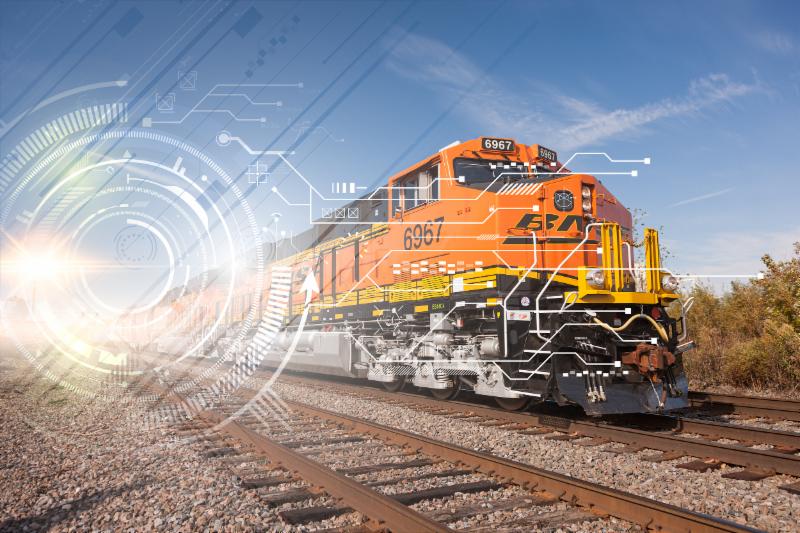
BNSF LEADS THE CHARGE ON TESTING BATTERY-ELECTRIC LOCOMOTIVE
BNSF and project partners are developing and will soon begin testing a battery-electric high-horsepower road locomotive (the type that moves freight trains from Point A to Point B). BNSF and other railroads have tested low-horsepower battery-electric locomotives in rail yards for years, but mainly for switching freight cars.
“What’s different about today’s batteries is that they are significantly more powerful than before, and manufacturers have improved battery quality, reliability and technology so we’re able to test their power for our road locomotives,” said BNSF’s Michael Cleveland, senior manager, Emerging Technologies.
In 2018, BNSF and Wabtec (formerly GE Transportation) joined forces to begin developing a 100-percent battery-electric road locomotive prototype that works with conventional diesel locomotives to make a battery-electric hybrid consist. (Consist refers to when two or more locomotives are coupled together.) Performance testing of the hybrid is expected to begin in late 2020.
Read more ...
|
|
2019-21 Article 8
What Happened to Stop, Look and Listen?
The news on July 26, 2019 of the derailment at speed of Amtrak 393 at University Park, Ill., due to a careless truck driver created a PTSD-like reaction for me. Instantaneously, I thought back to the derailment of Amtrak 59 at Bourbonnais, Ill., the night of March 15, 1999. Despite denials, this wreck was due to the overt negligence of a driver attempting to beat fully functional grade crossing warning devices with a truck loaded with 22 tons of steel pipe. Regrettably, the driver’s reckless behavior resulted in 11 people killed; much equipment was destroyed in the ensuing fire.
From my perspective, nothing has changed since that horrible March night more than 20 years ago. Amtrak’s self-insurance continues to fund, where feasible, equipment repairs and liabilities to passengers; the cost of business interruption of the train involved and possible cancellation of other trains due to damaged infrastructure; and costs for replacement bus transportation, hotels, meals for its displaced passengers. As well, the freight railroad (usually a Class I) on whose infrastructure Amtrak is a tenant also pays to repair its infrastructure and in certain cases, passenger liabilities.
With respect to the plethora of trucks violating grade crossings and the general apathy of the mainstream media, which continues to incorrectly report how “a train hit a truck,” as if the train jumped the tracks, it is high time for the railroad industry to take on this issue, as the timeliness could not be better, given how Congress is now marking up surface transportation bills and reviewing budgets.
Read more ...
|
|
2019-21 Article 9
The Fight for a Green New Deal Can Start With Your Union Contract
News coverage of the Green New Deal portrays organized labor as a major obstacle to its enactment. But our
new report
for Data for Progress paints a different picture. In a poll conducted for the think tank by YouGov Blue, union members overwhelmingly favored the proposed reforms, with 62 percent in support and 22 percent against. In a memo for Data Progress, where I am a legal fellow, I show how union contracts
can be an effective way to fight for a Green New Deal.
In step with the rank-and-file, some union leaders have already backed the ambitious plan. In a
resolution
adopted in June by its executive board, the Service Employees International Union called the Green New Deal “an unprecedented opportunity to unite the fights for environmental, racial and economic justice.” Los Angeles County Federation of Labor secretary-treasurer Rusty Hicks
said
in March the “framework is vital to fighting” inequality and climate change. Association of Flight Attendants president Sara Nelson
explained
in April that it is “not the solutions to climate change that kills jobs,” but climate change itself. To be sure,
a handful of union leaders
, such as United Mine Workers of America president Cecil Roberts and International Brotherhood of Electrical Workers president Lonnie Stephenson, have come out against the proposal. Yet even Roberts
has said
that he and Green New Deal supporters “agree on 75 percent.”
Even as union support for the measure continues to grow, the current political stalemate in Washington means that passage of the Green New Deal is unlikely in the near future. But labor leaders have an immediate way to translate member support for the Green New Deal into tangible wins: bargaining green union contracts.
Read more ...
|
|
Railroad Workers United
Solidarity -- Unity -- Democracy
|
|
|
|
|
|
|