|
American College of Vedic Astrology
The ACVA Newsletter 2025-04 (April 2025)
|
| |
Note from the President of ACVA
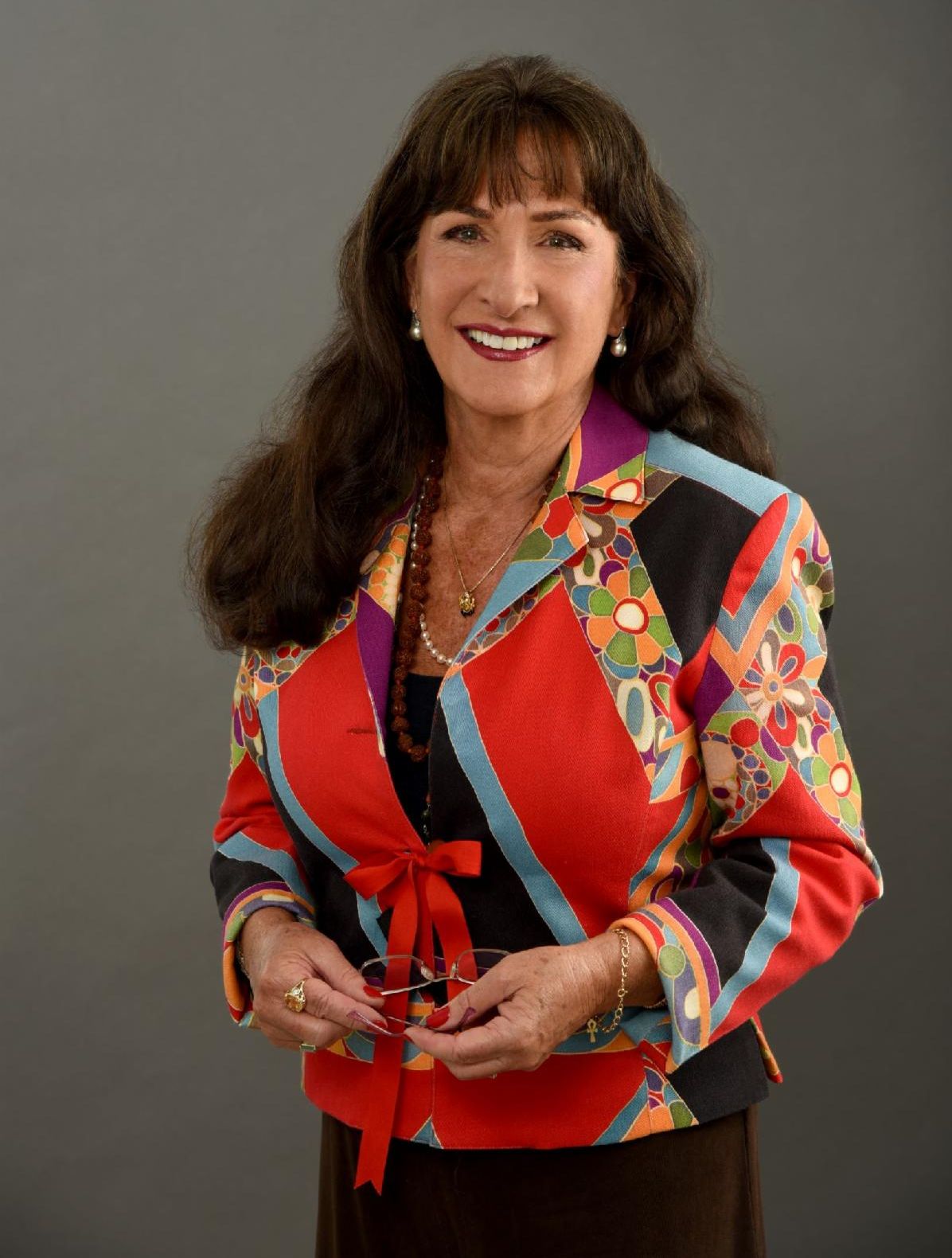
By Professor Charlotte Benson (Jyoti Devi) President, ACVA
April 2025
Dear Friends of ACVA,
On behalf of our Faculty, I extend to you all warm greetings in this season of multiple religious celebrations, and hope that all is well in your corner or the country or world. Although we now seem to be experiencing that ancient Chinese blessing – May you live in interesting times – we hope that this too will pass.
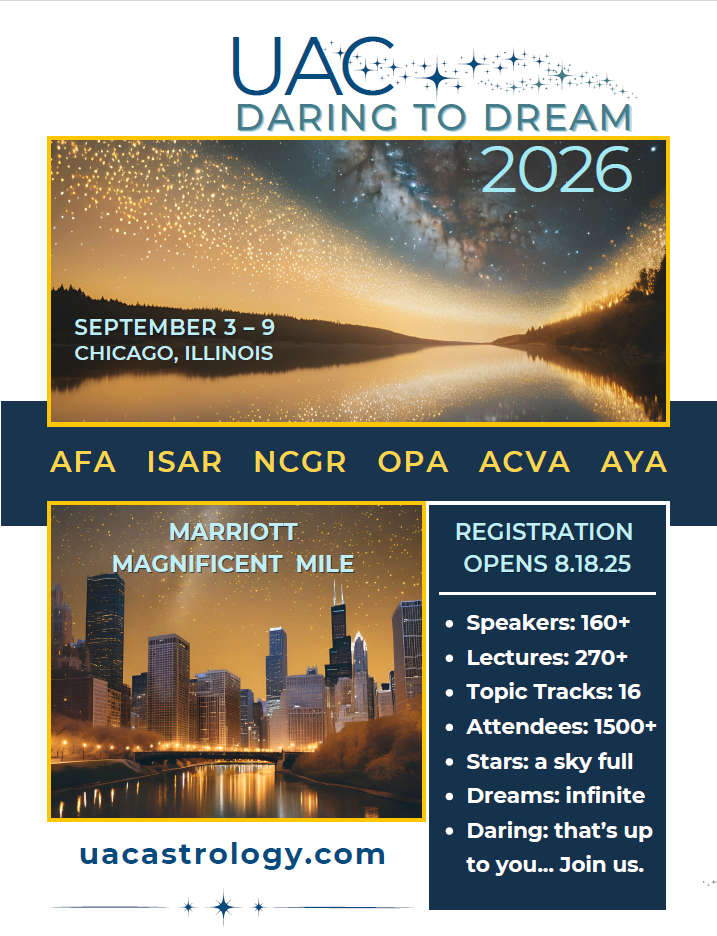
As you know from previous announcements, that great kumbh mela of western astrology – the United Astrology Conference – will be gathering in Chicago in September 2026. Thanks to liaison and negotiations by our Editor-in-Chief, Alan Annand, we’ve now finalized ACVA’s participation in this major conference. As an organization, we’re both pleased and proud to say that our veteran speakers have shown a remarkable degree of altruism in surrendering one of their two lecture slots to be used for another veteran who otherwise wouldn’t have made the cut, or a new speaker who deserved an opportunity to speak at a major conference.
Consequently, we have the following experienced astrologers on the UAC2026 roster: Charlotte Benson, Lynn Bootes, Freedom Cole, Ronnie Gale Dreyer, Sam Geppi, Dennis Harness, Kenneth Miller, Joni Patry, Barry Rosen, Sonal Sachdeva, and Komilla Sutton. Our new speakers are Simon Chokoisky, Gizem Heukelom, Nathan (Theo) Naicker, and Shreekala Ram.
This final roster includes eight (8) women and seven (7) men, of which a quarter (26%) are new speakers, an unprecedented achievement which rightfully acknowledges and welcomes new voices to the podium. Included among our speakers, both new and old, are candidates that will also boost international representation of ACVA at UAC 2026: Sonal Sachdeva (UK), Nathan Naicker (South Africa), and Gizem Heukelom (Turkish national, resident of Netherlands).
Click here for more ...
| |
Professor Charlotte Benson (Jyoti Devi)
President, American College of Vedic Astrology
| | |
Akshaya Tritiya
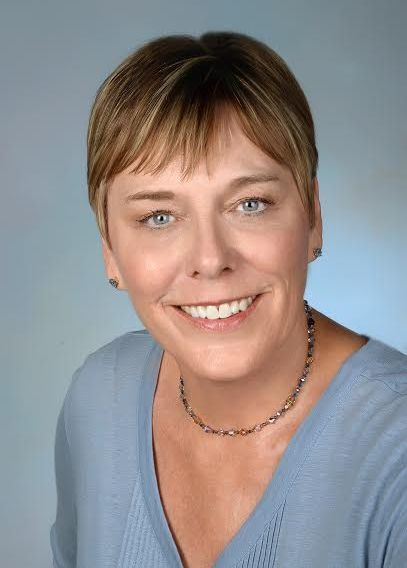
By Professor Juliana Swanson
ACVA Provost and Dean of Academics
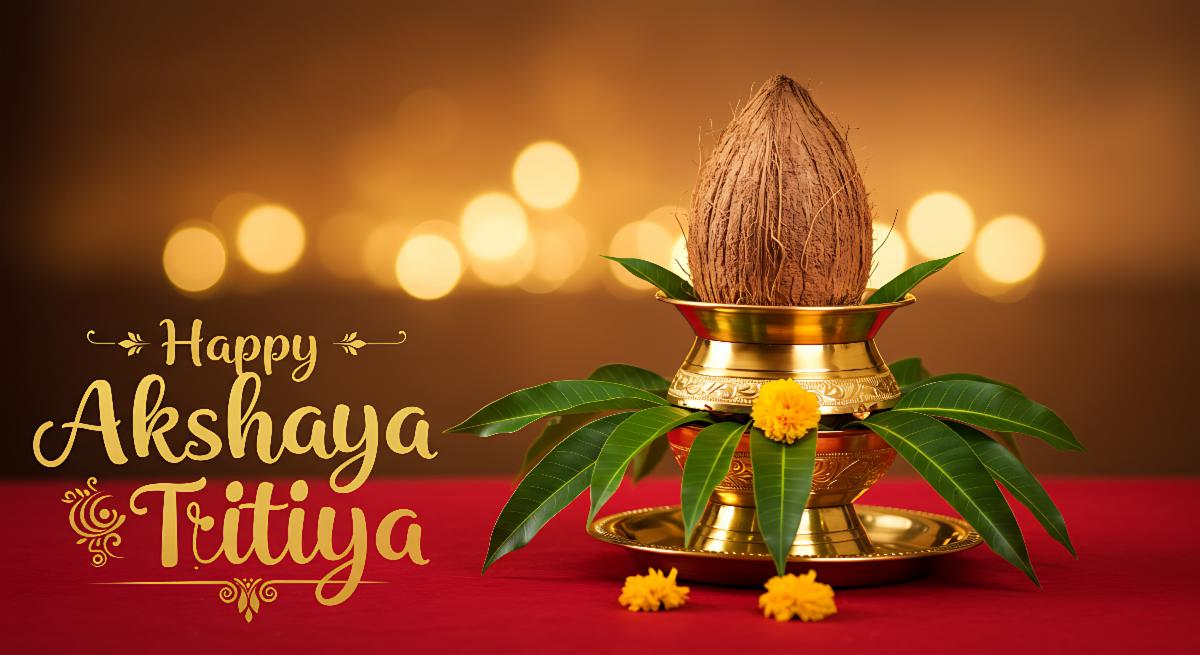
The very auspicious Vedic holy day known as Akshaya Tritiya will occur this year on April 29 in North and South America, and April 30 everywhere else in the world. According to Vedic tradition, a few days of every year are highly auspicious. These are known as abhuj muhurta (or muhurat). On these special days, any “seeds” that we plant have the potential to be especially fruitful.
| | Akshaya Tritiya (or Akha Teej or Akhi) is one of these rare abhuj muhurtas. It is a springtime celebration in the Vedic tradition known as the Day of Eternal Golden Success. It is believed to be a special day of abundance, peace, and harmony. Whatever we set into motion on this day will be indestructible, and metaphorically, will “turn to gold." It is also traditionally thought that gold coins, jewelry, and other valuables should be procured at this time to attract good fortune. | | |
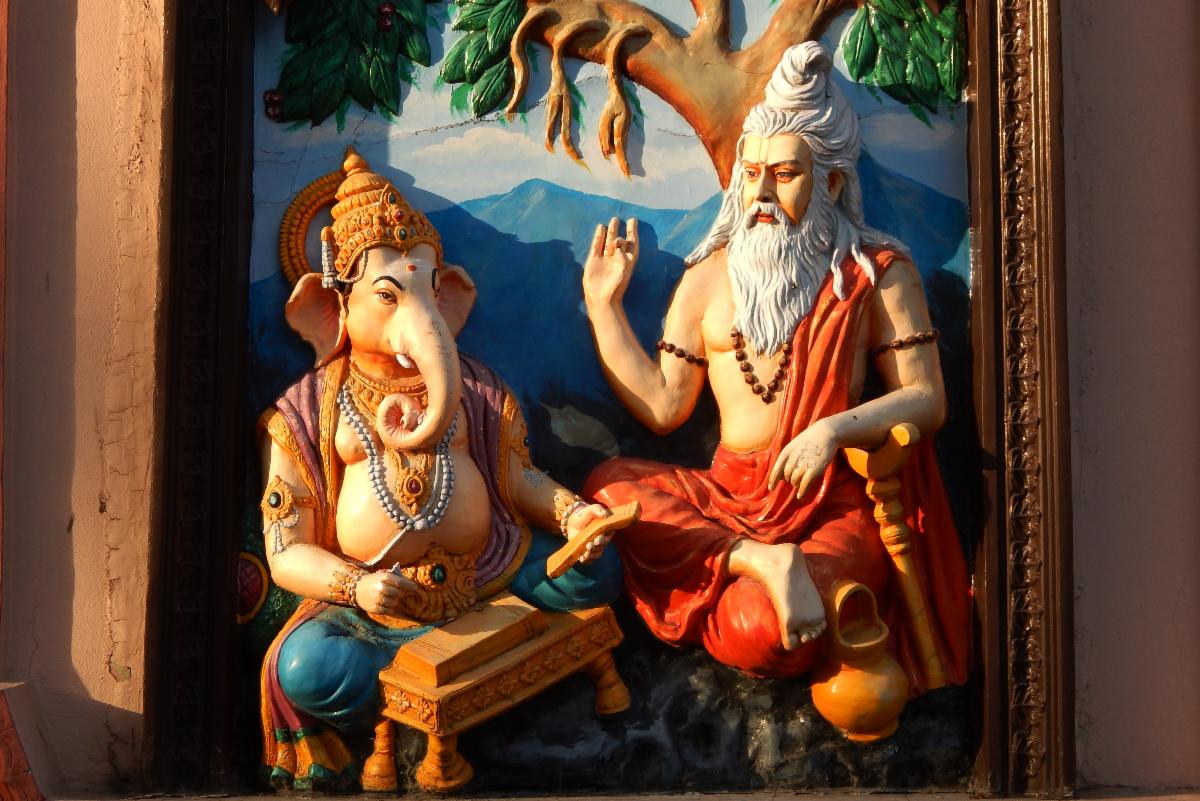
Akshaya Tritiya commemorates the time when Veda Vyas and Lord Ganesha began to write the Mahabharata, the Sanskrit epic of ancient India. The Lights of our solar system, the Sun and Moon, also known as the King and Queen of the Planetary Kingdom, are both especially "bright" (exalted or uccha) on this day. At the same time, the waxing Moon will transit in its prosperous, nourishing, and lucky third day known as tritiya tithi. It is believed that worshiping Goddess Lakshmi and Lord Vishnu on Akshaya Tritiya can act as a reset and new beginning that will bring positive energy into our lives.
Click here for more ...
| | |
The Observatory
By Dr. Lynn Bootes, MD
ACVA Dean of Students and Registrar
registrar@acvaonline.org
Sun in Aries Edition – April 13 - May 14, 2025
Dear Readers,
We have just ended a rather exceptional planetary month. The last time that Mercury and Venus were both retrograde in Pisces at the same time was between March 25 - April 17, 1985! That was the month when Mikhail Gorbachev became the ruler of the USSR (Russia) and began to pull back in Afghanistan. The first internet domain name was registered. USA for Africa released the hit song We Are the World to raise money for famine relief. Pope John Paul II announced the first ever World Youth Day. There were several events involving Islamist terrorist bombings in Europe and the Middle East, right-wing domestic extremists in the United States.
Mercury retrogrades three times a year, but this current one was in Pisces, Mercury’s sign of debilitation, which seemed to make the usual communication problems and electrical glitches worse. Venus retrogrades five times in eight years, and being exalted in Pisces, its strength is greatly enhanced. US President Donald Trump has initiated a shakeup of world trade agreements which has triggered sudden repercussions in the world economic ecosystem. That’s the sort of economic challenge that retrograde Venus might bring. Hopefully the strong and positive traits of Venus will prevail.
Venus began direct motion on April 12. Mercury and Venus will continue together in Pisces until May 6, when Mercury moves into Aries. Venus graces us with its exalted position in Pisces until the end of May. Venus and Jupiter in Taurus continue to make that lovely Parivartana Yoga in which they occupy each other’s signs. These combinations make for many auspicious muhurtas this month.
Mars spends the entire month in Cancer, where it’s debilitated and creating relatively less aggression than in Gemini. There is a predominance of water signs between Mars in Cancer and the group of planets in Pisces – emotion, intuition, and compassion are enhanced over logic. Watch for water-related weather events.
Click here for more ...
| | |
Practical Pañcāṅga – Introduction
(Part 2)
By Pratik Mehta
| | |
In last month’s newsletter I introduced you to the five elements of the Pañcāṅga and gave you a taste of Vara and Tithi. There’s more to be said about those two elements which I’ll now cover as part of our deep dive into them.
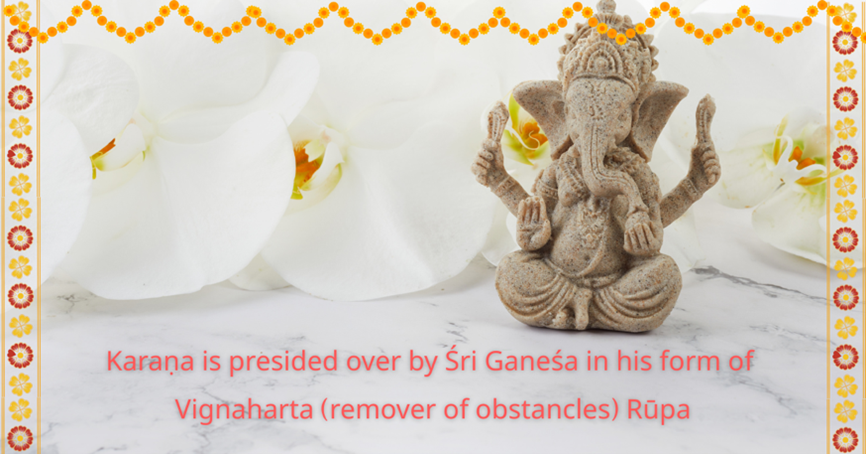
For the remaining three elements, I’ll take a slightly different approach. Reason being, Karana and Yoga are two of Pañcāṅga’s more obscure components, and there just isn’t a lot said about these Pañcāṅga elements in the classical Jyotiṣa texts, or at least the mainstream ones. As part of this introductory series, I’ll share here everything that I currently know about them, albeit one at a time.
The last part of Pañcāṅga, ie, Nakṣatras, is a whole different ball game. There’s lots of material out there on Nakṣatras and their qualities. Nonetheless, there are a few things to be said about Nakṣatras, especially around Pañcāṅga, that are not mainstream yet. I’ll cover them in the final segment of this series.
But for now, let’s dive into the current topic, Karaṇa.
| |
Karaṇa (करण)
Consensus in the world of Jyotiṣa is a rarity, although most Jyotiṣis would concur that Karana and Yoga (which we’ll cover next month) are probably two of the most mysterious parts of the Pañcāṅga.
Even though veiled in mystery, they’re no less significant than their better-known cousins (Vara, Tithi and Nakṣatra). It almost makes you wonder whether the Vedic seers kept these two Pañcāṅga gems hidden for a reason.
Nonetheless, here’s what’s known about Karana, to the best of my knowledge.
Definition and Meaning
To begin with, the meaning of the word is an enigma in itself. To me, the meanings that make most sense are “activity” or “action of dance” or “the initial enactment.” Here’s why.
Karana is simply half a Tithi. Quite literally, that’s the definition. Tithis are the first thing that come to mind when one thinks of Pañcāṅga and Muhurta. Muhurta can be posited as the auspicious moment for initiating the “action of dance”. Karaṇa, therefore, bodes well as the “initial enactment” in the “action of dance.” Please take a moment and let that sink in.
Moving on from the esoteric to the practical, if you recollect, a Tithi is defined as 12 degrees of the Moon’s movement relative to the Sun. A Karana therefore is defined as six degrees of the Moon’s movement relative to the Sun. Subsequently, since we have 30 Tithis, there are 60 Karaṇas.
Click here for more ...
| | |
Sudarshan Chakra Dasa
By Brendan Feeley, M.A. D.Ay.
Professional Vedic Astrologer
- SHRI GURAVE NAMAH -
In Brihat Parasara Hora Shastra the great Maharishi tells us the that the Sudarshan Chakra Dasa is a source of “great secrecy and superior importance” through which “the Devajnas will be able to predict the favorable and unfavorable results for every year, every month and every day from the time of birth to the time of death” of a person.
He goes on to tell us how to construct the chart and that effects of the dasa should be examined from the Lagna, Chandra Lagna and Surya Lagna. The Lagna represents the physical level of existence, the gross body, the sthūla śarīra, while the Moon represents the subtle body, the sūkṣma śarīra, and from the Sun we can see the influences arising from the causal body, the karana śarīra.
If the indication from all three are similar, either favorable or unfavorable, then the event is bound to happen. In the author’s experience, the event can generally be seen from the dasa sequence based on the Lagna, but it is advisable to follow the teachings of Parasara and examine all three reference points in the chart. If the event is promised from the Lagna and unsatisfactory from the Moon, then the native may not be entirely satisfied about the outcome on a mental/emotional level. If favorable from the Lagna and Chandra Lagna, but unfavorable from Surya Lagna, the person’s heart and soul may not be entirely committed to the matter at hand.
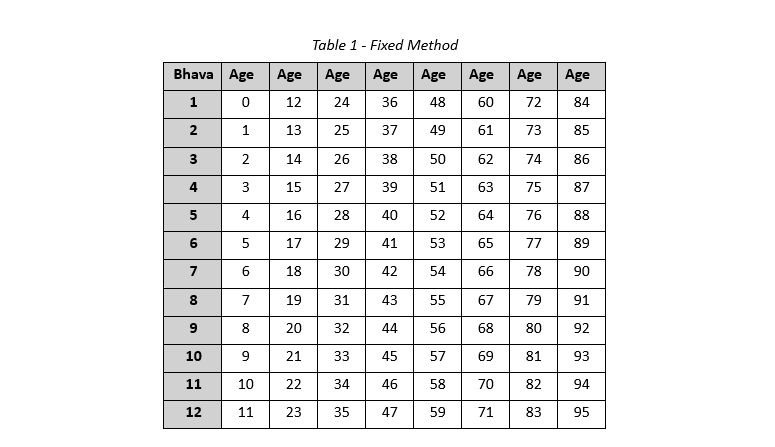
There are two methods used to progress this dasa. One is referred to as the Fixed Method and the other is referred to as the Movable Method. These terms were coined by Sarajit Poddar in his ‘Search for Jyotish’ series1. The author learned about Sudarshan Chakra Dasa from his Jyotish Guru, Sanjay Rath.
1. Fixed Method
In the Fixed Method, the dasa is progressed by one Rāśi for each year of life from the three reference points and the results are judged accordingly. In this case the dasa is repeated from the Lagna, Moon and Sun every 12 years and the dasa is of 1 year duration. The following Table shows the dasa calculation using the Fixed Method for the different years of life.
| | |
2. Movable Method
In the Movable Method, each sign is progressed for a period of 12 years duration beginning with the Rāśi for three reference points, the Lagna, Moon and Sun; each antaradasa is 1 year in length. The first antaradasa begins with the sign itself and is progressed zodiacally. The pratyantara dasa gives the results that the native can expect for the months of that year and its progression is from the current antaradasa. Th following Table shows the dasa using the Movable Method for the corresponding years of life.
Click here for more ...
| | |
Coming Attractions at ACVA
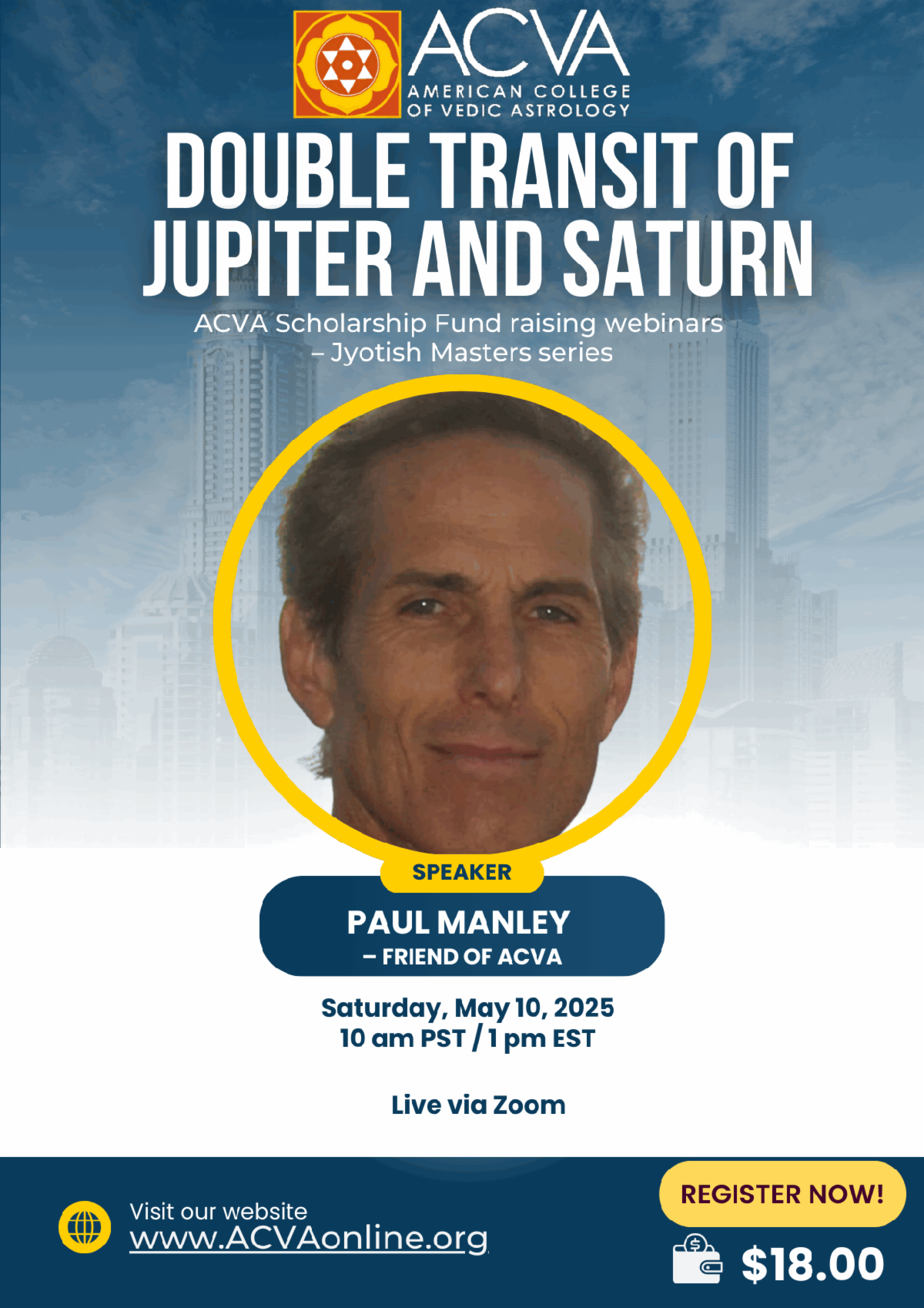
(1) ACVA webinar by Paul Manley
(ACVA Scholarship Fund raising webinars – Jyotish Insights series)
Saturday, 10 May 2025 @ 10 AM Pacific / 1 PM Eastern time / 11.00 AM Mountain time. 1.5 Hours.
Topic: Double Transit of Jupiter and Saturn
Jupiter and Saturn, as the slower-moving of the outer planets, are major “chronocrators” or time-lords within the scheme of transits. Classically, Jupiter is considered the “greater benefic” while Saturn is the “greater malefic.” Thus, within their 12- and 29.5-year cycles, respectively, they exercise benign and malign influence upon the various houses of the horoscope. But when their simultaneous transits are in play, it requires careful judgment to assess their likely effects, the analysis of which is the subject of this webinar.
| | |
Speaker: Paul Manley, Professional Vedic Astrologer
Paul Manley, M.A., has been a professional Vedic astrologer since 1992, blending over three decades of study and practice with a master’s degree in counseling psychology. His primary training in Jyotish comes from K.N. Rao, one of the world’s most respected astrologers. Paul has taught seminars in the U.S., Japan, and India, including at Bharatiya Vidya Bhavan, K.N. Rao’s renowned school. He is also a certified teacher and tutor with the American College of Vedic Astrology (ACVA) and has taught at ACVA conferences, offering his practical and methodical instruction.
For more information, visit his website: https://www.lightonvedicastrology.com/
Webinar Registration link:
https://us06web.zoom.us/webinar/register/WN_Jm0Lf79BSkW5WRRtlKrewg
| | |
(2) ACVA webinar by Sue Ann McKean
(ACVA Scholarship Fund raising webinars – Jyotish Insights series)
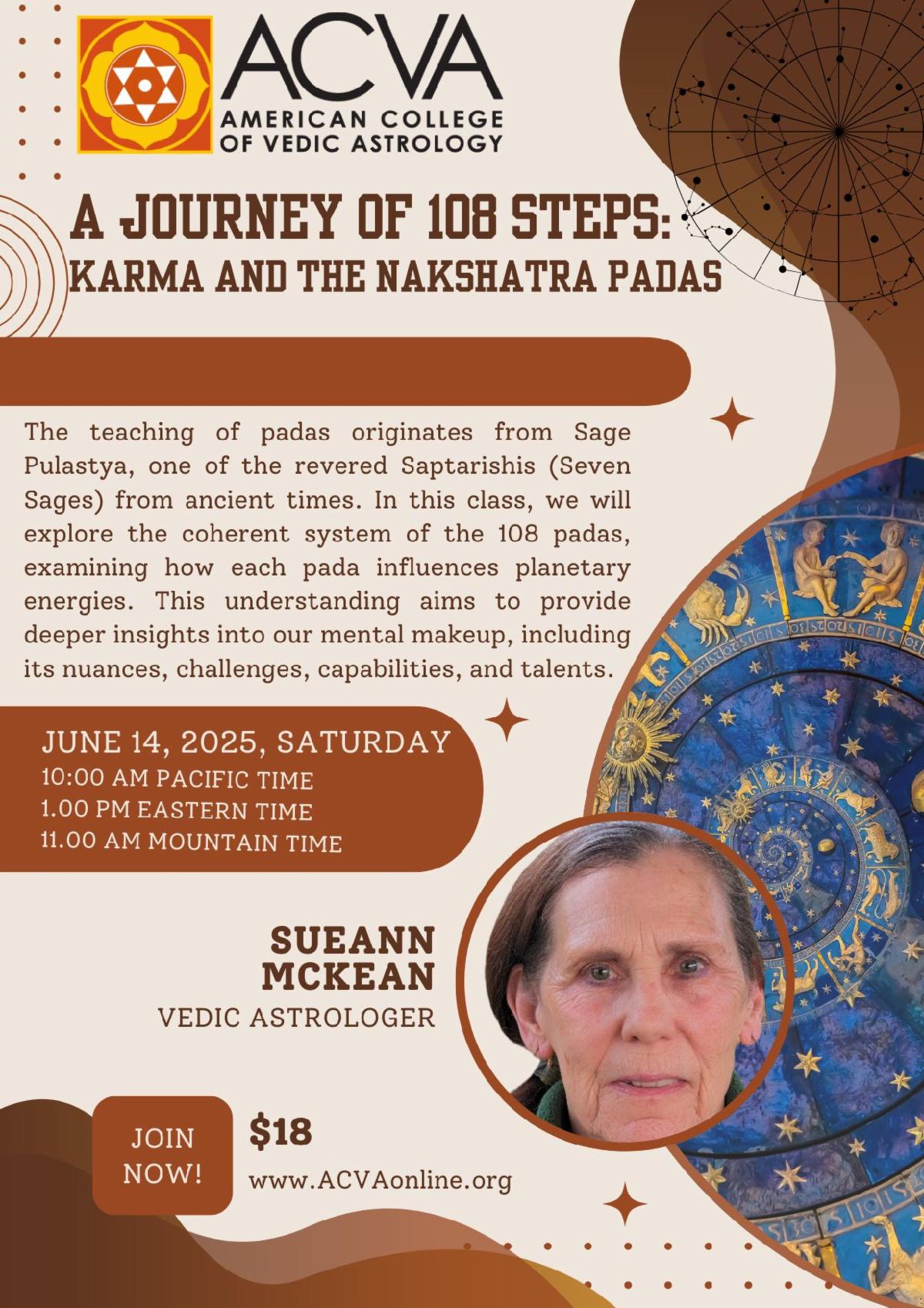
Saturday, 14 June 2025 @ 10 AM Pacific / 1 PM Eastern time / 11.00 AM Mountain time. 1.5 Hours.
Topic: A Journey of 108 Steps: Karma and the Nakshatra Padas
This webinar delves into the nakshatra padas and their influence on planetary energies, uncovering subtle aspects of an individual's psychology and life direction. Each of the 27 nakshatras is divided into four padas, corresponding to the four purusharthas—Dharma (duty), Artha (wealth), Kama (desire), and Moksha (liberation). This framework offers profound insights into personal motivations and behaviors.
The teaching of padas originates from Sage Pulastya, one of the revered Saptarishis (Seven Sages) from ancient times. In this class, we will explore the coherent system of the 108 padas, examining how each pada influences planetary energies. This understanding aims to provide deeper insights into our mental makeup, including its nuances, challenges, capabilities, and talents.
| |
Speaker: Sue Ann McKean, Professional Vedic Astrologer
Sue Ann McKean is a life-long student of Vedic wisdom and consulting Vedic Astrologer. Her Jyotish journey began in 1990 while on a retreat in India. A founding member of ACVA and regular attendant at ACVA conferences, she studied Jyotish with Hart De Fouw and Ernst Wilhelm. She met her guru, Pundit Sanjay Rath in 2005, participating in the founding of his school Deva Guru Brihaspati as a student and mentor from 2009-12. In 2011 she completed the 5-year intensive Jaimini Sutras program conducted in the Himalayas with Pundit Sanjay Rath. From 2011 to 2018, Sue Ann was also a student and mentor at AIAC - Ancient Indian Astrology Classes where she studied with Pundit Souvik Dutta.
Webinar Registration link: https://us06web.zoom.us/webinar/register/WN_H9GXT0EETzi9iVosb8TIEQ
| | |
It is due to the generosity of our patrons that ACVA can continue to offer its current special tuition rates. Thank you.
ACVA is a 501-C3 not-for-profit educational institution that provides a very valuable service to learners of Vedic astrology.
It is due to the generosity of our volunteers and patrons that ACVA can continue to thrive. If you choose to press the "donate" button, your donation will be tax-deductible.
To donate, Visit our Website!!
https://acvaonline.org/donate/
In gratitude,
The Leadership Team
| | American College of Vedic Astrology | | |
ACVA Leadership Team
-
Prof. Charlotte Benson (Jyoti Devi) - President, ACVA’s External Relations Leader
-
Dr. Sisira K. Amarasinghe, Ph.D. – ACVA Vice President, Executive Director of Corporate Strategy and Technology
-
Prof. Juliana Swanson - ACVA Provost and Dean of Academics
-
Dr. Lynn Bootes, M.D.- Registrar, and Dean of Students
-
Julene Louis – Curriculum Leader
-
Arjun Kodikannath – ACVA Corporate Communications Officer
-
Alan Annand – ACVA Editor-in-Chief of Publications
ACVA Staff
-
Dr. Arjuna de Silva, MBBS (ACVA LMS & IT Operations Manager)
-
Sudath Mudalige (IT Administrator)
- Susheel Erramilli (Social Media and Digital Marketing Coordinator)
To contact any one of us
| | American College of Vedic Astrology Inc, 2675 W. S.R. 89A #190, Sedona, AZ 86336 | | | | |