December 4, 2020
The Out-of-Pocket Health News Digest
|
|
Below you will find briefs about recent health policy news stories. Our hope is for students to have an information outlet at their fingertips to keep up-to-date with the most pressing news stories in health policy.
This compilation is produced by the HPSA Education Committee: Matthew Dunn, Magdalena Mihaylova, Atticus Raasch, and Brynna Thigpen
|
|
Lowering the age of Medicare eligibility to 60: public support and hospital opposition
by Matthew Dunn
|
|
Medicare is a federal health insurance program that mostly serves Americans aged 65 and older. In his platform for health reform, President-elect Joe Biden calls for decreasing the age of Medicare eligibility from 65 to 60. According to an analysis by Avalere, this could potentially bring Medicare coverage to an additional 23 million additional Americans. However, it is not clear how much of this group would actually join the Medicare rolls under a Biden plan. There are approximately 20 million Americans aged 60-64 with commercial health insurance, and many of these would ostensibly elect to keep their employer-provided insurance.
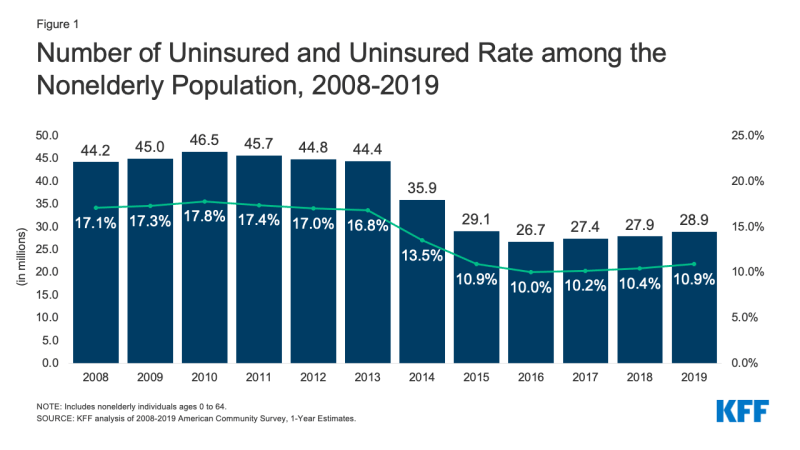
Lowering the age of Medicare eligibility would still leave the U.S. short of universal coverage, with over 20 million people below age 60 currently lacking health insurance. However, it would offer a critical health insurance option for the 1.7 million uninsured Americans between the ages 60-64.
Public polling routinely indicates broad support for this change. A KFF tracking poll from January 2019 found that 77% of Americans supported lowering the Medicare age to 50, a more drastic reform than what Biden is proposing. A more recent survey of Americans aged 55 and older was conducted by GoHealth in November 2020, which also found a majority support for lowering the Medicare age, including 64% of those not enrolled in Medicare.
Despite apparent public support, lowering the Medicare age faces a large political obstacle due to opposition from hospitals and health care providers. Given that Medicare reimbursements can be substantially lower than commercial payers, the hospital industry fears this reform could cost them billions in revenue. In fact, some have argued that healthcare providers represent an even greater obstacle than a Republican-controlled Senate to achieving this policy.
|
|
Can - and should - vaccination against COVID-19 be mandated?
by Brynna Thigpen
|
|
Since promising vaccine trial results were released by Pfizer and Moderna in November, the world has begun considering next steps. Leaders have been considering how to vaccinate as many people as possible, as quickly as possible to facilitate a return to normal life. To achieve this end, some employers and states are considering enacting vaccine mandates.
What is a vaccine mandate?
A vaccine mandate is a law, rule, or regulation requiring some or all people be appropriately vaccinated against a disease, or show proof of a valid exemption. Vaccine mandates aren’t new. Since 1902, state vaccine mandates have been protected by U.S. courts as reasonable regulations to protect the common good and public safety and health.
Mandates vary by state, but in most circumstances, schools verify children’s immunization records and require them to be up-to-date to start a new school year. This allows for optimal immune responses to the diseases, and is an ideal point of interaction between the state and the public to apply these mandates and monitor population-level immunization rates.
Vaccines protect patients on an individual level from the disease, but also work on a population scale when large proportions of the population are vaccinated. Once a certain threshold is passed, a population reaches “herd immunity.” This means that when a large number of people get vaccinated, it decreases the circulation of the disease in the general population, so those who cannot medically get vaccinated enjoy protection too. While some object to these requirements, patients’ options to reject the mandates vary; some states only permit medical exemptions to the vaccines, while others also allow for religious or personal objections.
What might a COVID-19 vaccine mandate look like?
A Gallup poll conducted in late October (before publication of the most recent vaccine results) found that over 40% of Americans said they would not get vaccinated when a vaccine became available. Although this number has been steadily decreasing, this still presents an obstacle to achieving herd immunity.
Some employers are considering requiring proof of vaccination for employees to return to work. Employers may be within their legal rights to require this, particularly if the workplace presents elevated risk of exposure to COVID-19, because employers are obliged to remove hazards from the workplace. For example, many workplaces, particularly healthcare centers, require their employees to get a flu shot every year, or show proof of a valid exemption.
Individual states may also try to enact COVID-19 vaccination mandates, but would need a way to track and implement adoption, as well as a mechanism for making sure the vaccine is free and accessible. The CDC-led Vaccines for Children program exists to make sure vaccines are accessible to children 18 and under, but no such nationwide program exists for adults.
The ultimate intention of these mandates is to protect employees, citizens, and the public’s health. States and businesses will need to weigh their responsibility to protect their people with civil and individual liberties.
|
|
New Supreme Court ruling highlights rightward shift after confirmation of Judge Barrett
by Atticus Raasch
|
|
On Wednesday, November 25, the Supreme Court voted 5-4 to bar the state of New York from imposing limits on religious gatherings for purposes of slowing the spread of COVID-19. This ruling passed in stark contract with similar challenges in May and July, in which the court ruled in favor of Nevada and California imposing restrictions on religious gatherings. In those rulings, Chief Justice Roberts sided with Democratic appointees, stressing that states needed flexibility to handle the virus. But what makes this ruling different?
This ruling marks a rightward shift of the Supreme Court in light of the recent confirmation of Judge Amy Coney Barrett in place of the liberal Justice Ruth Bader Ginsberg. The ruling showcases an altering attitude towards approaches to COVID-19 by the court.
Many suspected that Judge Barrett would side with the conservative majority on this case despite previous similar rulings by the court ruling in favor of restrictions of religious gatherings due to COVID-19. In their unsigned opinion, the conservative majority suggested the restrictions were too broad, and were not narrowly tailored enough to be considered solely a response to COVID-19.
“They are far more restrictive than any COVID–related regulations that have previously come before the Court,” the signed opinion stated about the New York restrictions, “Much tighter than those adopted by many other jurisdictions hard-hit by the pandemic, and far more severe than has been shown to be required to prevent the spread of the virus at the applicants’ services.”
The ruling showcases the predictions of various legal experts coming to fruition: that Judge Barrett’s addition to the supreme court may radically change the nature of upcoming court rulings. Judge Barrett creates a 6-3 conservative majority on the court, meaning there is likely to be substantially less swing on votes than we have seen in recent years.
|
|
One-Liners
by Magdalena Mihaylova
|
|
-
COVID-19: As the government prepares to distribute close to 6.5 million doses of a COVID-19 vaccine, pending approval by the FDA, they announced vaccines will be distributed to states based on their total population of adults, not on risk level (NPR).
-
Drug Pricing: Canada imposed new guidelines last week to limit bulk drug sales with the United States, in an effort to protect their current deficit. This came in response to a U.S. Importation of Drugs rule which allowed for certain pharmacists and wholesalers to import prescription drugs meant for the Canadian market (Bloomberg).
-
Global Health: According to data from the United Nations, COVID-19 lockdowns have led to a surge in domestic violence, rape, and feminicides worldwide. And yet, the UN estimates that only one in eight countries has taken measures to decrease the pandemic’s burden on women and children. (France 24).
-
Health Law: A toxic chemical ban was signed into law by California Governor Gavin Newsom in September, which covers over 24 chemicals that are commonly found in cosmetic products. The law, which will take effect in 2025, marks the first major legal action to ensure safer beauty products in over a century. (Kaiser Health News).
-
Women’s Health: A new study conducted in the United Kingdom found that the interruption of cervical cancer screenings due to the COVID-19 pandemic could increase the risk of cancer for women by sevenfold. (News Medical).
|
|
|
|
|
|
|