Swimming and Diving Points of Emphasis 2022-23
NFHS April 2022
Sportsmanship
Good sporting behavior is one of the fundamental ingredients to the continued success and enjoyment of education-based high school sports and activities. In fact, in the 103-year history of organized high school sports in the United States, good sportsmanship has been one of the most important outcomes of high school activity programs. NFHS playing rules are written to encourage sportsmanship. Participation in these programs should promote respect, integrity and sportsmanship. However, for these ideals to occur, everyone involved in these programs must be doing their part.
The NFHS is concerned that unsporting behavior in education-based athletics has increased across all sports. As a result, the NFHS has made sportsmanship the No. 1 Point of Emphasis for the 2022-23 school year. Sportsmanship, or good sporting behavior, is about treating one another with respect and exhibiting appropriate behavior. It is about being fair, honest and caring. When these types of appropriate behavior occur, competitive play is more enjoyable for everyone.
Coaches set the tone at athletic contests with their display of sportsmanship. If these individuals act in a sportsmanlike manner, their behavior sets the tone for players, spectators and others. If coaches, however, are complaining constantly about the decision of contest officials, spectators are more likely to do the same. There must be a collaborative, working relationship between contest officials and game administration to promote good sportsmanship and safely conduct the contest.
Everyone has their roles to play in creating a positive, sportsmanlike atmosphere at contests. Officials should focus on the actions of players, coaches and other bench/sideline personnel. A positive, open line of communication between officials and coaches ultimately results in a better contest for everyone involved. Contest officials, however, should never engage with spectators who are exhibiting unsporting behavior.
Once the contest begins, school administration is responsible for dealing with unruly spectators. A proactive approach by school administration includes monitoring the behavior of spectators and intervening as needed. If spectators are using demeaning or profane language at officials – or at others in the stands – those individuals should be removed from the contest by school administration. In recent years, a heightened level of unsportsmanlike behavior has been occurring by spectators at high school sporting events, and it must be stopped.
The use of demeaning language, or hate speech, by students, parents and other fans must cease. High school sports and other activities exist to lift people up, not demean or tear people down. The goal is to treat everyone fairly and treat each other with respect. Any speech or harassment that is insulting, demeaning or hurtful will not be tolerated. High schools must establish a culture that values the worth of every single person – both players on the school’s team and players on the opposing team. There must be a no-tolerance policy regarding behavior that shows disrespect for another individual.
Good sports win with humility, lose with grace and do both with dignity. It takes the efforts of everyone every day to ensure that sportsmanship remains one of the top priorities in education-based activity programs.
Diving Announcer Error
Announcer errors occur most frequently in dual meets but may occur in championship meets as well. When errors do occur, they should be corrected to prevent divers from being penalized by doing dives that they are not prepared for, or repeating dives already performed. In all cases the diver should be given time to be properly prepared to perform the dive.
When an announcer error occurs:
(a) during a dual meet or a championship format meet without cuts, the diver performs the dive announced and chooses to accept the scores. The referee should instruct the table to record scores for the dive actually performed and in the appropriate round on the scoresheet. The dive that was not performed will then become the next dive and the rest of the dives will be performed in the appropriate order. Additionally, the announcer and table should note the adjustments on the scoresheet;
(b) during a championship meet which includes cuts, when the diver chooses to accept the scores, the referee should verify that acceptance will not create a violation of a legal order of dives, causing an unfair competitive advantage (and possibly result in a penalty in a later round). Before allowing the diver to accept the scores the referee needs to check the diver’s list to verify that no rules are being violated. Changes can be made if both dives occur in the prelims, both occur in the semifinals, or if both occur in the finals without creating a penalty;
(c) if accepting the scores will cause a violation of the NFHS Championship meet dive order, or the diver does not accept the scores, or the dive announced was not written on the score sheet, the announcer shall announce the correct dive and the diver shall perform that dive when they have had proper time to prepare. A referee should never allow a change that will result in penalties later in the meet. Within these limitations, the diving referee has broad discretion to assure the least possible negative impact upon the diver for the official’s error.
Relay Entries
A competitor becomes a participant in an event when the official entry card is delivered to the meet director, or designee, at a specified time and place. For relays, eight individuals may be designated, if the state association requires. The penalty for submitting an inaccurate entry card, one that does not bear the name of the event, coach’s signature, school name, and submitted time if one exists, is disqualification from the event. Four swimmers declared on the relay card, submitted at the designated time and place prior to the start of the event, are permitted to report to the blocks and compete. The coach shall submit the name of the lead-off swimmer at the specified time and place prior to the start of the event, although there is no penalty for incorrectly listing that name. There is no NFHS mandate to list the order of swimmers, which is not a required part of the entry process.
Provide Deck Space for Officials
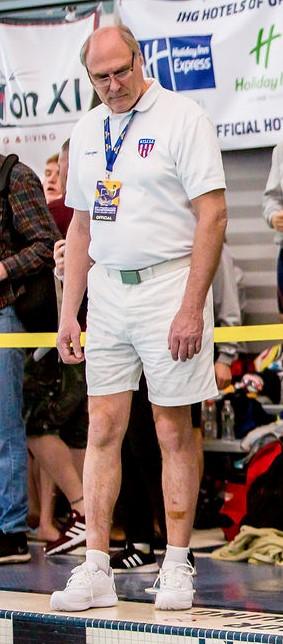
NFHS swimming and diving officials work in swimming facilities with a wide variety of pool configurations which sometimes necessitate creative ways to officiate strokes. Schools are reminded of the importance of officials to be provided space on the deck that allows for free movement during the swimming event. It is recommended that a minimum of 3 feet be established for officials on the deck. In addition, adequate space should be provided for coaches and competitors to safely move about on deck. The referee shall determine the positioning and jurisdiction of all deck officials, which depend on the number of officials being used and the pool configuration. Officials may need to ask meet management for assistance in keeping a clear path to move up and down the sides and ends of the pool.
Diving Area Safety
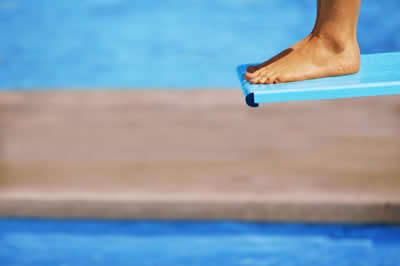
Rule 9-1-1 states the diving pool may be separate from or part of the swimming pool and the following standards for clearance are recommended for one-meter diving, with the measurement from the center of board to pool side wall a distance of 10 feet. Risk minimization and athlete safety should be a high priority. Divers, by rule are required to dive in front of the diving board and judges are instructed to reduce scores accordingly when they fail to do so. In addition, it is recommended that facilities management and officials remove any obstacles that may pose a risk (lane lines, backstroke flags, other athletes, etc.) as best practices and to minimize risk.