This newspiece is generously supported by Newton Investment Management
|
|
RETIREMENT SECURITY MATTERS
A forum for retirement innovation information sharing focused on
states, supporters, and service providers.
Vol 46 | January 13, 2022
|
|
Greetings! welcome! to Retirement Security Matters – where we talk about retirement readiness innovation by states, supporters, and service providers.
|
Baby it’s COLD outside! And you have been on zoom waaaay too long already this year. Grab yourself a mocha a take a little break. We’ll make you smarter while you do:
-
Keith Welks of Pennsylvania: 2022 - wrong time or right time for new ideas?
- The freshest State stats: Now vs. last year, and more
- What’s new in: California, Connecticut, New Mexico, Oregon, and Virginia
- Joel Metlen on the Speed of Government - timely!
-
Hot Sauce: Elizabeth Bauer asks – is there a retirement crisis? And we give you two great webinars + some hot tips for 2022 reboot, followed by
- A PIC of the week. Just one. You only get one this week.
|
Comments or content suggestions? We welcome both. Have something about your program you’d like to share? We are all ears.
|
|
No Silver Lining? Let’s Look Again.
|
|
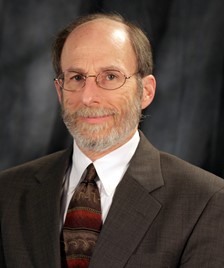
Keith Welks, Senior Advisor for Policy
Pennsylvania Treasury Department
|
|
Keith Welks is Senior Advisor to the State Treasurer in the Pennsylvania Treasury Department. In this role he is working on several discrete projects, including the Keystone Saves retirement initiative championed by State Treasurer Stacy Garrity and enhancements to the Department’s unemployment insurance benefits disbursement platform. During his tenure at Treasury, Keith helped develop some of the ideas included in proposed legislation for Keystone Saves and identified investment opportunities for Treasury related to green and clean technologies. |
|
We were talking with Keith recently about whether, as some have suggested, this is a particularly bad time for states to consider Auto IRA legislation. Not surprisingly, Keith had an opinion and some data to back it up. This week Keith generously shares what he has seen and learned during the pandemic, and how states may factor the pandemic experience into their thinking.
We pulled a few highlights below, and you can read the full piece here.
Confronting a pandemic.
No rational person would suggest that the continuing COVID-19 pandemic prompts anything like the “best of times / worst of times” dialectic that Dickens used to introduce profound social and political challenges, and sweeping changes, confronting late 18th century France and England in A Tale of Two Cities. The pandemic has certainly presented challenges and propelled changes; is it therefore necessarily true that the pandemic has been the worst of times for everything?
Specifically, have the challenges forced on employers in fact made this the worst possible time to be promoting a new state-facilitated workplace auto-IRA program intended to increase employee retirement savings activity?
Damaging business impacts.
Many businesses, and especially smaller and medium sized ones, have suffered multiple terrible blows from the pandemic.
-
Financial fragility of many businesses. According to a recent survey, about 75% of responding firms said they would not be able to last more than two months with cash on hand.
-
Small business closure. There seems to be a fair degree of consensus that the number of small American firms has declined by roughly one-third by the middle of 2021.
-
Quit rates are up. November of last year saw a new record with about 4.5 million workers departing their jobs. Indications, moreover, suggest that we may be only in the early stages of the phenomenon called “The Great Resignation.”
The wrong time or the right time for new ideas.
Remarkably enough, there appear to be several strong reasons why the obvious answer to the question above may very well not be the right one. Perhaps the most significant of these considerations come directly from the core DNA of the auto-IRA model.
-
Getting in the employers’ corner. State-facilitated auto-IRA programs can be viewed as almost designed specifically to provide employers with a responsive solution to the following riddle: facing pressure to exercise tight control over expenses during periods of substantially reduced revenues, while needing to address heightened demands from employees who have become more willing than ever to leave jobs that do not meet their expectations.
-
Improving efficiency and ease by partnering with the private sector. The responsible state agency forms what is in effect a partnership with each participating employer, and specialized companies that provide both the necessary back office administrative functions and asset management skills needed to oversee investment strategies for the retirement savings. The nature and structure of the savings program makes them exempt from ERISA responsibilities, another significant benefit to employers.
If You Offer It, They Could Stay.
|
|
|
|
o Important benefit. A survey conducted by Glassdoor found that almost four out of five workers responding said they preferred new or additional benefits to an increase in salary. Specifically, 31% identified retirement plans as an important benefit for them.
o Factor for retention. A survey by Willis Tower Watson found that 75% of those responding said that the availability of a retirement plan (in this instance, a 401(k) vehicle) was a compelling reason to remain at a firm.
o When emergency savings is a by-product of focusing on retirement. Sixteen percent of employed workers – and 45 percent of unemployed ones – see emergency savings accounts as one of the most important employer-sponsored financial wellness benefits. A key characteristic of the Roth IRA is that, for most purposes, workers can withdraw contributions to their workplace Roth accounts without penalty.
|
|
Benefits Enough To Be Shared by All.
Angela Antonelli, the Director of the Center for Retirement Initiatives at Georgetown University, has recognized the powerful capacity of auto-IRA programs to provide benefits of mutual appeal to both employers and their employees. There are encouraging signs that the instant relevance of these benefits is being recognized in the real world.
State Program Progress Provides Optimism.
Fortunately, the pace of activity of state auto-IRA programs around the country provides a genuine basis for optimism. … (What! Tell us more – you’ll find the non-excerpted version of this piece here).
A Common Benefit to Employers and Employees.
The sharp bite of the pandemic has pushed to the foreground the often-overlooked reality that many aspects of the employer-employee relationship are symbiotic, not adversarial. With a state-facilitated auto-IRA program, employers gain the ability to offer a convenient and effective wealth aggregating opportunity to their employees at little or literally no cost and effort. Even better, the retirement savings opportunity is a fringe prized by workers who associate it with job satisfaction and retention. Participating employees gain a coveted benefit that can materially aid them today in reducing anxiety about long-term financial insecurity.
Dickens also wrote, “Take nothing on its looks; take everything on evidence. There’s no better rule.” Businesses long suspicious of additional governmental involvement in their activities may think they see in an auto-IRA program a bad idea proposed at the worst time. If so, they would be well served to look again. All available evidence indicates that businesses currently offering no savings opportunity can provide through such programs a valuable new benefit to their workers. In so doing, they will benefit themselves as well.
Keith Welks is Senior Advisor to the State Treasurer in the Pennsylvania Treasury Department. The views and opinions expressed in this article are entirely and his, and may not be considered to be statements by the Department of its position on any issues. You can follow the work of Pennsylvania Treasury here, and you can connect with Keith by email here.
|
|
*Fresh!* State Auto IRA Program Metrics |
|
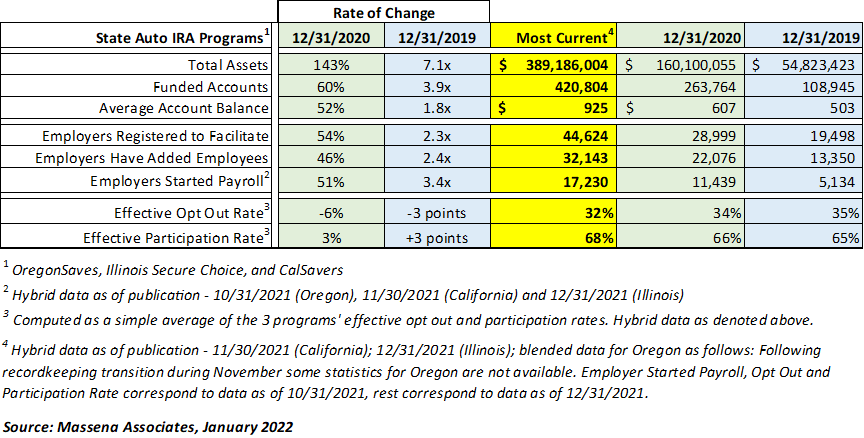
Breaking it down for you! States are working on their data and we don’t yet have a full set for 12/31/2021. However, the data we do have is very useful. What you’ll see:
Funded accounts are now over 420,000, up 1.6x from where we were at the start of 2021, and almost 4 times greater than the start of 2020. These savers have accumulated more than $389 million in combined assets, for an average account balance of $925. (Oregon’s average account balance is over $1,300). Remember that these averages “mush” together both the newest savers and long term savers – so long term savers have balances that are higher.
More than 44,000 employers have registered to facilitate a state Auto IRA program, an increase of more than 50% over the course of 2021, and more than 2.3x since the start of 2020. More than 17,000 employers have executed first payroll deductions. That’s also an increase of 50% in 2021, and more than 3.4x since the start of 2020.
Opt out rates have declined slightly over the two year period, from about 35% to about 32%. Participation rates are the inverse of this, and have risen to 68%. Note that a portion of these workers who intend to save are waiting for their employers to complete the third step in the process: executing and forwarding payroll deductions.
|
|
State Facilitated Retirement Programs - Fresh Highlights |
|
California (workforce 17.9 million) – in an effort to ensure all eligible workers would be able to save through the program, CalSavers announced this week that it will begin to impose penalties for non-compliant employers beginning this month. “We strongly urge employers to come into compliance now before we mail penalties this month,” said Executive Director Katie Selenski. The program is offering technical support and other assistance to employers who have not met the state’s savings facilitation steps.
|
|
Connecticut (workforce 1.6 million) – Connecticut continues its program rollout with pilot employers. Raising awareness, AARP released an opinion piece about MyCTSavings featuring AARP Volunteer Tim Ryan of Trumbull who helped push to get the program started. Available here. |
|
New Mexico (workforce 1 million) – Shannon Jacques of the Albuquerque Hispano Chamber of Commerce interviewed New Mexico Work and Save Executive Director Claudia Armijo and Board Member Othiamba Umi of AARP New Mexico. The three discussed the New Mexico Work and Save program, including program access and affordability for workers in the state. You can view the podcast here. |
|
Oregon (workforce 1.9 million) - The National Association of Plan Advisors (NAPA) published a January 4 article about a new study on how OregonSaves has helped those without plan access. In Auto-Enrollment Retirement Plans in OregonSaves, authors John Chalmers with the University of Oregon, Olivia S. Mitchell of the University of Pennsylvania, Jonathan Reuter of Boston College and Mingli Zhong of the Urban Institute analyze participation choices, inflow and outflow data between August 2018 and April 2020, and the evolution of account balances. The authors conclude that OregonSaves “has meaningfully increased employee savings by reducing search costs.” |
|
Virginia (workforce 4.3 million) – The Virginia529 Retirement Program Advisory Committee held its Board meeting on December 7, 2021. The meeting provided recommendations related to initial design elements of the Commonwealth of Virginia’s State-Facilitated IRA Savings Program. Program Director Peter Thompson shared staff and program consultant analysis findings and provided the following recommendations: i) offer a Roth IRA as the standard IRA type with the option of a Traditional IRA by election; ii) establish a default contribution rate of 5%; and iii) establish a default automatic annual escalation of 1% every year up to a maximum 10% for participants. Government Relations Director Leslie Crudele provided a legislative update. CCO Sherri Wyatt discussed conflict of interest filings, proposed meeting dates and new Committee Members for 2022. |
|
COMING UP
-
California (workforce 17.9 million) –The next meeting of the CalSavers Board is scheduled for January 24, 2022.
-
New Mexico (workforce 1 million) – The next New Mexico Work & $ave Board meeting that was to have been held on Thursday, January 6, 2022, has been postponed, potentially to January 18. New date to be confirmed soon. For updates, please visit the Board’s website here.
-
Oregon (workforce 1.9 million) – The next meeting of the OregonSaves Board is scheduled for Feb. 15, 2022.
|
|
Government moves slowly. That can be a good thing. It can help preserve institutions, ensuring they weather dramatic shifts in political winds. Slow, bureaucratic processes are also purposely designed to create barriers for rushed, poorly thought-out policy, which is important given the immense power of government and how hard it can be to undo bad policy.
The glacial speed of Government can also create opportunities to take time to engage people impacted by policy changes, especially marginalized people without easy access to those in power, with the goal of fully vetting ideas and then implementing them in a thoughtful way. That’s not usually what happens, of course. The slow speed of government isn’t due to a desire to engage people. It’s usually just the result of plain old bureaucracy, a prioritization of paperwork and process over the actual needs of people. Engaging the people impacted is either a minor, deprioritized step in the process or not done at all.
Can government move quickly enough to make a difference?
I’ve seen it happen. In response to the growing retirement savings gap, David John and Mark Iwry co-authored the concept of the Auto-IRA. It went from idea to implemented program in Oregon in 11 years. That might not seem fast, but it is when you consider what was involved …
|
|
During these times of accelerating change, we’ve seen the importance of our institutions, their limitations, and, importantly, ways that they can change and act quickly. It’s worth learning from the examples of change, because it’s likely we’re going to need more of it going forward.
More to come! / Joel
|
|
Columnist and Senior Associate Joel Metlen is based in Oregon. Joel is a pioneer of the state facilitated retirement savings space, woven into a career of public service and innovation. At OregonSaves, Joel’s responsibilities ranged from marketing and employer engagement to operations and data analysis. You’ll see his insights from that experience, and more, here.
|
|
A December 31, 2021 post in Forbes, Elizabeth Bauer looks at retirement legislation in 2022 and the ongoing question: is there a retirement crisis? Touching Secure Act 2.0, early version of the “Build Back Better”, state retirement savings programs, pushes for increase in the monthly benefits through SSI, and of course the Social Security 2100 Act. Plus, thoughts on Andrew’s Biggs’s latest op-ed and on where should we go from here.
New year, new us? If you are like many in our sphere you’re already busy in 2022 looking back at 2021 and thinking about the aftermath of Pandemic: Season 2. You might care about EBRI’s February 2 Wellness in the Workplace: Findings From the 2021 WW Survey. Financial stress and benefits offerings will be on the menu. Learn more and register here.
And, we hope you can join us on January 26 when we share the virtual stage with Karen Andres, Kendra Isaacson, Yemi Rose and Aaron Schumm for the Aspen Institute’s Big Challenges, New Ideas: Will 2022 Be the Biggest Year Yet for Inclusive Savings? This event is free and not to be missed! Join the conversation - Register here.
Other cool stuff: We listen to the Daily Audio Bible. We think it makes us a better person. The start of a year is always a great time to refresh the habit but we’re already a little bit behind. If you need a pick-me-up though, we just cruised through the Beatitudes. If you have mourned, or felt poor in spirit, better times are coming.
In presidential reading, we’re still chewing through Scott Miller’s The President and the Assassin on Audible. Cuba figures very prominently, and if you do any reading about Cuba in the 1890’s it sounds like a pretty tough place to be, except for a select few. We are realizing how much we do not know about our neighbor to the south. Were we asleep during history class?
OK, one more reboot for the New Year – we like Yoga with Adriene on Youtube. She’s working her way through a 30-day yoga reboot for 2022. If you’re like us you might not do them all in a row over 30 days, but you’ll get started with Day 1 and Day 2. And you’ll feel better about yourself.
|
|
… And our PIC of the Week IS … ! |
|
This one. If we can only have one, let it be this one: |
|
That’s it for this edition. 🥂Have a Happy and Safe New Year!
If you like this piece, please stick with us. We’ll be back in about two weeks. If you don’t like it, please unsubscribe below. Comments for us? Please let us know. Want your own subscription? Request one here. All information shared is from public sources or used with express permission.
|
|
Massena Associates provides process, policy, and implementation consulting on retirement savings programs and products.
Our clientele includes states, governments, policy organizations, and private sector providers. Our specialty – efficient, targeted results. We are an active speaker on retirement security topics, including state-facilitated programs, MEPs and more.
If you’d like to explore working together, we welcome the conversation. Connect with us here, and at 339-236-0684.
|
|
Looking for a great retirement savings innovation resource? Led by Dr. Alicia Munnell, the Center for Retirement Research at Boston College develops and hosts terrific content and proprietary research related to states, financial security, social security, and more.
Pew’s Retirement Savings Project studies the challenges and opportunities for increasing retirement savings and is another great resource - check out the work of John Scott and his terrific team.
|
|
|
|
|
|
|