|
|
Why Are You Getting This?
You signed up to receive The Privacy Professor® Tips, or initiated contact to stay in touch with Rebecca and/or Privacy & Security Brainiacs® (PSB) and consented to receive the Tips. Please read our Privacy Notice & Communication Info at the bottom of this message for more information. You may unsubscribe from there as well.
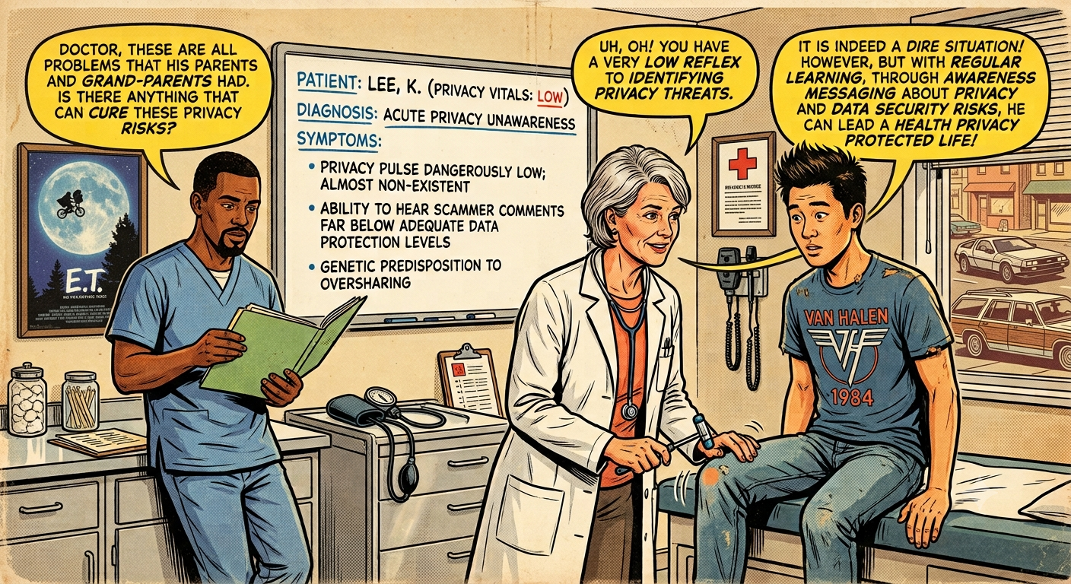
| | Image created by Rebecca Herold using ChatGPT. | | |
Pop quiz! What do state fairs, annual physicals, summer vacations, and back-to-school preparations have in common? If you answered, “They can all involve collecting, sharing, or exposing a surprising amount of personal information,” congratulations! You get an A in Privacy 101! The end of summer is a fascinating time for privacy because so many routines change at once. Families head to crowded fairs and festivals. Travelers return home and post their vacation photos. Students, and their parents, complete mountains of forms for schools, sports, childcare, transportation, and activities. College students move into dorms, while high school, elementary, preschool, trade, vocational, technical, and career-school students prepare for a new year. Meanwhile, many people are visiting their doctors for annual physicals required for school, sports, or work, or for checkups after returning from summer travel.
My own doctor recently told me that late July through August is the busiest time of year at her clinic for exactly these reasons. With so much information changing hands, August is the perfect month for a privacy pop quiz. Are your passwords ready? Are your devices protected? Do you know what information you are sharing—and with whom? Class is officially back in session, and privacy homework is due now!
We receive dozens of questions each month. Because we do take a significant amount of time to consider all aspects and then provide a thoughtful answer (that we wrote using our own expertise and experience, not using AI) that is as succinct as possible, we decided to limit the number of questions answered to four. As we are making changes in our business, later this year we will also start regularly posting to our blog again, and we will answer more questions there, and point to them from our Tips.
This month our Question of the Month asks about HIPAA risks during mergers and acquisitions. The other three cover: privacy and security at fairs and festivals; HIPAA and hospital use of tracking tech in websites; and risks of digital storage media. Thank you for sending them in!
Please read to the end where we provide some important information.
Since 2005, we have been freely distributing the Privacy Professor Tips monthly publication to help both businesses and individuals, of all ages, identify risks throughout their daily lives, within their own businesses, and to help them know how to prevent security incidents, privacy breaches, and to keep from being a victim of scams.
By sharing this Tips issue with others in your organization, you are also supporting a wide range of regulatory and other legal compliance requirements to sending such awareness communications. Thank you for reading and sharing!
| | |
We would love to hear from you!
Did you find the tips we provided useful? Did you like this issue? Do you have questions for us to answer? Please let us know at info@privacysecuritybrainiacs.com.
| | |
August Tips of the Month
- News You May Have Missed
- Privacy & Security Questions and Tips
- Where to Find the Privacy Professor
| | |
End-of-Summer Checkup: Is Your Privacy in Good Health?
Many readers are sending us alerts of privacy related news on a wide range of privacy topics. Thank you! We love getting your notices. With your help we are finding more unique news stories to share with you than ever before, along with news items that we believe are important for most folks to know, but that often do not get much mention in traditional news, or even in security and privacy news outlets.
Here are just a few of the 150+ news stories we discovered throughout the past month that provide a wide range of interesting security and privacy related news. These news items demonstrate that such types of risks exist basically anywhere in the world, and that everyone needs awareness.
We have grouped the 40 news items into four broad categories: the first expands upon this month’s topic of “Don’t Let the End of Summer Be the End of Your Privacy” with tips and news to raise privacy awareness for everyone. Followed by privacy related news in the categories, “Of Broad Interest,” “Privacy in Businesses, Governments, and Other Organizations,” and “Laws, Legal Issues, and Lawsuits About or Significantly Involving Privacy and/or Security Issues.”
Within each category the items are in no particular order. Some include “INSIGHTS” to provide some advice or additional insights to specific news items. Thanks to those many readers who sent your positive feedback; we appreciate it!
Do you have interesting, unusual, bizarre or odd stories involving security and privacy? Some of the most surprising items are in local news! Or questions about any of the notes we included for the stories we listed this month? Let us know!
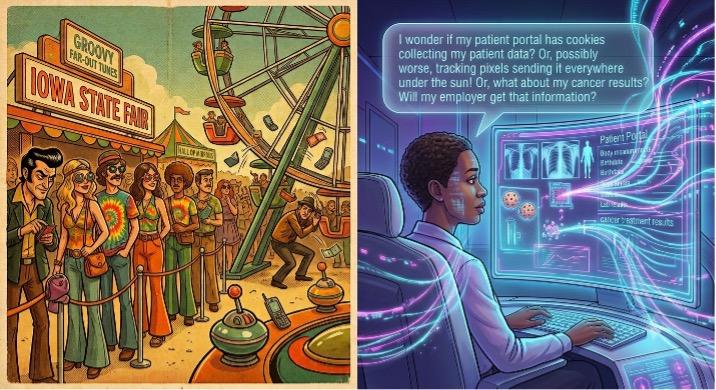
| | Don’t Let the End of Summer Be the End of Celebrating Your Privacy | | |
Image created by Rebecca Herold using Gemini Image Nano Banana 2.
NOTE: A few fun 1980s references are included. Can you find them all?
| | |
Summer may be winding down, but your privacy certainly shouldn’t be taking a vacation. In fact, the final weeks of summer can be some of the busiest—and most privacy-intensive—weeks of the year. Families are squeezing in one last trip to the state fair, parents and students are preparing for a new school year, college students are moving into dorms, and people are returning from vacations and catching up on medical appointments. Many are also scheduling annual physicals for school, sports, employment, or simply because it is time for a health checkup. My own doctor told me that the last half of July through August is her clinic’s busiest time, with patients coming in for school and employment physicals, post-vacation checkups, and concerns about illnesses or injuries picked up while traveling.
All of these activities have something in common: they involve information. Lots of it. Health information, identity information, contact information, financial information, educational records, travel details, photographs, and more. So as summer draws to a close, it is a perfect time to ask: Are you giving your privacy the attention it deserves? Or are you accidentally sending it back to school without its security and privacy homework?
1. How Smart Appliances Collect Data and What It Means for Smart Home and IoT Privacy. Smart appliances have become a common part of modern households. From refrigerators that monitor food inventory to washing machines that can be controlled with a smartphone, these connected devices make daily tasks more convenient. However, many people are unaware that these appliances also participate in ongoing data collection.
2. RFID tags in tires spark debate over safety and privacy. While passive tags have limited range, integration with connected car systems could enable detailed driver profiling, raising future privacy questions.
3. Most Smart Watches, Rings, and Bands Lack Basic Transparency Reports and Key Privacy Features. Surveys suggest that around 40 percent of people in the United States own some sort of commercially available wearable health device. Despite being marketed as health devices, they have no special health-related privacy protections that one might hope for. The companies who make these devices can and do collect an abundance of data. Many of them share that data with third-parties for marketing or to influence insurance rates, or use it for their own purposes, like training artificial intelligence models. Health data is increasingly an important part of law enforcement or government investigations. Wearable data has been critical in a number of cases, where information about heart rate and steps was used to determine the whereabouts of individuals. The surveillance company Penlink calls fitness trackers and wearables an “overlooked source” for law enforcement since they tend to show movement patterns and changes in heart rates. Law enforcement can try to get access to this data through subpoenas or warrants.
4. How period trackers share your private details. Stardust is a period tracking app that combines users' menstrual cycles with astrology and horoscopes. It also makes bold privacy promises. "Your data is private," Stardust says on its website. "Period." The problem, according to a new report shared exclusively with the BBC, is you and Stardust may have different definitions of "private". The Mozilla Foundation, creator of the Firefox web browser, investigated the privacy practices of six popular period trackers: Flo, Clue, Stardust, Spot On, Period Calendar and Euki.
5. Smart appliances quietly collect personal data, raising privacy concerns. Smart fridges, washers, and other appliances send megabytes of usage data weekly to manufacturers, often including personal information, without the knowledge of those using the devices. These devices track detailed habits, such as grocery purchases, fridge openings, and even family calendar events. The data collected could be sold, raising concerns over how it is used, who gets it, and consumer control over personal information.
6. Data-privacy experts said on a recent panel that while state privacy laws regulate what data brokers can collect and sell, those laws often do not extend to the problematic conclusions those companies can infer, such as sexual orientation, health conditions or political beliefs, from seemingly unrelated data points.
7. The Trump administration is forging ahead with a controversial plan to collect the medical records of millions of federal workers and retirees, as well as their family members. The Office of Personnel Management (OPM) said in a notice posted last month that it will begin routinely collecting identifiable, personal health information on more than 8 million people, despite concerns from privacy advocates who have demanded the agency drop the plan. The notice went into effect July 24, allowing OPM to begin its collection at any point afterward.
8. Hillsborough County, Florida, advances school zone speed camera expansion. Hillsborough County Commissioners voted unanimously to begin drafting an ordinance that would expand the county’s school zone speed camera program. In contrast, Tampa’s proposal has drawn concerns from Council members over privacy, surveillance, vendor oversight and how the city would spend revenue. Tampa currently operates cameras at 12 schools. An ordinance advancing through the Tampa City Council would increase that number to 18.
9. Hackers breached a major healthcare industry software supplier and stole a large trove of files. The British software firm Craneware, which makes software that helps companies track their financial performance and manage governance requirements, published a regulatory filing about “a cyber security incident involving unauthorized access to a subset of its data environment,” including the theft of “a significant volume” of files that included “employee data as well as a subset of customer and partner records.” More than 2,000 healthcare organizations and nearly 10,000 clinics and retail pharmacies use Craneware’s product, according to its website, meaning that the breach could have a significant downstream impact on the U.S. healthcare sector. Craneware is the latest healthcare vendor to announce a cyberattack in an era that has seen many breaches of medical-device makers and hospital software suppliers.
10. At the most recent Oklahoma State Fair, deputies arrested a state fair employee accused of stealing more than a thousand dollars while working the ticket booth. Investigators say the worker was charging people the $17 general admission, but then, handing them senior citizen or military discounted tickets that cost $12. They Hutson was pocketing the extra $5 difference. They say Hutson did this for five days, skimming at least a thousand dollars from the fair; an embezzlement felony. INSIGHTS: See the Q&A section for more information about precautions to take while at such events.
| | Image created by Rebecca Herold using using Adobe Firefly. This scene relates to a news story in this section. | | |
11. Meta Addresses One Smart Glasses Privacy Problem, but Many Others Remain Unsolved. “A wave of bans on smart glasses in certain places, such as New York courtrooms and parts of cruise ships, has already begun. Public policies on glasses are likely to get more intense. Some glasses-makers are offering camera lens covers, and Meta’s Andrew Bosworth admitted during a Meta glasses launch a few weeks ago that he’s interested in making camera-free glasses down the road.”
12. Waymo called the cops on teen riders, raising privacy concerns. Police in San Mateo, Calif., posted Monday on social media that they had apprehended a pair of teenagers from a Waymo driverless robotaxi after the company alerted authorities to suspected criminal activity. It's the latest incident involving video surveillance of passengers and others by autonomous vehicles — raising questions about the limits of privacy in such vehicles.
13. Moving Scams: More Than Your Stuff at Stake. “Criminals often advertise low prices and provide unusually cheap estimates—sometimes without even seeing your belongings. Once hired, they may demand a cash deposit or full payment up front, raise the price at the last minute, or hold your belongings hostage until you pay more. In some cases, they never show up at all.”
14. Meta Patents AI Device That Tracks Your Emotions, Watches You Take Your Meds. Imagine a wearable device that records every moment of your day and makes suggestions based on your mood. Meta has filed a patent for a system that records your voice and surroundings all day, then uses an AI to analyze your mood. The patent’s stated, theoretical goal is for Meta, a company that makes billions of dollars targeting ads at its users based on their data, is to sell users a wearable that tailors workouts for them based on whether they’re happy or sad. Patentlyze first noticed the patent which was published on July 2 after Meta filed it back in December of 2025.
15. Do You Own Property? Protect Yourself From Seller Impersonation Fraud. In this real estate scam, criminals use public information for identity theft and title fraud, then sell properties out from under the legitimate owners
16. When cyberattacks turn physical: Threats of violence in digital extortion. Cyberattacks are increasingly paired with threats of physical harm, targeting employees, executives and sometimes their families. Ransomware groups are escalating pressure tactics as payment rates decline, pushing them toward more aggressive extortion methods. Attackers are expanding their focus beyond organizations to individuals and communities, including students, parents and healthcare workers. Critical sectors like healthcare and education are targeted because disruption can create immediate real-world risk and urgency.
17. Data breach on healthcare AI vendor exposes records from 1.4 million patients. Stolen data was determined to include protected health information, including details on medical treatments that patients received. Names, dates of birth, contacts, Social Security numbers and health insurance information were also compromised. Xsolis, a company that uses artificial intelligence to improve patient care utilization, posted a notice earlier this month that contained many of the details of the data security incident, said to have stemmed from a “targeted phishing attack” that resulted in an unauthorized third party accessing its network.
18. Cathay Pacific says the personal data of up to 9.4 million passengers have been accessed in the latest security breach to hit the aviation industry. Passport numbers, email addresses and expired credit card details were among the data leaked. Last month, British Airways said hackers managed to breach its website and app, stealing data from many thousands of customers in the process. Air Canada app has suffered a data breach in August, resulting in the suspected loss of thousands of its customers' personal details. In April, Delta Airlines said credit card details of thousands of customers were exposed following a cyberattack on a vendor.
19. $500K SportsEdTV Settlement Resolves Class Action Lawsuit Over Alleged Video Privacy Violations. It resolves a class action lawsuit that alleged that sports education company unlawfully disclosed consumers’ private video viewing information to third parties without consent. The deal covers United States residents identified in SportsEdTV’s records as having watched videos on SportsEdTV.com at any time from May 9, 2023 to May 16, 2025.
| | Privacy In Businesses, Governments, and Other Organizations… | Image created by Rebecca Herold using ChatGPT. A depiction of one of the news items in this section. | | |
20. Sumner County Schools delays opening after network breach in Tennessee. Classes will begin six days later than planned after the district discovered unauthorized access to its network. The district, based in Gallatin, serves about 31,000 students at 53 schools across Sumner County, north of Nashville. Officials have not said which computer systems were compromised. Superintendent Scott Langford said the district became aware of the unauthorized access July 20. The district notified local and federal law enforcement and the Tennessee Department of Education and hired third-party forensic specialists, according to a message sent to parents.
21. DA: 2 former school bus drivers break into Parkland School District bus garage, illegally access computer records, student photograph rosters. Shawn Levy, 32, of Breinigsville, and Tyler Young, 27, of Allentown, Pennsylvania, are both charged with felony counts of Conspiracy to Burglary, Conspiracy to Criminal Trespass, and Conspiracy to the Unlawful Duplication, the Lehigh County District Attorney’s Office said in a news release. The school district provided surveillance video from the night of the incident around 10 p.m. June 6, according to the news release. The DA’s office said the video showed Levy and Young arrive together in a Tesla registered to Young. The car parked in a lot near the garage and a few minutes later, they entered a secure bus garage which neither had access to open, according to the DA’s office.
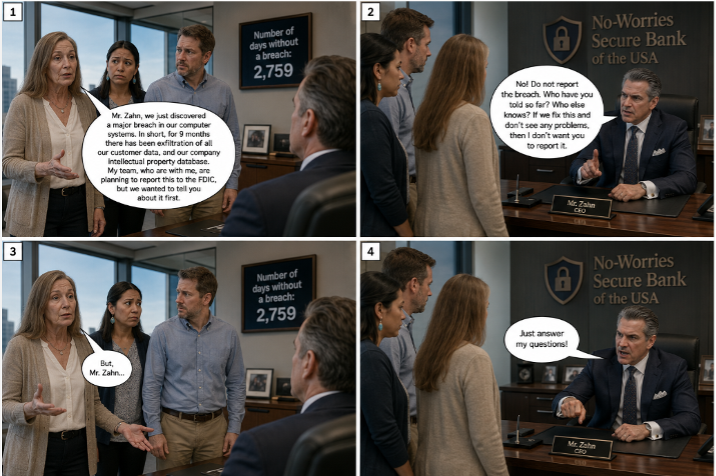
22. Most cybersecurity workers have been told to conceal a breach, report finds. Security firm Bitdefender also found that U.S. companies were simultaneously more confident and more strained on cyber defense than foreign peers. “55% of workers said they were told to keep quiet about a breach. That number rose from 42% in 2024 to 58% in 2025 before plateauing this year.”
23. “Digital Colonialism”: U.S. Demands To Access Africans' Data Raise Privacy, Sovereignty Concerns. But if it refused, the East African nation would likely lose out on more than a billion dollars to address HIV, malaria, tuberculosis and other deadly infectious diseases. So, on Dec. 10, it agreed. “If you take the deal, you’re going to be exploited. If you don’t take it, you’re going to die,” said Ssekamwa, an attorney and digital rights expert in Uganda. “It’s the essence of digital colonialism.”
24. New CMS voting memo sparks concerns over resident assistance in nursing homes. CMS rescinded voting rights memos issued in 2021 and 2024 and replaced them with a new memo meant to reinforce providers “existing obligation” to support residents who wish to vote. But the new memo focuses instead on prohibiting assistance. Lori Smetanka, executive director of The National Consumer Voice for Quality Long-Term Care, said the agency’s combined actions will have the effect of further inhibiting nursing home residents’ ability to exercise their vote, “a process that is already difficult for many residents.”
25. When Identity Verification Fails: Lessons from a Real-World SIM Swap and Near Account Takeover. a recent attack against my own wireless services account demonstrated that point-in-time authentication is no longer sufficient against determined identity-focused adversaries. What began as a seemingly routine customer service call quickly evolved into a coordinated attack that combined social engineering, identity impersonation, stolen personal information, SIM swapping, session hijacking, and unauthorized account changes. Although the attackers ultimately failed to achieve full account takeover due to rapid detection and response, the incident exposed significant weaknesses in how organizations continue to treat identity as a one-time event rather than something that must be continuously evaluated throughout the customer journey.
26. Anubis Ransomware Halts Fairlife Milk Production in the US. The Anubis ransomware gang is claiming responsibility for a halt in milk production by U.S. dairy brand Fairlife after an attack disclosed July 16 by parent company Coca-Cola. The Russian-speaking ransomware-as-a-service operation claims to have stolen 1 terabyte of confidential data from the company and was threatening to leak it unless it receives a payoff. Coca-Cola told investors the attack reached production-related systems. Operations in Canada are not affected.
27. Inside FakeAgent: How a Claude Desktop Malvertising Campaign Hit 29 Organizations with SectopRAT. Between July 21 and July 22, 2026, Huntress' Security Operations Center (SOC) lit up with a swathe of unusual executable installs, Defender exclusions, and anomalous persistence across 29 organizations, all coming from ClaudeDesktop.exe. The attacks had one common denominator: victims had searched for the Claude desktop app and were taken to a malicious public Claude Artifact on the actual Claude AI domain, which appeared to be a legitimate download link for the desktop app.
28. UK hospital reports itself after 40 staff accessed crocodile attack victim’s records. Cambridge University Hospitals is investigating a potential data breach after 40 people were found to have accessed the medical records of a three-year-old who was allegedly thrown into a crocodile pit last week, and has reported itself to the UK’s data watchdog, the ICO.
29. And in other hospital-related security and privacy news from the UK: Software provider to more than 2,000 US hospitals says hackers stole employee and customer data. A British company whose software is used by thousands of U.S. hospitals said Monday that hackers broke into its internal network and stole data on employees, customers and business partners. Craneware, which is headquartered in Edinburgh and listed on London's AIM market, told investors it detected unauthorized access to a “subset” of its data environment and has since brought in outside forensic investigators. “The company said a large number of file names were viewed and copied out of its network. Most of that material was non-sensitive or already publicly available regulatory data, but the company confirmed that some employee data and customer and partner records were also taken.”
30. Unprotected Hospital Printers Expose Healthcare Networks to Cyberattacks. Overlooked network printers and connected IoT devices represent a critical vulnerability for healthcare providers facing modern cyber threats. Because healthcare systems traditionally procure printers through supply chain channels rather than central IT, standard cybersecurity controls are frequently bypassed. Industry estimates indicate that up to 99% of enterprise printers remain unmonitored, with many operating on default administrator passwords with open network ports.
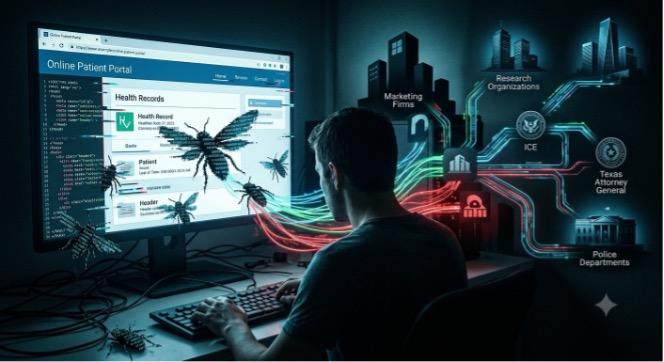
| | Laws, Legal Issues, and Lawsuits About Or Significantly Involving Privacy and/or Security Issues… | Image created by Rebecca Herold using Gemini Images Nano Banana 2. Representing some healthcare provider websites and some of the entities that received data from them via tracking tech (bugs) as reported in a wide variety of news reports in recent months. | | |
31. DraftKings Faces Class Action Lawsuit Over Sale of Consumer Data. Case comes as a number of other DraftKings lawsuits are already moving forward, involving allegations the online sportsbook employs aggressive promotions and game-like features that prey on vulnerable gamblers. A proposed class action lawsuit alleges that DraftKings secretly collects and shares personal information from visitors to its website with third-party data brokers, allowing the companies to identify users, track their online activity and build consumer profiles without their knowledge or consent.
32. Oregon lawmakers pushed to secure sensitive data from ICE. How does the law work? A new law could result in state agencies severing their contracts with data brokers who obtain Oregonians’ personally identifiable information and share it with federal immigration authorities. Senate Bill 1587, which took effect last month, was originally an attempt to dramatically limit the use of data captured by private data brokers for enforcing civil law, including immigration, family and torts claims. The new state law instead focuses on restricting state agencies from giving personal information to data brokers who won’t promise not to hand that data over to the federal government for immigration enforcement. It allows Oregon agencies to reject a data broker’s promises to follow the law if it “reasonably believes” that the company has made “material misrepresentations, falsehoods or omissions.”
33. Preliminary Approval Granted in Cone Health Data Privacy Settlement. On July 7, 2026, in Singh v. Cone Health, Case No. 1:24-cv-00558-LAF-JGM, Judge Freeman of the United States District Court for the Middle District of North Carolina granted preliminary approval of a health data privacy class action settlement that resolved claims that Cone Health disclosed patients’ personal information through website tracking technologies. In granting preliminary approval, Judge Freeman certified the following class for settlement purposes: All living individuals who from September 1, 2016, to November 3, 2022, accessed the MyChart patient portal on Cone Health’s website or completed a submission form on their website. The Preliminary Approval Order can be found at this link. INSIGHTS: See question and answer #3 below for more information about the website tracking technology in healthcare websites.
34. Harsh penalties for data brokers in New Jersey threaten campaign tech. New Jersey looked to crack down on data brokers by passing a strict new law to prevent the sale of personal data. Instead, it’s causing chaos over the last month for the state’s electoral system. A new bill, A-5328, was signed into law by Gov. Mikie Sherill (D) just 48 hours after it was introduced during the Legislature’s rush to pass the state budget. The measure has since rattled the political tech world. Campaign consultants, advertisers, Democrats and Republicans have warned that the law could sweep in political data firms, raising the prospect of steep registration fees and potentially massive fines for handling voter data.
35. Federal Court Allows Wiretap Claim To Proceed Based On Alleged DOJ Bulk Sensitive Data Rule Predicate Violation. In a first-of-its-kind pleading-stage decision, a federal district court in Baker v. Index Exch. Inc., No. 25 C 10517 (N.D. Ill. June 16, 2026), denied a motion to dismiss a putative class action alleging that supply-side platform (“SSP”) Index Exchange Inc. and its affiliate Index Exchange USA, LLC violated the Electronic Communications Privacy Act (the “Federal Wiretap Act”), in connection with alleged data transfers to a Chinese e-commerce platform. The ruling did not determine whether the defendants, any publisher, or any advertising partner actually violated the Federal Wiretap Act or the Department of Justice bulk sensitive data (“BSD”) rule. The decision is notable because the court considered whether alleged violations of the BSD rule—which prohibits or restricts certain transfers of data by U.S. persons to prescribed “countries of concern” and companies with nexus to these countries of concern—could defeat a consent defense under the Federal Wiretap Act’s crime/tort exception.
36. FTC Requires Amazon to Pay $2.25 Million to Resolve Charges It Knowingly Violated the Fair Credit Reporting Act (FCRA). FTC alleged that Amazon routinely denied requests from identity theft victims seeking records of fraudulent transactions made with their personal data. The complaint, filed by the Department of Justice upon notification and referral from the FTC, alleged that in numerous instances, Amazon.com Inc. failed to comply with Section 609(e) of the FCRA, which requires companies to, within 30 days of a consumer’s request, provide victims of identity theft with application and business transaction records about fraudulent transactions made in their names. According to the complaint, Amazon had no written policy to respond to Section 609(e) requests until early 2025, after it learned of the FTC’s investigation, despite prior outreach from FTC staff advising the company to review its compliance with Section 609(e).
37. Class Certification Denied In CIPA Internet Tracking Lawsuit. A California federal judge recently denied a CIPA-based motion for class certification. Plaintiffs, on behalf of themselves and several putative classes of consumers, alleged that Defendant, a financial institution, violated CIPA by employing internet tracking software on its website without first obtaining their consent. Through the use of such internet tracking technology, Plaintiffs alleged that Defendant captured: (1) employment information; (2) bank account information; (3) citizenship status; (4) credit card approval and eligibility data; (5) browsing activities, including pages viewed and content; and (6) credit card application status. Although the Court found that the information shared by the tracking technology raised a common question, the Court denied class certification on the basis that individual inquiries predominated over common questions. Specifically, the Court found, among other things, that individualized inquiries were required of each prospective plaintiff’s interactions with the tracking technologies and into whether putative class members agreed to Defendant’s privacy policy.
38. Judge dismisses Prince Harry's privacy invasion lawsuit against publisher of Daily Mail. Justice Matthew Nicklin rejected the broad inferences the Duke of Sussex relied on to try to show that Associated Newspapers Ltd. engaged in unlawful activities. The judge said there was a realistic possibility the news came from legitimate sources. The ruling scuttles lawsuits filed by Harry and six others, including singer Elton John and actor-model Elizabeth Hurley, that sought substantial damages. The legal costs alone - which the claimants could end up having to pay - for years of preparation and an 11-week trial were estimated at about 40 million pounds ($53.5 million).
39. Fayette County, West Virginia, Woman Sentenced for Federal Fraud Crime. Crystal Renee Severson was sentenced to one year of federal probation and ordered to pay $1,855 in restitution for fraud and related activity in connection with identification documents, features, and information. From March 28, 2016, to March 16, 2022, Severson was employed as an administrative assistant at the West Virginia Board of Barbers and Cosmetologists with duties that included receiving applications and application fees from individuals seeking to be licensed as nail technicians. In January 2022, Severson altered a $100 money order submitted by a licensure applicant by removing the payee’s name and address. As part of her plea agreement, Severson admitted that she replaced that information with the name and address of her mother and deposited the money order in her own personal bank account. Severson further admitted that her mother was unaware that she had altered the money order and had not given her permission to use her name on it. Severson also admitted that she fraudulently deposited 19 other money orders submitted by licensure applicants between August 21, 2019, and November 23, 2021. The 20 money orders fraudulently deposited by Severson totaled $1,855.00.
40. Apple Accused of Sharing Safari User Data Despite Privacy Pledge. Apple tracks Safari users and shares their data with advertisers despite promises that the browser protects their privacy, a new lawsuit alleges. The company infringed upon consumers’ privacy by allowing third parties to “learn intimate details about individuals’ lives” through a process called “fingerprinting", where websites identify and track users through their browser data, plaintiff Sarah Simpson said in a complaint filed Wednesday in the US District Court for the Northern District of California. Simpson alleges that tracking scripts continue to load and execute even in Private Browsing mode, while the Privacy Report misleadingly shows these trackers as blocked.
| | Check out our Privacy & Security Brainiacs blog page for more unique security and privacy news items. Have you run across any surprising, odd, offbeat or bizarre security and/or privacy news? Please let us know! We may include it in an upcoming issue. | | |
Privacy & Security Questions and Tips
Rebecca answers hot-topic questions from Tips readers
August 2026
| | |
We continue to receive a wide variety of questions about security and privacy. Questions about current hot topics in society, and increasingly more about healthcare privacy and security. Thank you for sending them in! This month, our Question of the Month asks about HIPAA risks during mergers and acquisitions. The other three cover: privacy and security at fairs and festivals; HIPAA and hospital use of tracking tech in websites; risks of digital storage media.
Are the answers interesting and/or useful to you? Please let us know! Keep your questions coming!
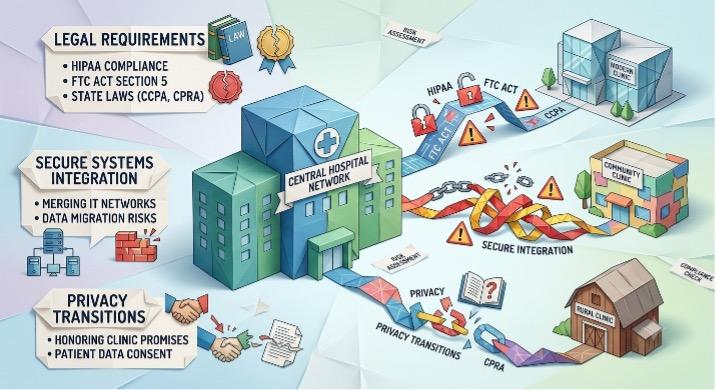
| | Image created by Rebecca Herold using Gemini Image Nano Banana 2. | Q1: I'm responsible for HIPAA security and privacy compliance at a hospital system. We are getting ready to acquire three clinics. What security and privacy issues are unique to acquisitions that I should look out for? | | |
A1:
Great question! It is one every healthcare organization considering an acquisition should ask.
Healthcare entities handle vast amounts of Protected Health Information (PHI), alongside sensitive non-HIPAA data for staff, contracted providers, website visitors, and third parties. Furthermore, with AI increasingly integrated into clinical tools and data pipelines, both parties must carefully scrutinize how legacy data was collected and under what terms it can be transferred or used.
Mergers and acquisitions create a special risk period because you are not just buying clinics; you are inheriting patient data, workforce data, vendors, systems, and any unresolved compliance issues that came with them.
The main issues to watch out for are:
1. Data protection legal requirements.
a) HIPAA compliance and inherited liability.
I. Administrative Controls: Review each of the acquired clinic’s HIPAA risk analysis, breach history, policies, training, access controls, and BAAs to identify unvetted vendor risk before closing. Re-train acquired staff immediately on your system's incident response plan and HIPAA policies, and conduct or validate a current risk analysis.
II. Technical Controls: Reconcile role-based access controls (RBAC) to eliminate legacy or orphaned accounts and reduce over-privileged access. Require multi-factor authentication (MFA) where applicable before integrating identity systems. Limit PHI sharing pre-close to the minimum necessary, and plan to remediate inherited compliance gaps promptly after closing.
III. Physical Controls: Audit site-level physical security (keycards, badging, visitor logs, workstation positioning, etc.) and secure medical devices and any paper record storage. Include safeguards for remote and mobile workforce environments.
b) FTC Act Section 5. Assess whether the acquisition implicates unfair or deceptive privacy or data security practices. Review representations made by the acquired clinics (e.g., privacy notices, security claims) and determine whether actual practices align. Any gaps will need to be remediated by the acquiring organization.
c) State data protection laws. Evaluate applicable state privacy and data protection laws, particularly for non-HIPAA data and uses beyond treatment, payment, and operations (TPO).
d) Contractual legal requirements. Compare privacy notices and determine whether prior commitments must be honored. Inventory all business associates and review BAAs for adequacy and transferability. Also review other binding agreements, including research, data sharing, and marketing arrangements involving PHI and other personal data and confidential data.
2. Secure systems integration. Connecting an acquired clinic’s environment without proper vetting is a common source of breaches and lateral malware spread.
a) Perform pre-connection audits and assessments: Review vulnerability scans, penetration tests, SIEM logs, and patching records.
b) Use staged integration: Avoid direct network connections on Day 1. Use segmentation, zero-trust principles, or virtual environments until systems are validated, re-imaged if necessary, and protected with endpoint detection and response (EDR).
c) Inventory assets: Identify all hardware and connected devices, including medical and IoT devices. Patch, isolate, or decommission unsupported systems.
d) Decommission legacy systems carefully and align security controls before full integration. M&A periods are especially vulnerable to cyberattacks due to operational disruption and inconsistent controls.
3. Privacy transition planning. Integrating multiple organizations requires deliberate alignment of privacy practices and data governance.
a) Update notices, workflows, data-sharing practices, and vendor governance structures.
b) Conduct data mapping and inventory updates, including AI-related data uses. Review historical consents and vendor agreements to confirm data was not improperly used or disclosed.
c) Align patient-facing processes: Issue updated Notices of Privacy Practices (NPPs) where required and define clear procedures for record access, amendments, and restrictions during transition.
d) Map data lifecycles and minimize data: Identify and securely dispose of data that exceeds retention requirements rather than migrating unnecessary risk.
e) Address all personal data: Ensure appropriate handling of employee, contractor, and other non-PHI data.
In short, the unique acquisition challenge is not only staying compliant on paper, it is preventing a messy handoff from becoming a PHI breach, a privacy mistake, a security incident, or an inherited enforcement problem.
| | |
(Somewhat) Quick Hits:
Here are three more questions, most of which we are answering at a comparatively high level. We provide more in-depth information and associated details about these topics in separate blog posts, videos on our YouTube channel, in infographics and e-books, LinkedIn posts to our business page, and within our online training and awareness courses.
| | |
Q2: What should we do to strengthen our security and privacy protections while being at the Iowa State Fair in August, and being able to focus on fun more than possible scammers?
A2:
It is so good know that you are planning ahead! Yes, it is very important to stay aware at state fairs, festivals, and other end-of-summer large events. There are many ways in which criminals take advantage of people having fun and not staying aware. There are also, unfortunately, some of the workers at such large events who take advantage of their authorized access to valuable data and exploit it to commit crimes. For example, see news item #10 above for one real-life example.
While U.S. state fairs themselves have largely avoided massive, headline-grabbing direct database breaches, they have been significantly impacted by widespread ticketing platform hacks, third-party vendor breaches, physical point-of-sale skimming, and other physical-location-based scams. Because major multi-day events rely on interconnected modern digital infrastructure for ticketing, parking, and concessions, their attendees are frequently exposed to cyber threats.
The most severe data exposure for event attendees happens through centralized platforms used to buy tickets online. However, state fairs and festivals feature hundreds of temporary food trucks, midway rides, and merchandise booths, with many people flashing payment cards and cash many times throughout the day, creating a high-risk environment for localized cyber and financial crimes.
Here are some actions you can take to protect your data while at fairs and festivals:
- Use mobile wallets (Apple Pay, Google Pay, etc.). Whenever possible, tap your phone to pay instead of handing over a card. This significantly mitigates the privacy and security risks. Mobile wallets tokenize transactions, generally meaning they never share your actual credit card number with the vendor or their machine.
- Never let your card leave your sight. If a vendor has to step away or reach under a counter to process a card, ask them to bring the reader into your view or pay with cash.
- Wiggle the card reader. Before inserting your card into a parking kiosk, automated ticket machine, ATM, or any other type of payment device, firmly pull on the plastic card slot. A legitimate machine will not budge, whereas an attached skimmer will loosen or pop right off.
- Put your hand over the area above where you use debit and credit cards. Thieves often mount a microscopic pinhole camera disguised as a structural edge or a brochure holder directly above the keypad to steal card PINs along with the card data.
- Carry your cards in an RFID-blocking wallet. Use a wallet lined with a basic electromagnetic shield to block digital pickpockets from scanning your cards while you walk through the venue.
- Bring a mobile phone charger with you. Malicious actors are increasingly tampering with public multi-device phone charging stations provided at multi-day fairs and music festivals. By modifying the USB port connection, they initiate "juice jacking;" a process where the cord not only charges your phone but secretly establishes a data connection to download personal photographs, saved passwords, and financial autofill data, and all the other data you have from your device.
For more information on security and privacy tools, see “Protecting Privacy and Security While Traveling” and “Privacy and Security Gifts.”
| Image created by Rebecca Herold using Gemini Image Nano Banana 2. | | Q3: I am the VP of IT at a large U.S. hospital system. I just learned that our marketing department implemented tracking pixels throughout our website over six months ago, including within our patient portal. To say I am very concerned is a very huge understatement. Can you give me some guidance for actions to take at this point? | | |
A3:
You are right to be concerned. Tracking technologies on healthcare websites, especially within authenticated patient portals, can create impermissible disclosures of PHI if data is transmitted to third parties without a valid HIPAA basis. In most cases, advertising/marketing vendors will not sign BAAs, making these disclosures high risk. These tracking tech deployments create massive risks, as well as HIPAA, FTC, and state regulatory non-compliance exposure.
Immediate priorities for the CISO/security leader:
- Disable all tracking technologies (pixels, SDKs, cookies, APIs, etc.) in patient portals and all other authenticated areas.
- Initiate incident response with legal (under privilege), privacy, compliance, IT, PR, and other applicable for your organization
- Preserve evidence (all portal login activity, server logs, pixel data configurations, tag and pixel logs, web page source code, affected URL paths, estimated user counts, etc.).
- Inventory all tracking tools, data elements transmitted, and third-party recipients.
- Conduct a HIPAA breach risk assessment and determine notification obligations.
- Review vendor relationships and BAAs.
- Conduct an enterprise web audit. Audit every public and private web page across your organization. This should include creating an inventory of technologies, mapping data transmissions, and identifying recipients.
- Reassess marketing practices; avoid tracking where PHI is involved and ensure appropriate consent mechanisms on public pages.
Regulatory scrutiny in this area is active, and prompt, well-documented remediation is essential.
For a detailed step-by-step approach, see the full analysis in my blog post, “Tracking Tech in Healthcare Provider Websites Can Violate HIPAA.”
If you want to discuss the details in more depth or get more information about tracking technologies and the impacts on privacy and information security, let us know. We’d be happy to help you.
| | Binder degradation on magnetic tape. Source: Preservation Self-Assessment Program - University of Illinois | | |
Q4: Please settle an argument: Isn't consideration of the type of digital storage media and material part of what should be considered for a computer data security risk assessment? Especially for data that you want to have available decades from now?
A4:
I love this question! And it is very timely (I’ll explain later).
Yes indeed; consideration of the storage media material, and the associated technology needed to read it, is absolutely a consideration to include within a data security risk assessment. Sadly, this inclusion is rarely done any more, which leaves significant vulnerabilities unidentified, and puts valuable data at risk, which often also results in significant data loss.
For long-retention data, the two biggest mistakes organizations make are picking the wrong storage medium up front, and failing to test and refresh media over time. The safest design is almost always a documented, redundant preservation strategy rather than trusting one device or one type of media format to last “forever”. Seriously. Nothing, including digital storage media, lasts forever.
A well-known cautionary example is the BBC’s Domesday project, which was stored on LaserDiscs and later became difficult to access because the media and the reading systems became obsolete. This is a classic example of data loss caused less by physical decay than by technology obsolescence.
Another example is backup media that was never tested until a disaster occurred. The U.S. National Institute of Standards and Technology’s (NIST’s) contingency guidance explicitly calls for testing backup information to verify media reliability and information integrity. The practical lesson is that media can fail silently long before anyone notices.
Here is something else to consider that will likely surprise many readers. Magnetic tape remains widely used for backup and archival storage, and some industry sources estimate that 70%–80% of data stored in data centers is on tape. However, this truly is risky business if appropriate security precautions are not taken! This is a currenty, timely, risk that makes it imperative to include as a consideration in security risk assessments.
Here is a case in point demonstrating that we must always study and remember the past so we do not repeat the same mistakes in the future. In the 1960s and 1970s, magnetic reel-to-reel tape was the state-of-the-art storage medium. However, magnetic tape relies on a polyurethane binder to hold magnetic oxide particles onto the polyester backing. Over 10–20 years, moisture absorption breaks down the binder; a phenomenon known as Sticky-Shed Syndrome. When read, the binder flakes off, destroying the magnetic layer. When NASA searched for original high-resolution raw telemetry tapes from the 1969 Moon landing in the early 2000s, many tapes had degraded beyond recovery, were overwritten, or suffered severe physical breakdown. A significant amount of important data was lost.
| | We hope you found the previous news items and questions/answers interesting and/or useful! Please send us any other security, privacy and/or compliance questions you have. We thank you for reading the monthly Privacy Professor Tips! | | |
Security Informed included a short article I wrote answering their question, “How Do Changes in the Broader Economic Climate Impact Security.”
We are excited to provide ways for MSPs, law firms, and other professional services organizations to offer our monthly tips to their clients! It is already working well for some such organizations. Get in touch with us for the details!
| | If you are a HIPAA business associate (BA) have you and the others in your organization taken your HIPAA security and privacy training for the year yet? If you are a HIPAA covered entity (CE), have you checked to ensure your Bas have taken their training? HIPAA requires security and privacy training, and the HHS OCR has indicated in all their HIPAA non-compliance settlements that such training needs to occur at least once a year. We can help you! Take our “HIPAA Basics for Business Associates: 2026 Edition”, which includes many supplemental materials you can use during the course of your business activities. Click here for more information. | |
What topics would you like to see us create videos, and more formal online courses, for? Let us know!
Have questions about our education offerings? Contact us!
| | |
Permission to Share
If you would like to share, please forward the Tips message in its entirety. You can share excerpts as well, with the following attribution:
Source: Rebecca Herold. August 2026 Privacy Professor Tips
www.privacysecuritybrainiacs.com.
NOTE: Permission for excerpts does not extend to images.
Privacy Notice & Communication Information
You are receiving this Privacy Professor Tips message as a result of:
1) subscribing through PrivacyGuidance.com or PrivacySecurityBrainiacs.com or
2) making a request directly to Rebecca Herold or
3) connecting with Rebecca Herold on LinkedIn.
When LinkedIn users invite Rebecca Herold to connect with them, she sends a direct message when accepting their invitation. That message states that in the spirit of networking and in support of the communications that are encouraged by LinkedIn, she will send those asking her to link with them her monthly Tips messages. If they do not want to receive the Tips messages, the new LinkedIn connections are invited to let Rebecca know by responding to that LinkedIn message or contacting her at rebeccaherold@rebeccaherold.com.
If you wish to unsubscribe, just click the SafeUnsubscribe link below.
| | | | |