|
Dear Community:
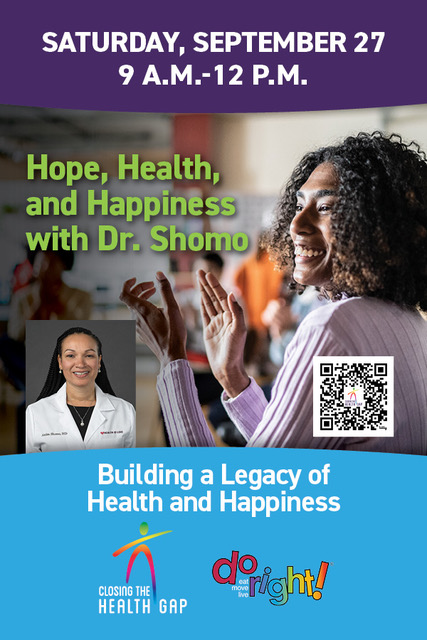
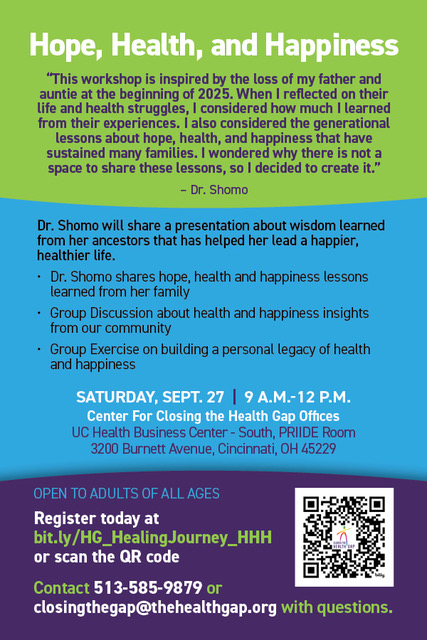
At Closing the Health Gap, we know that health is more than checkups and test results. It’s also about the wisdom, resilience and traditions that sustain us across generations. That’s why I’m thrilled to share our newest event: “Hope, Health, and Happiness” with Dr. Shomo, happening Saturday, September 27, from 9am–12pm at our offices in the UC Health Business Center (PRIDE Room).
This powerful workshop was inspired by the personal journey of Dr. Shomo, who will share lessons passed down from her ancestors. Together, we’ll discuss insights from our community, reflect on what it means to live healthier, happier lives, and participate in a group exercise to build our own personal legacies of well-being.
I invite you to join us for this uplifting and transformative morning. Register today and let’s continue building health equity as a community. Also, we'll be recognizing important observances throughout September, including Sickle Cell Awareness, Prostate Cancer Awareness and Suicide Awareness. Follow our social media channels to learn more. We Must Save Us!
Blessings to all of you for a safe and healthy week ahead!
Renee Mahaffey Harris
President & CEO
| |
OP-ED: Crisis in Black health worsened by Trump policies
by Dr. Jessie Fields
Changes in national health policy under the Trump administration exacerbate the health challenges faced by Black Americans. Cuts to Medicaid and to the Supplemental Nutrition Assistance Program (SNAP), disproportionately harm the health of Black people by reducing access to preventive care and chronic disease management, increasing disparities in health outcomes, and worsening maternal and infant mortality rates.
During the COVID-19 pandemic Black communities experienced disproportionately high rates of COVID-19 infections, hospitalizations, and deaths. According to the National Institutes of Health, “This disparity is linked to long-standing social and economic inequalities, such as differences in health care access, socioeconomic status, and employment in essential frontline jobs increased exposure risk.”
COVID-19 vaccination helped to decrease the burden of the pandemic in Black communities by reducing infections, hospitalizations, and deaths, even though vaccination rates were initially lower in Black communities due to factors like hesitancy and structural inequities. Studies have shown vaccines are highly effective at reducing severe outcomes, and increasing vaccination rates in Black communities, despite existing health disparities, did help to control the pandemic within those communities. The Centers for Disease Control and Prevention (C.D.C.), once a reliable guide in American public health, under Trump-appointed Secretary of Health and Human Services Robert F. Kennedy Jr., is in turmoil.
| |
4th Annual Women’s Cardiovascular Symposium – Registration Open through Sept. 13!
With cardiovascular disease remaining the leading cause of death for women in the United States, morbidity and mortality rates continue to rise despite medical advances and public health awareness campaigns. Persistent knowledge gaps in sex-specific risk factors and differences in clinical presentation often lead to delayed care. Even when women seek medical attention, they are frequently misdiagnosed or undertreated.
To address these alarming disparities, The Women’s Heart Center at The Christ Hospital established the Women’s Cardiovascular Symposium, offering continuing medical education for physicians and healthcare professionals managing cardiovascular disease (CVD) in women. This symposium on October 3 focuses on advancing sex-specific risk assessments and evidence-based strategies to improve clinical outcomes and bridge the care gap for women with or at risk of CVD.
REGISTRATION DEADLINE: September 13, 2025
- Physicians: $175
- Physician Assistants, Nurse Practitioners, & Pharmacists: $135
- Nurses, First Responders or other Healthcare Professionals: $100
| |
Racial, Ethnic Disparities May Impact Age Differences at First Heart Failure Hospitalization
Black patients are more likely to be hospitalized for heart failure (HF) nearly 14 years earlier than White patients, according to a new study published in the Journal of the American College of Cardiology.
While the major clinical risk factors for HF are well known, the prevalence of these factors may vary depending on social determinants of health (SDOH). SDOH is defined as the conditions of an individual’s environment related to where a person was born, where they live, work, play, and worship, and their age, and is often grouped into 5 categories: economic stability, access to quality education and health care, neighborhood, and social community. In a systematic review from the Journal of the American Heart Association, economic instability, like poverty and unemployment, was associated with the inability to afford resources necessary for managing HF, like healthy foods, stable housing, and working utilities. Additionally, they associated poverty with increased toxic stress and adverse health effects like high blood pressure and inflammation.
|
Writing about health inequality: recommendations for accurate and impactful presentation of evidence
There is a growing amount of data pertaining to health inequalities. Written outputs, including academic research papers, are key tools for describing health inequalities. Epidemiologists, data analysts, policy advisors and health equity scholars can have greater impact through accurate, concise and compelling presentation of this evidence and so assist those advocating for action to close health gaps. We make recommendations to improve the accuracy and impact of written evidence on health inequality. Focusing on the micro, macro and meta aspects of developing written reports, we drew from our varied experiences promoting health inequality monitoring to identify key strategies specific to this field, which were further expanded and explored through literature searches and consultation with experts.
We recommend four general strategies:
- (i) using terminology deliberately and consistently
- (ii) presenting statistical content accurately and with sufficient detail
- (iii) adhering to guidelines and best practices for reporting
- (iv) respecting and upholding the interests of affected communities
Specifically, we address the use of terminology related to health inequality and health inequity, dimensions of inequality and determinants of health, economic inequality and economic-related inequality, sex and gender, and race and ethnicity.
| | |
Join the University of Cincinnati Cancer Center for a film viewing followed by a dinner and panel discussion of the latest prostate cancer prevention and care. There will be two screenings of the event:
- Thursday, September 18, 2025 from 5:30 - 8:30 p.m. at Probasco Auditorium (2839 Clifton Ave., Cincinnati, OH 45220)
- Saturday, September 20, 2025 from 3:30 - 6:30 p.m. at United Community Christian Church (1710 Maryland Ave., Covington, KY 41014)
The Black Walnut is an award-winning docudrama about the alarming prostate cancer disparity impacting Black men. Featuring nine actual prostate cancer survivors, a urologist and a medical oncologist in dramatic roles, the film explores the myriad of barriers Black men encounter in securing healthcare. Black men are more likely to develop prostate cancer than white men and the film aims to encourage men to prioritize their health.
Participants will have the opportunity to:
-
View The Black Walnut film and meet the writer and producer Terrance Afer-Anderson.
- Connect and have a discussion with a panel of local prostate-focused physicians and survivors who will provide suggestions on how to address some of the significant barriers and disparities the Black community faces regarding prostate cancer.
- Receive free PSA screenings via blood draw.
Register HERE.
| | | | |